
The World War I ‘Christmas Truce’: The True Story of Enemy Soldiers Halting Their Bloody Battle to Play Football
It Was Supposed to Be a Bloody Christmas Truce
A Christmas Truce could stop a war on Christmas Day.December 1914.
The war was only 5 months old, but it already felt like hell.
Young men from Britain, France, and Germany were stuck in trenches.
Cold. Wet. Rat-infested. Waiting to die.
The Western Front stretched 400 miles. And right in the middle of it,
British and German soldiers were staring at each other from 100 yards away.
That strip of mud and barbed wire between them? They called it “no man’s land”.
Everyone thought Christmas would be just like any other day.
More shells. More death.
But then, the guns went quiet.
Life in The Trenches: Why The Christmas Truce Ended
To understand the Christmas Truce, you have to feel the trenches first.
Imagine living in a ditch. For weeks.
Your feet are rotting from trench foot.
You haven’t had a proper wash in a month.
Letters from home are 2 weeks late.
And every night, you hear men screaming 50 feet away.
By December, both sides were exhausted.
This wasn’t supposed to happen. Generals promised “it will be over by Christmas”.
Instead, it was stalemate.
Morale was low. On both sides.
These weren’t professional killers. Most were farmers, clerks, students.
They didn’t hate the guy across the field. They didn’t even know him.
And that’s exactly why something impossible happened.
Christmas Eve 1914: The Singing Started
It began after dark on December 24th.
From the German lines, candles flickered. Small Christmas trees appeared on the parapets.
Then came the sound. “Stille Nacht, Heilige Nacht”. Silent Night.
British soldiers listened. Then they sang back. “The First Noel”.
Back and forth. Carols echoing across no man’s land.
No one fired a shot.
One British private wrote to his mom: “The Germans were shouting ‘You no shoot, we no shoot'”.
By midnight, the impossible was happening. Men were standing up. Waving.
Not to attack. To talk.
Christmas Morning: Walking Into No Man’s Land
December 25th. Dawn.
German soldiers climbed out first. Hands up. No guns.
British soldiers watched, hearts pounding. Then they climbed out too.
What happened next sounds made up. But it’s in hundreds of letters.
They met in the middle.
They shook hands. They laughed. Awkwardly at first.
They showed each other photos. “This is my wife”. “This is my son”.
They traded stuff. British cigarettes for German sausage and chocolate.
They buried the dead together. Gave each other proper funerals.
A Scottish soldier wrote: “We had a shave and a wash in the same shell hole.”
For a few hours, the war didn’t exist.
The Football Match: Myth or Real?
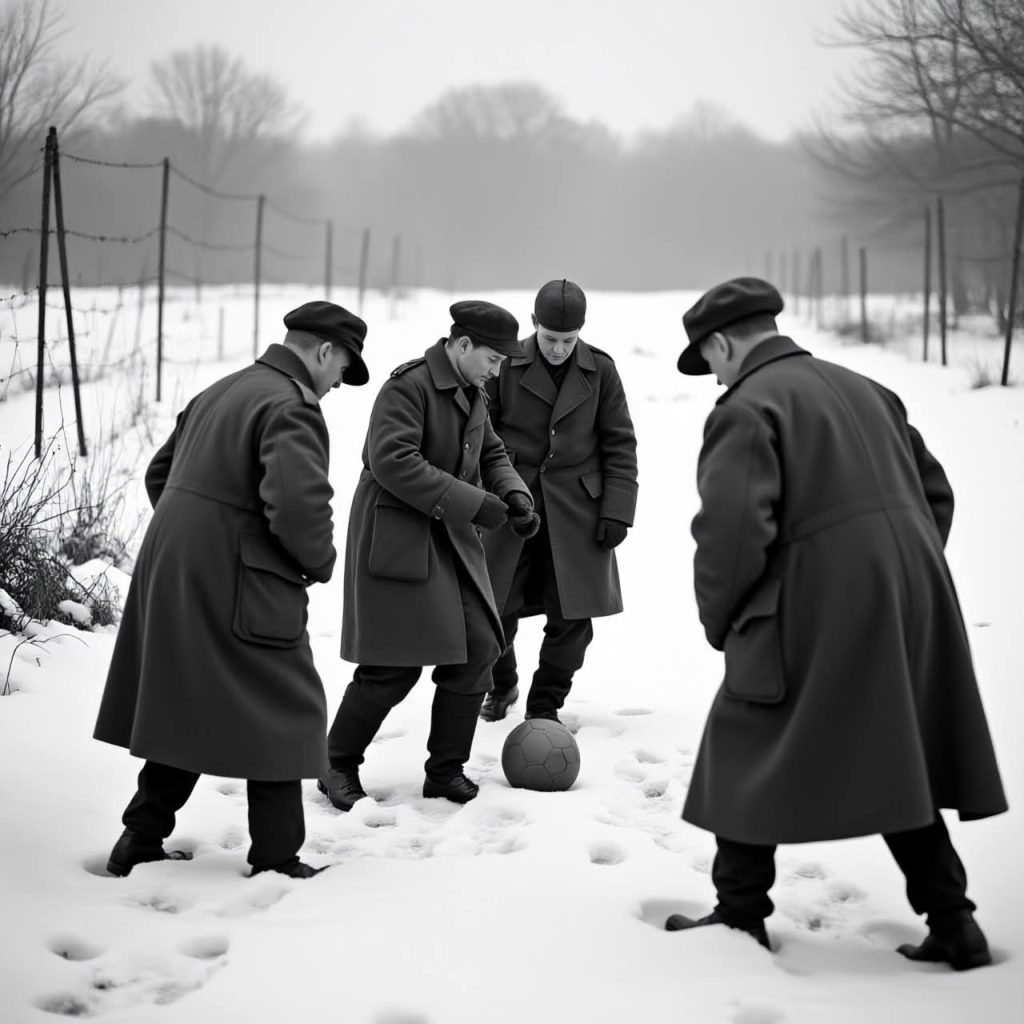
Okay, let’s talk about the football.
Did it really happen? Yes. But not everywhere, and not like in the movies.
In some sectors, someone found a ball. Maybe it was a proper football.
Maybe it was just a ration tin kicked around.
British vs Germans. No referee. No rules.
Goal posts were helmets and caps.
The ground was frozen mud and craters.
Different accounts give different scores.
One says 3-2 to Germany. Another says the British won.
Most soldiers just said “we played for fun”.
Lieutenant Johannes Niemann of Germany later said: “I got the ball and kicked it out.
A Scot came running and kicked it back. So we started a game.”
Was it one big match? No.
There were small kickabouts all along parts of the front.
From Ypres in Belgium down to the Somme in France.
The point wasn’t winning. The point was: we’re not shooting today.
What The Soldiers Actually Wrote Home
This is why we know it’s true. Because of the letters.
Captain Sir Edward Hulse wrote: “Germans came out of their trenches unarmed and came to ours.
We gave them cigarettes and they gave us cigars.”
Private Frank Richards: “I shook hands with a German. We were all pals.”
A German soldier wrote to his sister: “Today we had peace with the English.
It was so strange to talk to the enemy.”
These weren’t propaganda. These were private letters.
Men trying to explain something that made no sense.
Why Did The Generals Hate It So Much?
Here’s the problem. War doesn’t work if you see the enemy as human.
By December 26th, the party was over.
High command on both sides were furious.
“Fraternizing with the enemy” was forbidden.
Orders came down. More artillery. More raids.
They rotated troops out so they wouldn’t get friendly again.
One British general wrote: “Such a thing must never happen again.”
And it didn’t. Not on that scale.
In 1915 there were a few small truces. But by 1916, the war was too brutal.
Too much blood. Too much hate.
The magic of 1914 was gone.
The Legacy of The Christmas Truce
Did it change the war? No.
4 more years. 10 million dead.
So why do we still talk about it?
Because it proved one thing.
Even in the worst place on earth, people chose peace.
The Christmas Truce shows us that “the enemy” is just another person.
With a family. With fears. With a song they know too.
In 2014, FIFA and The FA made a memorial.
A statue of two soldiers kicking a ball.
The inscription says: “All together. One game.”
FAQ About The Christmas Truce
1. Was the Christmas Truce real?
Yes. It happened on parts of the Western Front on Dec 24-25, 1914.
We have letters, diaries, and photos to prove it.
2. Did they really play football?
Yes, in some areas. There were informal games. Scores vary in accounts.
It wasn’t a World Cup final. It was just men kicking a ball.
3. Why did it stop?
Generals on both sides ordered it to stop. They feared soldiers wouldn’t want to fight again.
4. Did it happen again in later years?
Small instances in 1915. But after the battles of 1916, it never happened again on that scale.
5. Where can I visit today?
There’s a memorial in Frelinghien, France. And museums in London and Berlin have artifacts.
The Most Important Goal Ever Scored
Think about it.
In the middle of one of history’s bloodiest wars,
enemies put down their guns.
They sang together. They ate together.
And for a little while, they played football together.
The Christmas Truce didn’t win the war.
But it won something bigger. It won our memory.
It reminds us that even when everything is broken,
humanity can still show up.
And maybe that’s the real victory.
Read more:https://worldhistorytales.com/ancient-persian-yakhchal-ice-desert/


