History of VPN: The Complete Timeline From 1996 to 2026
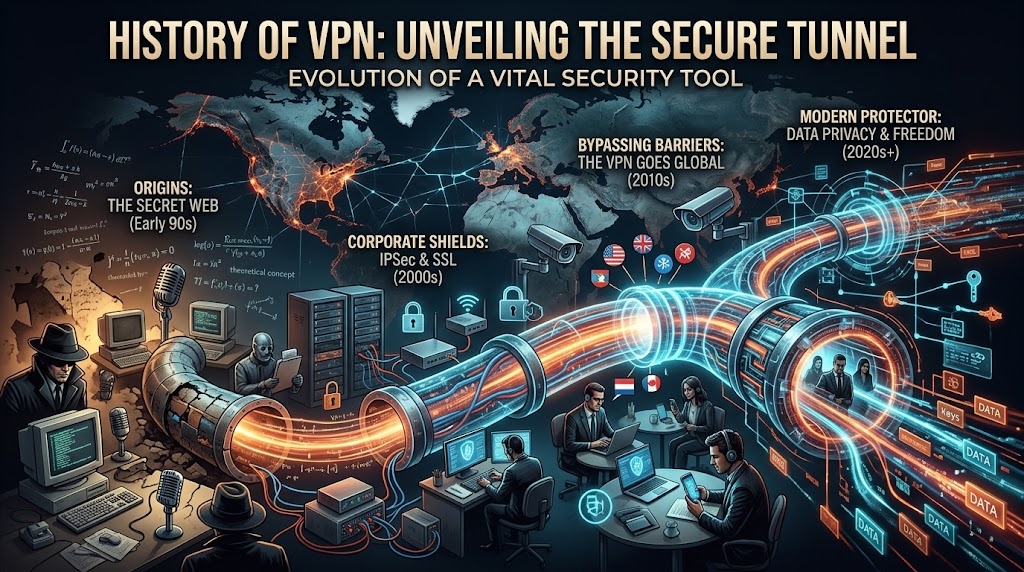
1. Introduction: The History of VPN Is Really The History of Internet Privacy
If you think the history of VPN starts with people trying to watch Netflix from another country, you’re missing the real story. The history of VPN actually starts in 1996, inside a Microsoft office, where a group of engineers were trying to solve a very boring but very important problem. People wanted to work from home, but sending company files over the public internet at that time was like mailing your bank statements on a postcard. Anyone could read them.
So they built a tunnel. Not a real tunnel, but a digital one. A private, encrypted path through the public internet. They called it PPTP. That was the first VPN.
Fast forward to 2026, and the Evolution of VPN has gone from that one corporate tool to something 1.6 billion people use every day. Students use it to get around school WiFi blocks. Journalists use it to protect sources. Gamers use it to get better ping. And yes, millions use it to watch Netflix.
The Evolution of VPN is the story of us trying to make the internet feel a little less public. And it’s far from over.
Why The History of VPN Matters Right Now
In 2026 your ISP can see every site you visit. Your phone tracks where you go. AI tools scrape everything you post. The Evolution of VPN matters because it shows us how we’ve been fighting back against that for 30 years.
2. 1996: PPTP and The Day The History of VPN Began
Microsoft Windows NT 4.0. That’s where it all started.
PPTP stands for Point-to-Point Tunneling Protocol, and it was Microsoft’s answer to remote work. The idea was simple. Take your data, wrap it in encryption, and send it through the internet. To anyone watching, it just looked like noise.
The Evolution of VPN began as a business-only thing. No one cared about privacy back then. Companies just didn’t want competitors stealing their files. PPTP was slow, it was buggy, and by today’s standards it was incredibly insecure. Hackers eventually cracked it wide open in 2012.
But you have to start somewhere. And in the Evolution of VPN, 1996 is that somewhere. Without PPTP, none of the VPNs we use today would exist.
The First Tunnel Wasn’t Perfect
The Origin of Virtual Private Network teaches us that every technology starts messy. PPTP was the proof of concept.
3. 1998 to 2000: IPsec, L2TP, and The History of VPN Goes Corporate
After Microsoft, Cisco and other networking giants jumped in. They built IPsec and L2TP. These were way more secure than PPTP, but they were also way more complicated.
During this part of the Origin of Virtual Private Network, everything was enterprise. If you wanted a VPN, you had to buy a $20,000 box from Cisco and hire an IT guy to set it up. Banks used them. Hospitals used them. The government used them.
Regular people? They had no idea what a VPN was. The Origin of Virtual Private Network in the late 90s was locked behind corporate firewalls and IT departments. But it proved one thing: the concept worked. You really could make a private network on top of the public internet.
WireGuard Official Documentation
VPNs Were Expensive and Boring
The Origin of Virtual Private Network shows it took a while before regular people could even touch this technology.
4. 2001: OpenVPN and The Moment The History of VPN Became Free
This is the most important year in the history of VPN.
In 2001, a developer named James Yonan released OpenVPN. And he made it open source. That meant anyone could download it, use it, and modify it for free.
Before OpenVPN, the Origin of Virtual Private Network was about expensive hardware. After OpenVPN, it was about software anyone could run. Small businesses started using it. Schools started using it. Privacy activists started using it.
OpenVPN is still the backbone of most VPN services today. The Origin of Virtual Private Network would be completely different without it. It took VPNs out of the data center and put them in the hands of regular people for the first time.
Free Software Changed Everything
The Origin of Virtual Private Network proves that when you make something free, it spreads.
5. 2005 to 2009: The History of VPN Meets Censorship and Politics
Between 2005 and 2009, the internet changed. YouTube launched. Facebook took off. And governments started blocking things.
China blocked Google. Iran blocked social media during protests. The history of VPN shifted during this time. It was no longer just about business security. It became about access.
Students in China used VPNs to get to Google. Journalists used them to file stories from dangerous places. Activists used them to organize.
For the first time in the Origin of Virtual Private Network, people weren’t using it for work. They were using it to speak freely. And governments noticed. They started trying to block VPN traffic too.
VPNs Became a Tool for Freedom
The History of Virtual Private Networks shows that once politics gets involved, technology never stays neutral.
6. 2010 to 2012: The History of VPN Goes to Your Phone
The iPhone 4 came out. Android exploded. And suddenly everyone was on public WiFi.
Coffee shops. Airports. Hotels. All of them had free WiFi, and all of them were easy targets for hackers. The History of Virtual Private Networks hit the consumer market right at this moment.
In 2012, companies like Private Internet Access, ExpressVPN, and NordVPN launched. They weren’t selling to IT departments anymore. They were selling to you. Ads said things like “Protect yourself on public WiFi” and “Hide your IP address.”
The History of Virtual Private Networks became a product you could buy for $10 a month. And people did. Millions of them.
Smartphones Made VPNs Necessary
The history of VPN shows that mobile internet created a whole new set of privacy problems.
7. 2013: Snowden and The Biggest Wake-Up Call in The History of VPN
June 2013. Edward Snowden leaked NSA documents.
The world found out the NSA was collecting phone records and emails from millions of people. Not terrorists. Just regular people.
The History of Virtual Private Networks changed overnight. Before Snowden, most people thought “I have nothing to hide.” After Snowden, everyone realized mass surveillance was real.
VPN searches spiked. Sales tripled. VPN companies started advertising “no logs” policies and privacy features. The History of Virtual Private Networks split into a before and after. Before 2013, VPNs were niche. After 2013, they were mainstream.
Snowden Made Privacy a Mainstream Issue
The history of VPN will always have a chapter called “After Snowden.”
8. 2015 to 2016: The History of VPN and The Netflix Wars
In 2016, Netflix went global. But here’s the catch: the shows available in the US were different from the shows in the UK, which were different from the shows in India.
People figured out they could use a VPN to pretend they were in another country. Suddenly, the Development of VPN technology was about streaming.
Netflix fought back. They started blocking VPN IP addresses. VPN companies bought new ones. It became a game of cat and mouse that’s still going on today.
Millions of people signed up for VPNs just to watch The Office. The Development of VPN technology became part of pop culture.
Entertainment Drove VPN Adoption
The history of VPN shows that sometimes people care more about TV shows than privacy.
9. 2017 to 2018: GDPR and The History of VPN in Business
May 25, 2018. GDPR went live in Europe.
The General Data Protection Regulation forced companies to protect user data. And one of the easiest ways to do that was with a VPN.
At the same time, massive breaches were happening. Equifax lost 147 million records. Facebook had the Cambridge Analytica scandal. People were losing trust.
The Development of VPN technology in business got a second wave. Companies needed VPNs for remote employees and for compliance. The history of VPN was no longer optional. It was becoming required.
Laws Made VPNs a Business Necessity
The history of VPN shows that regulation drives adoption.
10. 2020: COVID and The Biggest Boom in The History of VPN
March 2020. The world shut down.
Everyone started working from home. Overnight.
Company VPNs crashed because they were never designed for that many people. Consumer VPN sales exploded because people were stuck at home and spending all day online.
The Development of VPN technology in 2020 saw 300% growth in 3 months. For the first time, VPNs were considered essential infrastructure. Just like internet and electricity.
If you worked from home, you needed a VPN. The Development of VPN technology will always remember 2020 as the year it went from “nice to have” to “must have.”
The Pandemic Made VPNs Essential
The history of VPN proves that crisis accelerates technology.
11. 2021: WireGuard and The Speed Problem Gets Solved
For 20 years, the number one complaint about VPNs was speed. They slowed down your internet.
Then WireGuard came along.
WireGuard is only 10,000 lines of code. OpenVPN is 400,000. WireGuard is 10 times faster and more secure. The history of VPN changed in 2021.
NordVPN launched NordLynx. ExpressVPN launched Lightway. Both were built on WireGuard. Suddenly VPNs were fast enough for gaming, 4K streaming, and video calls.
The Historical background of VPN in 2021 is about speed finally catching up to what people needed.
WireGuard Was the Breakthrough
The Historical background of VPN shows that one protocol can change an entire industry.
12. 2022 to 2023: The History of VPN During War and Protest
In 2022, Russia invaded Ukraine. Russia blocked Facebook, Twitter, and independent news sites.
In 2022, Iran had massive protests and the government shut down the internet.
The Historical background of VPN became about survival. Ukrainians used VPNs to talk to family. Russians used VPNs to see what was really happening. Iranians used VPNs to organize protests.
Governments tried to ban VPNs. People kept finding ways to use them. The Historical background of VPN in these years wasn’t about Netflix. It was about human rights.
VPNs Became a Lifeline
The history of VPN shows it’s bigger than privacy. It’s about freedom.
13. 2024 to 2025: The History of VPN Enters the AI Era
In 2024, AI started scraping everything. Every post, every comment, every photo. AI companies were training models on your data without asking.
New VPNs launched with “AI tracking protection.” They blocked AI bots from scraping your data. They added protection against deepfakes and voice cloning.
The Historical background of VPN in 2024 and 2025 is about adapting to AI. It’s an arms race. AI tries to collect more data. VPNs try to block it.
AI Created New Privacy Problems
The history of VPN shows that every new technology creates new threats.
14. 2026: Where The History of VPN Stands Today
Today in 2026, there are 1.6 billion VPN users.
Apple has iCloud Private Relay. Google has Google One VPN. Browsers like Opera and Brave have VPNs built in.
The Historical background of VPN shows that VPNs are becoming invisible. You don’t download an app and turn it on. It’s just there.
We also have mesh VPNs that connect all your devices. And decentralized VPNs that run on blockchain with no central company.
The history of VPN in 2026 is about privacy being the default.
VPN Is Disappearing Into the Background
The history of VPN shows the goal is to make privacy automatic.
15. The 10 Protocols That Shaped The History of VPN
If you want to understand the history of VPN, you have to understand the protocols.
1. PPTP 1996 – The first one.
2. IPsec 1998 – The corporate standard.
3. L2TP 1999 – Better for mobile.
4. OpenVPN 2001 – Made VPNs free.
5. SSTP 2006 – Microsoft’s second try.
6. IKEv2 2013 – Great for phones.
7. WireGuard 2020 – Fast and modern.
8. NordLynx 2021 – WireGuard with privacy tweaks.
9. Lightway 2022 – ExpressVPN’s custom protocol.
10. Quantum VPN 2025 – Designed to resist quantum computers.
The history of VPN is the history of these 10 protocols getting better.
Better Protocols Mean More Users
The history of VPN proves that technology drives adoption.
16. The 6 Reasons People Use VPNs According to The History of VPN
After 30 years, the Evolution of virtual private networking shows there are 6 main reasons people use them.
1. Remote Work – Started in 1996 and still the number one use.
2. Bypassing Censorship – Started in 2005 and still critical.
3. Streaming – Started in 2015 and huge today.
4. Public WiFi Security – Started in 2010.
5. Hiding from ISPs – Started after Snowden in 2013.
6. Gaming and Torrenting – Became big after WireGuard in 2021.
The history of VPN shows one tool can do a lot of different jobs.
Versatility Is Why VPNs Survived
The history of VPN proves that flexibility matters.
17. The Scandals in The History of VPN
The history of VPN isn’t all good. There have been some big scandals.
In 2015, Hola VPN was caught selling users’ bandwidth to other people. In 2019, UFO VPN leaked 1TB of user data. In 2020, researchers found that most free VPNs were full of malware.
The Evolution of virtual private networking teaches one hard lesson: if a VPN is free, you are the product. Always research before you trust a VPN with all your internet traffic.
Trust Is Everything
The history of VPN shows that not all VPNs deserve it.
18. The History of VPN vs Proxy vs Tor vs VPS
People get confused about this.
A proxy from the 1990s just forwards your traffic. No encryption.
A VPN from 1996 encrypts your traffic and makes a tunnel.
Tor from 2002 bounces your traffic through 3 servers. Super anonymous but super slow.
A VPS from 2010 is just your own private server.
The history of VPN shows that VPNs sit in the middle. Faster than Tor. Safer than a proxy. That’s why they won.
VPN Found the Sweet Spot
The history of VPN shows it balanced speed and security perfectly.
19. How to Choose a VPN Based on 30 Years of The History of VPN
After looking at the history of VPN, here’s what actually matters in 2026:
1. Protocol: WireGuard.
2. No-logs policy: And it should be audited.
3. Jurisdiction: Outside the 5/9/14 Eyes countries.
4. Speed: At least 500Mbps.
5. Servers: In 50+ countries.
6. Price: Between $3 and $8 per month.
The history of VPN proves that paying $15 doesn’t get you a better VPN. Don’t fall for marketing fluff.
Smart Buyers Ignore the Hype
The history of VPN gives us a clear checklist.
20. The Future: What’s Next in The History of VPN
The history of VPN isn’t over.
By 2030, VPNs will be built into 6G networks. They’ll be in your smart home and your car. We’ll have AI that negotiates privacy settings for you. There will be decentralized VPNs that run on crypto, and quantum-resistant VPNs to survive future computers.
The history of VPN is heading toward invisibility. You won’t think about turning on a VPN. It will just protect you in the background.
The End Goal Is Automatic Privacy
The history of VPN shows that the final goal is privacy without effort.
Frequently Asked Questions
1. What is the history of VPN in short
The history of VPN starts in 1996 with Microsoft PPTP for business. OpenVPN in 2001 made it free. Consumer VPNs launched in 2012. Snowden in 2013 boosted demand. COVID in 2020 doubled users. WireGuard in 2021 made it fast. In 2026 VPNs are built into phones.
2. When did VPNs become popular with regular people
The history of VPN shows 2012 was the start for consumers, and 2020 was the big boom.
3. Who invented the first VPN
The history of VPN credits Microsoft engineers who created PPTP in 1996.
4. Why do people use VPNs today
The history of VPN shows 5 main reasons: privacy, security, streaming, bypassing censorship, and remote work.
5. What is the best VPN protocol in 2026
Based on the history of VPN, WireGuard is the fastest and safest protocol right now.
6. Are VPNs legal everywhere
The history of VPN shows they are legal in most countries but restricted in China, Russia, Iran, and UAE.
7. Did VPNS exist before 2000
Yes. The history of VPN starts in 1996, but they were only for big companies back then.
8. What is the future of VPN technology
The history of VPN points to built-in VPNs, AI-powered privacy tools, and decentralized networks.
9. How much did VPNs cost in the 90s
The history of VPN shows corporate VPN hardware cost $10,000 to $50,000 in the late 90s.
10. Will VPNs still matter in 2030
The history of VPN suggests yes. They will just be invisible and built into everything.