
History of Windows: The Complete Story From Windows 1.0 to Windows 11
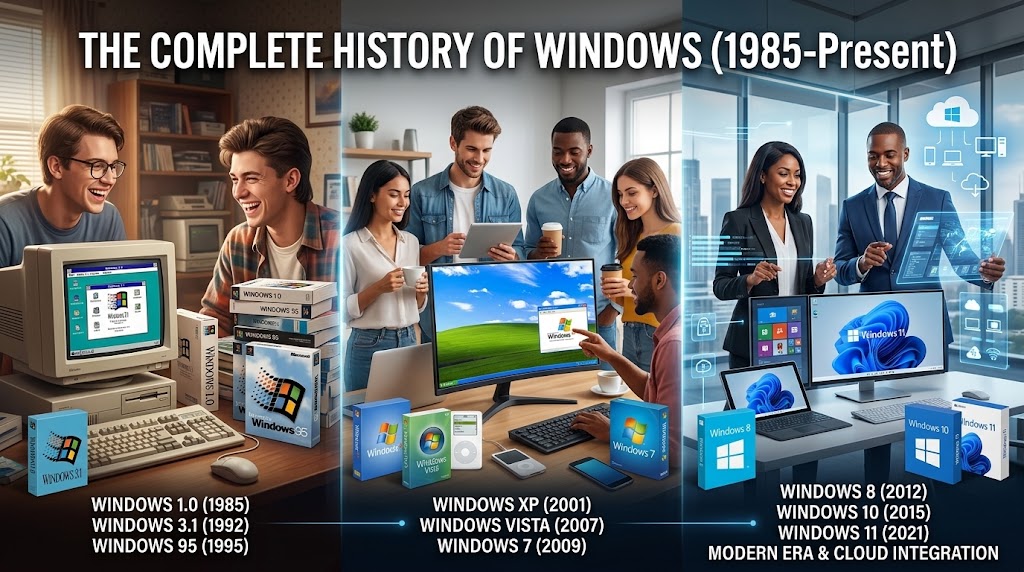
Introduction: The History of Windows
The history of windows is not just about software updates. It is about how computers went from being scary machines for engineers to becoming something that your grandma can use to watch YouTube.
I still remember the first time I turned on a computer in 2009. It was my cousin’s old PC. The screen turned blue, I heard that famous startup sound, and then I saw the green hill with blue sky. That was Windows XP. I had no idea at that time that I was looking at 25 years of hard work by Microsoft.
In this article I am going to tell you the full history of windows in a way that feels like we are sitting in a tea stall and talking. No boring technical jargon. Just real stories about how Bill Gates and his team built, failed, and rebuilt the most used operating system in the world.
Chapter 1: Why We Should Care About The History of Windows
Because Before Windows, Computers Were Only For Smart People
Let me take you back to 1983. If you bought a computer that time, you would see a black screen with a blinking cursor that said C:\>.
To open a file you had to type commands. To copy something you had to type COPY. To see what’s inside a folder you had to type DIR.
My uncle told me that he had to keep a small notebook where he wrote down all the DOS commands. Because if he forgot one command, he was stuck.
Normal people were scared of computers. They thought computers are only for scientists and banks.
That’s when Microsoft had a crazy idea. What if we make everything visual. What if we put programs inside little boxes called windows. What if we let people use a mouse to click instead of typing.
That one idea changed everything. And that is why the history of windows matters to every single person who uses a computer today.
Chapter 2: History of Windows Starts With Windows 1.0 in 1985
November 20 1985 The Day Bill Gates Showed The World The First Window
On a cold day in November 1985, Bill Gates stood on a stage and showed something that looked very simple but was actually revolutionary.
It was called Windows 1.0.
The screen had boxes. You could click on them with a mouse. You had Paint to draw, Notepad to write, Calculator to do math, and a Calendar to check dates.
But it was slow. Like really slow. It only had 16 colors. And you could not run two programs at the same time properly. People in the tech magazines laughed at it. They said this will never work.
But Microsoft did not give up. Because they believed that one day every home will have a computer and those computers need to be easy.
If you want to see the original announcement you can check it here:Windows 1.0 Was Announced in 1985
Windows 1.0 only sold around 500 thousand copies. But it was the seed. And that seed would grow into something huge.
Chapter 3: History of Windows Continues With Windows 2.0 and 2.1
The Years 1987 To 1988 When Windows Learned To Overlap
After Windows 1.0 flopped, Microsoft went back to work. Two years later in 1987 they released Windows 2.0.
The biggest change was small but important. Now you could put one window on top of another window. In Windows 1.0 all windows had to stay side by side which was very frustrating.
Then in 1988 came Windows 2.1. This version supported newer and faster Intel processors. So it ran a little bit faster.
Still normal people were not buying it. But something important was happening behind the scenes. Software companies like Microsoft Office started making versions for Windows.
So even though sales were low, the history of windows was slowly building an ecosystem. And that ecosystem would explode in the next version.
Chapter 4: The Game Changer In History of Windows – Windows 3.0 in 1990
How Solitaire and Minesweeper Made Microsoft Rich
May 22 1990. This date is very important in the history of windows.
Windows 3.0 was released and suddenly everyone wanted it.
Why did it become so popular. Three reasons.
First it was actually fast. Second it supported 256 colors so it looked beautiful. Third it came with two games. Solitaire and Minesweeper.
I am not joking. People were buying computers for their office and the first thing they did was play Solitaire during lunch break.
For the first time, the history of windows was not just about work. It was about fun too.
Windows 3.0 sold 10 million copies. That was a massive number at that time. And this is when Microsoft became the king of PC software.
Chapter 5: History of Windows 95 – The Version That Everyone Remembers
August 24 1995 The Day Microsoft Spent More Money Than A Movie
If you ask anyone who was a teenager in the 90s about Windows, they will immediately talk about Windows 95.
Microsoft did something insane for this launch. They spent 300 million dollars on marketing.
They got the Rolling Stones to let them use the song Start Me Up. They held midnight launch parties in stores. People were lining up to buy an operating system like it was a new iPhone.
And Windows 95 deserved all that hype.
It gave us the Start Button. It gave us the Taskbar. It gave us Plug and Play so you could just connect a printer and it would work. It came with Internet Explorer.
This was the first time Windows felt modern. It was 32 bit. It could run big programs. It rarely crashed.
Windows 95 sold 7 million copies in the first 5 weeks. In the history of windows, this was the moment when Windows became a household name.
Chapter 6: History of Windows For Business With Windows NT and 2000
When Microsoft Built Windows For Offices and Banks
While home users were enjoying Windows 95, there was another problem. Businesses needed something stable.
Windows 95 was good but it would crash sometimes. Banks and hospitals could not afford that.
So Microsoft made a separate line called Windows NT. NT meant New Technology.
Windows NT 3.1 came in 1993. Windows NT 4.0 came in 1996. Then in 2000 came Windows 2000.
These versions were boring to look at but they were rock solid. They did not crash. They had better security.
So for almost 10 years the history of windows had two paths. One fun path for home users and one serious path for businesses.
That all changed with the next version.
Chapter 7: History of Windows XP – The Version That Felt Like Home
October 25 2001 The Green Hill and The Music That We All Miss
If I ask you what is your first memory of a computer, 80 percent of you will say Windows XP.
And there is a reason for that.
Windows XP was the version where Microsoft finally merged the home version and the business version. It was beautiful and stable at the same time.
The wallpaper was a green hill with a blue sky and fluffy clouds. That photo was taken in California and Microsoft paid a lot of money for it.
The startup sound was made by Brian Eno. He is a famous musician. He made that 6 second sound in his studio.
XP gave us System Restore, Fast User Switching, and built in support for WiFi.
Microsoft sold 400 million copies of XP. Even in 2026, if you go to some small shops or ATMs, you will still see XP running.
When people talk about the history of windows, they always start with XP. Because that was the Windows that raised a whole generation.
Chapter 8: The Biggest Failure In History of Windows – Windows Vista in 2007
How A Beautiful Operating System Became A Joke
January 30 2007. Microsoft launched Windows Vista with huge ads.
The ads showed glass effects. Everything was transparent and shiny. It looked like the future.
But there was a big problem. Vista needed a lot of power.
In 2007 most computers had 512MB or 1GB of RAM. Vista wanted 2GB minimum. So it was very slow on normal PCs.
Also the drivers were not ready. So printers, graphics cards, and sound cards did not work properly.
And the worst part was the constant popups. Every time you tried to do something Windows would ask Do you want to allow this.
People hated it. Tech reviewers made fun of it.
In the history of windows, Vista is the lesson that Microsoft learned the hard way. You cannot release software before the hardware is ready.
Chapter 9: History of Windows 7 – The Perfect Comeback Story
October 22 2009 When Microsoft Listened To The Users
After the Vista disaster, Microsoft had to do something big.
They went back to the drawing board and asked people what they hated about Vista.
Then they made Windows 7.
Windows 7 was basically Vista but fixed. It was faster. It used less battery. It was more stable.
The new taskbar was amazing. When you hover over an icon you could see thumbnails of all open windows.
Libraries made it easy to find your documents and music.
People loved it immediately. It sold 630 million licenses in 4 years.
Many people still say that Windows 7 was the best Windows ever made.
In the history of windows, this was Microsoft’s biggest comeback.
Chapter 10: History of Windows 8 – When Microsoft Tried To Copy Phones
October 26 2012 The Year Microsoft Removed The Start Button
By 2012, everyone was using iPhones and Android phones.
Microsoft thought that the future is touchscreens. So they made a big decision.
They removed the Start Button.
Instead they gave us a full screen of big colorful tiles. It looked like a giant phone.
PC users were very confused. People who used mouse and keyboard did not know where to click.
Microsoft realized the mistake very quickly. In 2013 they released Windows 8.1 and brought back the Start Button.
But the damage was done.
From the history of windows we learned that you should not force a phone design on desktop users.
Chapter 11: History of Windows 10 – The Version That Ran For 6 Years
July 29 2015 The Day Microsoft Said This Is The Last Windows
When Windows 10 was announced, Microsoft made a big promise.
They said this will be the last version of Windows. From now on we will just keep updating it.
They were wrong about that. But Windows 10 was still very good.
It brought back the Start Menu and combined it with tiles. It added Cortana, the voice assistant. It came with the new Edge browser.
Microsoft gave free upgrade to anyone using Windows 7 or 8. And 1 billion people upgraded.
For 6 years, the history of windows was just Windows 10 getting new features every 6 months.
It became the most used operating system in the world.
Chapter 12: History of Windows 11 – The New Modern Look
June 24 2021 When Microsoft Broke Their Own Promise
In 2021, Microsoft shocked everyone.
They said Windows 10 is the last. Then they announced Windows 11.
Windows 11 had a centered Start Menu. It had rounded corners. It had new widgets. It could even run Android apps.
But it also had a big requirement. TPM 2.0.
This meant that many old computers could not upgrade. People got very angry on the internet.
Still, the design was clean and modern. By 2024, Windows 11 had 30 percent of all Windows users.
So the history of windows is still being written. And we don’t know what Windows 12 will look like.
Chapter 13: Complete Timeline of History of Windows In One Table
All Major Versions From 1985 To 2025
| Year | Version | Why It Was Important |
| — | — | — |
| 1985 | Windows 1.0 | The very first graphical Windows |
| 1987 | Windows 2.0 | Windows could now overlap |
| 1990 | Windows 3.0 | Sold 10 million copies |
| 1995 | Windows 95 | Start Button and Taskbar was born |
| 2001 | Windows XP | The most loved Windows ever |
| 2007 | Windows Vista | Beautiful but too heavy |
| 2009 | Windows 7 | The most stable Windows |
| 2012 | Windows 8 | Tried to be a tablet |
| 2015 | Windows 10 | Used by 1 billion people |
| 2021 | Windows 11 | New modern design |
If you forget everything else, just remember this table. This is the history of windows in 10 rows.
Chapter 14: 15 Things You Did Not Know About History of Windows
Some Fun Facts To Impress Your Friends
1. Windows 1.0 was first called Interface Manager
2. Microsoft spent more money on Windows 95 ads than most Hollywood movies cost
3. Solitaire was added just to teach people how to drag and drop with a mouse
4. The famous XP Bliss wallpaper is a real photo taken in Sonoma County California
5. Windows Vista was codenamed Longhorn for 5 years
6. Windows 7 was codenamed Vienna
7. Windows 8 was the first Windows to support USB 3.0
8. Cortana is named after an AI character from the Halo video game
9. Windows 11 needs TPM 2.0 to make your PC more secure
10. Microsoft will officially stop supporting Windows 10 in October 2025
11. The Blue Screen of Death first appeared in Windows 3.1
12. Clippy the paperclip was in Microsoft Office from 1997 to 2003
13. NT in Windows NT stands for New Technology
14. There have been 12 major Windows versions in the last 40 years
15. More than 90 percent of all business computers in the world run Windows
Chapter 15: FAQ About History of Windows
When Did Microsoft Release The Very First Windows
Microsoft released Windows 1.0 on November 20 1985. It was very basic but it started the whole revolution.
Which Windows Version Is The Most Popular
Windows XP and Windows 7 are the most loved by people. But Windows 10 has the most users right now.
Is Windows 11 The Last Version Of Windows
No. Microsoft said that about Windows 10 but then they released Windows 11. So we will probably see Windows 12 in the next few years.
Why Did Windows Vista Fail So Badly
Because it needed very powerful hardware in 2007 and most PCs were not ready. Also the software drivers were not stable at launch.
Chapter 16: Final Thoughts On The History of Windows
From C:\> To Centered Start Menu
If you look at the history of windows, it is really a story of 40 years of learning.
Windows 1.0 was slow but it had a vision.
Windows 95 was magic and it gave us the Start Button.
Windows XP felt like home and raised a generation.
Windows Vista was a hard lesson about hardware.
Windows 7 was the perfect version.
Windows 8 tried something new and failed.
Windows 10 was everywhere for 6 years.
Windows 11 is trying to make Windows modern again.
We went from typing commands to clicking icons.
We went from 16 colors to 4K HDR displays.
We went from 500 thousand users to 1.4 billion users.
That is the power of making technology simple for everyone.
Now I want to ask you something. Which Windows was the first one you ever used.
Was it XP with the green hill. Was it 7 with the new taskbar. Or was it 10 that you are using right now.
Tell me in the comments. I read every single comment ❤️
If you found this article about the history of windows helpful, please share it with your friends who love computers and technology.


