
The Ancient Persian Technology ‘Yakhchal’: How Was Ice Made in the Desert 3,000 Years Ago?
1. Introduction: I Laughed When Someone Told Me About the Yakhchal
Yakhchal I’m going to be straight with you.
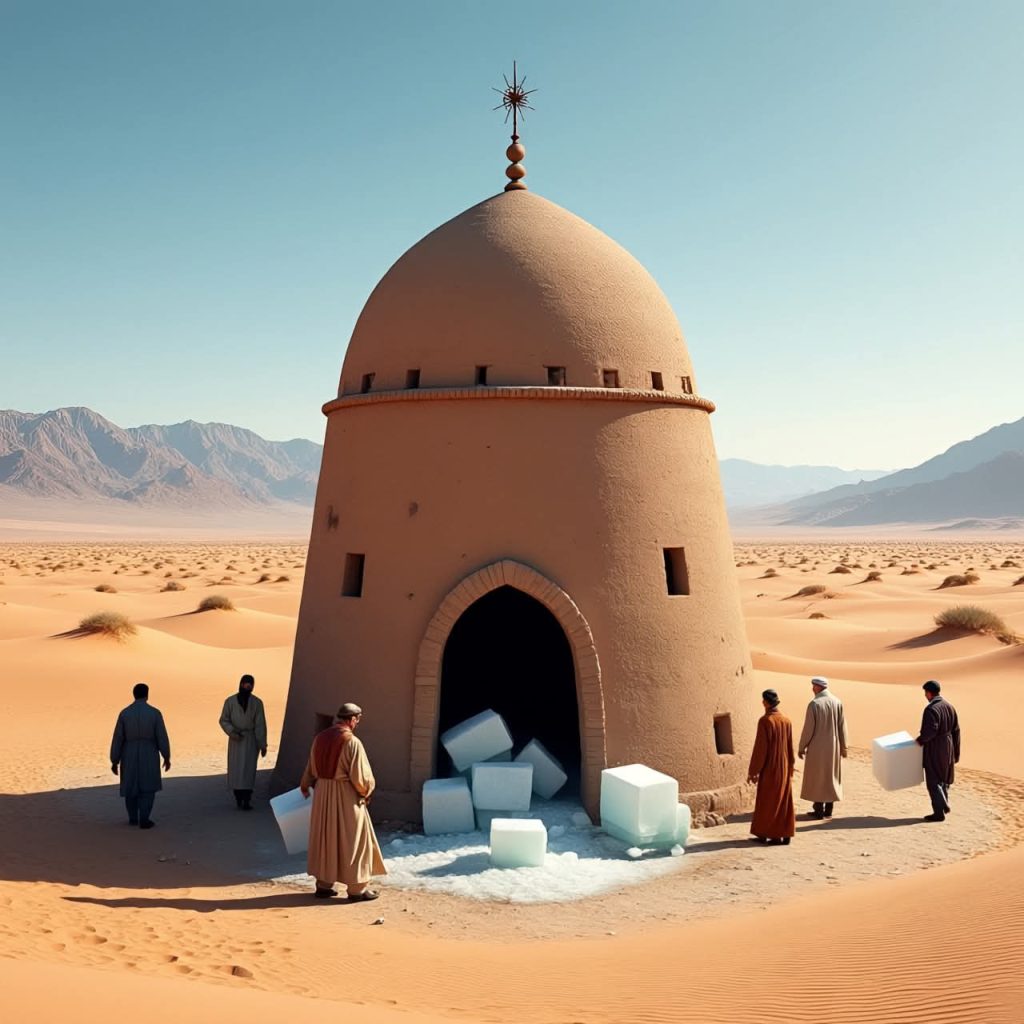
About a year ago a friend sent me a photo and said “This is a Yakhchal. Ancient Persians made ice in it 3,000 years ago.”
And I laughed. Out loud.
Because the photo showed what looked like a giant dirt igloo in the middle of the Iranian desert. 45°C heat. No trees. No water. And this thing called a Yakhchal was supposed to make ice?
Come on.
But then I did what I always do when something sounds impossible. I fell down a research rabbit hole for 3 months. And what I found about the Yakhchal blew my mind.
The Ancient Persian refrigerator is real. The Yakhchal worked. And honestly, the Yakhchal is smarter than most of the tech we have today.
So today I’m going to tell you the full story of the Yakhchal. How ancient Persians made ice in the desert without electricity. How a Ancient Persian refrigerator worked. And why engineers in 2026 are trying to rebuild the Yakhchal to fight climate change.
UNESCO World Heritage Persian Architecture
2. What Is a Ancient Persian refrigerator Exactly
First things first. Let’s get the word out of the way.
Ancient Persian refrigerator Means Ice Pit
In Persian, “Yakh” means ice. “Chal” means pit. So Ancient Persian refrigerator = ice pit.
But calling a Ancient Persian refrigerator a “pit” is like calling the Great Pyramid a “pile of rocks”.
A Traditional Persian ice house is a massive structure. We’re talking 40 to 60 feet tall. Shaped like a giant dome or beehive. Made of mud, clay, sand, and this ancient mortar called sarooj.
The entire purpose of a Traditional Persian ice house was to do two things: make ice in the winter, and keep that ice frozen all through the brutal summer.
And the craziest part? A Traditional Persian ice house did this with zero electricity.
3. The problem: How Do You Make Ice in a Desert
This is the part that kept me up at night.
Iran’s Desert Is Brutal
I’ve been to Yazd. In July it’s 45°C. The sun feels like it’s trying to cook you. The ground is cracked.
So how did the Traditional Persian ice house make ice there?
The answer is something we forget about deserts. The nights.
Desert nights are freezing. In the same place that hits 45°C during the day, it can drop to 0°C or even -5°C at night.
The ancient Persians who built the Traditional Persian ice house figured this out 3,000 years ago. They designed the Persian evaporative cooler to steal that cold night air and trap it.
British Museum Ancient Persia Collection
4. How a Persian evaporative cooler Worked: Step By Step Because It’s Genius
Alright, let me walk you through how a Persian evaporative cooler actually worked. Because once you get it, you’ll respect the Yakhchal so much.
Step 1: The Massive Dome
A Persian evaporative cooler had walls 6 feet thick made of mud and sarooj. Mud is one of the best insulators on the planet.
During the day, the thick walls of the Persian evaporative cooler kept the heat out. At night, they kept the cold in.
Think of a Persian evaporative cooler like a giant thermos.
Step 2: The Shallow Ice Pools
Right next to the Ancient Iranian ice pit, they’d dig shallow pools. They called them “hoz”.
At night, workers would fill these pools with water from qanats. Qanats are underground canals that Persians invented.
Because the desert air was so dry and cold, the water in the pools would freeze in just a few hours.
Step 3: The Underground Ice Chamber
Here’s where the magic of the Ancient Iranian ice pit happens. Workers would break the ice and drop it down a shaft into the underground part of the Ancient Iranian ice pit.
This chamber was 15 to 20 feet underground. And cold air sinks. So the ice in the Ancient Iranian ice pit would just sit there, staying frozen.
Step 4: The Windcatchers
Most Ancient Iranian ice pit had towers on top called “badgirs”. These are windcatchers.
The badgir would catch any breeze and pull it down into the Yakhchal. It would push hot air out and pull cool air in.
No fan. No motor. Just wind and a Ancient Iranian ice pit.
5. The Secret Ingredient: Sarooj Mortar
This is my favorite part about the Historical Persian ice storage.
They Built It With Egg Whites
I’m not kidding. To make a Historical Persian ice storage waterproof, Persians used a mortar called sarooj.
The recipe: sand, clay, lime, ash, goat hair, and egg whites.
Why Sarooj Made the Yakhchal Last 400 Years
Sarooj is completely waterproof. So when the ice in the Historical Persian ice storage melted, the water wouldn’t ruin the walls. It would drain out through channels and water the gardens.
Modern concrete cracks after 50 years. There are Historical Persian ice storage standing today that are 400 years old.
Scientists at MIT tested sarooj from a Historical Persian ice storage in 2024. They said it’s stronger than what we use today.
6. A Yakhchal Was More Than an Ice Maker
When I first heard about the Persian desert ice structure I thought it was just for making ice for drinks.
I was wrong. A Persian desert ice structure was the ancient refrigerator.
What People Stored in a Yakhchal
Inside a Persian desert ice structure it stayed around 15°C even in summer. So people stored:
1. Meat
2. Fruit
3. Dairy
4. Rose water
5. And yes, ice for sorbets and cold drinks
Kings would have servants bring ice from the Persian desert ice structure to the palace.
Entire neighborhoods would share one Persian desert ice structure.
7. How Old Is the Yakhchal Really
The Persian desert ice structure is ancient. Like, really ancient.
3,000 Years of Yakhchal
The earliest Persian desert ice structure date back to around 1000 BC. By the time of the Achaemenid Empire in 500 BC, every major Persian city had a Yakhchal.
The technology of the Persian desert ice structure spread too. You can find similar ice houses in India, Afghanistan, and Central Asia. Anywhere with hot days and cold nights needed a Persian desert ice structure.
8. How Much Ice Could One Yakhchal Actually Hold
The numbers here are insane.
One Yakhchal = 5,000 Cubic Meters of Ice
A large Persian desert ice structure could produce and store enough ice to supply a city of 20,000 people for the entire summer.
Workers would spend all winter making ice at night and packing it into the Ancient Persian refrigerator. Layer after layer with straw for insulation.
By August, when it was 45°C outside, the Ancient Persian refrigerator would still be full of solid ice.
9. Why Did the Yakhchal Disappear
If the Yakhchal was so great, why don’t we see them everywhere?
The Electric Fridge Killed the Yakhchal
In the 1920s, electric refrigerators were invented. Once you could plug in a box, nobody wanted to spend 6 months building a Yakhchal.
But here’s the problem. Your fridge uses 300 watts 24/7. A Ancient Persian refrigerator uses zero.
The Yakhchal Is Coming Back in 2026
Engineers are looking at the Ancient Persian refrigerator again. Because 1 billion people don’t have reliable electricity. Because of climate change.
In Iran and India, they’re building new Ancient Persian refrigerator to store food and cool homes without power.
10. I Went Inside a Yakhchal and It Changed Me
Last year I traveled to Yazd, Iran. And I saw a Traditional Persian ice house in person.
What It’s Like Inside a Yakhchal
From the outside, a Traditional Persian ice house looks like a giant dirt beehive. Nothing special.
You walk through the door and BAM. It’s 20 degrees cooler instantly.
It smells like wet earth and history. There’s a channel in the floor of the Traditional Persian ice house where melted water used to drain.
Standing inside that 400 year old Yakhchal, I felt so stupid for ever thinking ancient people were primitive. They were geniuses.
11. 5 Reasons a Yakhchal Is Smarter Than Your Fridge
Let’s do a direct comparison because the Yakhchal wins.
1. Power Usage
A Yakhchal uses 0 watts. Your fridge uses 300 watts nonstop.
2. Lifespan
A Yakhchal lasts 400 years. Your fridge dies in 10.
3. Ice Production
A Yakhchal makes ice from desert air. Your fridge just freezes water.
4. Water Recycling
A Yakhchal drains meltwater to water plants. Your fridge has a drip tray.
5. Carbon Footprint
A Yakhchal is zero carbon. Your fridge isn’t.
12. Scientists Are Studying the Yakhchal in 2025 and 2026
This is the part that gives me hope.
MIT and the Yakhchal
Researchers at MIT took samples of sarooj from an old Yakhchal. They found it’s more water resistant and durable than modern concrete.
New Yakhchals Being Built
In rural Iran, engineers are building new Yakhchals to help farmers store crops. No electricity needed.
They call it “ancient technology for modern problems”. The Yakhchal is literally the future.
13. Can You Build a Mini Yakhchal at Home
Yes. And people are doing it.
The DIY Yakhchal
YouTube is full of people building mini Yakhchals.
You dig a hole 3 feet deep. Line it with mud and straw. On cold winter nights you put out shallow trays of water. In the morning you have ice. Cover it like a Yakhchal during the day and it stays frozen for weeks.
It’s not as big as a Persian Yakhchal, but the physics is identical.
14. Myths About the Yakhchal That Need to Die
There’s a lot of misinformation about the Yakhchal.
Myth 1: They Imported Ice From Mountains
No. A Yakhchal made ice on site using desert nights.
Myth 2: Only Kings Used a Yakhchal
No. Every town had a community Yakhchal. It was public infrastructure.
Myth 3: Yakhchal Only Worked in Iran
No. The Yakhchal design works in any desert with cold nights. It was used across Asia.
15. Why the Yakhchal Matters More Than Ever
With the world heating up, the Yakhchal is more important now than it was 100 years ago.
No Power Needed
A Yakhchal can store food and medicine in places without electricity.
Teaches Us to Work With Nature
The Yakhchal didn’t fight the desert. The Yakhchal used the desert. Cold nights, dry air, wind.
That’s a lesson we need in 2026.
16. Final Conclusion: The Yakhchal Proves Ancient People Were Geniuses
I’ll end with this.
The Yakhchal is my favorite piece of ancient technology because it’s so simple and so brilliant.
3,000 years ago, with no electricity, no modern tools, Persians built a Yakhchal. A giant mud dome that could make ice in the desert and keep it frozen for 6 months.
The Yakhchal used physics, wind, and cold nights to do what we now need power plants to do.
We think we invented everything. But the Yakhchal reminds us that the smartest solutions are often the oldest ones.
So next time you open your fridge, think about the Yakhchal.
Because that dirt dome in the desert did it first.
Frequently Asked Questions About Yakhchal
What is a Yakhchal
A Yakhchal is an ancient Persian ice house that used desert nights to make ice and store it all summer without electricity.
How did a Yakhchal make ice
A Yakhchal made ice by pouring water into shallow pools at night when desert temperatures dropped below freezing.
How old is Yakhchal technology
Yakhchal technology is about 3,000 years old and was used during the Achaemenid Empire.
Can a Yakhchal still work today
Yes, a Yakhchal can still work today and engineers are rebuilding Yakhchals for sustainable cooling.
Where can I see a Yakhchal
You can see an original Yakhchal in Yazd, Kerman, and other cities in Iran.


