History of Open Source Software: From MIT Hackers to AI
The History of Open Source Software: How It All Started
history of open source software.
I’ll tell you when I first understood open source.
It was 2014. I had a $200 laptop that couldn’t run Windows. A YouTuber said “install Ubuntu, it’s free.”
I did. And that $200 laptop ran faster than my friend’s $800 Mac.
That’s when I realized: the best software in the world is free.
But “free” didn’t start with Ubuntu. It started 60 years ago in a basement at MIT.
This is the full history of open source software. No boring textbook stuff. Just the real story of hackers, fights, and how free code took over the world.
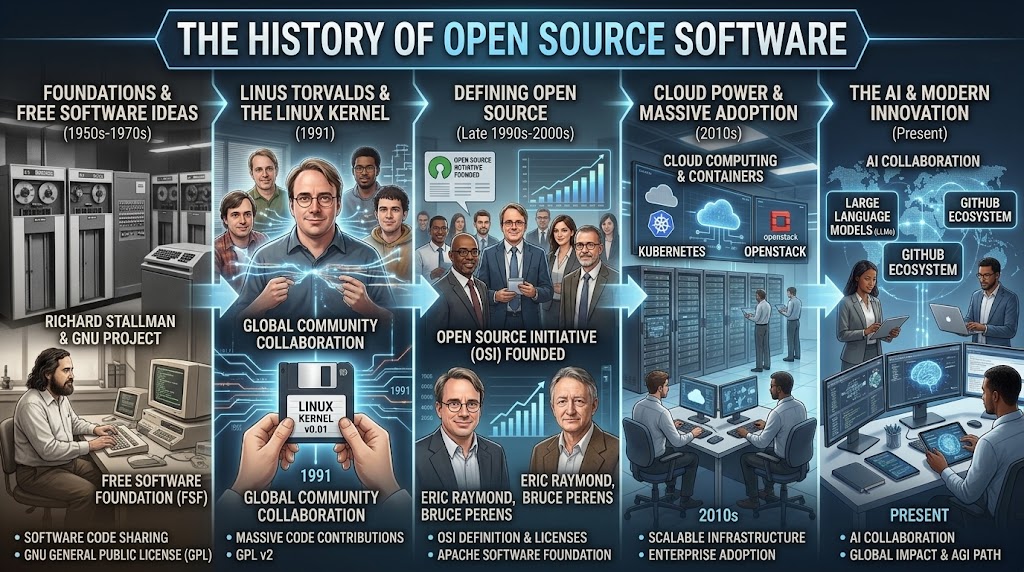
1950s-1960s: The Early History of Open Source Software
When Sharing Code Was Normal
In 1955, if you bought a computer from IBM, they gave you the code.
For free.
Sounds crazy today right? But back then nobody knew what to do with a computer. So engineers shared code like recipes.
MIT’s “Tech Model Railroad Club” had a room called “The Hacker’s Room”. Guys would stay up all night writing code and sharing it on paper tape.
There were no licenses. No lawyers. No “proprietary software”.
The early history of open source software is simple: if you fixed something, you shared it.
Bell Labs did this with Unix in 1969. They licensed it to universities for $100. Students modified it and sent improvements back.
That’s open source. 20 years before we had a name for it.
Unix, Bell Labs and The Birth of Code Sharing
The Operating System That Started Everything
Ken Thompson and Dennis Ritchie were bored in 1969. So they built Unix in a month.
Bell Labs could have sold it. Instead they shared it.
By 1975, there were 10 versions of Unix. Berkeley Unix. AT&T Unix. All different. All free to modify.
Professors taught Unix. Students learned it. Then those students went to companies and demanded Unix.
This is where the mindset started: “Code should be open.”
Without Unix, there would be no Linux. No Android. No Mac.
The history of open source software literally starts with 2 guys and a PDP-11 computer.
1983: Richard Stallman and The History of Open Source Software
The Printer That Made Him Angry
1983. MIT AI Lab. Richard Stallman, aka RMS.
He had a laser printer that kept jamming. He wanted to fix the software. The company said “no, that’s proprietary.”
Stallman lost it.
He said: “This is wrong. Software should be free.”
Not free beer. Free freedom.
So he quit MIT and started the GNU Project. GNU = “GNU’s Not Unix”.
Goal: Build a complete free operating system.
In 1989 he wrote the GPL license. The General Public License.
The rule: “You can use my code for free. But if you change it, you MUST share your changes too.”
This one license changed the history of open source software forever.
Linux, Android, WordPress – all use GPL or similar licenses.
GNU Project: The Philosophy Behind Free Software
“Free As In Freedom”
Stallman didn’t call it “open source”. He called it “Free Software”.
He had 4 freedoms:
1. Run the program for any purpose
2. Study how it works
3. Change it
4. Share it
He thought companies were evil for locking code.
Most people thought he was crazy. “How will you make money?”
His answer: “I don’t care. Freedom matters more.”
30 years later, we’re still arguing about this. But GNU built the tools. GCC compiler. Bash shell. Emacs.
Without GNU, Linux would be nothing.
1991: Linux and The History of Open Source Software Goes Global
The Email That Changed Everything
August 25, 1991. 21:57.
A Finnish student named Linus Torvalds sent an email:
“Hello everybody out there using minix – I’m doing a free operating system just as a hobby, won’t be big and professional like gnu.”
He attached the code.
Within weeks, people from around the world sent him patches.
By 1994: Linux 1.0
By 1996: Linux was running servers
By 1999: Companies were betting their business on it
The history of open source software went from “philosophy” to “real” that day.
Linus didn’t care about philosophy. He just wanted a free Unix for his PC.
And he accidentally built the foundation of the internet.
The Dot Com Boom: LAMP Stack Takes Over The Web
Free Tools Built Billion Dollar Companies
1999-2005. Dot com bubble.
Companies were burning VC money. But they all used the same free stack:
Linux – Operating System
Apache – Web Server
MySQL – Database
PHP – Programming Language
LAMP.
Google ran on Linux.
Amazon ran on Linux.
eBay ran on Linux.
The history of open source software during this time is: free software made millionaires.
Apache alone powered 70% of websites. For free.
VCs started asking: “Wait, we can build a company without paying for software?”
Yes. And it’s better.
1998: The Term Open Source and The History of Open Source Software
How Marketing Saved Free Software
Problem in 1997: “Free Software” scared companies.
“Free” = “no money” = “bad quality” in business minds.
So Eric Raymond, Bruce Perens and others had a meeting. They needed a new brand.
They picked: “Open Source”.
Same idea. Different words. “Open” sounds good to business.
February 1998: Netscape announced they were open sourcing Netscape Navigator.
Stock went up 10%.
That was it. The history of open source software got a new name and went mainstream.
Open Source Initiative was founded. The OSI approved licenses.
Business was finally okay with it.
Big Tech Embraces Open Source: Google, Facebook, Microsoft
From Enemies To Contributors
2008: Google releases Android. Open source.
2012: Facebook releases React. Open source.
2013: Microsoft starts contributing to Linux.
2015: Microsoft joins the Linux Foundation.
2016: Satya Nadella says “Microsoft ❤️ Linux”
What happened?
Big Tech realized: If we open source our tools, 10,000 developers improve them for free.
The history of open source software stopped being about rebels. It became corporate strategy.
Google’s entire cloud runs on open source.
Facebook’s AI is open source.
Even Apple uses open source in iOS.
2005-2014: GitHub and The Modern History of Open Source Software
How One Website Made Contributing Easy
Before 2005, contributing to open source sucked.
You had to email patches. Wait weeks. Beg the maintainer.
Then Linus created Git in 2005.
Then Tom, Chris and PJ created GitHub in 2008.
Now: Click “Fork”. Fix bug. Click “Pull Request”. Done.
A 15 year old could contribute to NASA’s code.
The modern history of open source software is the GitHub story.
2008: 1 million repos
2012: 10 million repos
2018: 100 million repos
Open source became social. Like Instagram but for code.
This is when your mom started hearing about open source.
Microsoft Buys GitHub: A $7.5 Billion Validation
The Day The Internet Freaked Out
June 4, 2018.
Microsoft buys GitHub for $7.5 billion.
Developers lost it. “Microsoft killed Linux!” “They’ll add ads!” “I’m moving to GitLab!”
But Microsoft did the opposite. They made private repos free. They hired maintainers.
The history of open source software reached its peak: The company that called Linux “a cancer” now owns its home.
That $7.5B told every company: Open source is not a hobby. It’s the future.
Top 5 Open Source Projects Running The Internet Today
You Use These Every Day
1. Linux – 96% of cloud servers. Runs Android. Runs your router.
2. Kubernetes – How Google, Amazon, Microsoft run containers. All free.
3. React – Facebook’s JS library. 90% of websites use it.
4. TensorFlow – Google’s AI library. Free. Used by everyone.
5. VS Code – Microsoft’s editor. 70% of developers. Completely free.
Total value: Trillions of dollars.
Total cost to you: $0.
That’s the power of the history of open source software.
2018-2024: The History of Open Source Software in The AI Era
The New Fight: Open AI vs Closed AI
2020: OpenAI releases GPT-3. Closed. $20/month.
2023: Meta releases Llama 2. Open source. Free.
Now the fight is about AI.
Should AI models be open?
Elon sued OpenAI for not being open.
Meta is betting open AI wins.
Startups are building on Llama instead of paying OpenAI.
The history of open source software in 2024 is about who controls AI.
My bet: Open wins. Again.
The Dark Side: Burnout and Security Problems
When Free Software Breaks The World
2021. Log4Shell.
A bug in a free logging library maintained by 3 volunteers.
That bug affected the entire internet. Banks. Government. Everyone.
The maintainers got death threats.
This is the ugly part of the history of open source software.
We expect 2 volunteers to secure the world for free.
Many maintainers quit due to burnout.
Companies are now starting to pay maintainers. GitHub Sponsors. Google Summer of Code.
But we’re not there yet.
How Do People Make Money From Free Software
5 Business Models That Work
“But how do they make money?”
1. Support – Red Hat. $34B. Sells support for free Linux.
2. Cloud – Amazon takes open source and sells it as a service.
3. Open Core – Free version + paid features. GitLab does this.
4. Donations – Wikipedia style. VLC does this.
5. Sponsored Devs – Google pays engineers to work on Kubernetes.
The secret: Most open source is written by people paid by big companies.
Free for you. Paid for them.
Why The History of Open Source Software Matters Today
It’s Not About Code Anymore
You don’t code. Why should you care?
Because open source runs your life.
Your phone: Android
Your browser: Chrome
Your bank: Runs on Linux
Your hospital: Uses open source software
The airplane you fly in: Open source code
The history of open source software is the history of cooperation.
Strangers choosing to build together instead of compete.
In a world of walls and paywalls, that matters.
The Future of Open Source: AI, Funding and Regulation
What Happens Next
2025 and beyond:
1. AI Models Go Open – Meta, Mistral, and others will push open AI.
2. Government Funding – US and EU are funding open source for security.
3. Better Pay for Maintainers – Companies can’t ignore burnout anymore.
4. Open Hardware – RISC-V chips. Open source phones.
My prediction: In 2030, 95% of all software will touch open source.
Because it’s just better. Faster. Safer.
The history of open source software isn’t over. We’re in chapter 3.
Final Thoughts:History of Open Source Software From MIT to Your Phone
Thank a Stranger
I started this article with a $200 laptop.
I’m ending it with this: Open source is the biggest act of generosity in human history.
Millions of people wrote code. For free. And gave it to you.
The history of open source software is about Stallman getting mad.
About Linus sending an email.
About you downloading Ubuntu.
Next time you use free software, think about that.
And maybe contribute back. Fix a typo. Donate $5. Say thanks.
Because that’s how this whole thing keeps going.
Frequently Asked Questions History of Open Source Software
1. What is the history of open source software
It began in the 1950s with shared code, was formalized by Richard Stallman in 1983, and exploded with Linux in 1991.
2. Who started open source
Richard Stallman started the Free Software movement. Linus Torvalds made it popular with Linux.
3. Is open source really free
Free as in freedom. You can use, modify, and share it. Some companies charge for support.
4. Why did Microsoft buy GitHub
Because open source is now standard. GitHub is where 100M developers work.
5. What is the most important open source project
Linux. It runs 96% of servers and all Android phones.
6. Is open source safe
Generally yes. More eyes means more bugs get found. But it depends on maintainers.
7. Can I make money with open source
Yes. Red Hat, MongoDB, and Elastic are all billion dollar open source companies.