
History of The Semiconductor Industry: From Sand to AI Chips
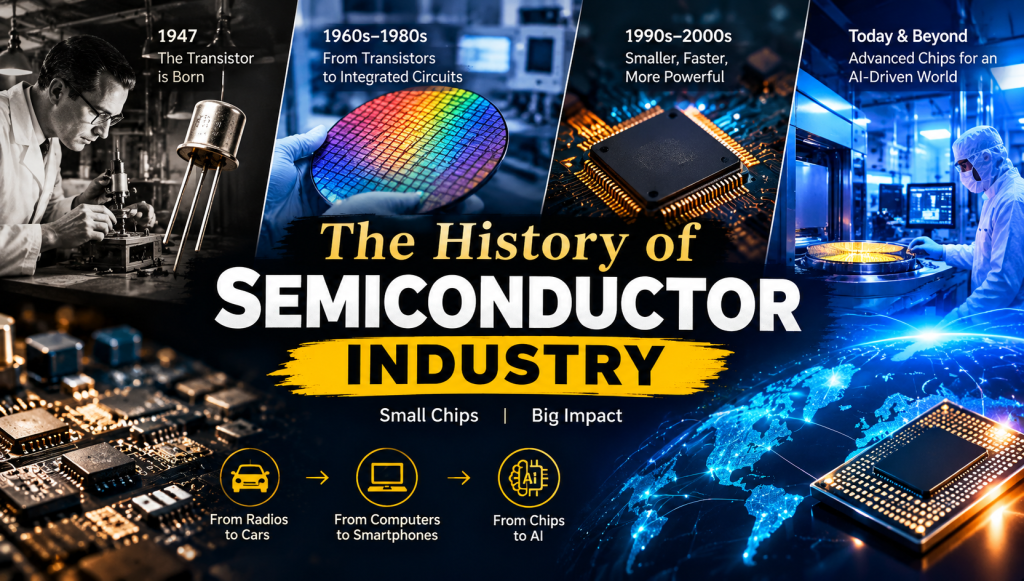
Introduction : History of The Semiconductor Industry: How Sand Became Intelligence
history of the semiconductor industry.
I dropped my phone last week. Screen cracked. $300 repair.
And while I was crying about it, I realized something crazy.
Inside that phone is a chip smaller than my fingernail. And that chip has 15 BILLION transistors.
15 billion switches. Made of sand.
How did we get from beach sand to AI? That’s the history of the semiconductor industry.
And it’s the wildest 80 year story you’ll ever hear.
It’s about nerds, wars, greed, and how 3 guys in a lab changed everything.
Let’s start at the beginning.
1947: The Transistor – Where The History of The Semiconductor Industry Begins
Bell Labs and The “Point-Contact” Accident
December 1947. New Jersey.
3 guys at Bell Labs were pissed. Vacuum tubes were huge, hot, and broke every 2 weeks.
William Shockley, John Bardeen, and Walter Brattain were trying to build something better.
On December 16th, they touched two gold wires to a piece of germanium.
It worked. It amplified a signal.
They called it a “transistor”. Transfer + resistor.
Nobody cared.
But the history of the semiconductor industry officially starts that day.
Because that tiny piece of germanium killed the vacuum tube.
Why It Mattered History of The Semiconductor Industry
Before 1947: Computers filled a room and used 18,000 tubes.
After 1947: You could fit a computer on a desk.
The transistor won the Nobel Prize in 1956.
And it started the biggest industry in human history.
1958: The Integrated Circuit – From 1 to 1000 Transistors
Two Guys Who Didn’t Know Each Other Invented The Same Thing
1958. The history of the semiconductor industry gets its second big moment.
Jack Kilby at Texas Instruments and Robert Noyce at Fairchild both had the same idea:
“What if we put multiple transistors on one piece of silicon?”
Kilby did it first with germanium. Called it the “integrated circuit” or IC.
Noyce did it better 6 months later with silicon and a better way to connect them.
This is huge. Because now instead of soldering 1000 transistors, you could print them.
The history of the semiconductor industry from 1958 onward is the story of putting more and more stuff on one chip.
1960s: NASA, Vietnam, and The First Big Customers
How War and Space Made Chips Cheap
In 1962, a single IC cost $1000.
Nobody could afford it. Except 2 customers: The US Military and NASA.
The Apollo Moon program needed computers that were small and light.
So NASA bought millions of ICs from Fairchild and Texas Instruments.
By 1965, the price dropped to $20 per chip.
The history of the semiconductor industry is this: government money made chips cheap enough for everyone else.
Without Apollo 11, there would be no iPhone.
1965: Moore’s Law – The Rule That Broke History of The Semiconductor Industry
The Prediction That Came True
1965. Gordon Moore was an engineer at Fairchild.
He looked at a graph and said: “The number of transistors on a chip doubles every 2 years.”
He called it Moore’s Law.
Everyone laughed.
But he was right. For 50 years.
The entire history of the semiconductor industry has been a race to obey Moore’s Law.
More transistors = faster phones, better games, smarter AI.
Moore’s Law is why your phone is 100,000x more powerful than the Apollo computer.
1968-1971: Intel, Silicon Valley, and The Microprocessor
3 Guys Walk Out and Change Everything
1968. Robert Noyce and Gordon Moore quit Fairchild.
They were mad. So they started a new company. Intel.
Their 4th employee was Andy Grove.
In 1971, Intel released the 4004. The first microprocessor.
It had 2300 transistors. It was made for a calculator.
Nobody knew it, but the history of the semiconductor industry just entered its main character era.
The microprocessor = a whole computer on one chip.
This is what’s in your laptop, your car, your fridge.
1970s: The PC Revolution and The Rise of Silicon Valley
From Garages to Billion Dollar Companies
1975: Microsoft starts. They need chips.
1976: Apple starts in a garage. They need chips.
1977: Commodore, Atari, all need chips.
And who sold them? Intel, AMD, and a bunch of new companies in “Silicon Valley”.
The history of the semiconductor industry in the 70s is the story of nerds getting rich.
Chips went from military to consumer.
And demand exploded.
1980s: Japan Attacks and The US Almost Loses
The “Chip War”
1980s. Japan came in hot.
Companies like NEC, Toshiba, and Hitachi started making memory chips better and cheaper than Americans.
By 1986, Japan controlled 70% of the memory chip market.
US companies were dying. Intel almost went bankrupt.
The history of the semiconductor industry almost ended for America here.

So the US government stepped in. Gave Intel money. Imposed tariffs on Japan.
Intel made a bet: “We’re quitting memory. We’re only doing microprocessors.”
That bet saved Intel. And the US chip industry.
1990s: The Fabless Revolution and TSMC
The Guy Who Invented “We Design, You Build”
1990s. Making chips got INSANELY expensive. A new factory cost $1 billion.
So a Taiwanese guy named Morris Chang had a crazy idea.
“What if we don’t design chips? We just build them for other companies?”
He started TSMC in 1987. Taiwan Semiconductor Manufacturing Company.
The “fabless” model was born.
Companies like Nvidia, AMD, and Apple would design chips. TSMC would build them.
The history of the semiconductor industry split in two: Designers and Manufacturers.
Today TSMC makes 60% of all chips in the world. And Apple’s iPhone chip.
2000s: Smartphones and The Mobile Chip War
How ARM and Qualcmm Took Over
2007. iPhone launches.
Suddenly everyone needed a chip that was fast but didn’t kill battery.
Intel’s chips were too power hungry.
So ARM chips won. Designed in UK, made by TSMC.
Qualcomm made the Snapdragon. Apple made the A-series chip.
The history of the semiconductor industry in the 2000s is mobile.
Billions of phones. Billions of chips.
And the center of manufacturing moved to Taiwan and South Korea.
2010s: AI, Crypto, and The End of Moore’s Law
When Physics Said “Stop”
2010-2020. We hit a wall.
Transistors got so small that electrons started “leaking”. Physics said no more.
Moore’s Law started slowing down.
But demand didn’t. AI needed more power. Crypto needed more power.
So companies did 2 things:
1. GPUs – Nvidia realized graphics cards are perfect for AI math.
2. 3D Chips – Stack transistors vertically instead of making them smaller.
The history of the semiconductor industry entered its “we need new tricks” era.
2020-2024: The Chip Shortage and The AI Boom
Why Your PS5 Was Sold Out
2020. COVID hits.
Everyone buys laptops and game consoles. Car companies also need chips.
But factories shut down.
Result: 2 year chip shortage. Cars couldn’t ship. PS5 was $1000 on eBay.
At the same time, ChatGPT launches in 2022.
And it needs 10,000 Nvidia GPUs to run.
The history of the semiconductor industry in 2024 is AI.
Nvidia became a $2 trillion company selling chips to train AI.
TSMC is building $40 billion factories in Arizona.
The US, EU, and China are all spending $500 billion to build their own chips.
Because whoever controls chips, controls the future.
The 5 Companies That Run The History of The Semiconductor Industry
You’ve Never Heard of 3 of Them
1. TSMC – Taiwan – Makes 60% of all advanced chips. Apple, Nvidia, AMD.
2. Samsung – South Korea – Makes chips and memory. Apple’s rival.
3. Intel – USA – Used to make everything. Now trying to catch up.
4. Nvidia – USA – Designs AI chips. Worth $2 trillion.
5. ASML – Netherlands – The only company that makes the machines to print chips. $1 machine = $400 million.
That’s it. 5 companies. The entire digital world depends on them.
That’s the modern history of the semiconductor industry.
How Are Chips Actually Made History of The Semiconductor Industry
It’s Insane
Making a chip is the hardest thing humans do.
Step 1: Start with sand. Purify it to 99.9999999% pure silicon.
Step 2: Slice it into a wafer.
Step 3: Use light 13.5nm wide to “print” transistors. That’s 10x smaller than a virus.
Step 4: Do this 100 times. Layer on layer.
Step 5: Test it. 1 speck of dust ruins the whole thing.
A modern factory costs $20 billion. Takes 3 years to build.
And ASML’s machine does it with light.
The history of the semiconductor industry is the history of humans getting better at making tiny things.
The Dark Side: Geopolitics and Chip Wars
Why The US and China Are Fighting
Chips are the new oil.
In 2022, the US banned selling advanced chips to China.
Why? Because AI chips can be used for weapons.
China responded: “We’ll build our own.”
The history of the semiconductor industry is now about countries, not companies.
Taiwan makes most chips. But China says Taiwan is theirs.
If there’s a war, the entire world’s chip supply stops.
That’s why the US is spending $52 billion to build factories in Arizona.
What’s Next: 2025-2035
The Future of The Semiconductor Industry
What’s coming next:
1. 2nm and 1nm Chips – Even smaller transistors. Coming 2025.
2. Chiplets – Instead of 1 big chip, connect 10 small chips.
3. Quantum Chips – Not silicon. Uses quantum physics.
4. AI Chip Design – AI designs better chips than humans.
The history of the semiconductor industry isn’t over. We’re in chapter 3.
My prediction: In 10 years, AI will design chips that humans can’t understand.
10 Things You Didn’t Know About The History of The Semiconductor Industry
1. The first transistor was made of germanium, not silicon
2. Intel’s name comes from “Integrated Electronics”
3. ASML is the only company that can make EUV machines
4. A modern iPhone chip has more transistors than stars in the galaxy
5. TSMC’s founder was 55 when he started the company
6. The US invented chips but now makes only 10% of them
7. A chip factory uses as much water as a city of 50,000 people
8. Nvidia started as a gaming company
9. The Apollo computer had 4000 transistors. Your phone has 15 billion.
10. The history of the semiconductor industry is only 77 years old
Why The History of The Semiconductor Industry Matters To You
You Touch 100 Chips Per Day
Your phone: 3 chips
Your laptop: 5 chips
Your car: 100 chips
Your fridge: 2 chips
Your TV: 4 chips
The history of the semiconductor industry is the history of modern life.
Without it: No internet. No GPS. No Netflix. No AI.
That piece of sand in your pocket is the most complex thing humans have ever made.
Final Thoughts:History of The Semiconductor Industry
The Craziest 80 Years
In 1947, 3 guys touched wires to germanium.
In 2024, that led to ChatGPT.
The history of the semiconductor industry is about making things smaller, faster, and cheaper.
And we did it.
We took sand and turned it into intelligence.
The next 20 years will be even crazier. AI chips. Quantum chips. Brain chips.
So next time your phone lags, be patient.
Inside it is 15 billion tiny switches. And it took 80 years and $10 trillion to build.
Frequently Asked Questions History of The Semiconductor Industry
1. What is the history of the semiconductor industry
It started in 1947 with the transistor, grew with integrated circuits in 1958, and exploded with microprocessors and smartphones.
2. Who invented the semiconductor
The transistor was invented by Shockley, Bardeen, and Brattain at Bell Labs in 1947.
3. What is Moore’s Law
The prediction that transistors on a chip double every 2 years. It drove the industry for 50 years.
4. Who makes most chips today
TSMC in Taiwan makes 60% of advanced chips. Samsung and Intel make the rest.
5. Why is there a chip shortage
COVID demand + factory shutdowns + cars needing more chips caused it in 2020-2022.
6. What is the future of semiconductors
AI chips, 2nm technology, chiplets, and quantum computing.
7. How much does a chip factory cost
$20 billion and 3 years to build.


