
History of GitHub: From a Side Project to Microsoft’s $7.5 Billion Buy
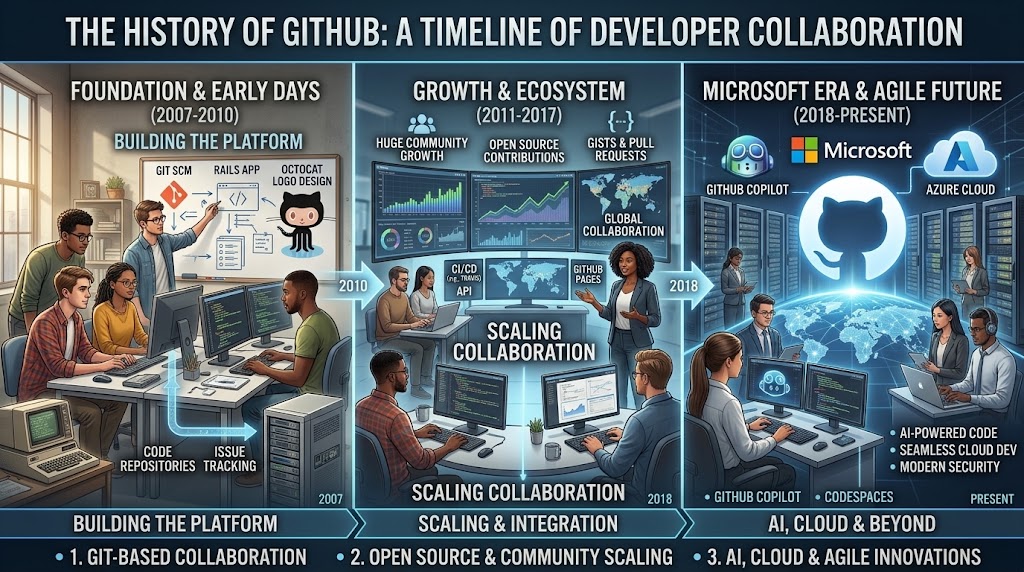
Interduction:The History of GitHub: How 3 Guys in a Bar Built The Home of Code
history of github.
I remember the first time I used GitHub.
It was 2016. I was 17. I had no idea what I was doing. I just wanted to download someone’s Python script and my friend said “just get it from GitHub.”
I opened the site and I was lost. Green buttons. Pull requests. Issues. What the hell was all this?
Fast forward to today and GitHub is where I live 8 hours a day. 100 million developers live there too.
But GitHub didn’t start as this giant. It started as 3 guys, a bar in San Francisco, and a problem that was pissing them off.
This is the full history of GitHub. Not the Wikipedia version. The real one. With the fights, the mistakes, and the $7.5 billion ending.
The History of GitHub Starts Before GitHub: The Problem With Code in 2005
Before 2005 Sharing Code Was A Nightmare
To understand the history of github you have to go back to 2005.
Back then if you wanted to work on code with someone, you had 2 bad options.
Option 1: Email zip files back and forth. “v3_final_FINAL.zip”
Option 2: Use something called SVN or CVS. Which was slow, broke all the time, and made grown developers cry.
Linus Torvalds, the guy who created Linux, was dealing with this too. Thousands of developers were sending him patches by email. He was losing his mind.
So in 2005 he got pissed off and built his own tool in 2 weeks. He called it Git.
Git was fast. Git was distributed. Git didn’t need a central server.
But there was one problem. Git was a command line tool. It was ugly. It was for Linux nerds only.
No normal person was going to use it.
That’s where our story really starts.
2007: The History of GitHub Begins In a Bar
Tom, Chris, and PJ Were Tired of Bad Tools
Tom Preston-Werner, Chris Wanstrath, and PJ Hyett.
3 developers in San Francisco. They all hated the tools for sharing code.
Tom was building a Ruby library and he was tired of emailing code. Chris was working at a company with terrible internal tools. PJ was running a company and needed something better.
One night in early 2007 they were drinking at a bar and complaining.

Tom said: “What if we just put Git on the web and made it pretty?”
Chris said: “And make it social. Like MySpace but for code.”
PJ said: “I’ll pay for the servers.”
That night the history of github started.
They didn’t quit their jobs. They just started coding at night.
2008: GitHub Launches and Nobody Cares At First
The Beta Launch With 300 Users
April 2008.GitHub.com goes live.
The homepage was super simple. “Social Coding”. That was it.
For the first month they had like 300 users. Mostly their friends.
Tom was doing customer support himself. If you emailed, Tom replied. At 3am.
The big problem: Git was still hard. Developers didn’t know Git. So GitHub had to teach them.
They wrote guides. They made the UI as simple as possible. The famous green “contribute” button was born here.
By the end of 2008 they had 10,000 users. Not huge. But the right 10,000 users.
Rails developers. Open source people. The people who would later build the internet.
2009-2010: The History of GitHub Explodes Because of Open Source
Rails and The Fork Button Changed Everything
2009 was the year everything changed.
Ruby on Rails was blowing up. And all the Rails developers were on GitHub.
Then GitHub added 2 features that changed everything:
1. The Fork button. One click to copy someone’s code.
2. Pull Requests. A way to say “hey I fixed your code, please take it.”
Before this, contributing to open source meant emailing a patch and praying.
After this, a 15 year old kid could fix a bug in Facebook’s code and send it back.
By 2010 GitHub had 1 million repositories.
Companies started noticing. Not because GitHub sold to them. Because their employees were already using it at home.
2011-2012: GitHub Gets Big And Gets Weird
1 Million Users and No HR Department
2011. GitHub hits 1 million users.
They were still only 10 people. Working remotely. No office. No HR. No managers.
Their rule was: “You do what needs to be done.”
This worked for a while. But it also created problems later.
2012 they raised $100 million from Andreessen Horowitz. At a $750 million valuation.
People thought they were crazy. “Who pays $100M for a website with code?”
The answer: Everyone.
Because by now the history of github was tied to the history of the internet. If you were building software, you were on GitHub.
2013-2014: GitHub Becomes The Default
Atom, Desktop, and 10 Million Repos
2013 GitHub launched GitHub Desktop. For people scared of the command line.
2014 they launched Atom. Their own text editor.
They also hit 10 million repositories.
At this point if you were a developer and you weren’t on GitHub, people assumed you were weird.
Microsoft was using GitHub. Google was using GitHub. NASA was using GitHub.
The history of github was no longer about a startup. It was about infrastructure.
2014-2018: The Dark Years and The CEO Problem
When Growth Broke The Culture
Here’s the part nobody talks about in the happy history of github.
2014 things got bad internally.
GitHub had no HR, no managers, no rules. And as they grew to 200+ people, that broke.
There were complaints about harassment. About burnout. About the founders not knowing how to run a 200 person company.
In April 2014, Julie Ann Horvath, a top employee, quit publicly and wrote a blog post about the toxic culture.
Tom Preston-Werner resigned as CEO.
For 3 years GitHub drifted. They had 3 different CEOs. Revenue was growing but morale was bad.
Employees were asking: “Are we going to sell?”
2018: The History of GitHub Changes Forever – Microsoft Buys It
$7.5 Billion and The Internet Loses Its Mind
June 4, 2018.
Nat Friedman tweets: “Big news tomorrow.”
The internet explodes. “Microsoft is buying GitHub?!”
June 4th it was official. Microsoft buys GitHub for $7.5 billion in stock.
Developers lost their minds.
“Microsoft killed Linux!”
“They’re going to put ads on my code!”
“I’m moving to GitLab!”
For 48 hours it felt like the end of the world.
But here’s what actually happened.
Microsoft put Nat Friedman as CEO. And they did… nothing.
They didn’t put it behind a paywall. They didn’t kill it. They made it free.
In 2019 they made private repos free for everyone. That alone brought in 20 million new users.
The history of github under Microsoft became: leave it alone and let it grow.
2019-2021: GitHub Under Microsoft Gets Better
Copilot, Actions, and 50 Million Developers
This is where GitHub actually got good.
2019: GitHub Actions. So you could run tests and deploy right from GitHub.
2020: GitHub Codespaces. Code in the browser.
2021: GitHub Copilot. AI that writes code with you.
User count went from 28 million in 2018 to 50 million in 2021.
Microsoft didn’t ruin GitHub. They funded it.
Nat Friedman’s rule was simple: “Don’t mess with what developers love.”
2022-2024: 100 Million Developers and The AI Era
Where The History of GitHub Is Right Now
As of 2024:
100 million developers.
420 million repositories.
90% of Fortune 100 companies use it.
GitHub is no longer “a website for code.”
It’s where AI models are trained.
It’s where governments publish open data.
It’s where students learn to code.
The biggest change: AI.
Copilot now has 1 million paying users. It writes 46% of all code on GitHub.
Some developers hate it. Some love it. But it’s there.
The history of github in 2024 is the history of AI and code colliding.
The People Behind The History of GitHub
The 3 Founders and What Happened To Them
Tom Preston-Werner: Left in 2014. Now runs a company called Chatterbug.
Chris Wanstrath: Was CEO until 2018. Left after Microsoft deal. Now an investor.
PJ Hyett: Still works at GitHub as a board member.
Nat Friedman: Ran GitHub from 2018 to 2021. Left to do AI stuff.
The funny thing: None of them are at GitHub anymore. But their code is.
Why The History of GitHub Matters To You
It’s Not About Code Anymore
Here’s why I think the history of github is important even if you don’t code.
GitHub proved 3 things:
1. Developers will work for free if the tools are good. Open source runs the world because of GitHub.
2. Community beats features. GitLab had more features. Bitbucket was cheaper. But people stayed for the community.
3. A good company can be bought and not ruined. Microsoft could have killed GitHub. They didn’t.
If you’re building anything online, study GitHub.
10 Things You Didn’t Know About The History of GitHub
The Weird Facts
1. The octocat logo was bought for $1000 on iStock.
2. The first paid customer was a company that paid $7/month.
3. For the first 2 years they had no search function.
4. GitHub was profitable from day 1.
5. They said no to ads. Forever.
6. The name “GitHub” was almost “GritHub”.
7. Linus Torvalds has never made a GitHub account.
8. The first repo was a library called “grit”.
9. They have a data center in the Arctic to store code for 1000 years.
10. Microsoft employees were banned from using GitHub internally before the acquisition.
The Future: What Happens Next To History of GitHub
AI, Copilot, and Beyond Code
The history of github isn’t over.
Microsoft’s plan is clear: make GitHub the place where humans and AI write code together.
Expect more AI features. Expect GitHub to go into education more. Expect them to store more than code – docs, designs, data.
Will someone kill GitHub? Probably not. The network effect is too strong.
100 million developers are not moving.
Final Thoughts: The History of GitHub Is The History of The Internet
From 3 Guys To 100 Million
When I started writing this I thought it would be a story about code.
It’s not.
The history of github is a story about community. About making something so useful that people can’t live without it.
It’s about 3 guys who were annoyed and decided to fix it.
It’s about mistakes. About almost failing. About getting bought and not dying.
If you’re building something today, remember this: GitHub wasn’t special because of Git. Git existed.
GitHub was special because they made it human.
And that’s why 100 million of us are still there.
Frequently Asked Questions About The History of GitHub
1. When was GitHub founded
GitHub was founded in February 2008 by Tom Preston-Werner, Chris Wanstrath, and PJ Hyett.
2. Who owns GitHub now
Microsoft bought GitHub in 2018 for $7.5 billion.
3. How many users does GitHub have in 2024
Over 100 million developers use GitHub as of 2024.
4. What was GitHub before Microsoft
GitHub was an independent private company from 2008 to 2018.
5. Why is GitHub important
Because it became the default place for developers to share code and collaborate.
6. Did Micoro soft ruin GitHub
No. Most developers agree GitHub got better after Microsoft bought it and made more features free.
7. What is the difference between Git and GitHub
Git is the version control software. GitHub is a website that hosts Git repositories.
Git Official Documentation


