
The History of Moore’s Law: How One Man’s 1965 Prediction Built The World We Live In Today
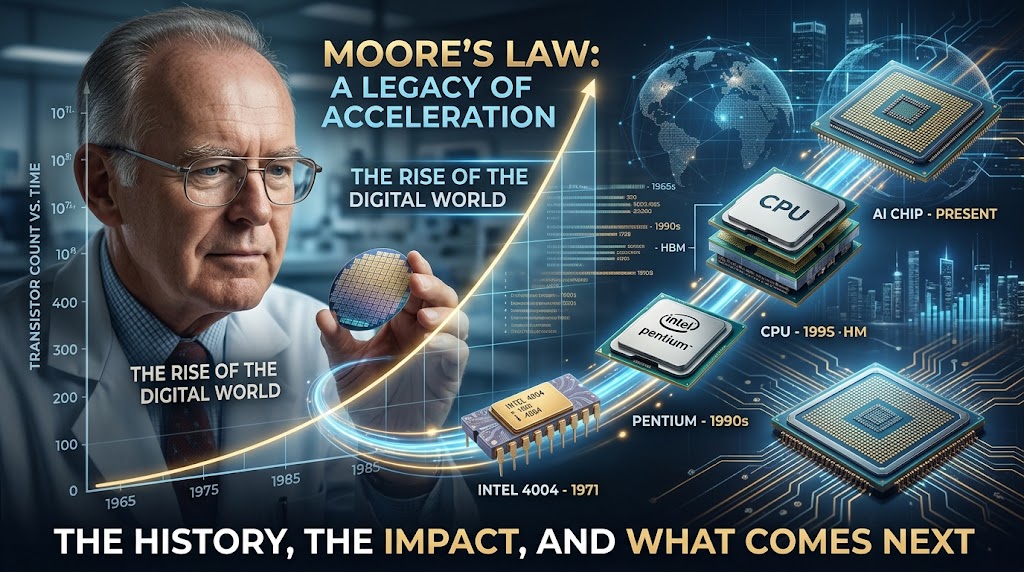
1. Introduction: History of Moore’s Law and The Little Guess That Created Everything
The history of moore’s law began with a deadline.
April 19, 1965.
Gordon Moore was 36 years old, working at Fairchild Semiconductor in California. The editor of Electronics Magazine called him and said “We need 1000 words from you about the future of chips.”
Moore didn’t have time to do a big research paper. So he sat at his desk, looked at the data from the last few years, and made a guess.
For the past 5 years, engineers had been figuring out how to put twice as many transistors on a computer chip every year.
So he wrote: “The complexity for minimum component costs has increased at a rate of roughly a factor of two per year.”
That was it. Three lines.
60 years later, that guess became the most important rule in technology. It’s the reason your phone is more powerful than the computers that sent people to the moon. It’s why computers got cheaper every year. It’s why we have the internet, TikTok, YouTube, and AI in 2026.
The history of moore’s law is the story of how we took sand from a beach and turned it into thinking machines. And now everyone is asking: after 60 years, is it finally over?
2. Who Was Gordon Moore? The Man Behind The History of Moore’s Law
Before we talk about the law, let’s talk about the man. Because the history of moore’s law is really just the story of one person paying attention.
He Was a Chemist
Gordon Moore was born in 1929 in San Francisco. He grew up in a small town called Pescadero. He went to UC Berkeley and got a PhD in chemistry. He wasn’t a computer programmer. He just liked science.
The Traitorous Eight
In 1957, Moore was working at Shockley Semiconductor. The boss was awful. So Moore and 7 other young engineers quit together and started their own company. People called them “The Traitorous Eight.” Their company was Fairchild Semiconductor.
Then He Built Intel
In 1968, Moore and his friend Robert Noyce left Fairchild and started Intel. Intel would become the biggest chip company in the world. And the history of moore’s law would become Intel’s plan for the next 40 years.
3. 1965: The Three Page Article That Started The History of Moore’s Law
The article came out in Electronics Magazine. The title was “Cramming More Components Onto Integrated Circuits.”
What Moore Actually Observed
From 1959 to 1965, the number of transistors on a chip doubled every year. In 1959, the first chip had 1 transistor. By 1965, chips had 60 transistors.
What He Predicted
Moore wrote: “I believe that such a rate of increase is sustainable for at least 10 years.”
He never called it a “law.” He was just describing what he saw.
Why Did Anyone Care
In 1965, computers cost millions of dollars and filled entire rooms. The idea that they could get 1000 times better in 20 years sounded impossible. But Moore was right.
4. 1975: Moore Updates The History of Moore’s Law
10 years went by. In 1975, Moore was invited to speak at a conference.
The Rule Becomes Every 2 Years
By 1975, things were getting harder. Factories were more expensive. Engineering was more complex.

So Moore updated his guess. “Now I think it will double every 2 years instead of every year.”
This is the version of the history of moore’s law that everyone knows today.
5. The 1980s and 1990s: The Golden Age in The History of Moore’s Law
This is when you could really feel it in your life.
The PC Revolution
In 1981, the first IBM PC came out. It had an Intel 8088 chip with 29,000 transistors and cost $5000. By 1999, a Pentium 3 chip had 9.5 million transistors and the whole computer cost $1000.
Because of the history of moore’s law, computers went from being for big companies to being in every home.
The Internet Explosion
Cheaper computers meant more people could get online. More people online meant companies like Yahoo, Google, and Amazon could exist.
Intel’s Ticking Clock
Intel literally built their business around it. Every 2 years, they would release a new chip that was twice as fast.
6. How Did Engineers Actually Make The History of Moore’s Law Happen
It wasn’t magic. It was thousands of engineers working hard.
1. Make the Transistor Smaller
A transistor is just a tiny switch. If you make the switch half as wide, you can fit 4 of them in the same space. So every 2 years, engineers figured out new ways to shrink them.
2. Use Bigger Silicon Wafers
Chips are made on big circles of silicon called wafers. In 1970, wafers were 2 inches across. In 2020, they were 12 inches.
3. Build Crazier Machines
Companies like ASML built machines that use light to draw lines that are 1000 times thinner than a human hair.
7. The 2000s: The First Problems in The History of Moore’s Law
Around 2005, engineers started running into real problems.
The Heat Wall
When transistors get too small, they start leaking electricity and they get hot. So around 2005, CPU clock speeds stopped going up.
The Money Wall
In 2000, a new chip factory cost $3 billion. In 2020, a new factory cost $20 billion.
But even with these problems, the history of moore’s kept going.
8. 2010-2020: You Felt Moore’s Law In Your Pocket
This is when the history of moore’s law became personal.
The Smartphone
The first iPhone in 2007 had a single core processor and 128MB of RAM. The iPhone 15 Pro in 2023 has 16 billion transistors.
AI Was Born Because of It
Training ChatGPT takes massive amounts of computing power. Because of the history of moore’s law, Nvidia was able to build GPUs with 80 billion transistors.
9. 2020-2026: Is The History of Moore’s Law Finally Over
This is the big debate now.
We Hit Physics
In 2024, the best chips are made on a 3 nanometer process. A silicon atom is about 0.2 nanometers.
Big CEOs Are Saying It
Jensen Huang from Nvidia said: “Moore’s Law is dead.”
Pat Gelsinger from Intel said: “Moore’s Law is alive, but it’s much harder now.”
10. What Comes After Moore’s Law
Even if transistor doubling stops, computing is not stopping.
1. Chiplet Design
Instead of making one giant chip, companies now make many small chips and connect them together.
2. 3D Chip Stacking
Instead of making chips wider, stack them on top of each other.
3. New Materials and New Ideas
Quantum computers. Optical computers. Neuromorphic chips.
11. The Money Impact: How The History of Moore’s Law Made Everything Cheap
The history of moore’s law is also an economic story.
Computers Got 1 Million Times Cheaper
In 1965, one transistor cost about $1. In 2025, one transistor costs less than $0.000001.
Entire Industries Were Created
No Moore’s Law = No Google, No Facebook, No Netflix, No iPhone, No ChatGPT.
12. Moore’s Law and AI in 2026
AI is the reason people still care about the history of moore’s law.
Training Big AI Models
GPT-4 took 10,000 Nvidia GPUs running for months.
Running AI On Your Device
Because chips are so efficient now, you can run AI models on your phone.
13. Who Benefited The Most From The History of Moore’s Law
Intel
They built a $300 billion company by following Moore’s rule.
TSMC
The Taiwanese company that now makes chips for Apple, Nvidia, and AMD.
Regular People Like Us
Your $800 laptop today is more powerful than every computer on Earth combined in 1965.
14. Was Moore’s Law Real or Was It a Self-Fulfilling Prophecy
Some smart people argue that the history of moore’s law happened because everyone believed it.
It Was a Target
Engineers at Intel, TSMC, and Samsung all had “double every 2 years” written on the wall.
It Was Also Marketing
“Buy our new chip, it’s 2x faster” is a great way to sell computers.
But the data doesn’t lie. For 60 years, it was mostly true.
15. The Future After The History of Moore’s Law
Quantum Computing
For some specific problems, quantum computers will be 1 million times faster.
Specialized Chips
Instead of one chip that does everything, we will have chips designed just for AI.
The Spirit Continues
Even if transistors stop doubling, engineers will keep finding new ways.
16. Final Thoughts: History of Moore’s Law and 60 Years of Progress
April 19, 1965.
Gordon Moore wrote 1000 words in a magazine.
60 years later, we live in a world that he helped create.
The history of moore’s law is not just about chips. It’s about what happens when humans decide to make something better, year after year, for 60 years straight.
It gave us the internet. It gave us smartphones. It gave us AI.
Gordon Moore died in 2023 at age 94. He lived long enough to see his little prediction change the entire world.
The history of moore’s law teaches us one thing: sometimes a simple observation can change everything.
Frequently Asked Questions
What is the history of moore’s law
The history of moore’s law started in 1965 when Gordon Moore predicted that the number of transistors on a chip would double every 2 years.
Is moore’s law still true in 2026
The doubling has slowed down, but computing is still getting faster through new methods like chiplets and AI chips.
Who created moore’s law
Gordon Moore, co-founder of Intel, wrote about it in 1965.
Why is the history of moore’s law important
Because it explains why computers, phones, and the internet got exponentially better and cheaper for 60 years.


