History of Supercomputers: The 83 Year Race to Build The World’s Fastest Brain
1. Introduction: History of Supercomputers and The Room That Changed Everything
The History of Supercomputers started with a problem.
1943. Philadelphia.
World War 2 was happening. The US Army needed to calculate where artillery shells would land. Doing it by hand took 40 hours. By then the battle was over.
So a group of engineers built a machine. It was 80 feet long. 8 feet tall. Weighed 30 tons. It had 18,000 vacuum tubes. When they turned it on, the lights in the whole building dimmed.
They called it ENIAC.
That machine could do 5,000 calculations per second.
Today in 2026, the phone in your pocket does billions. The fastest supercomputer does 1.3 quintillion.
The History of Supercomputers is the story of humans who refused to wait. We wanted answers faster. Weather faster. Medicine faster. Science faster.
This is how we got here.
2. History of Supercomputers Begins: The War Years
War always makes technology move fast.
ENIAC 1943
The engineers didn’t call it a supercomputer. That name came later. They just called it “the computer.”
It took up an entire room. A team of women called “computers” used to do the math by hand. ENIAC replaced them.
It Wasn’t Pretty
Vacuum tubes burned out every day. Engineers had to crawl inside to fix them. But it worked. And it proved one thing: if the problem is big enough, we will build a machine big enough.
3. The 1950s and 1960s: When Scientists Took Over
After the war, the machines left the battlefield and entered the lab.
IBM 704 and 7090
These were the first machines universities could actually use. They cost millions. Only governments and big companies could afford them.
They were used for weather. For nuclear physics. For things that needed lots of math.
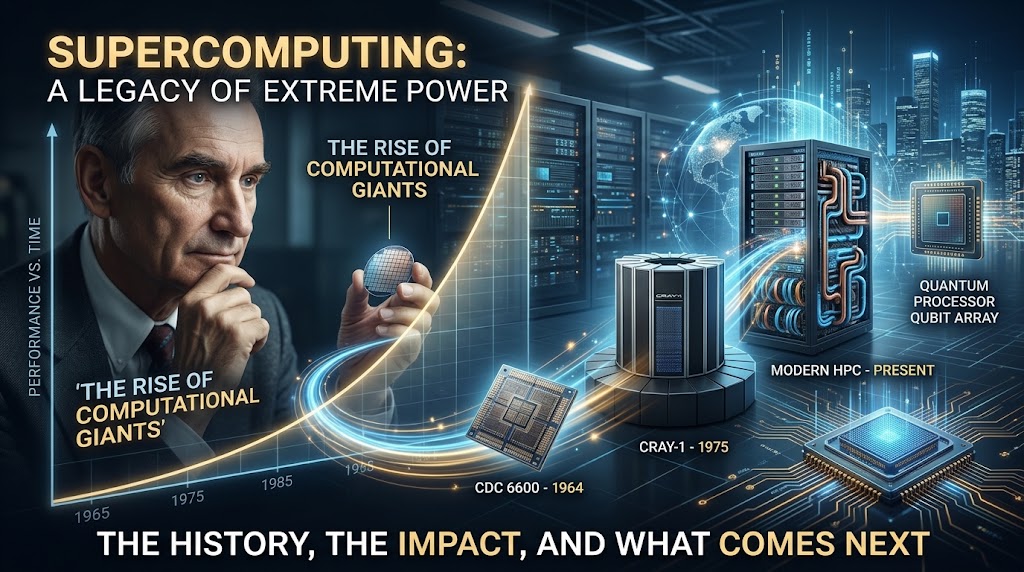
CDC 6600 1964
Then came Seymour Cray. He was an engineer who hated meetings. He just wanted to build fast machines.
His CDC 6600 could do 3 million calculations per second. That was 10 times faster than anything else.
People started calling machines like this “supercomputers.”
4. History of Supercomputers in The 1970s: The Man and The Couch
The 70s belonged to one man. Seymour Cray.
Cray-1 1976
It didn’t look like a computer. It looked like a circle couch. People sat around it.
It was liquid cooled. It made a humming sound. And it was the fastest machine on Earth. 160 million calculations per second.
Why Did It Matter
For the first time, scientists could ask “what if.” What if we crash a car? What if a hurricane hits this city? What if we set off a nuclear bomb?
They didn’t have to do it in real life. They could simulate it. That changed science forever.
5. The 1980s: When Countries Competed For Speed
The Cold War wasn’t just about missiles. It was about computers too.
Cray-2 1985
It looked like a water fountain. Seriously. Liquid flowed through it to keep it cool. 1.9 billion calculations per second.
It Was About Pride
If your country had the fastest machine, you were the smartest. So the US and USSR threw money at engineers.
This is when the History of Supercomputers became a race.
Oak Ridge National Lab Frontier
6. Evolution of High Performance Computing in The 1990s
In the 90s, engineers hit a wall. One big processor couldn’t get much faster.
So they changed the idea.
Parallel Processing
Instead of one giant brain, use thousands of small brains. Make them work together.
ASCI Red 1996
The first machine to break 1 trillion calculations per second. 1 Teraflop.
The US used it to simulate nuclear weapons. So they didn’t have to test them in the desert anymore.
7. History of Supercomputers and The List That Made It a Sport
In 1993, two guys made a list.
The TOP500
Every 6 months they ranked the 500 fastest computers in the world.
Suddenly it was a competition. Countries wanted to be number 1. Companies wanted to be number 1.
Japan’s Earth Simulator 2002
It held number 1 for years. It was built to predict earthquakes and climate.
The list made the History of Supercomputers public.
8. The 2000s: When Speed Jumped 1000 Times
We went from Teraflops to Petaflops. That’s 1000 times faster.
Tianhe-1A 2010 China
The first Chinese machine to hit number 1. Everyone realized China was serious about this.
Titan 2012 USA
This machine did something smart. It used GPUs. The same chips that ran video games. But for science, they were perfect.
9. History of Supercomputers Enters The Exascale Era
Exascale. 1 quintillion calculations per second.
We thought we would never get there.
Fugaku 2020 Japan
Number 1 during COVID. Scientists used it to model how the virus spread through a train.
Frontier 2022 USA
First Exascale machine. 1.1 Exaflops. At Oak Ridge National Lab in Tennessee. It used as much power as 20,000 homes.
El Capitan 2024 USA
As of 2026, this is the king. 1.3 Exaflops. It helps keep nuclear weapons safe and trains new AI.
10. What Do We Actually Use These Machines For
Speed is cool. But what do we do with it?
Weather
We can now predict a hurricane’s path 10 days out. We can model climate change for 100 years.
Medicine
Want to test a new drug? Don’t wait 5 years. Simulate it in 5 days. See how it interacts with a virus.
AI
ChatGPT. Gemini. Claude. All of them were trained on supercomputers. Without these machines, there is no AI.
Science
Black holes. Fusion energy. New materials. Things we can’t test in real life, we simulate.
11. How Do You Build a Machine This Big
It’s not one computer. It’s 10,000 computers pretending to be one.
The Parts
El Capitan has 9,000 CPUs and 37,000 GPUs. All connected with cables that are faster than light through fiber.
The Heat
All that math makes heat. Lots of it. So they pump water through the machine to keep it from melting.
The Cost
600 million dollars to build. 10 million per year to run. Only governments can afford it.
12. Who Is Winning The Race in 2026
Right now it’s close.
United States
Has the 2 fastest machines. Leads in Exascale.
China
Has the most machines in the TOP500. They are catching up fast.
Japan and Europe
Fugaku in Japan. LUMI in Finland. They care less about being number 1 and more about doing science.
13. The Problems We Are Hitting Now
We can’t just keep making them faster forever.
Power
Frontier uses enough electricity for a small city. Where do we get more power?
Heat
37,000 GPUs get hot. Really hot. Cooling is now half the job.
Code
Writing software that uses 1 million processors at once is a nightmare. Most programmers can’t do it.
14. What Comes After Exascale
The race doesn’t stop.
Zettascale 2030s
1000 times faster than today. The goal is to model the entire Earth in real time.
Quantum Computers
They won’t replace supercomputers. But for some problems like chemistry, they will be 1 million times faster.
AI Machines
Special computers built only for training AI. Nvidia is building them. xAI is building them.
15. Your Laptop vs The World’s Fastest Machine
Let’s put it in perspective.
Your laptop: 1 billion calculations per second
El Capitan: 1,300,000,000,000,000,000 calculations per second
That’s 1.3 million times faster.
The History of Supercomputers is the story of that gap.
16. Final Thoughts: History of Supercomputers and Why We Keep Building Them
1943 to 2026.
83 years.
We started with a machine that could barely do math.
Now we have machines that can simulate the universe.
Why? Because we are curious. Because we want to predict the next storm. Cure the next disease. Understand how the world works.
The History of Supercomputers is not about computers. It’s about humans refusing to say “that’s fast enough.”
The next chapter will be about AI and climate. And the machines we build today will decide what happens.
Frequently Asked Questions History of Supercomputers
What is the History of Supercomputers
The History of Supercomputers starts in 1943 with ENIAC and goes to today’s Exascale machines like El Capitan.
What is the fastest supercomputer in 2026
El Capitan in the USA at 1.3 Exaflops.
What are History of Supercomputers used for
Weather forecasting, medicine, AI training, science research, and national security.
How much does a supercomputer cost
About 500 to 600 million dollars to build.