History of Globalization: From Ancient Trade Routes to the Internet Age
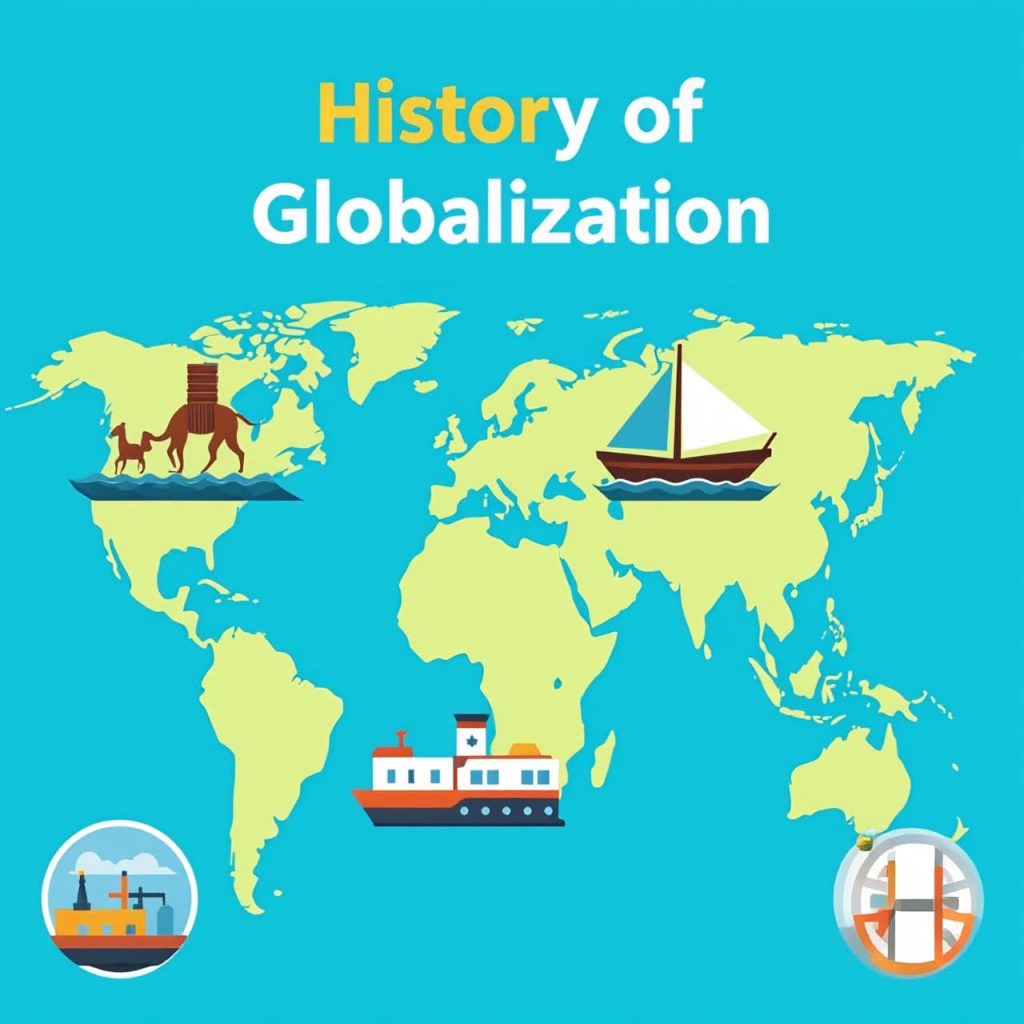
The history of globalization started with my morning coffee
The history of globalization is literally in my cup.
I was drinking Brazilian coffee, wearing a Bangladeshi shirt, watching a Korean drama on my Chinese phone. All before 10 AM.
That’s globalization baby.
And this didn’t start with Amazon.
We’ve been obsessed with “foreign stuff” for 5000 years.
From camel caravans to internet cables. Let me tell you how we got here
Wave 1:history of globalization- When Camels Were FedEx
This was globalization 1.0. Everything was slow. Dangerous. But people did it anyway.
The First “I Want That” Moment
3000 BC. Mesopotamia.
A rich guy looks at his wall. It’s boring. He wants something BLUE.
Lapis lazuli. Super rare.
Problem? It only grows in Afghanistan. 2000 km away.
What does he do? He hires traders.
No trucks. No planes. Just boats and donkeys.
10 bags of wheat = 1 shiny blue rock.
That was the first Amazon order.
Egypt did the same. They imported incense from Arabia. Gold from Nubia. Wood from Lebanon.
Even 4000 years ago, flexing with imported goods was a thing.
The Indus Valley people traded beads and cotton with Mesopotamia.
The Chinese traded silk with Central Asia.
Humans have always wanted stuff from far away.
The Silk Road: The Original Internet
130 BC. This is where it got spicy.
China’s Han Emperor wanted cool horses. Sent guys west.
They came back like “Bro… there’s this place called Rome. They’re rich AF.”
Boom. Silk Road was born. 4000 miles long.
But it wasn’t just silk. That was only 10%.
History of Globalization:What else traveled?
Ideas: Buddhism went to China. Islam went east.
Tech: Paper, gunpowder, compass all went to Europe.
ood: Carrots, grapes, sesame. Your salad owes the Silk Road.
Germs: Yeah… Black Death in 1347 also came via this route.
A trip took 2 YEARS. Bandits. Deserts. Death.
But profit was 1000% so people did it anyway.
Mongols in 1200s made it safe for 100 years. They called it Pax Mongolica.
Marco Polo was basically a travel vlogger of that time.
Then 1453. Ottomans blocked everything. Europe panicked.
“No spices? No silk?”
So they said “fine, we’ll go by sea”.
The Indian Ocean: The First Free Trade Zone
While Europe was crying, Arab sailors were chilling.
700 AD. They cracked the code of monsoon winds.
Every 6 months wind changes. Perfect for sailing.
No country owned the ocean. So everyone traded.
Calicut, Mombasa, Malacca became the Dubai of that era.
What moved
Africa: Gold, ivory
India: Spices, cotton, gems
China: Porcelain, silk, paper
Indonesia: Nutmeg that was worth more than gold
Ancient globalization was slow. But it was happening.
Wave 2: Age of Exploration – When Europe Got Lost on Purpose
This is when the world map got filled in.
Columbus’s Big Oops
1492. Columbus wanted India. Ended up in America.
Best wrong turn in history.
Suddenly 4 continents were connected. Europe, Asia, Africa, America.
And this started the Columbian Exchange. Biggest swap meet ever.
What America gave: Potatoes, corn, tomatoes, chocolate, tobacco
What the world gave: Horses, wheat, cattle, guns, and sadly… smallpox
Within 50 years Irish people were eating Peruvian potatoes.
Italians were putting Mexican tomatoes in pasta.
Your pizza wouldn’t exist without globalization.
The First Corporate Giants
Portugal, Spain, Britain, France. They weren’t just exploring. They were shopping. With guns.
They invented the modern corporation. The British East India Company had its own army, navy, and money.
Bigger than some countries.
Dark part? Atlantic Slave Trade. 12 million people.
Globalization has always had light and shadow.
By 1800: Mexican silver in China. Chinese tea in London. Indian cotton in Manchester.
World loop complete.
History of Globalization Wave 3:Industrial Globalization – When Steam Changed Everything
Steam and steel changed everything.
Trains and Telegraphs
1800: London to India = 3 months
1900: London to India = 3 weeks
Telegraph in 1837 meant news traveled instantly.
For the first time, wheat price in Chicago affected bread price in London same day.
Countries picked jobs:
Britain: We make clothes
India: We grow cotton
Argentina: We raise cows
Australia: We grow wool
Everyone needed everyone. This was globalization 2.0.
Then Everything Broke
1914: World War 1. Borders closed.
1929: Great Depression. Everyone put up walls.
1939: World War 2. Boom.
30 years of progress gone.
The world learned: connection is easy to break.
History of Globalization Wave 4: Modern Internet and Container Magic
After WW2, the world said “never again”.
Let’s build a system to keep the world connected.
The New Rules
1944: IMF and World Bank. Let’s make money move freely.
1947: GATT. Later WTO. Let’s make trade easy.
Two Inventions That Changed Your Life
1956: Container ship. Shipping cost dropped 90%.
1991: Internet. Information became free.
A designer in New York. A factory in Dhaka. A customer in Canada.
All in 24 hours.
What Your Life Looks Like Now
Your phone: Designed in California, chip from Taiwan, made in China
Your breakfast: Coffee from Brazil, banana from Ecuador
our clothes: Made in Bangladesh and Vietnam
Your Netflix: Korean drama, American movie, Indian song
Cool right? But not perfect.
Jobs moved. Some towns got empty.
Every city started looking same. Same coffee shop. Same clothes.
COVID 2020 was the reality check.
China shut down → No chips → No cars → No phones.
We’re connected. So when one part sneezes, everyone catches cold.
History of Globalization:3 Lessons I Learned From 5000 Years
Lesson 1: Tech Always Wins
Boat to Train to Internet.
Every new tech made the world smaller and faster.
Lesson 2: Nothing Is New
That Sumerian trader in 3000 BC? He was just a Shopify seller.
Same desire. Different tools.
Lesson 3: Someone Always Loses
When trade opens, some get rich. Some lose jobs.
That’s been true for 5000 years. No way around it.
So What’s Next For Us?
Experts are calling it “Slowbalization”.
After COVID and wars, countries are like “maybe we should make our own chips and medicine”.
But internet isn’t going anywhere.
Remote work, YouTube, TikTok, global friends. That’s here to stay.
We started trading salt.
Now we get everything delivered in 1 day.
The history of globalization is just the history of humans being curious.
“I want what you have.”
And that curiosity isn’t stopping.
FAQ History of Globalization
Q1: What is the history of globalization in simple words?
The history of globalization is how humans connected the world through trade and tech. Started 5000 years ago with traders, now we do it with internet.
Q2: When did globalization start?
Around 3000 BC with ancient trade. But it grew fast in 3 big waves: 1500s, 1800s, and after 1945.
Q3: What are the 4 waves of globalization?
Wave 1: Ancient 3000 BC to 1500 AD
Silk Road and Indian Ocean trade
Wave 2: Exploration 1500 to 1800
Columbus and sea routes
Wave 3: Industrial 1800 to 1945
Trains, steamship and telegraph
Wave 4: Modern 1945 to Today
Internet and container shipping
Q4: What are 3 examples of globalization today?
1. Your phone: Designed in USA, made in China
2. Your food: Coffee from Brazil, clothes from Bangladesh
3. Your work: Freelancing for foreign client
Q5: What are the positive and negative effects of globalization?
Positive Effects
Cheaper goods, more jobs, cultural exchange, technology sharing
Negative Effects
Job loss, cultural loss, economic inequality, environmental issues
Q6: What is the future of globalization?
Experts call it “Slowbalization”. Countries are making more products locally after COVID. But internet and digital trade will continue to grow.
Read more:https://worldhistorytales.com/why-us-dollar-reserve-currency/
URL: https://www.britannica.com/topic/globalization
Anchor Text: What is Globalization – Britannica