
History of Cybersecurity: The Full Story From 1971 to 2026
1. Introduction: The History of Cybersecurity Started the Night I Lost Everything
Let me be honest with you. I didn’t care about the history of Cybersecurity until the night I woke up at 3am and my phone wouldn’t stop buzzing. 47 emails saying “password changed”. My Instagram was posting crypto scams. My Gmail was sending messages I never wrote. And my bank was asking if I wanted to send money to someone in Nigeria.
I was 18. I cried. I panicked. I called my dad.
That was the night I realized the internet isn’t safe. And that night I also realized something else. This war has been going on for 50 years.
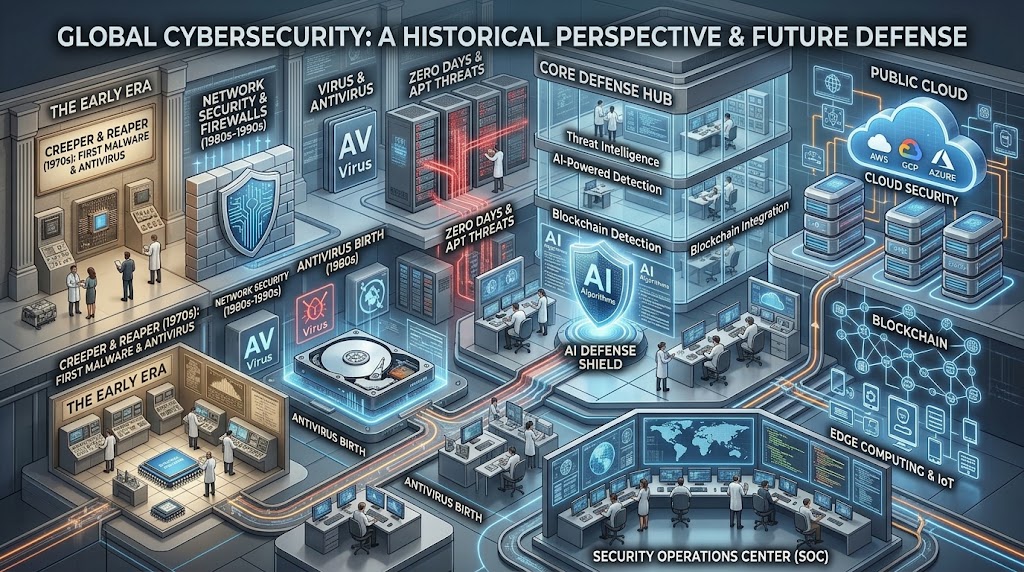
The Evolution of cybersecurity doesn’t start with Norton or McAfee or 2FA. It starts in 1971 with a program called Creeper that just jumped from computer to computer and said “I’M THE CREEPER : CATCH ME IF YOU CAN”. And then another guy made Reaper to chase it and delete it.
Attack. Defense. Attack. Defense.
That’s the entire Evolution of cybersecurity in 4 words. And in 2026, we’re still doing the same thing. Just with AI and billion dollar ransoms instead of floppy disks.
Why I’m Telling You This Story
Because if you know where we came from, you’ll understand why you need to care today. This isn’t tech talk. This is about protecting your photos, your money, your identity.
2. 1970s: The History of Cybersecurity Began With Trust and No Passwords
Picture this. 1971. The internet doesn’t exist yet. There’s something called ARPANET. Maybe 200 people in the world can use it. All universities and military people.
Bob Thomas was bored. So he wrote a program called Creeper just to see if code could move between computers. It worked. It printed a message and moved on.
Then Ray Tomlinson, the same guy who invented email, thought “this is annoying” and made Reaper to delete Creeper.
That was it. That was the beginning.
The Origin of cybersecurity in the 70s is basically two nerds playing tag on a network of 60,000 computers. No passwords. No locks. No laws. Everyone trusted everyone.
Sounds crazy now, right? But back then, it made sense. You knew everyone on the network.
The First Antivirus Was Just Two Guys Chasing Code
Reaper chased Creeper. That’s all. The history of Cybersecurity started with that simple chase. And we’ve been chasing ever since.
3. 1980s: When Computers Came Home, The History of Cybersecurity Got Real
The 80s changed everything. Because computers left the labs and came into people’s homes.
1986. Two brothers in Pakistan made something called the Brain virus. It spread through floppy disks. It didn’t delete anything. It just slowed your PC and showed a message. But it proved something scary. Viruses could travel without the internet.
Then 1988. Robert Morris. 23 years old. Cornell student. He released the Morris Worm by accident. He just wanted to see how big the internet was. Instead, he took down 10% of it. About 6,000 computers.
The government freaked out. They passed the Computer Fraud and Abuse Act in 1986. That law is still used today to put hackers in jail.
The history of Cybersecurity in the 80s taught us one thing. Cheaper computers = more targets. More targets = more problems.
We Made Laws After People Got Hurt
That’s the pattern. The history of Cybersecurity shows we never fix the roof until it rains. And in the 80s, it started raining.
4. 1990s: The History of Cybersecurity Became a Business Overnight
The 90s. The internet went public. Your grandma got email. Companies put credit cards online.
And suddenly, there was money to steal.
1995. The first commercial firewall. Basically a bouncer for company networks.
1999. Melissa virus. It infected your Outlook and emailed itself to everyone in your contacts. 20% of the world’s computers got it. Companies couldn’t send email for days.
That’s when Norton and McAfee became household names.
The history of Cybersecurity in the 90s stopped being about pranks. It became about profit. Because now there was real money online. And where there’s money, there are thieves.
This Is When Security Became a Job
Before the 90s, “cybersecurity” wasn’t a job title. After the 90s, it was a 10 billion dollar industry. The history of Cybersecurity made millionaires.
5. 2000s: The History of Cybersecurity Became About Organized Crime
The 2000s were messy. Hackers stopped doing it for fun. They did it for cash.
2003. SQL injection. Hackers figured out how to pull entire databases from websites.
2007. TJX. 45 million credit cards stolen. Cost them 250 million dollars.
And this is when ransomware was born. Gpcode. It locked your files and asked for 200 dollars in Bitcoin.
Here’s the crazy part. The history of Cybersecurity in the 2000s shows that hackers started running like real companies. They had HR. They had customer support. If their decryption didn’t work, they gave refunds.
I’m not joking.
Cybercrime became more profitable than drugs. That’s how bad it got.
Hackers Started Wearing Suits
The History of information security proves that by 2008, crime had a business plan. And it was working.
6. 2010-2013: The History of Cybersecurity Became Cyberwar
This is when things got political.
2010. Stuxnet. A virus so advanced it physically broke Iranian nuclear centrifuges by making them spin too fast. It was the first time code broke real machines. Nobody admitted who made it. But everyone knew.
2013. Edward Snowden. He leaked NSA documents showing the US was spying on everyone’s emails and phone calls.
Suddenly the History of information security wasn’t about IT guys anymore. It was about countries. About war. About spies.
Defense budgets went from millions to billions. Countries started building cyber armies.
Code Became a Weapon
Stuxnet changed everything. The Development of cybersecurity after 2010 is about nations, not nerds.
7. 2014-2017: The Years The History of Cybersecurity Hit Everyone
2014. Sony Pictures got hacked. Emails leaked. Movies leaked. US blamed North Korea.
2015. Ashley Madison. 32 million names dumped online. Marriages ended. People lost jobs.
2016. DNC hack. Election interference.
2017. WannaCry. 300,000 computers in 150 countries in one weekend. Hospitals in the UK shut down.
Also 2017. Equifax. 147 million Americans’ social security numbers leaked because they forgot to patch one thing.
The Development of cybersecurity in these years proved one thing. Nobody is safe. Not Sony. Not the government. Not you.
2017 Changed Everything
After that year, every CEO started asking “what’s our cybersecurity budget”. The history of Cybersecurity forced them to.
8. 2018-2020: GDPR, COVID, and The History of Cybersecurity Going Home
2018. Europe passed GDPR. If you lose European data, you can be fined 4% of your global revenue. That’s billions.
Then 2020. COVID.
Everyone went home. Your living room became the office.
Phishing went up 400%. Because hackers didn’t need to break into an office. They could just email you at home. Zoom bombing became a thing.
The Development of cybersecurity in 2020 showed us that technology moves fast. Humans don’t.
We were protecting office networks. But the office was now everywhere.
Your WiFi Became the Firewall
The history of Cybersecurity in 2020 was about protecting kitchen tables. And most of us had no idea.
9. 2021-2023: The History of Cybersecurity Meets AI and ChatGPT
This is where it gets scary.
2021. Colonial Pipeline. Ransomware. One phishing email. Gas shortages across the US East Coast.
2022. Hackers started using ChatGPT. They could write perfect phishing emails in any language in 10 seconds.
2023. AI voice cloning. Criminals copied a CEO’s voice and told an employee to wire 25 million dollars. The employee did it.
At the same time, Microsoft and Google built AI defenders that could block attacks in 10 seconds.
The history of Cybersecurity in these years is AI vs AI. Bots attacking bots. And humans are just watching.
The First AI War
For the first time in the history of Cybersecurity, both sides had the same weapon. And it’s getting faster every day.
10. 2024-2026: The Current Chapter of The History of Cybersecurity
Right now, in 2026, the history of Cybersecurity is being written.
AI agents attack and defend automatically.
Quantum computers are coming that can break all current encryption.
Zero trust. That means we don’t trust any login by default. We check everything.
Companies spend 200 billion dollars a year on security.
The average breach costs 4.8 million dollars.
And the scariest part? The history of Cybersecurity today isn’t about protecting your laptop. It’s about protecting your voice. Your face. Your identity. Because deepfakes are that good.
2026 Is Different
Attacks are automatic now. The history of Cybersecurity shows automation always helps attackers first. Defenders are always catching up.
11. 7 Lessons I Learned From 50 Years of Hacking
I spent weeks reading about this. Here’s what kept coming up.
Lesson 1. Attackers only need to be right once. Defenders need to be right every time.
Lesson 2. Every new tech creates new security problems. We never think about it until it’s too late.
Lesson 3. Humans are the weakest link. We’re tired. We’re busy. We click things.
Lesson 4. Security is always 2 years behind innovation.
Lesson 5. Breaches will happen. So backups are not optional.
Lesson 6. Fines are the only thing that make big companies care.
Lesson 7. This war never ends. As long as there’s data, someone will try to steal it.
What That Means For You
You can’t outsource this. You have to care every day. The history of Cybersecurity proves that.
12. Why The History of Cybersecurity Matters To You Right Now
You’re online 100 times a day. Email. Bank. Instagram. Smart doorbell.
In 2026, all of that can be hacked.
But here’s the good news. The history of Cybersecurity shows that 80% of attacks are stopped by 3 simple things.
Turn on 2FA.
Use a password manager.
Don’t reuse passwords.
If you run a business, one breach can kill you.
If you’re a student, cybersecurity jobs pay 120k plus because every company needs them.
The history of Cybersecurity isn’t history. It’s your life right now.
Do These 3 Things Today
Seriously. 2FA. Password manager. Backups. That’s what 50 years of pain taught us.
13. Myths That The History of Cybersecurity Proves Wrong
Let’s kill 3 myths.
Myth 1. “I’m too small to be hacked”. Wrong. 43% of attacks hit small businesses. Bots don’t care how big you are.
Myth 2. “Antivirus is enough”. No. In 2026 you need AI, training, firewalls, and backups.
Myth 3. “Macs don’t get viruses”. The history of Cybersecurity shows malware is on every platform. Hackers follow money, not logos.
Stop Thinking This Way
Attackers don’t care what you use. They care what you have. And you have data.
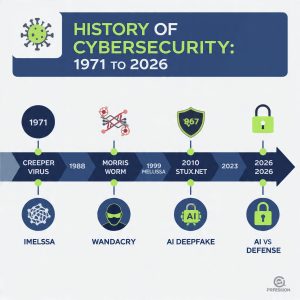
14. The Full Timeline: The History of Cybersecurity Year by Year
Let me make this easy.
1971. Creeper and Reaper.
1986. Brain virus and first cyber law.
1988. Morris Worm.
1995. First firewall.
1999. Melissa virus.
2007. TJX 45 million cards.
2010. Stuxnet.
2013. Snowden leaks.
2017. WannaCry and Equifax.
2020. SolarWinds.
2021. Colonial Pipeline.
2023. AI deepfake scams.
2026. AI vs AI.
The history of Cybersecurity shows attacks double every 3 to 5 years. And they’re not slowing down.
We’re Writing the Next Chapter Now
And it’s probably going to be about AI.
15. The Future: Where The History of Cybersecurity Is Going
Here’s what’s coming.
Quantum encryption. Unhackable.
AI agents that fight without humans.
Biometrics that kill passwords forever.
Laws that force companies to tell you about breaches in 72 hours.
Personal AI bodyguards that watch your accounts 24/7.
The history of Cybersecurity is moving from protecting computers to protecting people. Your digital twin. Your voice. Your face.
After 2026
We won’t be protecting devices. We’ll be protecting identity. The history of Cybersecurity is becoming personal.
16. Final Thoughts: The History of Cybersecurity Is About Trust
Here’s the truth.
In 1971 we trusted everyone.
In 2026 we trust no one.
From “I’m the creeper” to “pay 10 million or we leak everything”. The game never changed.
Someone tries to break in. Someone tries to keep them out.
Technology helps. But your brain is still the best firewall.
The war isn’t over. It’s just getting started. And now both sides have AI. And you’re in the middle.
Frequently Asked Questions
1. What exactly is the history of Cybersecurity
The history of Cybersecurity is the story of how we went from zero security in 1971 to AI defenses in 2026. It started with Creeper, a harmless virus that moved between computers. Then came PC viruses, then firewalls, then organized crime, then cyberwar, and now AI. The history of Cybersecurity is basically 50 years of attack and defense.
2. Who started cybersecurity and when
The history of Cybersecurity started in 1971. Bob Thomas made the first virus called Creeper. Ray Tomlinson made the first antivirus called Reaper. They were on ARPANET. So the history of Cybersecurity is as old as computer networking.
3. What are the biggest moments in the history of Cybersecurity
The biggest moments are 1988 Morris Worm, 1999 Melissa, 2007 TJX breach, 2010 Stuxnet, 2013 Snowden, 2017 WannaCry and Equifax, 2020 SolarWinds, 2021 Colonial Pipeline, and 2023 AI CEO voice scam. Each one changed the rules. The history of Cybersecurity is built on these moments.
4. How has the history of Cybersecurity changed over time
It went from pranks to money to politics to AI. 70s and 80s were experiments. 90s were about business. 2000s were organized crime. 2010s were countries. 2020s are AI vs AI. The history of Cybersecurity keeps getting faster and more expensive.
5. Why should I care about the history of Cybersecurity
Because 80% of attacks can be stopped with 3 things we learned from history. 2FA. Password manager. No password reuse. The history of Cybersecurity shows humans are the weakest link. If you know the history, you won’t make the same mistakes.
6. What comes next in the history of Cybersecurity
After 2026 we’ll see quantum encryption, AI agents fighting alone, biometrics replacing passwords, and laws forcing fast breach reporting. The history of Cybersecurity will be about protecting people, not just computers.
7. How much does cybersecurity cost in 2026
Companies spend 200 billion dollars a year. The average breach costs 4.8 million. The history of Cybersecurity shows spending doubles every 5 years because attacks get worse. It’s one of the biggest industries now.
8. What’s the biggest lesson from the history of Cybersecurity
That attackers only need to be right once. We need to be right every time. And that your attention is the best defense. The history of Cybersecurity proves that tech helps, but you are still the firewall.


