
History of Data Centers: From Room-Sized Computers to AI Mega Facilities in 2026
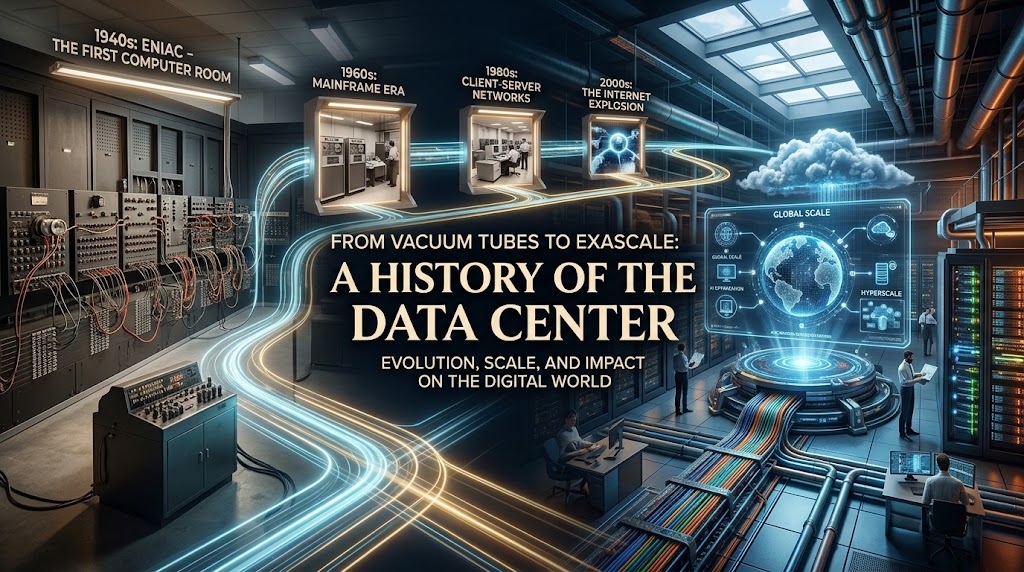
1. Introduction: History of digital data storage Starts in a Sweaty Room in 1946 With One Giant Machine
The History of Data Centers did not start with cloud computing or AI or giant buildings in Virginia. It started with a single room in Philadelphia that was so hot the engineers had to open the windows in winter.
1946. The computer was called ENIAC. It weighed 30 tons. It filled an entire room. It used as much electricity as a small town. And to make it work, 6 women had to crawl under it and plug and unplug thousands of cables by hand.
That room was the very first data center, even though no one called it that at the time.
Fast forward 80 years to 2026, and we now live in a world where data centers are the size of 10 football fields, they cost 10 billion dollars to build, and they use more power than some countries. They run Netflix, they run ChatGPT, they run your bank, and they run the entire internet.
The History of Data Centers is basically the history of how humanity learned to store and process information at massive scale. And it is only getting bigger.
2. Origin of data centers Begins in the 1940s and 1950s With Mainframes That Needed Their Own Building
In the beginning, computers were not personal. They were national projects.
The first computers like ENIAC and UNIVAC were so big and so expensive that only governments and universities could afford them. Each one needed its own dedicated room with special air conditioning, special power, and a team of engineers who worked 24 hours a day to keep it running.
This is where the idea of a “computer room” was born. The room had raised floors so cables could run underneath. It had industrial AC because the machines produced massive heat. It had backup generators because if power went out, the computer would crash and you could lose weeks of work.
Companies like IBM started selling mainframes in the 1950s. Banks bought them. The military bought them. Insurance companies bought them. And every single one of those mainframes needed its own data center. Even though they only called it “the computer room” back then.
3. 1960s and 1970s: History of digital data storage Grows as Corporations Realize They Need Centralized Computing
By the 1960s, computers were still huge but companies were getting bigger too. A single mainframe could cost 1 million dollars, which was an insane amount of money at the time.
So instead of every department buying its own computer, big corporations built one central computer room and let everyone share it. This was the first real version of what we now call a data center.
These rooms were serious business. They had glass walls so managers could look in. They had strict rules. No food. No drinks. You had to wear a special coat. The floor was raised 2 feet off the ground so that cold air could be pumped up through the tiles to cool the machines.
The biggest challenge in the History of Data Centers during this era was cooling. Mainframes produced so much heat that if the air conditioning failed, the room would overheat and the computer would shut down in under 10 minutes. Data center managers literally slept next to the AC units.
4. 1980s: Evolution of data centers Changes With the Personal Computer and the Birth of the Server Closet
The 1980s brought the PC revolution, and that changed everything about data centers.
Suddenly every office had 20 or 30 personal computers on desks. But those PCs needed to talk to each other and share files and printers. So companies bought something new called a “server” and put it in a closet.
This was the birth of the server closet, and it was a disaster. IT people would shove a tower server next to the cleaning supplies, with no cooling and no backup power. And then they would wonder why it crashed every week.
By the end of the 1980s, smart companies realized they needed to treat these server closets like mini data centers. They started adding dedicated AC, fire suppression, and UPS battery backup. The History of Data Centers was moving from the big corporate mainframe room to thousands of small rooms in every office building in the world.
5. 1990s: Evolution of data centers Explodes Because of the Internet and the Dot-Com Boom
The 1990s is when data centers went from being boring corporate IT to being the backbone of the entire economy.
In 1995, the commercial internet opened up. Suddenly every company needed a website. And a website needs a server that is online 24/7. But most companies did not want to run a server in their office, so they started renting space in buildings that were full of servers.
These buildings were called “colocation data centers.” You would rent a rack, put your server in it, and pay for power and internet.
Then came the dot-com bubble. Every startup needed servers. Data center companies could not build them fast enough. The History of Data Centers has its biggest spike in growth right here between 1998 and 2000.
And then came Y2K. Everyone was terrified that computers would crash on January 1st, 2000. So companies spent billions upgrading servers in 1999. Data center revenue doubled in 2 years.
6. 2000s: Development of data centers Is Rewritten by Google and Amazon With Hyperscale Computing
The 2000s changed everything because Google and Amazon decided to do data centers differently.
Google had a problem. To search the entire internet, one supercomputer was not enough. So they did something radical. They bought 10,000 cheap desktop PCs, put them in a warehouse, and wrote software that made them act like one giant computer.
This was called “hyperscale.” The idea was that instead of buying one expensive reliable server, you buy thousands of cheap unreliable servers and let software handle failures. If one dies, who cares.
In 2006, Amazon took this idea and productized it. They launched Amazon Web Services, or AWS. They said “don’t build your own data center, just rent ours.” That was the birth of cloud computing.
From this point on, the History of Data Centers splits into two paths. Path 1 is companies running their own data centers. Path 2 is everyone renting space from AWS, Microsoft, and Google.
7. Inside a Modern Data Center in 2026: What It Actually Looks Like When You Walk In
Let’s take a tour of a modern data center so you can understand what we are talking about.
First, you go through 3 security checkpoints. Biometric scan. ID check. Guard escort. This place is more secure than a bank.
Inside, the first thing you notice is the noise. It sounds like a jet engine because of all the fans. The room is huge, like a Walmart, but instead of products there are rows and rows of metal racks that go up 8 feet high.
Each rack holds 40 servers. Each server is a computer. There are 1000 racks in one room. Do the math. That’s 40,000 computers in one room.
Above you are pipes carrying chilled water. Under the floor are massive power cables. The temperature is kept at exactly 20 degrees Celsius. Any hotter and the chips will melt.
This is what 20 years of the History of Data Centers has led to. A building that is basically a robot brain.
8. 2010-2020: Evolution of data centers and The Cloud Wars Between Amazon Microsoft and Google
From 2010 to 2020, the entire data center industry became a war between 3 companies.
Amazon launched AWS first and got a 10 year head start. They built data centers everywhere and rented them to startups. Netflix, Airbnb, and Spotify all ran on AWS.
Microsoft came in second with Azure. They had an advantage because they already sold software to every big corporation. So they said “keep your data in our cloud.”
Google came in third with Google Cloud. They were late but they had the best AI and the best networking.
The result of this war is that instead of 1 million companies each running their own small data center, we now have 5 companies running 500 massive hyperscale data centers that serve the entire world. This is the biggest consolidation in the History of Data Centers.
9. 2020-2026: Development of data centers Enters the AI Era and Everything Gets 10x Bigger
The biggest shift in the History of Data Centers is happening right now, and it is because of AI.
Training an AI model like GPT-4 requires insane amounts of computing power. A single training run can use as much electricity as 1000 homes use in a year.
Old data centers were not designed for this. So companies started building brand new “AI data centers.”
These buildings are different. Instead of air cooling, they use liquid cooling because Nvidia GPUs get so hot. Instead of 10,000 CPUs, they have 100,000 GPUs. Instead of costing 200 million dollars, they cost 10 billion dollars.
Microsoft, Google, and OpenAI are all racing to build 20 of these “AI gigafactories” between 2024 and 2026. The History of Data Centers is being rewritten again, and this time it is all about AI.
10. The 5 Main Types of Data Centers That Exist in 2026
Not every data center is the same. There are 5 main types.
First, you have Enterprise Data Centers. These are owned by one company like JPMorgan or Walmart. They run their own banking or inventory systems.
Second, you have Colocation Data Centers. This is like renting an apartment for your server. You own the server, but you rent the space, power, and internet.
Third, you have Cloud Data Centers. This is AWS, Azure, and Google. You don’t own any hardware. You just rent computing power by the hour.
Fourth, you have Edge Data Centers. These are small data centers in your city. They exist so that TikTok videos and video games load fast without lag.
And fifth, you have Hyperscale Data Centers. These are the giants owned by Google, Meta, and Amazon. They have over 100,000 servers and are the size of 5 Walmarts.
11. The 4 Biggest Problems in the History of digital data storage That Engineers Are Still Fighting
Running a data center sounds easy. It is not. There are 4 massive problems.
Problem number 1 is power. A large data center uses 100 megawatts of electricity. That is enough to power a small city. In 2026, data centers use 2% of all electricity on Earth.
Problem number 2 is cooling. Computers make heat. AI computers make 10 times more heat. If you cannot remove the heat, the chips will literally melt. This is why some companies are now building data centers underwater or in the Arctic.
Problem number 3 is water. Traditional cooling uses millions of gallons of water per day. In a drought, that is a problem.
And problem number 4 is space and land. You cannot build a hyperscale data center in the middle of New York. You need cheap land and cheap power, which is why so many are being built in rural areas.
12. Data center history and Sustainability: How the Industry Is Going Green
For years, data centers were criticized for using too much power. But that is changing fast.
Google announced in 2020 that it runs 100% on renewable energy. Meta did the same. Microsoft wants to be carbon negative by 2030.
New cooling technology is helping. Microsoft’s Project Natick put a data center on the bottom of the ocean in 2018. It worked perfectly and used no water.
Some data centers are now recycling their waste heat to warm nearby buildings in the winter.
The goal for the next 10 years of the History of Data Centers is to make them 100% carbon neutral. And the industry is actually on track to do it.
13. Who Owns the Biggest Data Centers in 2026 and Who Is Winning the Race
As of 2026, here is the scoreboard.
Amazon AWS is still number 1. They have over 200 data centers around the world and they are still growing the fastest.
Microsoft Azure is number 2. They are winning with big corporate customers.
Google Cloud is number 3. They are winning with AI and data analytics.
Meta owns some of the biggest data centers in the world, but they only use them for Facebook, Instagram, and WhatsApp.
And China is not far behind. Alibaba and Tencent are building data centers just as fast as the US companies.
Over 200 billion dollars is being spent on new data centers in 2026 alone.
14. The Future of the Development of data centersFrom 2026 to 2040
What happens next?
Between 2026 and 2028, we will see the first 1 gigawatt AI data centers. That is the same power as a nuclear reactor.
Between 2029 and 2032, we will see quantum data centers. These will be specialized buildings just for quantum computers.
Between 2033 and 2040, we might even see data centers in space. In space you don’t need cooling, and you have unlimited solar power.
We will also see fully automated data centers with no humans inside. Robots will replace servers and AI will manage everything.
The History of Data Centers is only 20% written.
15. Why the Historical background of data centers Matters to You in 2026
You might never visit a data center, but you use one every 5 minutes.
When you take a photo on your iPhone, it goes to an Apple data center.
When you swipe your credit card, the transaction goes to a bank data center.
When you ask ChatGPT a question, it runs in an OpenAI data center.
When you watch Netflix, the video comes from a Netflix data center.
Data centers are the invisible buildings that make modern life possible. Without them, the internet stops, banks stop, and AI stops.
That is why the History of Data Centers is really the history of the last 80 years of human progress.
16. Final Thoughts on the History of Data Centers and Where We Go From Here
1946 to 2026.
80 years.
The History of Data Centers went from one room with one computer to 10,000 buildings with 100 million computers.
ENIAC used 150 kilowatts.
A modern AI data center uses 1000 megawatts. That is 6000 times more power.
We started with cables and punch cards.
Now we have robots and AI.
We started with banks and governments.
Now we have everyone.
In the next 10 years, data centers will become even bigger, even faster, and even smarter. And you will never see them. But they will run every part of your life.
Frequently Asked Questions
What is the History of Data Centers
The History of Data Centers started in 1946 with ENIAC and grew into cloud and AI data centers by 2026.
Who built the first data center
The first data center was the room that housed ENIAC in 1946 at the University of Pennsylvania.
How many data centers are there in the world
There are over 10,000 data centers worldwide as of 2026.
What is a hyperscale data center
A hyperscale data center is a massive facility with over 100,000 servers owned by companies like Google and Amazon.
Are data centers bad for the environment
They use a lot of power, but the industry is moving to 100% renewable energy by 2030.


