
History of CUDA: The Invisible Software That Runs All of AI
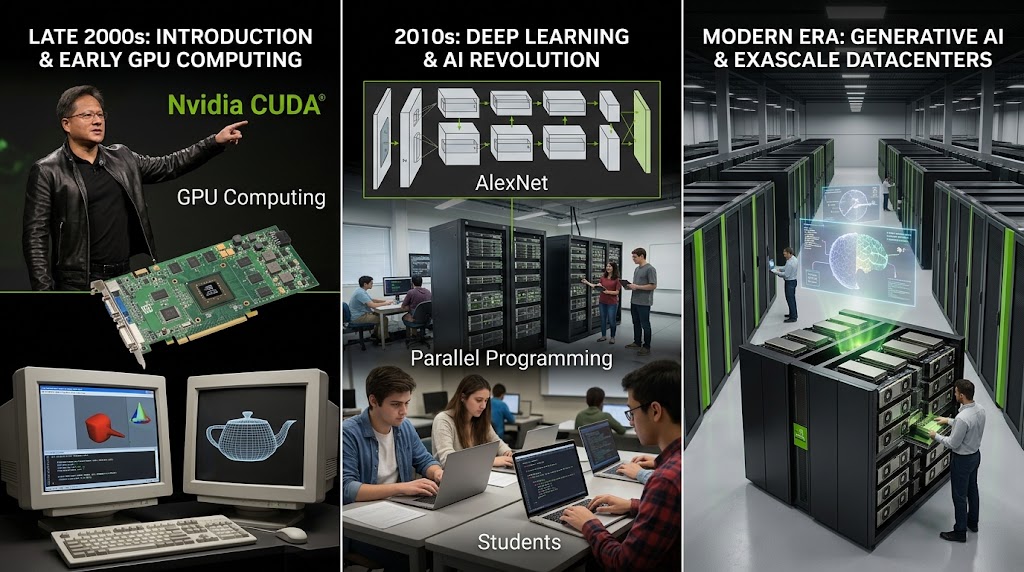
Introdution: history of CUDA Started With Angry Scientists
history of CUDA starts with frustration.
Picture this. It is 2006. You are a physics PhD student. You have a formula that takes 3 weeks to run on your computer.
Your friend down the hall is playing Crysis on his new NVIDIA gaming card. That card has 128 cores. Your CPU has 2.
You think “why can’t I use that for science”.
That exact thought is how CUDA was born.
Today in 2026 I can’t open ChatGPT without CUDA running somewhere. I can’t generate an image. I can’t use Google Maps traffic.
CUDA is invisible. But it runs the world.
This is not a Wikipedia page. This is the messy, human story of how a graphics card tool became the most important software on earth.
Chapter 1: Before CUDA: The Dark Ages 1999 to 2006
1999: GeForce 256 and The Birth of GPU
NVIDIA called it “The world’s first GPU”.
It was for games. Quake. Doom. Nothing else.
But inside those chips were hundreds of tiny processors. All doing math at once.
Scientists saw this and got ideas. “Can we use this for weather simulation”
Answer was no. Because programming it was impossible.
2003 to 2005: Hacking GPUs
Smart people at Stanford started cheating.
To do science on GPU, they had to pretend their data was a texture. Like paint on a 3D object.
They wrote code in “shader language”. It was like trying to do taxes in emojis.
It worked. 10x faster. But it was painful.
Dr. Ian Buck was one of them. He later joined NVIDIA.
He told his boss: “Give me 6 engineers and I will make this easy”.
Chapter 2: history of CUDA With The Big Bet 2006 to 2007
2006: Project G80
Inside NVIDIA they were building G80. A new chip for gamers.
But Jensen Huang asked a weird question in a meeting. “What if this is not just for games”
Most CEOs would say no. Jensen said “do it”.
NVIDIA pulled 20 engineers off other projects. Secret team. Code name: CUDA.
November 2006: CUDA Is Announced
No big stage. No Steve Jobs moment.
Just a PDF on NVIDIA’s website. “CUDA 0.8 Beta”.
It let you write C code. Normal C. And run it on GPU.
The example was “add two arrays”. Boring.
Tech press ignored it. Gamers ignored it.
But 3 guys at a university downloaded it that day.
Chapter 3: history of CUDA With The First Users 2007 to 2011
2007: Oil Companies Were First
The first people to pay for CUDA were not cool.
They were oil companies. Exxon. Shell.
They used CUDA to process seismic data. Find oil underground.
It was 40x faster. They didn’t care about games. They cared about money.
2008: Medical Imaging
Hospitals started using CUDA for CT scans and MRI.
A scan that took 20 minutes now took 2 minutes.
Doctors didn’t know what CUDA was. They just knew “the new computer is fast”.
2010: The Problem
By 2010 CUDA had 10000 users. That sounds like a lot. It wasn’t.
Everyone said “GPU is a fad”. “CPUs will catch up”.
Inside NVIDIA people were scared. What if they wasted 4 years.
Chapter 4: history of CUDA With The AlexNet Moment 2012
September 2012: 3 Guys and 2 Gaming Cards
This is the most important day in the history of CUDA.
Alex Krizhevsky was a grad student. His advisor Geoff Hinton said “we should enter ImageNet competition”.
ImageNet is a contest. Who can best recognize images.
The winning method used “neural networks”. But training took forever.
Alex had an idea. “Let’s use GPUs”.
He and Ilya bought 2 NVIDIA GTX 580 gaming cards. Cost 1000 dollars total.

They wrote CUDA code for 2 months.
On September 30 2012 they submitted AlexNet.
They won. By a lot. 15 percent better than second place.
The internet exploded. “Deep learning works”.
And the reason it worked was CUDA.
2013: The Rush
After AlexNet, every AI lab bought NVIDIA cards.
Google bought 1000. Facebook bought 1000.
NVIDIA’s gaming division suddenly had a new customer: researchers.
NVIDIA didn’t plan this. It was luck.
Chapter 5: history of CUDA With cuDNN and Making It Easy 2014 to 2016
2014: NVIDIA Admits AI Is Big
NVIDIA created a new team. “Deep Learning Team”.
Their first job: make CUDA easier.
They released cuDNN. CUDA Deep Neural Network.
Before cuDNN you had to write 500 lines of CUDA to do convolution.
After cuDNN you wrote 5 lines.
Google used it for Google Photos. Facebook used it for face recognition.
2016: Pascal and The P100
NVIDIA launched P100. First GPU made only for data centers.
It cost 13000 dollars. No HDMI port.
NVIDIA told gamers “this is not for you”.
And gamers were mad. But AI labs bought all of them.
Chapter 6: history of CUDA With Tensor Cores 2017 to 2019
2017: Volta and The AI Chip
NVIDIA CEO Jensen went on stage. He held up a new chip.
“This is Volta. It has Tensor Cores”.
Tensor Cores do one thing: matrix multiply. That is 90 percent of AI.
AI training became 12x faster instantly.
OpenAI used 1000 of these to train GPT-2.
2018: RTX and Gamers Fund AI
NVIDIA launched RTX 2080 Ti. For gamers. 1200 dollars.
Gamers complained it was too expensive.
What they didn’t know: the money from RTX cards funded the next AI chips.
2019: CUDA 10
Added support for Python. Added support for new frameworks.
By 2019 there were 1 million CUDA developers.
Chapter 7: history of CUDA With ChatGPT and The AI Gold Rush 2020 to 2022
2020: A100 and The 10 Billion Dollar Card
NVIDIA launched A100.
It didn’t go to stores. It went straight to Microsoft, Google, Amazon.
Price: 10000 to 20000 dollars each.
OpenAI bought 1000 of them. Trained GPT-3.
Training cost 4.6 million dollars. All on CUDA.
2021: CUDA 11
Added support for sparse tensors. Made training 2x faster.
NVIDIA also started CUDA training courses. Free on YouTube.
November 2022: The Day Everything Changed
ChatGPT launched.
No one at NVIDIA expected it to go viral.
But behind the scenes, ChatGPT was running on 10000 A100 GPUs.
Every answer you got was matrix math on CUDA.
NVIDIA stock went from 150 to 300 in 3 months.
Wall Street finally understood. “NVIDIA sells the picks and shovels”.
Chapter 8: history of CUDA With H100 and AI Factories 2023 to 2026
2023: The H100 Waitlist
NVIDIA announced H100.
It was so in demand that companies waited 12 months.
Elon Musk, Mark Zuckerberg, Satya Nadella all called Jensen personally.
Price: 30000 to 40000 dollars.
Microsoft ordered 150000 of them for Azure.
2024:history of CUDA 12.4
Added FP8 support. Made training use half the memory.
Also added CUDA for Windows Subsystem for Linux.
Now students in Dhaka could run CUDA on their laptop.
2025: Blackwell B200
Jensen announced Blackwell at GTC.
He said “this is the engine for the next industrial revolution”.
B200 can train a model 30x faster than H100.
Cost: 30 to 40 thousand dollars per GPU.
2026: Where We Are Now
As of 2026, history of CUDA looks like this:
1. 20 million developers have downloaded CUDA
2. 90 percent of AI training runs on CUDA
3. NVIDIA market ca: Over 3 trillion dollars
4. CUDA 12.5 is the latest version
5. Competition: AMD ROCm and Intel oneAPI exist. But porting code is too hard
Jensen now calls data centers “AI Factories”. And the OS of that factory is CUDA.
Chapter 9: The Human Side of history of CUDA
The Engineers
Most CUDA engineers are not famous. They work in Santa Clara.
One engineer told me “we get bug reports from NASA at 3am”.
The Mistakes
2009: NVIDIA almost killed CUDA. Sales were bad.
2018: AMD tried to copy CUDA. Failed.
2021: Crypto miners bought all GPUs. AI researchers couldn’t get cards.
The Lucky Breaks
If AlexNet didn’t happen in 2012, CUDA would be dead.
If ChatGPT didn’t go viral, NVIDIA stock would be 100 dollars.
Chapter 10: CUDA vs The World
Why Not AMD
AMD has ROCm. It’s free. It’s open.
But 10 years of CUDA code exists. No one wants to rewrite.
It’s like asking everyone to switch from Word to Google Docs overnight.
Why Not Intel
Intel has oneAPI. It’s good. But late.
And Intel GPUs are not as fast yet.
Why Not Apple
Apple has Metal. Works great on Mac. But not for data centers.
Chapter 11: Real People Using CUDA in 2026
Example 1: Dr. Ayesha in Dhaka
She runs a cancer detection AI. It analyzes 1000 X-rays per day.
On CPU it took 1 week. On one RTX 4090 with CUDA it takes 2 hours.
Example 2: Game Developer
He uses CUDA to generate game textures with AI. Saves 3 artists.
Example 3: YouTuber
She uses CUDA to render 4K videos with AI upscaling. 10x faster.
Example 4: You
Every time you use ChatGPT, Midjourney, or Google Search AI, CUDA is running.
Chapter 12: The Future of history of CUDA
2027: CUDA for Robots
NVIDIA is putting CUDA in humanoid robots. For real time AI.
2028: CUDA in Your Phone
Snapdragon chips now have CUDA cores. Small AI runs locally.
2030: Post-CUDA World
Will something replace CUDA? Maybe.
But right now there is 15 years of code written in CUDA. That’s hard to beat.
Jensen’s bet: “In 10 years every computer will be an AI computer. And every AI computer will run CUDA.”
Chapter 13: FAQ About history of CUDA
1. When did history of CUDA start
2007 with CUDA 1.0. The idea started in 2004.
2. Who created CUDA
Ian Buck and the NVIDIA team. Jensen Huang approved the budget.
3. Do I need to learn CUDA to do AI
No. You use PyTorch or TensorFlow. They use CUDA under the hood.
4. Can I run CUDA on my laptop
Yes. If you have an NVIDIA GPU. Even a 300 dollar GTX 1650 works.
5. Why is NVIDIA so valuable because of CUDA
Because CUDA created a “moat”. Everyone’s code runs on it. Switching costs are huge.
Final Thoughts: What history of CUDA Teaches Us
The history of CUDA is not about smart planning. It’s about luck and timing.
NVIDIA built a tool for scientists. Gamers ignored it. Then AI saved it.
The lesson: Build tools. You don’t know who will use them.
In 2007 CUDA was for oil. In 2012 it was for images. In 2022 it was for chatbots. In 2026 it is for everything.
We are still in chapter 1 of the AI story. And CUDA is chapter 1 of the AI hardware story.
If you are a developer, learn PyTorch. If you are curious, learn a little CUDA.
Because the next 10 years will be written in CUDA code.
What do you think comes after CUDA. Quantum? Comment below.
If this helped you understand AI, send it to a friend who thinks AI is m


