History of ChatGPT: How Did AI Change the World Forever?
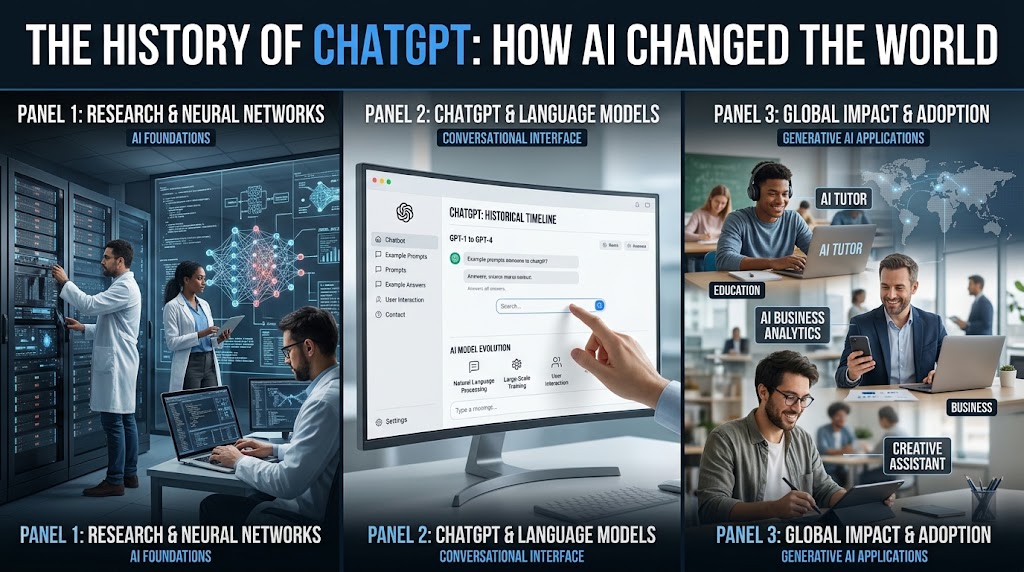
Introduction: The Day history of chatgpt Changed Everything
The history of chatgpt began on a random Tuesday night. November 30, 2022.
I remember it clearly because I couldn’t sleep. I opened Twitter and my entire timeline was the same thing. Screenshots. People were making a robot write poems, fix their code, write college essays, and even therapy sessions.
That robot was ChatGPT.
In 5 days, 1 million people signed up. In 2 months, 100 million.
For context, it took Instagram 2.5 months to hit 1 million. It took TikTok 9 months.
This wasn’t just another app launch. This was the moment AI became public.
But ChatGPT didn’t come from nowhere. Behind that chat box is 70 years of research, 3 failed GPT versions, and a $13 billion war between OpenAI, Google, and Microsoft.
In this post, we’re going deep into the history of chatgpt. How it started, how it exploded, and how AI changed the world in just 3 years. If you want to understand why everyone is talking about AI in 2026, start here.
Chapter 1: Before history of chatgpt-The 70 Year chatgpt timeline
To understand ChatGPT, we have to go back to 1950. Because AI is not new. We’ve been trying to make machines talk for 7 decades.
1950: Alan Turing Asks “Can Machines Think?”
A British mathematician named Alan Turing asked one question. He created the “Turing Test”.
If you chat with a machine and can’t tell it’s not human, then it’s intelligent.
For 50 years, every attempt failed. Chatbots sounded like robots from a 90s movie.
1966: ELIZA – The First Chatbot
MIT made ELIZA. It was super basic.
You: “I am sad”
ELIZA: “Why are you sad?”
It didn’t understand anything. But people still got emotional talking to it. That proved something important: Humans want to talk to computers.
1997: Deep Blue Beats Chess Champion
IBM’s computer beat Garry Kasparov. First time a machine beat us at strategy. People got scared.
2011: Siri and Alexa Arrive
Apple and Amazon put AI in our pockets. But Siri could only do “Set timer”. It was dumb.
But it showed us the demand. People wanted to talk, not type.
2012: Deep Learning Changes Everything
Google researchers used “neural networks” to recognize images and speech. Accuracy jumped overnight. This was the fuel for modern AI.

2017: The Paper That Created history of chatgpt development
Google published “Attention Is All You Need”.
This paper introduced “Transformers”.
Transformers are how AI understands context. The difference between “bank” as in money and “bank” as in river.
Without this 2017 paper, there is no ChatGPT. No Claude. No Gemini. This was the biggest breakthrough in chatgpt development.
Chapter 2: The Birth of OpenAI and history of chatgpt[2015-2018]
December 2015: Why OpenAI Was Created
Elon Musk, Sam Altman, Greg Brockman and others started OpenAI.
Their mission sounded like a movie: “Ensure that artificial general intelligence benefits all of humanity.”
AGI = Artificial General Intelligence. AI smarter than humans.
They started as a non-profit. The idea was to beat Google and Facebook and make sure AI is safe.
2018: GPT-1 – The First Step
GPT-1 = Generative Pre-trained Transformer 1
117 million parameters. Trained on books.
It could write sentences. That’s it. Not impressive.
But it proved the idea: If you train AI on all of the internet, it learns language.
This is the real chatgpt origin story.
Chapter 3: How history of chatgpt evolution Led to GPT-2 and GPT-3 [2019-2020]
February 2019: GPT-2 – “Too Dangerous to Release”
1.5 billion parameters. 13x bigger than GPT-1.
When OpenAI tested it, they panicked. It could write fake news. It could copy any writing style. It could write stories.
OpenAI only released a small version. They said it was “too dangerous”.
The internet called it a PR stunt. But investors saw the future. This moment changed the chatgpt evolution forever.
June 2020: GPT-3 – 175 Billion Parameters
This was the big one. GPT-3 had 175 billion parameters. Trained on 45TB of internet data.
OpenAI released an API. Developers went crazy. People built apps for:
1. Writing emails
2. Writing ads
3. Writing code
4. Customer support
It still made mistakes. But for the first time, AI felt human.
Microsoft Invests $1 Billion
OpenAI switched from non-profit to “capped-profit”. They needed supercomputers.
Microsoft became their exclusive partner.
But regular people still couldn’t use it. You needed to be a developer.
Chapter 4:history of chatgpt Launch and The impact of chatgpt [2022-2023]
November 30 2022: The Day AI Went Public
OpenAI did something risky. They put GPT-3.5 in a free chat box.
3 reasons it exploded:
1. Chat Interface – No API. Just type and ask.
2. Free – No credit card.
3. Useful Day 1 – Students, marketers, coders all got value.
The Numbers That Broke the Internet
Day 1: 10,000 users
Day 5: 1 Million users
Month 2: 100 Million users
Fastest growing app ever.
What Made It Feel Different
Before ChatGPT, AI gave 1 answer and stopped.
With ChatGPT you could say:
“Make it funnier”
“Explain like I’m 10”
“Write in Bangla”
“Add 3 examples”
That felt human. That’s the impact of chatgpt.
Chapter 5: GPT-4 and The AI War [2023-2024]
March 2023: GPT-4 Released
Bigger. Smarter. Could see images. Could pass the Law Bar Exam.
OpenAI launched ChatGPT Plus for $20/month.
Google and Microsoft Panic
Microsoft put GPT-4 in Bing in 30 days.
Google rushed out Bard, then Gemini.
Meta released Llama for free.
The AI war started. Users won.
Chapter 6: GPT-5 and Where is chatgpt going next [2024-2026]
2024: GPT-5 – The AI Agent history of chatgpt
GPT-5 could browse the web. Book flights. Send emails. It had memory. It remembered you.
2026: GPT-6 Multimodal
As of 2026, we have GPT-6.
– Talk to it like a phone call
– Show it a photo and ask questions
– Generate 10 second videos
– 10x cheaper than 2023
– 100x faster
ChatGPT is now in your iPhone, Windows, and WhatsApp.
This is where is chatgpt going next.
Chapter 7: Problems in the history of chatgpt
Problem 1: Hallucinations
ChatGPT makes up facts. A lawyer got in trouble in 2023 for fake cases from ChatGPT.
Problem 2: Job Loss
Data entry, customer support jobs are gone. New jobs: “AI Prompt Engineer”.
Problem 3: Copyright
OpenAI is being sued for training on books and news without permission.
Chapter 8: Business Case Studies in the history of chatgpt timeline
Khan Academy: Khanmigo
AI tutor. Students learn 2x faster.
Duolingo Max
AI roleplay for language learning.
Shopify Magic
AI writes product descriptions for 2 million sellers.
Freelancers in Bangladesh
Writers and developers are earning 3x more using ChatGPT.
Chapter 9: How to Use history of chatgpt
in 2026
1. Dont Ask, Instruct
Bad: “Write article”
Good: “Write 1000 word SEO article about history of chatgpt with H2 and examples”
2. Use It as a Thinking Partner
“Give me 10 blog ideas” “Which will rank?”
3. Always Fact Check
AI lies confidently.
Chapter 10: FAQ About history of chatgpt
1. What is the history of chatgpt in short?
It started in 2015 with OpenAI. GPT-1 in 2018, GPT-2 in 2019, GPT-3 in 2020. ChatGPT launched Nov 30, 2022. By 2026 we have GPT-6.
2. Who created ChatGPT?
OpenAI. Founded by Sam Altman, Elon Musk and others. Microsoft invested $13 billion.
3. How did history of chatgpt change the world?
It changed education, work, and business. Gave everyone a free AI assistant.
4. What is the difference between GPT-3, GPT-4 and GPT-5?
GPT-3 = Text. GPT-4 = Text + Images. GPT-5 = Agents + Memory. GPT-6 = Voice + Video.
5. Will ChatGPT take jobs?
It changes jobs. People who use AI will replace people who don’t.
6. Is ChatGPT safe?
Yes, but fact-check. It hallucinates 5% of the time.
7. What comes after ChatGPT?
AI Agents that do work for you. AGI by 2027-2030.
8. How to use ChatGPT for blogging?
Research, outline, first draft. Then add your own story and opinion.
Final Thoughts: The Real Legacy of history of chatgpt
The internet connected us.
Smartphones gave us information.
The history of chatgpt gave us a thinking partner.
In 3 years, AI went from a lab to your pocket.
We’re at 1%. By 2030 AI will be like electricity. Invisible but everywhere.
The question isn’t “Will AI take my job?”
The question is “Am I using AI to do my job 10x better?”
The history of chatgpt proves one thing: Adapt first, or get left behind.
What do you think? Will AI be bigger than the internet? Comment below.
If this helped you, share it with someone who is scared of