
The History of NVIDIA’s Rise: From Gaming GPUs to AI Empire
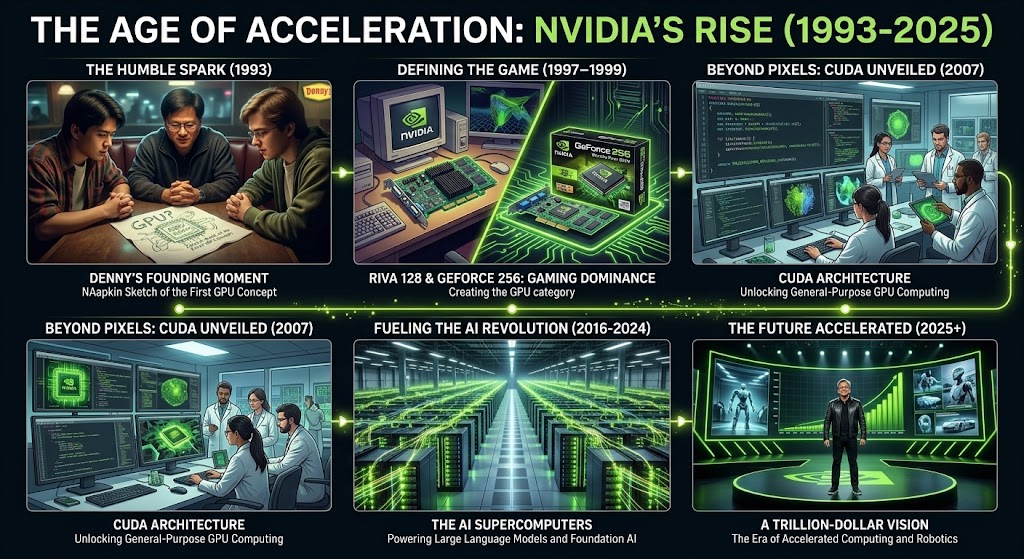
The History of NVIDIA’s Rise: How 3 Guys at Denny’s Accidentally Built the Future of AI
The history of NVIDIA starts with 3 guys, one paper napkin, and 59 investors saying “no.”
The history of NVIDIA ends with a company that powers ChatGPT, Tesla, and every AI lab on earth.
I’ll be straight with you. In 2014 I bought a GTX 760 for $250 just to play Battlefield 4. I thought history of NVIDIA was just about making graphics cards for gamers. I was so wrong it hurts.
Today in 2025, if AI is the new electricity, then NVIDIA is the new oil company. And nobody saw it coming.
This is the full, messy, human history of NVIDIA’s rise. From $20 million startup to $3 trillion empire.
Part 1: April 5, 1993 – The Denny’s Meeting That Started History of NVIDIA
8:30 AM. East San Jose, California. Denny’s restaurant.
Three cups of coffee. One paper napkin.
Jensen Huang. 30 years old. Just quit AMD and LSI Logic.
Chris Malachowsky. Hardware engineer from Sun Microsystems.
Curtis Priem. Also from Sun.
All 3 were pissed off about the same thing. PCs in 1993 were terrible at graphics.
You wanted to play Doom? Your CPU had to do everything. Graphics, sound, mouse, Windows. 1 frame took 5 minutes to render. It was painful.
On that napkin Jensen wrote “NV” – Next Version.
The pitch was stupidly simple: “We will build a chip that ONLY does graphics. It will be 100x faster than a CPU.”
They pitched 60 venture capitalists. 59 said no.
“Video games are for kids. This market is too small. Go home.”
But Sequoia Capital and Sutter Hill Ventures gave them $20 million.
That’s it. That’s how history of NVIDIA began. 3 employees. 1 office in Santa Clara. 0 products. $20M in the bank.
Why “NVIDIA”?
The name comes from Latin word “invidia” meaning envy.
Jensen wanted competitors to envy them. Pretty bold for 3 broke guys with no product.
For the next 2 years they burned cash and had zero revenue.
Part 2: 1995-1996 – Near Death in History of NVIDIA
The NV1 Disaster
1995. NVIDIA launches its first product. NV1.
Big problem: It used “quadratic textures”. But every game developer in the world used triangles. So nobody supported NV1.
Sega put the NV1 in the Sega Saturn console. The Saturn bombed. So NV1 bombed.
By January 1996 NVIDIA had 30 days of cash left in the bank.
Jensen called all 15 employees into a small room. I’ve read interviews about this. He said: “Look, if this next chip fails, we are dead. You should probably go update your resume.”
Most CEOs would quit at this point. Jensen did the opposite. He bet the entire company on one more chip.
Lesson 1 From History of NVIDIA
Survive long enough to get lucky. They were 30 days from dead.
Part 3: August 1997 – The Chip That Saved History of NVIDIA
RIVA128 Launch
August 1997. RIVA 128 launched. $199.
And finally, it worked.
It ran Quake 2 at 60 FPS. It had good 2D. It had good 3D. It didn’t crash every 5 minutes.
Dell started putting it in PCs. Then Gateway. Then HP.
Revenue went from $13 million in 1996 to $200 million in 1998.
I remember seeing that green “RIVA 128” sticker on my cousin’s PC in 1998. I had no idea that little sticker saved a company.
Without RIVA 128, the history of NVIDIA ends here. There is no ChatGPT. No AI boom. Nothing.
Part 4: August 31, 1999 – They Invented the Word “GPU”
GeForce 256 and The IPO
August 31, 1999. GeForce 256 launched. $299.
This was the first time NVIDIA used the word “GPU”. Graphics Processing Unit.
Before this everyone called it “graphics accelerator”. Jensen got on stage and said “No. This is a processor. For graphics.”
And he was right.
GeForce 256 had hardware transform and lighting. Games looked 10x better overnight. It destroyed 3dfx Voodoo. It destroyed ATI Rage.
Same year NVIDIA did IPO. Stock price: $12.
The company was now worth $200 million.
But here’s the key part. Jensen was already bored with just games. In internal meetings he kept asking: “What else can we do with all this parallel processing power?”
Part 5: 2000-2006 – The GPU Wars in History of NVIDIA
NVIDIA vs ATI vs 3dfx
For 6 years it was pure war.
NVIDIA vs ATI vs 3dfx.
NVIDIA won by one simple rule: ship faster.
GeForce 2. Then 3. Then 4. Then 6800. New card every 6 months.
In 2000 they bought their biggest rival 3dfx for $70 million. Voodoo was dead.
Big wins: Microsoft put NVIDIA in the original Xbox in 2001. Sony put them in PS3 in 2006. That was $500 million in revenue.
But there were mistakes too. GeForce FX 5800 in 2003 was so loud gamers called it “The Dustbuster”. ATI’s Radeon 9700 beat it badly that year.
Lesson 2 From History of NVIDIA
In chips, if you’re 6 months late, you lose.
Part 6: 2006-2016 – The Golden Age of Gaming in History of NVIDIA
GeForce 8800 to GTX 1080 Ti
If you were a PC gamer, this was heaven.
8800 GT in 2006. GTX 280 in 2008. GTX 970 in 2014. GTX 1080 Ti in 2017.
Every 18 months, 30% more performance.
Nvidia sponsored every esports tournament. Every Twitch streamer had a green logo. “The way it’s meant to be played.”
Gaming was paying 100% of the bills.
But behind closed doors, Jensen was doing something weird. He was flying to universities and meeting scientists.
Not game developers. Scientists.
Part 7: 2006 – The $3 Trillion Bet Called CUDA
This is the most important year in history of NVIDIA.
2006. NVIDIA released CUDA. Compute Unified Device Architecture.
What does that mean in normal words?
Before CUDA: A GPU could only do graphics.
After CUDA: You could tell a GPU to do any math problem.
Suddenly scientists realized: “Wait, I can buy a $500 GeForce card and do $500,000 of supercomputer work.”
Physics labs bought them. Weather labs bought them. Oil companies bought them.
NVIDIA thought “Cool, researchers like our cards.”
They had absolutely no idea what was about to happen.
Why CUDA Made History of NVIDIA a $3 Trillion Company
This is why AMD could never catch them. AMD had hardware. But NVIDIA had CUDA.
And software creates monopolies. Hardware doesn’t.
20 years later, CUDA is still why 90% of AI runs on NVIDIA.
Part 8: 2012 – The Accident That Changed History of NVIDIA
2 Gaming GPUs Beat The World: AlexNet
2012. University of Toronto.
3 researchers. Alex Krizhevsky, Ilya Sutskever, Geoffrey Hinton.
They built a neural network called AlexNet to recognize images.
To train it they needed massive computing power. CPUs would take 6 months.
So they bought 2 NVIDIA GTX 580 gaming GPUs for $1000 total.
They won the ImageNet competition. They were 10x faster than anyone using CPUs.
Google saw it. Facebook saw it. Baidu saw it.
Overnight, every AI lab in the world needed NVIDIA GPUs.
Jensen’s Roadshow 2013-2015
From 2013 to 2015 Jensen flew to every AI lab in the world.
“Buy our GPUs. This is the future of computing.”
He didn’t plan this. AI researchers hijacked NVIDIA’s gaming cards.
The smartest business move NVIDIA ever made was saying “yes” to customers they never expected.
Part 9: 2016-2022 – From $500 to $30,000 Per Chip
Once AI labs were hooked, NVIDIA stopped selling to gamers and started selling to data centers.
2016: DGX-1. 8 GPUs in one box. $129,000. First customer: OpenAI. Yes, that OpenAI.
2017: Tesla V100. $10,000 per chip.
2020: A100. $15,000 per chip.
2022: H100. $30,000 per chip.
November 2022: The ChatGPT Moment
ChatGPT launches.
Reporters ask “What is it running on?” Answer: 10,000 NVIDIA H100 GPUs.
Microsoft ordered $10 billion worth. Google ordered $10 billion. Meta ordered $10 billion. Amazon ordered $10 billion.
The Revenue Flip in History of NVIDIA
2016: 80% of NVIDIA revenue came from gaming.
2024: 80% of NVIDIA revenue came from data center.
NVIDIA stopped being a gaming company. It became an AI infrastructure company.
Part 10: March 2024 – Blackwell and $3 Trillion
GTC 2024
Jensen walks on stage in his black leather jacket.
He announces Blackwell. B200 chip. 208 billion transistors. $40,000 per chip.
Demand was insane. Delivery time: 12 months.
In June 2024 NVIDIA briefly became a $3 trillion company. More valuable than Apple and Microsoft.
Think about that. A company that started with $20M is now worth more than the GDP of most countries.
And it’s all because of one thing: AI needs compute, and NVIDIA is the only one who can provide it fast enough.
TSMC makes the chips. But only NVIDIA designs them.
Part 11: Why NVIDIA Won – 5 Reasons From History of NVIDIA
I’ve studied this for years. Here’s why NVIDIA won and Intel and AMD didn’t.
1. They Owned the Software: CUDA
AMD had faster hardware sometimes. But nobody could beat CUDA. 20 years of developer lock-in. If you learn CUDA, you’re not switching to AMD next year. It’s too much work.
2. They Survived Near Death
NV1 failed. Most companies die there. NVIDIA didn’t. That taught them to be paranoid.
3. They Listened to Weird Customers
Scientists, crypto miners, AI researchers. These were not NVIDIA’s target customers. But NVIDIA built for them anyway.
4. They Bet on Parallel Computing Early
While Intel chased “faster single CPU core”, NVIDIA bet that “1000 small cores” was the future. They were right.
5. They Created New Markets Every 5 Years
Gaming -> Crypto Mining -> AI Training -> AI Inference -> Robotics -> Self Driving Cars
Part 12: The Future of History of NVIDIA 2025-2030
Jensen says we’re moving from “data centers” to “AI factories”.
Instead of storing data, these factories will manufacture intelligence.
3 Big Bets:
1. Robotics: Jetson chips for humanoid robots. Tesla Optimus uses them.
2. Omniverse: A digital twin of the entire world. Build a factory in software first, then build it in real life.
3. Networking: They bought Mellanox for $7B. Now they own the chips AND the cables inside AI data centers.
The Risks
US government might block China sales. AMD MI300 is getting better. Google and Amazon are building their own chips.
But Jensen’s bet is simple: “AI will need 100x more compute in the next 5 years.”
Part 13: Lessons for Founders From History of NVIDIA
If you are building anything, here is what to steal from NVIDIA:
1. Survive long enough to get lucky: NVIDIA almost died 3 times.
2. Build platforms not products: Selling chips made them $10B. Owning CUDA made them $3T.
3. Say yes to accidental customers: Scientists using GPUs for AI was not the plan. NVIDIA said yes anyway.
4. Think in 10 year cycles: Jensen was talking about AI in 2006 when ChatGPT was science fiction.
Part 14: FAQ About History of NVIDIA
Q1: When was NVIDIA founded?
NVIDIA was founded on April 5, 1993 by Jensen Huang, Chris Malachowsky, and Curtis Priem.
Q2: What was NVIDIA’s first successful product?
RIVA 128 in 1997. It saved the company from bankruptcy.
Q3: When did NVIDIA invent the GPU?
August 31, 1999 with the launch of GeForce 256.
Q4: Why is NVIDIA so important for AI?
Because of CUDA. It is the software platform that 90% of AI researchers use to train models.
Q5: Who is the CEO of NVIDIA?
Jensen Huang. As of 2025 he is still CEO and still wears the leather jacket.
Q6: Can AMD or Intel beat NVIDIA?
On hardware, maybe. On software with CUDA, it will take 10 years minimum.
Q7: What is NVIDIA’s most expensive chip?
Blackwell B200. $40,000 per chip as of 2024.
Part 15: Final Thoughts – The Biggest Accident in Tech History
Here is the truth about the history of NVIDIA’s rise.
NVIDIA did not plan to be an AI company.
They planned to make graphics better for video games.
Scientists hijacked their gaming GPUs. Crypto miners hijacked them. AI researchers hijacked them.
And every time someone hijacked their product, NVIDIA said “yes, here’s more.”
From $20M to $3 trillion.
From rendering triangles in Doom to training GPT-5.
From a Denny’s napkin to powering the AI revolution.
If AI is the new electricity, then NVIDIA is the new oil company.
And it all started because 3 guys were annoyed that computers were bad at graphics.
That is the real history of NVIDIA’s rise.


