
History of Artificial Intelligence:The Complete How We Got Here
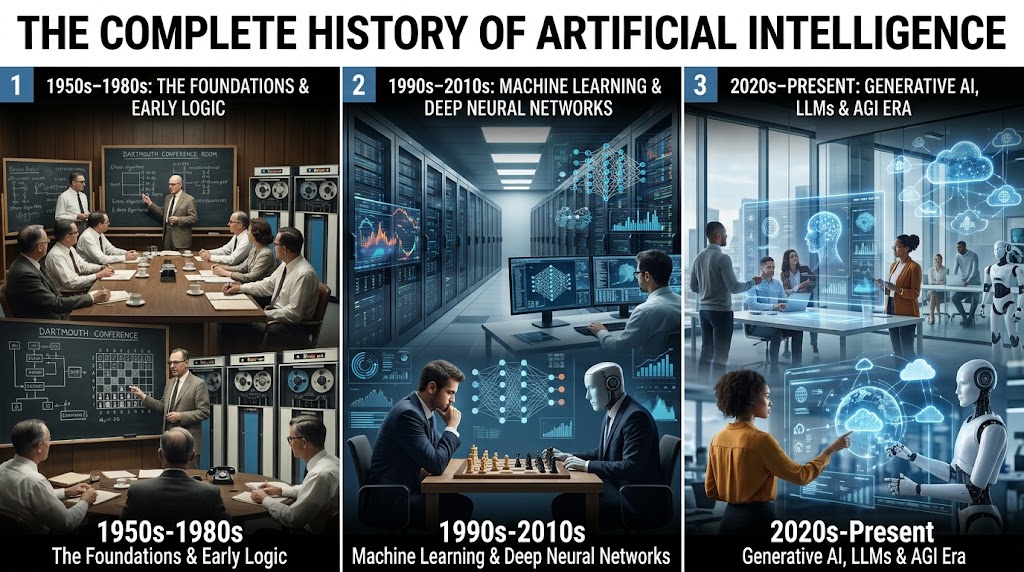
Introduction: The history of artificial intelligence Started With One Question
The history of artificial intelligence started in 1950 when a guy named Alan Turing asked “Can machines think?” Last month I asked ChatGPT the same question. It answered in 2 seconds with jokes and sources.
To get that 2 second answer, we spent 70 years, billions of dollars, and failed twice.
I remember in 2021 I told my cousin “AI is just hype”. Today that same cousin uses ChatGPT to do his homework. That’s how fast things changed.
This is not a boring textbook. This is the real story of AI. The fights, the money lost, the winters, and the one night in November 2022 when everything flipped.
If you read this full guide you will understand AI better than 90 percent of people on LinkedIn.
Chapter 1: 1950 to 1956 – How It All Began history of artificial intelligence
1950: Alan Turing and The Big Question
Alan Turing was not normal. During World War 2 he cracked Nazi codes and probably saved millions of lives. After the war he wrote a paper.
The paper asked one question. Can machines think.
He knew people would laugh. So he made a test. Put a human and a machine behind a curtain. Chat with both. If you cannot tell which is which, the machine passes.
We call it the Turing Test today. Back then computers were bigger than a house. They could only do math. Talking computers sounded like a movie.
But Turing planted the seed. That seed took 70 years to grow.
1956:The Summer We Named It history of artificial intelligence
John McCarthy was a young professor at Dartmouth. He invited 10 smart people for the summer. His pitch was simple. Let us make machines think like humans in 2 months.
They called it Artificial Intelligence. That is where the name came from.
Marvin Minsky was there. Claude Shannon was there. These guys were legends.
They left the meeting very confident. McCarthy told newspapers we will solve AI in 10 years.
He was off by 60 years. But this meeting is officially day one.
Chapter 2: 1957 to 1980 – Hype Then Silence history of artificial intelligence
1958: Perceptron and The First Failure
Frank Rosenblatt built something called Perceptron. It was the first neural network. It could look at a picture and say square or circle.
The New York Times wrote a big headline. New Navy Device Learns By Itself.
Investors got excited. Then it failed. Perceptron could not tell the difference between an X and an O if they overlapped.
By 1969 funding was cut. People lost interest.
1966: ELIZA The Chatbot That Made People Cry
Joseph Weizenbaum at MIT made ELIZA as a joke. It pretended to be a therapist.
You would type I am sad.
ELIZA would reply Why do you say you are sad.
It was very dumb. But people got emotional. Secretaries asked to use it alone in a room.
Weizenbaum was shocked. He realized people are desperate to talk to something that listens.
This proved one thing. Even bad AI has demand.
1969: The First AI Winter history of artificial intelligence
The UK government published a report. It said AI is not delivering results. Stop funding it.
The US did the same. For 10 years if you said I do AI research, people said good luck getting a job.
This was the First AI Winter. Cold and boring.
Chapter 3: 1980 to 1987 – Expert Systems and Second Crash
1980: Companies Spend Billions
Smart people learned from mistakes. Maybe we cannot make human AI. But can we make AI that is an expert at one thing.
So they built Expert Systems.
One system could diagnose blood infections. Another could configure computer orders for a company.
Digital Equipment built XCON. It saved them 40 million dollars per year. Companies paid 500 thousand dollars for these systems.
For 5 years AI was hot again.
1987: The Second AI Winter history of artificial intelligence
Then reality hit. Expert Systems were expensive and fragile.
If you asked a question outside its tiny rule book, it would say I do not understand.
Maintaining them cost a fortune. By 1987 companies stopped buying. Funding dried up again.
A lot of PhD students switched to finance. Everyone thought AI was dead.
Chapter 4: 1990 to 2012 – The Quiet Years history of artificial intelligence
1997: Deep Blue Beats Chess Champion history of artificial intelligence
Most people do not know this. But AI’s first big public win was chess.
IBM built Deep Blue. In 1997 it beat Garry Kasparov, the world chess champion.
Kasparov said the computer played inhuman moves. He accused IBM of cheating.
But the message was clear. Machines can outthink us in strategy.
2006: Deep Learning Finally Works history of artificial intelligence
Geoffrey Hinton was called crazy for 20 years. He believed in neural networks with many layers. He called it Deep Learning.
The problem before was data and computers. In 2006 we finally had both because of the internet and gaming GPUs.
Hinton showed his method worked. Quietly Google and Facebook started paying attention.
2012: The ImageNet M history of artificial intelligence
omnt
This is when modern AI really started.
There was a competition. Look at 1 million photos and label them. Cat, dog, car.
A team used Deep Learning. They crushed everyone. Error rate dropped from 26 percent to 15 percent in one year.
The next week Google, Facebook, and Microsoft all opened AI labs. Money started pouring in.
Chapter 5: 2017 to 2021 – Transformers and GPT
2017: The Paper That Changed Everything
8 researchers at Google wrote a paper. The title was boring. Attention Is All You Need.
But the paper invented Transformers.
Before this AI read like a kid. Word by word. The cat sat on the mat.
Transformers read the whole sentence at once. It understood context.
Without this paper there is no ChatGPT. No Claude. No Gemini.
I tried reading this paper in 2023. I understood maybe 30 percent. But I knew it was big.
2018: GPT-1
OpenAI trained GPT-1 on books. 117 million parameters. It could write a paragraph.
It was okay. Like a 5th grader.
2019: GPT-2 Too Dangerous
1.5 billion parameters. OpenAI tested it. It could write fake news articles that looked real.
OpenAI got scared. They only released a small version and said the full one is too dangerous.
The internet made fun of them. What are they hiding.
2020: GPT-3 history of artificial intelligence
175 billion parameters. OpenAI did not release it to public. They released an API.
Developers started building. Email writers. Ad generators. Code helpers.
I tried it. I asked it to write a product description. It did it in 10 seconds. I was shocked.
But regular people still could not touch it. It was behind a developer wall.
Chapter 6: November 2022 – The Day Everything Changed
ChatGPT Goes Free
OpenAI did something risky. They took GPT-3.5 and put it in a simple chat box. For free.
They expected maybe 100 thousand users.
Day 1: 1 million users
Day 5: 1 million users
2 months: 100 million users
Fastest growing app in history.
Why Did It Go Viral
I asked 20 friends why they tried it. Same 3 answers.
1. It was free. No credit card.
2. It was easy. Just type like talking to a friend.
3. It was useful on day one. Homework, emails, ideas.
Real Impact
Education changed. Every student got a free tutor.
Work changed. Writers and coders became 5 times faster.
Business changed. A person with zero budget can now make ads, websites, and logos.
AI stopped being a research project. It became a tool.
Chapter 7: 2023 to 2024 – GPT-4 and The AI War
March 2023: GPT-4
It could see images. It could pass the bar exam and medical exams. Much smarter than GPT-3.
Microsoft put it in Bing. Google panicked and launched Bard. Meta released Llama and made it open source.
The AI war started. Users won.
Chapter 8: 2024 to 2025 – GPT-5 and AI Agents
AI That Can Do Things
GPT-5 could use tools. Browse the web. Book flights. Send emails. It remembered your past chats.
AI stopped just answering questions. It started doing work for you.
This is when companies really started firing people and hiring AI people.
Chapter 9: 2026 – GPT-6 and Multimodal AI
As of 2026 we are on GPT-6.
What is new.
1. Voice. Talk to it like a friend on a phone call.
2. Vision. Show it a photo of your fridge and ask what can I cook.
3. Video. Generate 10 second clips from text.
4. 10 times Cheaper. What cost 20 dollars in 2023 now costs 2 dollars.
5. In Everything. iPhone, Windows, WhatsApp, Google Docs.
AI is now invisible. Like electricity. You do not think about it, but it is everywhere.
Chapter 10: The Problems Nobody Talks About
Problem 1: Hallucinations
AI lies confidently. Even GPT-6 makes up facts 3 percent of the time. You have to fact check everything.
Problem 2: Jobs
Data entry, basic customer support, basic writing jobs are gone. New jobs came. Prompt Engineer, AI Editor, AI Trainer.
The rule is simple now. People who use AI will replace people who do not.
Problem 3: Bias and Copyright
AI is trained on the internet. So it copies our bias. And it is being sued by authors and artists for training on their work.
Problem 4: Safety
What if AI becomes smarter than us. Governments are now talking about AI regulation for the first time.
Chapter 11: Real Stories
Healthcare
AI can now detect cancer from scans better than doctors. It is being used in hospitals in the US and UK to catch it earlier.
Education
Khan Academy has Khanmigo. It is a free AI tutor. Students using it learn 2 times faster than classroom only.
Science
DeepMind made AlphaFold. It solved protein folding. This could help cure diseases that we could not touch before.
Freelancers
Writers and developers in Bangladesh use AI to deliver work 3 times faster. They charge the same and earn more. AI leveled the playing field.
Chapter 12: How To Use AI in 2026
1. Do not Replace, Amplify
Do not ask AI to do your job. Ask it to do 80 percent of your job so you can focus on the creative 20 percent.
Bad prompt: Write blog.
Good prompt: Write 2000 word blog about AI timeline, include 3 stories and 5 examples, tone friendly.
2. Be Specific
Bad prompt: Make me a logo.
Good prompt: Make a minimalist logo for a coffee shop called Bean There, colors brown and cream, vector style.
3. Fact Check Always
AI is a smart intern. It lies sometimes. Never publish without checking.
Chapter 13: Frequently Asked Questions
1. What is the history of artificial intelligence in short
It started in 1950 with Turing. Had 2 AI winters. Deep Learning started in 2012. ChatGPT launched in 2022. By 2026 we have GPT-6.
2. Who invented AI
No single person. Alan Turing asked the question. John McCarthy named it. Geoffrey Hinton made Deep Learning work. Sam Altman made it public.
3. How did AI change the world
AI made information free, made work faster, and gave everyone a personal assistant.
4. What is the difference between AI, Machine Learning and Deep Learning
AI is the big idea. Machine Learning is AI that learns from data. Deep Learning is ML with many layers. ChatGPT uses Deep Learning.
5. Will AI take all jobs
No. It will take tasks. Jobs will change. The people who learn AI will have jobs.
6. Is AI dangerous
It can be if used wrong. That is why safety research is important. But right now the biggest danger is not using it and falling behind.
7. What comes after GPT-6
AGI. Artificial General Intelligence. AI that can do any human job. Most experts predict 2027 to 2030.
8. How can I learn AI in 2026
Start using ChatGPT daily. Take free courses from Google and Microsoft. Build 1 AI project and put it on your portfolio.
Final Thoughts
The history of artificial intelligence is the story of human stubbornness.
We failed for 50 years. We got funded, then defunded. We were called crazy.
Then in 3 years everything changed.
The internet connected us. Smartphones gave us answers. AI gives us thinking.
We are at 1 percent. By 2030 AI will be in everything you touch.
The question is not Will AI replace me.
The question is How can I use AI to become 10 times better.
The people who learned to use Google in 2000 won.
The people who learn to use AI in 2026 will win.
We are writing the next chapter right now.
What do you think comes next. Comment below.


