
WhatsApp Founder: The story of WhatsApp’s founding From 0 to 19 Billion Dollars
WhatsApp Founder: It Started With 2 Rejections From Facebook
whatsapp founder.
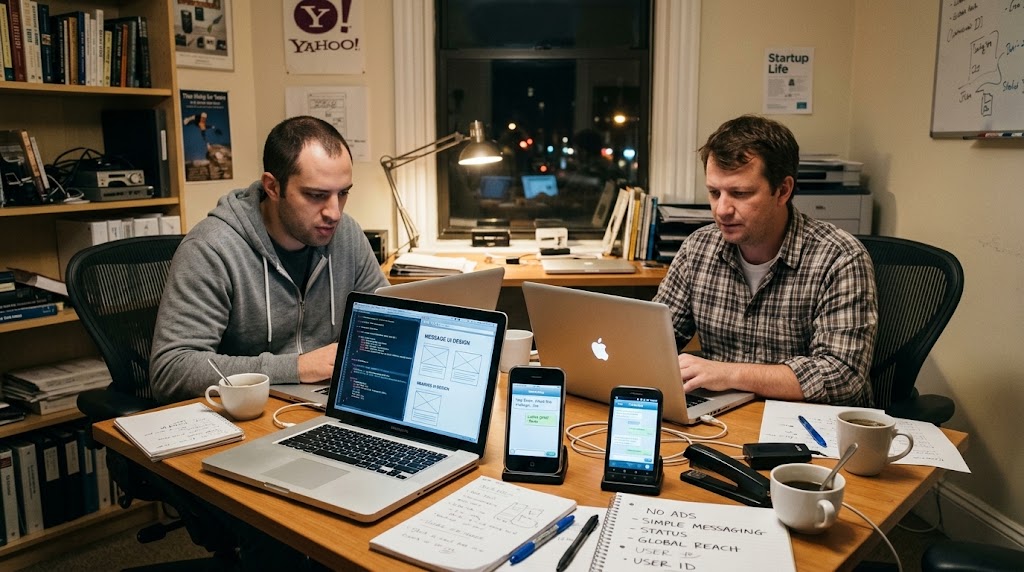
January 2009. A coffee shop in Mountain View, California.
Two guys in their 30s sitting with laptops. Both of them had just been rejected by Facebook for jobs.
Brian Acton tweeted: “Got rejected by Facebook. It was a great opportunity to connect with some fantastic people.”
Jan Koum replied: “Yep. Same here.”
They laughed about it. They had no idea that 5 years later, Facebook would pay them 19 Billion dollars for the app they were about to build in Jan’s apartment.
This is the story of WhatsApp’s founding. Not the press release version. The real version.
About an immigrant kid who grew up with no phone in Ukraine. About a Yahoo engineer who quit on the same day as his friend. About 2 guys who hated ads and just wanted to build something simple.
If you use WhatsApp today, 2 Billion people do, then you’re living in the world they built. Let’s start from the beginning.
WhatsApp Founder Early Life: Jan Koum and Brian Acton Before 2009
Jan Koum: From No Phone in Ukraine to Silicon Valley
Jan Koum was born in 1976 in a small village outside Kyiv, Ukraine.
His childhood was poor. Really poor. His house didn’t even have indoor plumbing. And there was no phone. If someone wanted to call, they had to go to a phone booth.
In 1992, when Jan was 16, his mom got sick. The doctors said she needed better treatment. So the family used their savings and moved to Mountain View, California.
They lived on food stamps. Welfare. Jan’s mom babysat to make money. Jan cleaned grocery stores.
But Jan was smart with computers. He taught himself programming from books he bought at used bookstores for 2 dollars. At 18, he got a job testing security at Ernst and Young.
That’s where he met hackers. That’s where he met Brian Acton.
Brian Acton: 11 Years at Yahoo
Brian Acton was born in 1972 in Michigan. He was a math kid. Then a computer kid.
In 1996, he joined Yahoo as employee number 44. Back then Yahoo was the internet.
He stayed 11 years. He saw Yahoo go from a startup in a trailer to a giant. He also saw it get slow, political, and boring.
By 2007, both Jan and Brian were done. They quit Yahoo on the same day. September 1, 2007.
They took a year off. Traveled South America. Played soccer. Did nothing.

In 2009, they were broke and looking for jobs. They both applied to Facebook. Facebook said no to both of them.
That rejection is where the story of WhatsApp’s founding really begins.
WhatsApp Founder 2009: The iPhone Idea That Changed Everything
“What If Your Status Meant Something?”
January 2009. Jan bought an iPhone. The App Store had just launched.
He was messing with it and had a simple thought: “What if the status next to your name could actually mean something?”
Like “at the gym” or “battery low” or “in a meeting”.
He called Brian. “I have an idea for an app.”
Brian said he was busy. Jan asked 5 other people. Everyone said no.
Finally in February 2009, Brian agreed to help. Just as a friend. Not as a co-founder yet.
WhatsApp Name and First Version
Jan wanted the name to sound like “What’s Up”. So he picked WhatsApp.
On February 24, 2009, he registered WhatsApp Inc.
The first version was bad. Really bad. It only showed your status. You couldn’t send messages. It crashed constantly.
By May 2009, Jan was ready to quit. He told Brian “This isn’t working.”
Then June 2009 happened. Apple released push notifications.
WhatsApp Founder June 2009: The Push Notification Moment
The “Aha” Moment in Russia
Jan was visiting his grandmother in Russia. He got a push notification on his iPhone.
And it hit him. “What if instead of just showing my status, the app could push a message to my friends when I update it?”
He called Brian from Russia. “What if we make it a messenger?”
Brian said “Let’s do it.”
They rebuilt the whole app in 2 weeks. Now when you updated your status, it sent a message to everyone in your phone contacts who also had WhatsApp.
On June 5, 2009, WhatsApp 1.0 launched.
No one downloaded it. For 2 months, nothing happened. Maybe 50 users total.
The Russian Users Who Saved It
August 2009. Something weird happened.
People in Russia started using WhatsApp. A lot.
Why? Because SMS was expensive in Russia. And WhatsApp used internet.
Suddenly they had a few thousand users. The servers kept crashing. Jan was panicking.
He called Brian again. “We need to make this stable or shut it down.”
Brian said “Don’t shut it down. I’ll join full time.”
October 2009. Brian Acton officially became co-founder of WhatsApp. He put in 250,000 dollars of his own Yahoo money.
The story of WhatsApp’s founding was officially starting.
WhatsApp Founder 2010-2011: No Ads, No Games, Just Messaging
The 1 Dollar Rule
From day one, Jan and Brian had one rule: No ads. Ever.
Jan grew up with no money. He hated seeing ads everywhere. He said “Advertising is not just a distraction. It’s an insult to your intelligence.”
So they charged 1 dollar per year after the first year was free.
That’s it. 1 dollar. No subscriptions. No hidden fees.
People loved it. Because it was simple.
“WhatsApp” Became a Verb
By 2010, WhatsApp hit 1 million users.
By 2011, 10 million users.
People started saying “WhatsApp me” instead of “Text me”.
The app was growing because it solved one problem really well. It let you message anyone in the world for free as long as you had internet.
No games. No timelines. No likes. Just a green app with chats.
This is why the whatsapp founder story is different. They didn’t try to be Facebook. They tried to be the opposite.
WhatsApp Founder 2012-2013: Exploding Growth
The Infrastructure Nightmare
2012 was chaos. WhatsApp hit 50 million users. Then 100 million.
The servers crashed every week. Jan was waking up at 3 AM to fix them.
He hired engineers slowly. He didn’t want a big company. He wanted 30 engineers for 200 million users.
His philosophy was “Focus on product, not on hiring.”
Why People Chose WhatsApp Over SMS
In 2013, phone companies started getting scared.
Because in countries like India, Brazil, and Indonesia, people stopped sending SMS. They used WhatsApp instead.
It was free. It worked on bad internet. It showed “delivered” and “read” ticks.
By end of 2013, WhatsApp had 400 million monthly users.
And they still had no marketing team. No sales team. No ads.
Just word of mouth.
WhatsApp Founder 2014: The 19 Billion Dollar Phone Call
Mark Zuckerberg Calls
January 2014. Jan was at the gym. His phone rang. Unknown number.
It was Mark Zuckerberg.
Mark said “We should talk.”
Jan said “About what?”
Mark said “About Facebook buying WhatsApp.”
Jan thought it was a joke.
The Deal: 19 Billion Dollars
For 2 months they negotiated.
Facebook offered 19 Billion dollars. 4 Billion in cash. 12 Billion in Facebook stock. 3 Billion in restricted stock.
On February 19, 2014, they signed the deal at a small government building in Mountain View. The same building where Jan used to go to get food stamps as a kid.
The photo of Jan standing outside that building went viral.
Brian Acton also got billions.
The story of WhatsApp’s founding went from 0 to 19 Billion in 5 years.
“No Ads” Promise
The most important part of the deal? Mark promised Jan: “No ads in WhatsApp.”
Jan put it in writing. He said he would quit if they ever put ads in.
For 5 years, they kept that promise.
WhatsApp Founder After 2014: What Happened to Jan and Brian
Jan Koum Stays Until 2018
After the sale, Jan stayed as CEO.
He kept the team small. 50 engineers for 1 Billion users.
In 2016, WhatsApp hit 1 Billion users.
But in 2018, Jan had a fight with Facebook. Facebook wanted to put ads in WhatsApp. Jan said no.
So in April 2018, Jan quit. He walked away from 1.3 Billion dollars in unvested stock.
He said “I sold my company, not my values.”
Brian Acton Left Earlier and Started Signal
Brian left in 2017. He was also uncomfortable with ads and data sharing.
In 2018, he put 50 Million dollars to start the Signal Foundation. Signal is a private messaging app. No ads. No tracking.
So both whatsapp founders ended up leaving Facebook because of ads.
WhatsApp Founder Philosophy: Why It Worked
1. Solve One Problem
WhatsApp did one thing: messaging. It did it better than anyone.
2. No Ads Ever
Jan believed ads ruin user experience. 2 Billion people agreed.
3. Stay Small
At 450 million users, WhatsApp had 32 engineers. Facebook had 10,000 for the same number.
4. Focus on Emerging Markets
WhatsApp won in India, Brazil, Mexico because SMS was expensive there.
5. Phone Number = Username
No need to create an account. Just your number. That made it 10x easier to join.
WhatsApp Founder Timeline: Key Dates
1. 1976: Jan Koum born in Ukraine
2. 1972: Brian Acton born in Michigan
3. 1996: Brian joins Yahoo
4. 2007: Jan and Brian quit Yahoo
5. January 2009: Rejected by Facebook
6. February 24, 2009: WhatsApp Inc founded
7. June 5, 2009: WhatsApp 1.0 launches
8. October 2009: Brian joins as co-founder
9. 2010: 1 Million users
10. 2013: 400 Million users
11. February 19, 2014: Sold to Facebook for 19 Billion
12. 2016: 1 Billion users
13. 2018: Jan and Brian both leave Facebook
WhatsApp Founder vs Other Founders
Why WhatsApp Is Different From Facebook
Facebook wanted to know everything about you to show ads.
WhatsApp wanted to know nothing. They didn’t even store your messages on servers.
Facebook had 1000s of employees.
WhatsApp had 50.
Facebook made money from ads.
WhatsApp made money from 1 dollar per year.
That’s why the story of WhatsApp’s founding is taught in business schools. It proved you can get huge without selling user data.
WhatsApp Founder Today in 2026
Where Is Jan Koum?
Jan is worth over 15 Billion dollars. He lives in California. He plays soccer. He invests in startups. He almost never gives interviews.
He still says the same thing: “We just wanted to build something useful.”
Where Is Brian Acton?
Brian runs the Signal Foundation. He’s worth over 3 Billion dollars. He funds privacy projects.
Both of them are still committed to no ads.
WhatsApp in 2026
2.2 Billion users.
Still no ads in the main chat.
Businesses can pay to message customers, but personal chat is still clean.
Facebook kept the “no ads” promise for 5 years. In 2020 they started business features, but personal chat is still free.
10 Lessons From the whatsapp founder Story
1. Solve a real problem. Expensive SMS.
2. Don’t copy. Be different. No ads.
3. Stay small as long as possible.
4. Focus on countries where your product is 10x better.
5. Say no to investors who want ads.
6. Your first 1000 users matter more than your next 1 million.
7. Don’t hire too fast.
8. Keep it simple. One feature.
9. Walk away if the buyer ruins your product.
10. Phone number is the best username.
FAQ: WhatsApp Founder
Who is the whatsapp founder?
Jan Koum and Brian Acton are the whatsapp founders. They started WhatsApp in 2009.
How did whatsapp founders meet?
They met at Yahoo. Then they met again through a hacker group called w00w00.
Why did whatsapp founders sell to Facebook?
They got 19 Billion dollars and a promise of no ads. Jan stayed for 4 years to protect that.
Is WhatsApp still free?
Yes. Personal messaging is still free in 2026.
Final Word: The story of WhatsApp’s founding
The story of WhatsApp’s founding is not about technology.
It’s about two guys who were rejected and decided to build something themselves.
It’s about an immigrant who remembered what it was like to not have a phone.
It’s about an engineer who was tired of big company politics.
They didn’t want to be billionaires. They wanted to make messaging free.
And they did.
From a 1 dollar app to 19 Billion dollars.
From 0 users to 2.2 Billion users.
The whatsapp founder story proves one thing. If you build something people truly need, and you don’t ruin it with ads, they will love you.
That’s why WhatsApp is still the number 1 messaging app in the world in


