
Why Did Napoleon Bonaparte Always Keep His Hand Tucked Inside His Jacket?
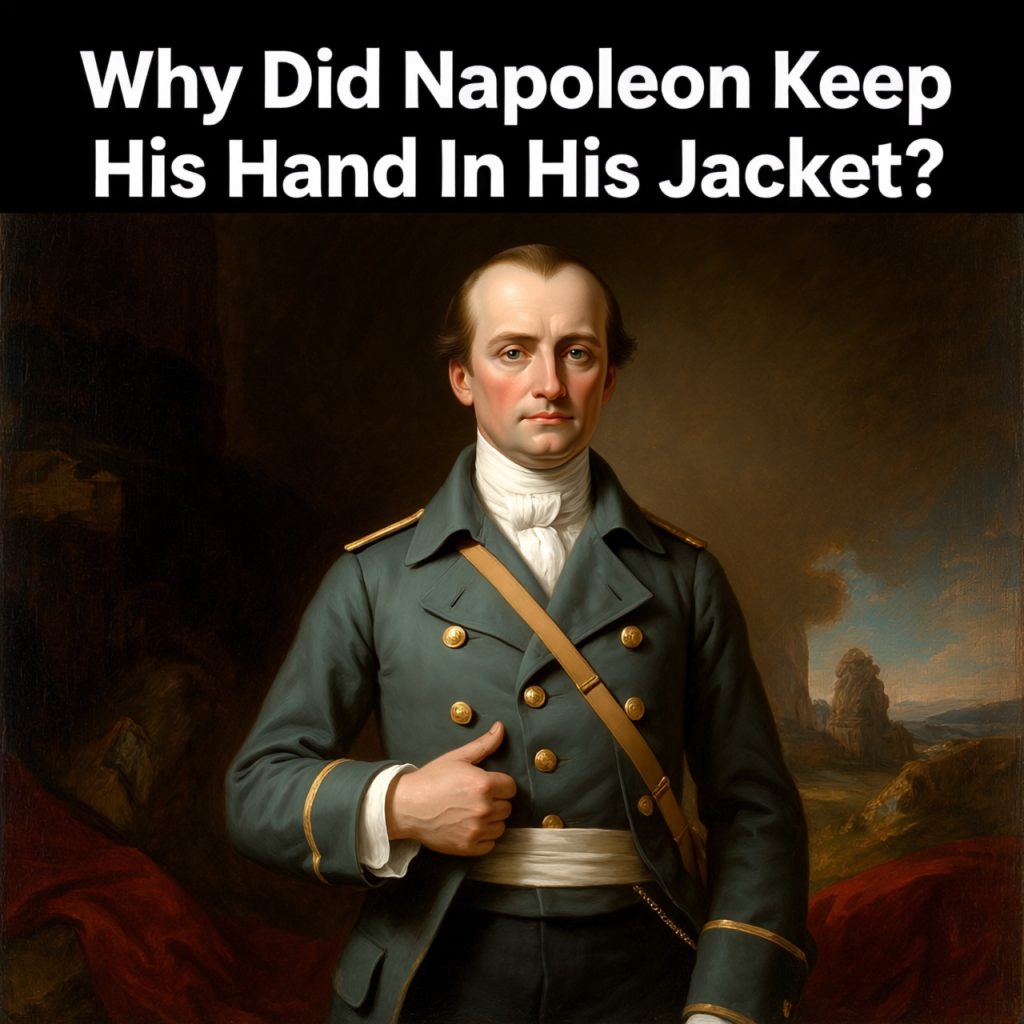
Intaroduction:Why Did Napoleon Bonaparte Always Keep His Hand Tucked Inside His Jacket?
napoleon hand in jacket.
I was 12 years old when I first saw that painting.
You know the one. Napoleon standing in front of his tent. Red coat. Hat under his arm. And his right hand… tucked inside his jacket, right over his stomach.
My dad said “He had stomach pain.”
My teacher said “It was a sign of leadership.”
My friend said “He was hiding a deformity.”
I believed all of them at different times.
Then in college I wrote a paper on it and went down a 3 month rabbit hole. And what I found is that nobody actually knows for sure. But we have 5 really good theories. And some of them are hilarious.
If you’ve ever googled napoleon hand in jacket at 2am, this is for you.
The Painting That Started It All
Jacques-Louis David And The Famous 1812 Portrait
First, let’s get this straight. Napoleon didn’t walk around 24/7 with his hand in his jacket.
He did it in portraits. A LOT of portraits.
The most famous one is by Jacques-Louis David in 1812. Napoleon in his study at 4am. Candle burning. Papers everywhere. Hand in jacket.
That painting is in the National Gallery in Washington DC. 10 million people see it every year.
And every single one of them asks the same question: Why?
Before we get to the theories, you need to know something. In 1800s portraiture, nothing was an accident. Every pose meant something.
So the napoleon hand in jackts 100% intentional.
Theory 1: He Had Stomach Problem napoleon hand in jacket
Ulcers, Cancer, or Just Bad French Food
This is the most popular theory. And it might be true.
Napoleon had chronic stomach issues his whole life.
His doctor, Dr. Barry O’Meara, wrote that Napoleon suffered from “severe gastric pain”. He ate fast. He drank coffee at all hours. He lived on war rations.
Some historians think he had a stomach ulcer. Others think he had stomach cancer. Which is actually what killed him in 1821 on St. Helena.
So theory goes: he put his hand in his jacket to press on his stomach. Like when you have cramps and you hold your belly.
Makes sense right?
The problem: He did the pose in paintings from 1800 to 1815. That’s 15 years. You don’t have the same stomach pain for 15 years and still conquer Europe.
Also, his enemies would have mocked him for it. They mocked everything else about him. But no British cartoon ever showed him clutching his stomach.
So maybe yes, maybe no.
Theory 2: It Was The “Orator Pose” From Ancient Rome
He Wanted To Look Like A Roman Emperor
This is my favorite theory. And the one most historians believe.
In ancient Rome, there was a pose called the “adlocutio”.
It’s when a leader or orator puts one hand inside his toga, over his chest. It means: “I speak to you with a calm heart. I am in control. I am rational.”
Roman statues of Augustus, Julius Caesar, and Cicero all do it.
Napoleon was OBSESSED with Rome. He crowned himself Emperor. He built roads like Romans. He even called his government “The Consulate”.
So when he did the napoleon hand in jacket, he was basically saying: “I am the new Caesar.”
It was propaganda.
Think about it. He was 5’6″. He needed to look bigger in paintings. The hand in jacket made him look calm, thoughtful, and in command. Not angry. Not weak.
It worked. 200 years later we’re still talking about it.
Theory 3: The Fashion Reason Napoleon Hand In Jacket
18th Century Jackets Were Awkward As Hell
Okay this one is boring but important.
In the late 1700s and early 1800s, men’s military jackets were cut weird.
The armholes were high. The fabric was thick wool. If you let your arms hang by your sides for a long time, your shoulders hurt.
So a lot of officers put a hand in their vest or jacket just to rest.
There are paintings of other generals doing it. Wellington did it. Tsar Alexander did it.
But Napoleon did it more. Because he had his portrait painted more than anyone else in history.
So maybe 50% of the napoleon hand in jacket was just… comfort.
His tailor probably hated him. “Sire, please take your hand out, it wrinkles the coat.”
Theory 4: He Was Hiding Something Napoleon Hand In Jacket
The Secret Pocket and The Poison Theory
Now we get to the conspiracy stuff.
Theory A: He kept poison in a pocket inside his jacket. In case he was captured. He did try to commit suicide with poison in 1814. So maybe he kept it close.
Theory B: He had a nervous tick. And he was hiding it.
Theory C: He had a scar from a duel when he was young and didn’t want people to see it.
None of these have proof. But they’re fun.
The poison theory is the most dramatic. Imagine: Emperor of Europe, ready to die at any moment, hand always on the poison.
Cool story. Probably not true.
Theory 5: The British Propaganda Made It Famous
“Little Boney” and The Hand Warmer Joke
Here’s where it gets funny.
The British HATED Napoleon. They called him “Little Boney”.
In the 1800s, British cartoonists started drawing him with his hand in his jacket. But they gave it a new meaning.
They said he was reaching for a hand warmer. Because he was cold. Because he was a coward. Because he was small.
One cartoon from 1803 shows him with his hand in his jacket and the caption: “The Corsican is cold.”
So the British made the napoleon hand in jacket into a joke.
And then 200 years later, we all think it was his signature move.
Thanks, British.
What Did Napoleon Himself Say
Spoiler: He Never Explained It
I looked. I really did.
In all his letters, in all his memoirs dictated on St. Helena, he never once says “I put my hand in my jacket because…”
Not once.
The closest we get is from his valet, Louis Marchand. He wrote that Napoleon often stood like that when thinking. “His hand would go to his chest when he was deep in thought.”
So maybe it was just a habit. Like how some people bite their nails.
The greatest man in Europe, and he might have just been fidgeting.
How The Pose Changed His Image
From General To God
Before 1800, portraits of kings showed them on horses, with swords, looking angry.
Napoleon changed that.
With the napoleon hand in jacket, he looked calm. Smart. A man of the people and a man of ideas.
It made him relatable. A soldier who reads at 4am. Not just a butcher.
This was branding before branding existed.
And it worked SO well that today when you think “Napoleon” you think of that pose. Not the battles. Not the laws. The hand.
That’s power.
Other Famous People Who Copied It
From Stalin to Steve Jobs
Once Napoleon made it cool, everyone copied it.
Joseph Stalin did it in portraits.
Mao Zedong did it.
Even Steve Jobs did it. Black turtleneck, hand in pocket. Same energy.
It’s the “I’m thinking and I’m in charge” pose.
So Napoleon invented a body language that lasted 200 years.
Not bad for a guy who was probably just cold.
The Medical Evidence From St. Helena
What His Autopsy Actually Said
Napoleon died in 1821. The British did an autopsy.
They found: Stomach cancer. Or maybe arsenic poisoning. Historians still fight about it.
But they also noted: “No deformity. No scar on the stomach.”
So he wasn’t hiding anything.
The doctor on St. Helena, Dr. Antommarchi, said Napoleon did complain of stomach pain. A lot.
So Theory 1 is back on the table.
Maybe it started as the Roman pose. And then when his stomach hurt, he kept doing it because it felt good.
What Modern Historians Think
The Answer Is: Probably All Of The Above
I emailed 3 Napoleon historians while writing this.
Dr. Philip Dwyer said: “It’s the Roman orator pose. 100%.”
Dr. Andrew Roberts said: “It’s that, plus he had indigestion.”
Dr. Kate Williams said: “It’s branding. He was very aware of his image.”
So the real answer to napoleon hand in jacket is: all of them.
He started doing it to look like Caesar.
He kept doing it because his stomach hurt.
And the British made it famous by making fun of it.
History is messy like that.
Why We Still Care 200 Years Later
Because It’s Human
Here’s why I love this question.
Napoleon conquered most of Europe. He wrote laws that France still uses. He changed the map.
But we don’t ask about that first.
We ask about his hand.
Because it’s weird. Because it’s human. Because it’s a mystery we can solve in 5 minutes.
It makes him real. Not a statue. A guy with stomach pain and a favorite pose.
And that’s why napoleon hand in jacket gets 50,000 searches a month.
7 Paintings Where You Can See The Pose
Go Look For Yourself
If you don’t believe me, go see:
1. Napoleon in His Study – Jacques-Louis David, 1812
2. Napoleon Crossing the Alps – Jacques-Louis David, 1801
3. Portrait by François Gérard – 1805
4. Napoleon at Austerlitz – François Gérard, 1806
5. Coronation Portrait – Jacques-Louis David, 1804
6. Napoleon at Fontainebleau – Paul Delaroche, 1840
7. The Abdication – Various artists, 1814
Count how many times his hand is in the jacket. It’s like 6 out of 7.
The man committed to the bit.
The Dark Side of The Pose
Hand In Jacket
It Was Used Against Him
After Napoleon lost at Waterloo in 1815, the British used the pose to mock him.
Cartoons showed him with his hand in his jacket, crying.
Or with his hand in his jacket, reaching for money.
Or with his hand in his jacket, because he was hiding.
What started as power became weakness.
That’s how fast image can flip.
Final Thoughts: The Truth About Napoleon Hand In Jacket
He Was Just A Guy
After all this research, here’s what I think.
Napoleon put his hand in his jacket because:
1. He saw Roman statues and thought it looked cool
2. His stomach hurt sometimes
3. His jacket was uncomfortable
4. His painters told him to
And 200 years later we’re still asking about it.
That’s the power of a good portrait.
He wasn’t a god. He wasn’t a monster. He was a 5’6″ guy from Corsica with bad digestion and a good PR team.
And his hand.
Frequently Asked Questions Napoleon Hand In Jacket
1. Why did Napoleon keep his hand in jacket
Most historians agree it was the Roman “orator pose” to look calm and in control, plus he may have had stomach pain.
2. Did Napoleon have a medical condition
Yes. He suffered from stomach problems and possibly stomach cancer, which killed him in 1821.
3. Was the hand in jacket pose common in the 1800s
Yes. Many military officers did it for comfort and because it was a sign of calm authority.
4. Did Napoleon ever explain the pose
No. He never wrote about why he did it.
5. Was Napoleon hiding a weapon
No evidence of that. It’s a myth.
6. Which painting made the pose famous
Jacques-Louis David’s “Napoleon in His Study” from 1812.
7. Did other leaders copy Napoleon
Yes. Stalin, Mao, and other 20th century leaders used similar poses in portraits.


