
mcdonalds success story: How a $0.15 Burger Stand Became a $200 Billion Global Empire
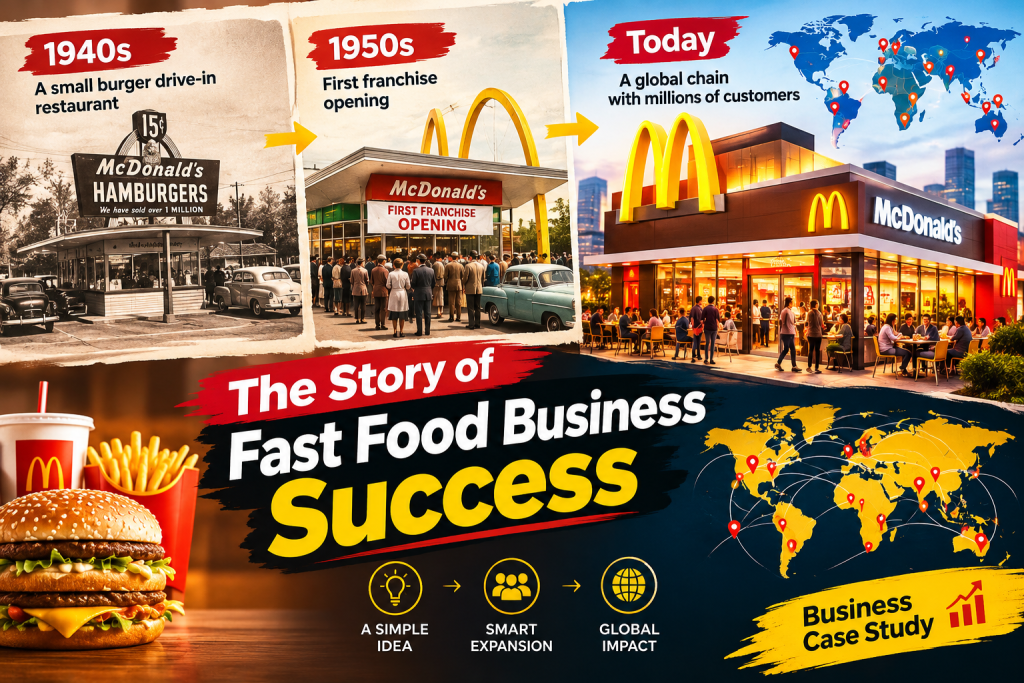
mcdonalds success story: How a 15 Cent Burger Built a 200 Billion Dollar Empire
mcdonalds success story starts with one simple problem. People were waiting too long for food.
1940. San Bernardino California.
Drive-in restaurants were everywhere. Carhops on roller skates.
You drive in, order a burger, and wait 20 minutes. By the time your food came, the movie was over.
Dick and Mac McDonald watched this every day.
They were tired of slow service, broken dishes, and employees calling in sick.
So they asked each other: What if we serve food in 30 seconds?
That one question started mcdonalds success story.
Today the company has 40,275 restaurants in 119 countries.
69 million people walk through the doors every single day.
That is more than the population of the UK.
Revenue is 25.9 billion dollars per year.
The brand is worth over 200 billion dollars.
But mcdonalds success story began with a 15 cent hamburger and a parking lot.
The Speedee Service System: The Real Invention
Before 1948 the brothers ran a regular BBQ drive-in.
They had 25 items on the menu. BBQ sandwiches, tamales, peanut shakes.
Carhops were running around. Dishes were piling up. It was chaos.
Profit was good. About 200,000 dollars a year. That was huge money back then.
But they saw the real problem. Too many choices meant the kitchen was slow.
So in 1948 they did something nobody expected.
They closed the restaurant for 3 whole months.
Their friends thought they were crazy. “You are shutting down at your peak?”
But Dick and Mac had a plan.
When they reopened, the place looked nothing like before.
Gone: Carhops. Dishes. 25 menu items. BBQ pit.
New: Walk-up windows. Paper wrappers. 9 items only.
They called it the Speedee Service System.
It was basically a factory that made food.
One person grilled burgers. One person toasted buns. One person added toppings. One person wrapped.
Burgers came out in 30 seconds. They cost 15 cents. Fries were 10 cents. Coke was 10 cents.
People didn’t just come for food. They came to watch the show.
The kitchen was fast, clean, and had zero mistakes.
By 1954 the business was making 350,000 dollars a year.
The foundation was set.
The brothers were happy. They thought the business would stay in California.
They had no idea what was coming next.
How Ray Kroc Scaled mcdonalds success story
The 52 Year Old Salesman Who Refused to Quit
1954. Ray Kroc was not living the dream.
He was 52 years old. Selling Multi-mixer milkshake machines door to door.
Business was terrible. He was 15,000 dollars in debt.
His wife was worried. His friends told him to get a real job and retire.
Then he got a strange order. One restaurant wanted 8 milkshake machines.
That didn’t make sense. One place doesn’t need 8 machines.
So Ray got in his car and drove to California to see why.
What he saw that day changed everything.
The kitchen was spotless. You could eat off the floor.
Teenagers worked like they were in the army. No talking. Just work.
Customers ordered and had food in under a minute.
There was a line out the door at 11am on a Tuesday.
Ray didn’t see a burger stand.
Ray saw this system in every town in America.
He walked up to Dick and Mac and said: “I want to franchise this.”
The brothers shrugged. “Sure. 0.5 percent royalty.”
April 15 1955. The first franchise opened in Des Plaines Illinois.
Before opening day Ray painted 4 words on the wall.
Quality. Service. Cleanliness. Value.
He told his first crew: “We are not in the burger business. We are in the show business.”
1959: 100 stores
1961: 228 stores
The brothers were getting royalty checks but they were not involved anymore.
In 1961 Ray bought the company for 2.7 million dollars.
He borrowed the money. His lawyer said it was a terrible idea.
It was the best business decision ever made.
That is when mcdonalds success story went global.
The First 1000 Stores and Growing Pains
Growing fast was not easy.
Ray had to deal with bad franchisees. People who cut corners.
Some stores were dirty. Some had bad service.
Ray’s answer was simple. Enforce the 4 rules.
Quality Service Cleanliness Value.
If you didn’t follow them, you lost your franchise.
This strict control is a huge reason why the brand worked.
Customers knew what to expect. Everywhere.
By 1965 the company went public.
By 1968 they opened store number 1000.
The brand was now a national name.
The Secret Business mcdonalds success story Model Nobody Talks About
It’s Not a Restaurant Company. It’s a Real Estate Company
Alright I am going to tell you the real truth.
And it will change how you see this brand.
The company does not make its money from burgers.
mcdonalds success story is actually a real estate story.
1956 Ray was sitting in his office doing math.
He realized something important.
If franchisees owned the building they could quit anytime.
But if the company owned the building the franchisee could never leave.
So Ray created a new company called Franchise Realty Corporation.
New rule: We buy the land. We build the store. Then we rent it to you.
How The mcdonalds success story: Actually Makes Money
Every franchise owner pays 2 bills every month.
First bill: Rent. For the land and the building.
Second bill: 4 percent royalty on all sales.
Why this model is impossible to beat:
1. Two streams of income. Rent comes in no matter what. Royalty comes in when they sell.
2. If a store fails the company still owns a building on a good corner.
3. Today the company owns 42 billion dollars worth of real estate.
Warren Buffett said it once and he was right.
“McDonald’s is a real estate company that happens to sell hamburgers.”
That is the financial engine.
The burgers pay the rent. The real estate builds the empire.
The Franchise Model That Built an Empire
Ray didn’t build 40,000 stores. Other people did.
With their money. With their risk.
That is franchising. That is how the brand scaled so fast.
Franchise fee was 950 dollars in the beginning.
Today it is 45,000 dollars.
But the real money is in the rent and royalty for 20 years.
This model meant the company could grow with almost no debt.
Other restaurant chains had to borrow money to build stores.
McDonald’s let franchisees do it.
Marketing Strategies That Won the World
Selling Feelings Not Food
Think about the last McDonald’s ad you saw.
Did it talk about protein? About calories? About grass fed beef?
No.
The brand sells you a feeling.
1963: Ronald McDonald showed up. To talk to kids.
1968: Big Mac came out. To talk to adults who wanted more.
1979: Happy Meal launched. To talk to parents.
Every product had a target audience.
The Power of Consistency
Here is why the company beat everyone.
A Big Mac in Dhaka tastes exactly like a Big Mac in New York.
Same bun. Same sauce. Same 2 patties. Same pickles.
That consistency built trust.
And trust is what built this empire.
In 2003 they spent 1.3 billion dollars on 3 words: I’m Lovin It.
It is still running 22 years later. That is how strong the brand is.
Going Local to Win Global
You cannot sell the same burger everywhere.
That is why the company adapts.
McAloo Tikki in India.
Rice Burger in Japan.
McSpicy in Asia.
McArabia in the Middle East.
Global brand. Local menu.
This is how the business won in 119 countries.
mcdonalds success story:9 Business Lessons From This Empire
I have studied this company for years.
Here are the 9 lessons that actually matter for your business.
Lesson 1: System First, Product Second
The brothers didn’t have the best burger in town.
They had the fastest system in town.
If you want your own success, systemize everything first.
Document your process. Make it fast. Make it repeatable.
Lesson 2: Scale With Other People’s Money
Ray Kroc did not build 40,000 stores.
Franchisees did. With their money. Their risk.
That is franchising. That is how the brand scaled so fast.
Use OPM. Other People’s Money.
Lesson 3: Own The Important Assets
Never rent what you can own.
The company owns the land under 70 percent of stores.
That is why the business can never be kicked out.
Control the asset and you control the business.
Lesson 4: Obsess Over Consistency
Customers need to know what they will get.
Every time. In every country.
That reliability is half the battle.
Boring is good in business.
Lesson 5: Keep It Dumb Simple
9 items. Then 30 items. Never 200 items.
Complexity kills profit.
Simplicity is what built the empire.
Do fewer things but do them perfect.
Lesson 6: Sell Emotion Not Food
Nobody goes to McDonald’s for nutrition.
They go because it reminds them of childhood.
They go because it is fast and easy.
Market the feeling. Not the product.
Lesson 7: Think Global, Act Local
You cannot sell the same burger everywhere.
The company adapts to local taste.
This respect for local culture is why the brand works worldwide.
Lesson 8: Never Stop Innovating
1975: Drive-thru invented.
1975: Breakfast added.
2015: Mobile app.
2018: Self-order kiosks.
The business reinvents itself every 10 years.
If you stop changing you die.
Lesson 9: Play the Long Game
Ray Kroc was 52 when this really started.
He worked until he was 81.
Most people quit too early.
This story proves that starting late is fine. Just don’t stop.
Big Problems and How The Brand Survived
The Super Size Me Disaster 2004
2004. A guy named Morgan Spurlock made a documentary.
He ate McDonald’s for 30 days straight. Got fat. Got sick.
Sales dropped overnight.
Stock dropped. The news was brutal.
How did the company respond?
They listened.
They killed the Super Size option.
They added salads. Fruit. Oatmeal. Grilled chicken.
They put calories on the menu boards.
They didn’t fight the criticism. They adapted.
That is why the brand is still here.
Becoming a Technology Company
Between 2015 and 2020 the company spent 6 billion dollars on tech.
Self-order kiosks so you don’t talk to anyone.
Mobile app for ordering ahead.
Delivery with Uber Eats and DoorDash.
Digital menu boards that change prices.
The business realized something.
We are not just selling food. We are selling convenience.
So the company became a tech company.
Labor and Wage Challenges
In the last 10 years the brand faced protests for 15 dollar minimum wage.
The answer was automation.
Kiosks. Mobile ordering. Kitchen robots.
Every problem became an opportunity to get more efficient.
The Future of The Brand
This story is not over. Not even close.
Here is what is coming next:
1. AI drive-thrus that remember your order and suggest food.
2. More plant based options like the McPlant.
3. Goal of 50,000 stores by 2028.
4. More delivery and ghost kitchens.
The next chapter will be digital and even faster.
FAQ About The Business mcdonalds success story
When dd it start
mcdonalds success story started in 1940 with Dick and Mac McDonald in San Bernardino.
Franchising started in 1955 when Ray Kroc opened store number 1.
Who built it
The McDonald brothers created the system and the speed.
Ray Kroc took that system and built the brand around the world.
How does it make money
Three ways.
Company owned store sales.
Rent from franchisees.
4 percent royalty on franchise sales.
Real estate is the biggest part.
How many restaurants are there
As of 2025 the company has 40,275 restaurants in 119 countries.
69 million customers every day.
What is the number 1 lesson
System plus Consistency plus Real Estate.
Copy those 3 things and you can build your own success story.
Final Thoughts: Write Your mcdonalds Success Story
Here is what this story really proves.
You do not need the best product.
You need the best system to deliver an okay product.
The burger did not change the world.
The process did.
If you want your own success remember these 4 things.
1. Be fast. People will pay to save time.
2. Be consistent. Be the same everywhere.
3. Own the assets. Land. Brand. System.
4. Sell the feeling. Not the product.
That is the formula in one paragraph.
Ray Kroc was 52 years old and 15,000 dollars in debt when this began.
He had every excuse to quit.
What is your excuse?
Stop waiting. Start building your success story today.


