
Great Depression: The 10 Years That Broke America
Great Depression
What was the Great Depression?
Imagine waking up.
You go to the bank.
There’s a line for 3 blocks.
A sign on the door: “Closed. No Money Left.”
Your life savings are inside.
Now imagine that for 10 years.
1929 to 1939.
That was the Great Depression.
The richest country on earth. Broke.
25% people had no job.
9,000 banks closed forever.
15 million people jobless.
GDP fell 30%.
World trade fell 65%.
Kids wore shoes with cardboard.
Men sold apples for 5 cents.
Farmers burned corn to stay warm.
This is not a story from a book.
This is what happened in America.
And it can happen again if we forget.
So let’s talk about the history of the Great Depression.
The real history.
Why it started.
How people lived.
How we got out.
And what it taught us.
Why Should You Care About 1929 in 2026?
Because we are making the same mistakes.
Too much debt.
Too much “this time is different”.
Too much trust in money.
1929. 2008. 2020.
Different years. Same pattern.
If you read this one time, you will never invest blindly again.
You will never trust a bubble again.
Let’s start.
Great Depression
The Roaring 20s: The Decade That Lied To Everyone
1920s. They called it “The Roaring 20s”.
And it did roar.
Cars.
Radios.
Movies with sound.
Jazz music.
Flappers dancing.
Prohibition. Secret bars.
America felt like heaven.
The stock market went up every single week.
From 1921 to 1929, Dow Jones went from 63 to 381.
That’s 600% in 8 years.
Everyone was getting rich.
On paper.
Everyone Became A Stock Expert Overnight
Your barber gave stock tips.
Your maid owned 3 stocks.
Your taxi driver talked about “buying the dip”.
People didn’t care what the company did.
They just cared that the price went up.
The reason? “Margin”.
It was like a drug.
You have $100.
Bank lends you $900.
You buy $1000 of stock.
If stock goes up 10%, you make $100.
You doubled your money.
If stock falls 10%, you lose everything.
And you still owe the bank $900.
Banks loved it. More loans = more fees.
Brokers loved it. More trades = more commission.
Nobody asked: “What if it falls?”
The Hidden Crack
While Wall Street partied, Main Street suffered.
Factories were making too much stuff.
10 million cars.
Millions of radios and fridges.
But worker pay was stuck.
$1200 a year was normal.
A car cost $800.
Farmers were poor.
Crops prices were low.
Europe was broke after World War 1.
So they couldn’t buy American stuff.
Who would buy all this stuff?
Nobody.
But nobody cared.
Because the stock market was going up.
And when the market goes up, people feel rich.
Even if they’re broke.
It was a bubble.
Built on credit.
And bubbles always pop.
Great Depression
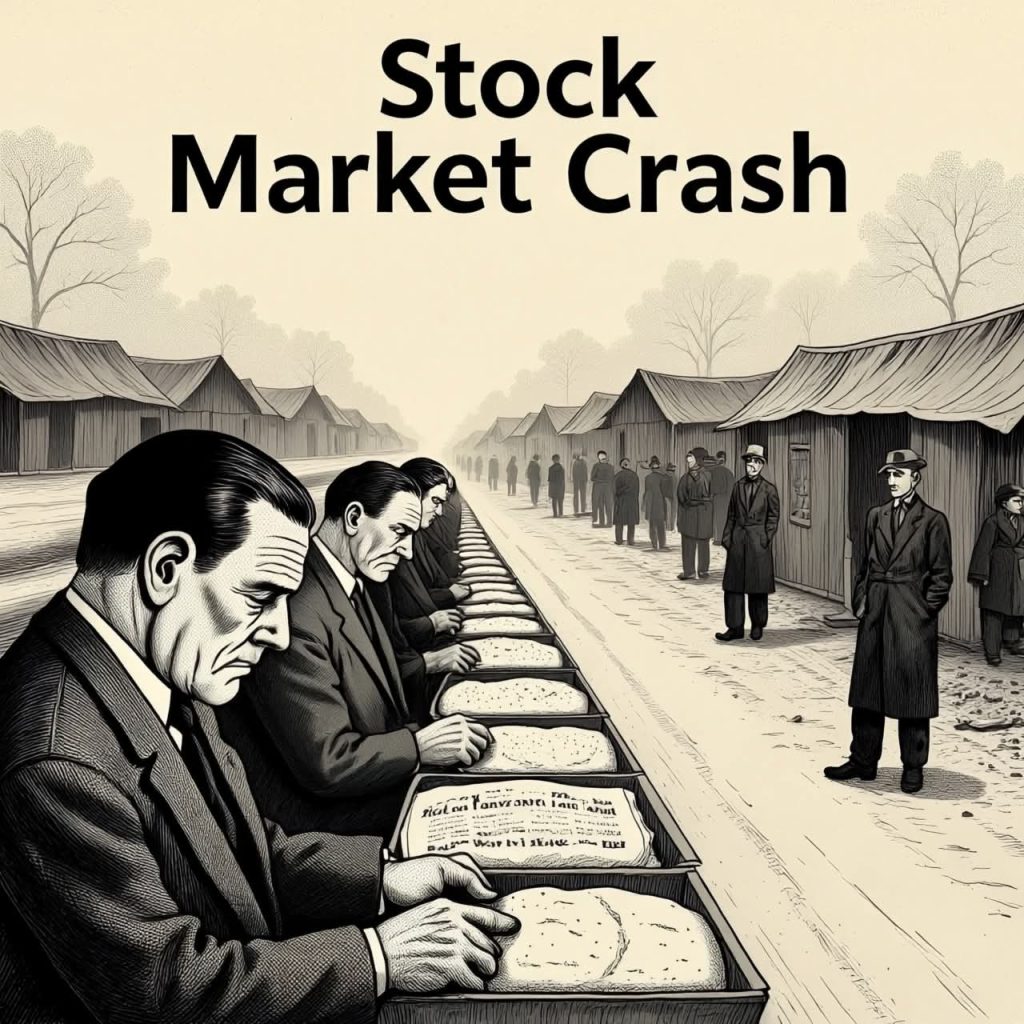
1929: The Crash That Changed Everything
Black Thursday: October 24, 1929
First warning sign.
The market opened.
And fell. And fell.
11% in one day.
Panic.
Big bankers met.
Pumped millions into the market.
Stopped the bleeding.
Newspapers said: “Just a bad day. Market is healthy.”
People believed them.
Black Tuesday: October 29, 1929
This was the day the world broke.
The market opened.
And crashed.
23% in 2 days.
$30 billion gone.
That’s $500 billion in today’s money.
Phone lines jammed.
Brokers stopped answering.
People ran to banks.
Lines around the block.
“Give me my money!”
Bank teller: “Sorry. We don’t have it.”
That night in New York.
Men jumped from tall buildings on Wall Street.
Newspapers didn’t report it.
Too much panic already.
The American Dream died that day.
The Banks: 9,000 Of Them Died
1929 to 1933.
9,000 banks closed.
There was no FDIC.
No government insurance.
If your bank closed, your money was gone.
A teacher saved $5000 for 40 years.
Bank closed.
She got zero.
She cried for weeks.
A farmer had $4000.
Bank closed.
He went home and shot himself.
People lost trust.
And without trust, money is just paper.
Great Depression
Life In Hell: How People Survived 1930-1939
Textbooks give you numbers.
I will give you life.
No Job Means No Food
1933. Worst year.
Unemployment: 25%.
1 in 4 people.
Men in suits stood in “bread lines”.
Waited 4 hours for 1 loaf of bread.
And soup.
Soup kitchens opened in every city.
1 bowl a day.
Kids went to school hungry.
Teachers said kids fainted in class.
A mother wrote to President Roosevelt:
“My 3 children have not eaten in 2 days. Please help.”
Hoovervilles: Cities Of Shame
People lost homes.
They couldn’t pay rent.
So they built new homes.
From cardboard.
From tin.
From wood scraps.
In Central Park, New York.
In Seattle.
In every big city.
They called them “Hoovervilles”.
Named after President Hoover.
Because people blamed him.
The Dust Bowl: When The Sky Turned Black
1930 to 1936.
No rain in the Great Plains.
Oklahoma. Texas. Kansas. Nebraska.
The soil turned to dust.
Then came the “Black Blizzards”.
Walls of dust 1000 feet high.
Blocked the sun.
You couldn’t breathe.
Farmers coughed blood.
Crops died.
Cattle died.
2.5 million people packed their cars.
Left everything.
Drove to California.
They were called “Okies”.
They slept in ditches.
Picked fruit for 5 cents a bucket.
John Steinbeck saw this.
He wrote “The Grapes of Wrath”.
It broke everyone’s heart.
The Cruelest Irony: Burning Food While People Starved
This made no sense.
Farmers grew corn.
Cost to grow: 20 cents.
Price: 10 cents.
So they burned corn to heat their homes.
Poured milk into rivers.
Killed pigs and left them.
10 miles away, children were hungry.
The system was completely broken.
Great Depression
FDR, The New Deal, And World War 2: The Way Out
1932. Election year.
Herbert Hoover lost badly.
People wanted someone to do something.
Franklin D. Roosevelt won.
FDR’s First 100 Days
March 1933.
His first act: “Bank Holiday”.
Close all banks for 4 days.
Stop the panic.
Then radio.
His voice came into every home.
“The only thing we have to fear is fear itself.”
People cried.
For the first time, someone saw them.
The New Deal: 3 R’s
1. Relief: Stop People From Starving
CCC: Civilian Conservation Corps
Hired 3 million young men.
$30 a month. Room and food.
They built roads. Parks. Dams.
FERA: Gave money to states.
To feed people now.
2. Recovery: Restart The Economy
NRA: National Recovery Administration
Set minimum wages.
Set prices.
So companies wouldn’t cut pay to zero.
AAA: Agricultural Adjustment Act
Paid farmers to grow less.
So food prices would go up.
3. Reform: Never Let This Happen Again
This was the most important.
1933 Glass-Steagall Act:
Split normal banks from risky Wall Street banks.
Your savings can’t be gambled on stocks.
1935 Social Security Act:
If you are 65, you get monthly money.
So old people won’t be poor.
1933 FDIC:
Government insures your bank deposits.
Up to $250,000.
Now if bank fails, you don’t.
Did The New Deal End The Depression?
Half yes.
Unemployment fell from 25% to 14%.
People had jobs.
People had hope.
But the economy was still sick.
What Really Ended It: World War 2
December 7, 1941. Pearl Harbor.
Japan bombed US.
US entered World War 2.
Government spent $300 billion.
$5 trillion today.
Hired everyone.
12 million men in army.
10 million women in factories.
“Rosie the Riveter”.
Built ships. Planes. Tanks. 24/7.
By 1944 unemployment was 1.2%.
The Great Depression was over.
Not because of New Deal alone.
Because government spent huge money on war.
3 Brutal Lessons From The Great Depression
1. Greed Comes In Cycles
1929: Stocks
1987: Stocks
2008: Houses
2021: Crypto and NFTs
Different toy. Same greed.
“Prices will never fall” – famous last words.
2. Speed Saves Economies
1929: Hoover waited 3 years. Made it worse.
1933: FDR acted in 100 days. Slowed it.
2008: Government bailed out banks in 2 weeks. Stopped depression.
When crisis hits, waiting kills.
3. Money Is Trust
Money is not paper.
Money is not gold.
Money is trust.
Trust in banks.
Trust in government.
When trust dies, economy dies.
That’s why FDIC and Social Security matter so much.
Could The Great Depression Happen Again in 2026?
Short answer: No. Not like 1929.
Why we are safer now:
1. FDIC: Your bank money is insured
2. Federal Reserve: Can print money in 24 hours
3. Unemployment: 26 weeks of benefits
4. Social Security: Old people won’t starve
We can have a bad recession.
12 months. Maybe 18 months.
But not 10 years.
Unless we forget history.
And repeat the same debt and greed.
Stories That Still Break My Heart
The Apple Seller
1928: Wall Street banker.
1931: Standing on street corner.
“Apples 5 cents” on a box.
The Coffee Can Grandma
Her bank died in 1931.
She took $2000 cash.
Put it in coffee can.
Buried under apple tree.
Never trusted banks again. For 40 years.
The Shoeless School Boy
School photo 1934.
All kids had holes in shoes.
Stuffed with newspaper.
Principal said: “But they come to school every day.”
The Dust Bowl Mother
“Dust came through windows.
We put wet towels under doors.
Kids wore wet rags on face to sleep.
Woke up with dirt in mouth.”
This was the Great Depression.
It was not a graph.
It was people.
FAQ – Great Depression
1. Great Depression: When did it start and end?
Started October 29, 1929 with stock crash. Ended 1939-1941 when World War 2 started.
2. What caused the Great Depression?
Stock market crash + 9000 bank failures + too much debt + Smoot-Hawley tariff + government did nothing at first.
3. How many people lost jobs?
15 million people. 25% unemployment at peak in 1933.
4. What did FDR do during the Great Depression?
New Deal. Created jobs, insured banks with FDIC, started Social Security.
5. How did the Great Depression finally end?
World War 2. Massive government spending and full employment in factories.
Read more:https://worldhistorytales.com/biggest-economic-crisis/


