
The French Revolution: The Bloody Siege of the Royal Palace
Introduction: The French Revolution Began With a Door Being Broken Down
The French Revolution wasn’t born in a meeting room.
It was born on a street. With shouting. With blood.
August 10, 1792. 6 in the morning. Paris was hot and angry.
20,000 people were marching toward the Tuileries Palace. Inside that palace was King Louis XVI.
A man who thought God picked him to rule France.
By 5 in the afternoon, 800 people were dead.
The Swiss Guards who protected the king were slaughtered.
And the king was in prison.
The French Revolution was a bloody siege of the royal palace that altered the political map of the world.
After that day, kings everywhere got scared.
Because for the first time, regular people proved they could drag a king out of his own house.
Why This Still Hits Hard
Because it wasn’t armies. It was bakers. It was women. It was angry people with kitchen knives.
And they won.
1. The French Revolution Before August 10: It Started With Bread
You can’t understand the siege without understanding the hunger.
July 14, 1789: The Bastille
People were starving. Bread cost almost everything they earned.
So they stormed a prison called the Bastille to get guns and gunpowder.
The king backed down. For 3 years France tried to have a king AND a parliament.
It Failed
King Louis XVI hated sharing power.
He secretly wrote to Austria: “Come help me crush these people.”
When the people found the letters, they called him a traitor.
2. The French Revolution in 1792: War and Rage
By 1792, everything was falling apart.
France Declared War
In April 1792, France went to war with Austria and Prussia.
The problem? The queen, Marie Antoinette, was Austrian.
So people said, “The king is helping our enemies kill us.”
Paris Was a Powder Keg
No jobs. Bread prices doubled.
And the king was still living like a god in the Tuileries Palace.
Something had to give.
3. The French Revolution and August 10: The March to the Palace
This is the day that changed everything.
20,000 People Walked
From the poor neighborhoods. Armed with pikes, old guns, and fury.
Their goal was simple: “Get the king. End the monarchy.”
Inside the Palace
600 Swiss Guards. Professional soldiers.
The king had one choice: fight or run.
He decided to stay and fight.
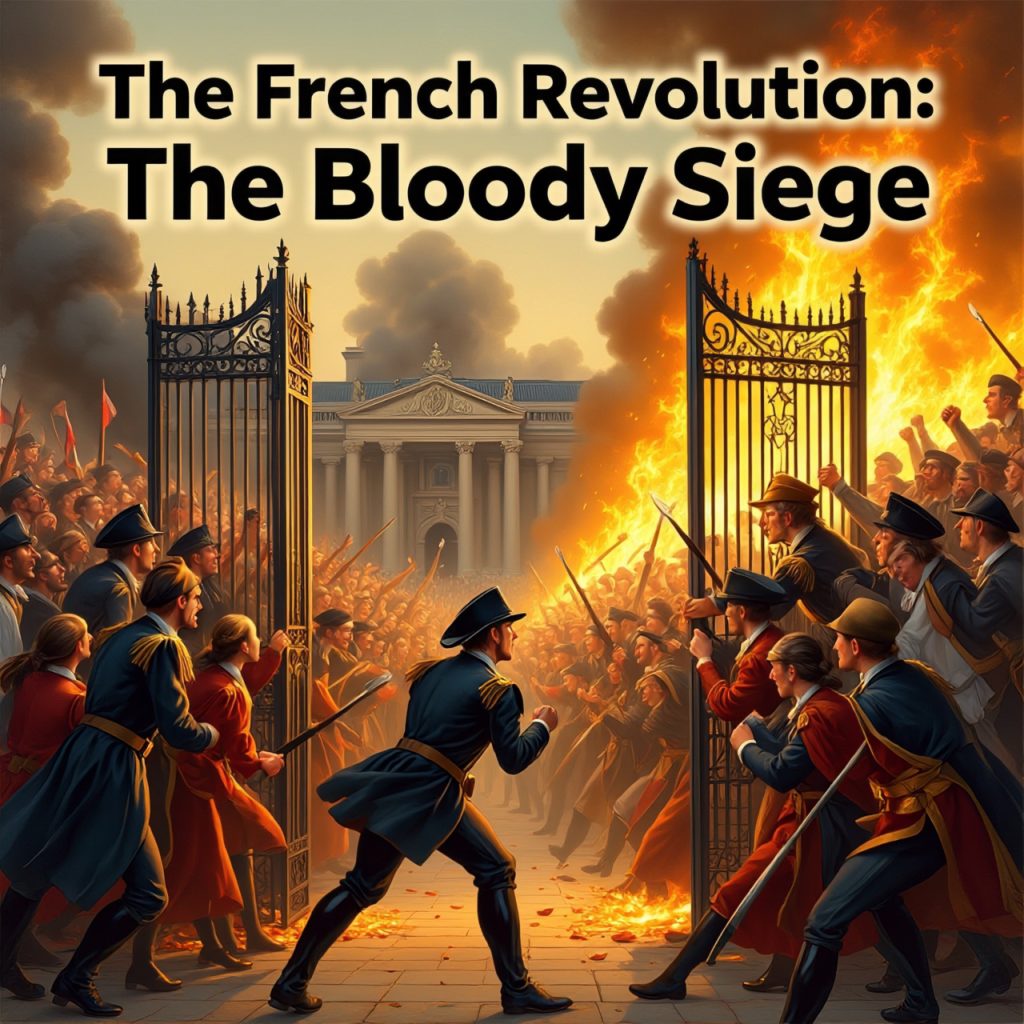
4. The Bloody Siege of the Royal Palace
Three hours. That’s all it took.
9 AM: The Guns Fired
No one knows who shot first.
The Swiss Guards fired into the crowd. 200 people fell.
The crowd lost it. They broke the gates. They poured inside.
Room by Room
The fighting was brutal.
The Swiss Guards were outnumbered 30 to 1.
When some surrendered, the crowd killed them anyway.
They dragged bodies into the garden and stabbed them.
By noon, it was over. 600 Swiss Guards dead. 200 citizens dead.
The palace was full of blood.
5. The French Revolution Ends the Monarchy
The king ran to the parliament building next door.
“I Surrender to the Law”
That’s what Louis XVI said.
He, Marie Antoinette, and their kids were arrested.
Four Months Later
January 21, 1793. The king lost his head to the guillotine.
Six months later, the queen did too.
France was now a Republic. No king. No queen. Ever again.
6. After the Siege: The Reign of Terror
Winning made the revolutionaries paranoid.
1793 to 1794: 17,000 Executions
The new government was terrified of enemies.
So they killed anyone who looked suspicious.
Nobles. Priests. Even other revolutionaries.
The Guillotine Became Normal
People brought lunch to watch executions.
That’s how far things had gone.
7. How The French Revolution Altered the Political Map of the World
This is why we still talk about it.
Reason 1: Kings Were No Longer Safe
Before 1789, kings said “God put me here.”
After 1792, people said “We put you here. And we can remove you.”
That idea spread to every country.
Reason 2: The Idea of a Nation
People stopped fighting for “the king.”
They started fighting for “France.”
That’s where modern nationalism was born.
Reason 3: Human Rights
In 1789 they wrote: “All men are born free and equal.”
The US copied it. The UN copied it.
We’re still using it today.
8. What It Felt Like Inside the Palace That Morning
Imagine being there.
The Royal Family
Louis, Marie, and their two children were locked in a small room.
They could hear the screaming getting closer.
Marie was crying. Louis was just quiet.
The Swiss Guards
They knew they were going to die.
They were foreigners. No one in France liked them.
But they stood and fought anyway. All 600 of them.
9. The French Revolution and Napoleon: From Freedom to Emperor
The revolution went crazy.
10 Years of Chaos
Five different governments in 10 years.
Constant war. Constant fear.
1799: Napoleon Takes Over
A young general named Napoleon Bonaparte staged a coup.
He said he would “save” the revolution.
Then he crowned himself Emperor.
The revolution killed one king… and made another one.
10. The 5 Real Reasons The French Revolution Happened
It wasn’t just about bread. Though bread mattered.
1. Bankruptcy:France was broke from helping America and fighting wars.
2. Unfair Taxes: Nobles paid nothing. Poor people paid everything.
3. New Ideas: Books said people should rule themselves.
4. Weak King: Louis XVI couldn’t make a decision.
5. Bad Harvest: 1788. Food prices exploded.
11. The Women of The French Revolution
Women were in the front lines.
The Women’s March on Versailles, October 1789
7,000 women marched 12 miles.
They were mad about bread.
They brought the king and queen back to Paris at gunpoint.
Olympe de Gouges
She wrote “Women have rights too.”
They executed her in 1793 for it.
12. Symbols of The French Revolution
Revolutions need logos.
The Red Phrygian Cap
It meant “I am free.” Everyone wore one.
“Liberty Leading the People”
A famous painting. A woman with a flag, stepping over dead bodies.
That’s the French Revolution in one picture.
13. The French Revolution vs The American Revolution
Both in the 1700s. Both about freedom. Very different.
America
Fought a king across the ocean. Kept their rich leaders.
Ended with a constitution.
France
Fought their own king in their own streets.
Killed their rich leaders.
Ended with 10 years of chaos.
America got George Washington. France got Napoleon.
14. How Long Did The French Revolution Last
10 years. 1789 to 1799.
From the Bastille to Napoleon.
10 years that ended 1000 years of kings ruling Europe.
15. The French Revolution Today: You Still Live In It
We use their words every day.
Left and Right
Comes from France.
Radicals sat on the left in parliament.
Royalists sat on the right.
We still use those terms.
Every Revolution Since
Haiti 1804. Latin America 1810. Russia 1917.
They all copied France.
16. Final Thoughts: The Price of The French Revolution
The French Revolution was brutal. And it was necessary.
What It Cost
40,000 people dead. A king and queen executed.
A decade of war.
What It Gave Us
Democracy. The idea that power comes from people.
Human rights.
The bloody siege of the royal palace on August 10, 1792 altered the political map of the world.
After that day, no ruler could ever feel safe again.
Because the people had learned one thing: we are stronger than you.
Frequently Asked Questions About The French Revolution
1. What was The French Revolution?
The French Revolution was from 1789 to 1799. French citizens overthrew the monarchy and established a republic based on liberty, equality, and fraternity.
2. What happened on August 10, 1792?
A crowd stormed the Tuileries Palace in Paris. They killed the king’s guards. The king was arrested and the monarchy was ended.
3. Why did people hate King Louis XVI?
He was seen as weak, wasteful, and a traitor for asking foreign countries to invade France.
4. What was the Reign of Terror?
From 1793 to 1794, the government executed 17,000 people by guillotine to eliminate enemies of the revolution.
5. Did The French Revolution succeed?
Yes and no. It ended the monarchy and spread democracy. But it also led to violence and then Napoleon’s dictatorship.
6. Who was Marie Antoinette?
The queen of France. She was hated for her spending and her Austrian background. She was executed in 1793.
7. How did The French Revolution change the world?
It spread democracy, nationalism, and human rights. It inspired revolutions around the world for the next 200 years.
8. Can you visit the Tuileries Palace today?
No. It was burned down in 1871. Only the gardens remain next to the Louvre in Paris.
9. What does “Liberty, Equality, Fraternity” mean?
It was the slogan of the revolution. Freedom, equal rights, and brotherhood.
10. Why is The French Revolution important today?
Because it was the first modern revolution. It proved that people could overthrow a government and change how the world is run.
Anchor Text: Louvre French Revolution Collection
Link: https://www.louvre.fr/en/departments/french-revolution


