
A Miraculous Night Amidst The War: How Enemy Soldiers Celebrated Christmas Together During World War I In 1914
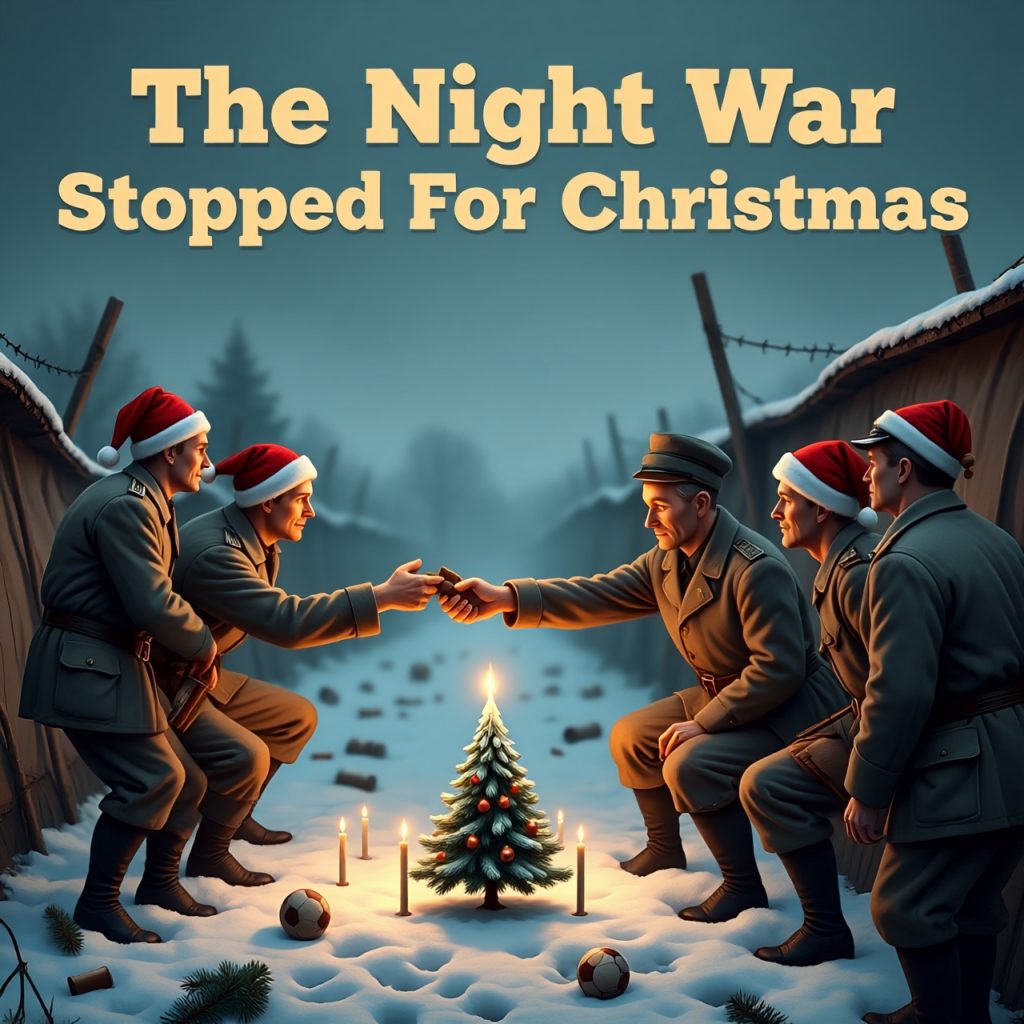
A Miraculous Night Amidst The War: How Enemy Soldiers Celebrated Christmas Together During World War I In 1914
Christmas Truce 1914.
Picture this.
It is December 24th, 1914.
You are 19 years old. You are lying in a trench in Belgium.
Mud up to your knees. Rats running over your boots. The smell of death everywhere.
For 5 months you have been trying to kill the man in the trench 60 yards away.
His name is Fritz. That is what you call all Germans.
Tonight is Christmas Eve.
You are thinking about home. About your mum’s cooking. About whether you will ever see her again.
Then you hear something.
Singing.
From the German trench.
“Stille Nacht, Heilige Nacht.”
Silent Night.
And for one night, the war stopped.
This is the true story of the Christmas Truce 1914. A night so human, so impossible, that generals tried to erase it from history.
Imperial War Museum Christmas Truce Letters
Chapter 1: August To December 1914 – How We Got Here
The War That Was Supposed To End By Christmas
When the war started in August 1914, everyone was excited.
“Home by Christmas” the posters said.
Young men signed up with flowers in their rifles.
The British thought it would be over in weeks. The Germans thought they would march into Paris in a month.
Nobody was right.
By September the Germans were stopped 20 miles from Paris at the Battle of the Marne.
Then both sides started digging.
400 miles of trenches from Switzerland to the sea.
This is where the Christmas Truce 1914 would happen.
Life in the trenches was hell.
You lived with mud, lice, and dead bodies.
You ate bully beef and hard bread.
Every day you watched your friends get shot by a sniper you could not see.
By December morale was low.
Soldiers were writing home saying “I don’t even know why we are fighting anymore.”
The Germans were thinking the same thing.
Both sides were cold, tired, and homesick.
That is why when Christmas came, something broke.
Chapter 2: Christmas Eve 1914 – The Singing Begins
When The Guns Went Quiet
December 24th. Night.
It was freezing. The ground was hard with frost.
On the German side of the line near Ypres, Belgium, small lights started appearing.
Candles. Tied to little Christmas trees.
The Germans had brought them from home.
Then the singing started.
First one voice. Then ten. Then hundreds.
“Stille Nacht.”
Across no man’s land, British soldiers listened.
Private Albert Moren of the British 2nd Queen’s wrote later: “I shall never forget it. It was one of the most wonderful things I have ever seen.”
Then the British started singing back.
“God Rest Ye Merry Gentlemen.”
For a few hours, no one fired a shot.
Then the shouting started.
“Merry Christmas Tommy”
“Merry Christmas Fritz”
Tommy was what Germans called British soldiers. Fritz was what British called Germans.
Can you imagine it.
5 months of trying to kill each other.
And now you are wishing each other Merry Christmas.
This was how the Christmas Truce 1914 began. Not with orders. With music.
Chapter 3: Christmas Morning – Climbing Out
The Bravest Walk Of The War
December 25th. Dawn.
Fog was thick. You could not see 10 feet.
At around 8 AM, something happened that should have gotten a man shot.
A German soldier climbed out of his trench.
Hands in the air. No rifle.
He walked into no man’s land.
He was yelling “Merry Christmas. We do not shoot.”
British soldiers in the trench watched. Fingers on triggers.
Then one British soldier stood up.
Then another.
Within 30 minutes, hundreds of men were standing in no man’s land.
Enemies shaking hands.
One British soldier described it: “We met in the middle and shook hands. It felt like meeting a long lost brother.”
They exchanged things.
Germans gave cigars and sausage.
British gave cigarettes and plum pudding.
They showed photos.
“Look, this is my wife.”
“Look, this is my baby daughter.”
For the first time, they saw the enemy as people.
This is the heart of the Christmas Truce 1914.
Chapter 4: Burying The Dead Together
Humanity Before War
One of the saddest parts of trench warfare was the dead.
For weeks bodies lay between the lines.
You could smell them.
On Christmas Day, that changed.
British and German soldiers worked together to bury them.
They dug graves.
They said prayers.
Sometimes together. Sometimes separately.
A German priest and a British chaplain held a joint service.
One soldier wrote: “We buried 12 men today. 6 British, 6 German. We all cried.”
Think about that.
Men who were trying to kill each other yesterday were now crying over each other’s friends.
The Christmas Truce 1914 was not just about fun.
It was about grief.
Chapter 5: The Football Match
The Story We All Know
Now let’s talk about the football.
Did it really happen.
Yes. Multiple times.
The most famous account comes from Private Frederick Heath of the Royal Berkshire Regiment.
He wrote home: “A football match was arranged. The Germans won 3-2. The ground was awful but we played anyway.”
Another soldier, Lieutenant Kurt Zehmisch, German: “We played a game of football. It was very rough but very friendly.”
They used anything as a ball. Sometimes a real ball. Sometimes a tin can.
The pitch was frozen, full of shell holes.
They played anyway.
For 90 minutes there was laughter.
For 90 minutes no one thought about war.
The Christmas Truce 1914 football match became legend because it was so simple.
Two teams. One game. No hate.
Chapter 6: Letters Home – The Proof
What The Soldiers Actually Wrote
The army tried to censor everything. But letters got through.
Here are real words from real men.
British Private George Ashworth: “We had a great time. The Germans were very decent fellows.”
German soldier: “We exchanged addresses. I promised to write to an English soldier after the war.”
British Officer: “It was the most extraordinary sight. Officers and men fraternizing all over the place.”
These letters were not published until years later.
The government did not want people to know.
Because if soldiers knew the enemy was human, they might not want to fight.
The Christmas Truce 1914 was dangerous to the war effort.
Chapter 7: Why Did It Happen
The 4 Reasons Historians Agree On
Reason 1: Christmas
Both armies were Christian. Both missed home. The holiday broke through the hate.
Reason 2: The Trenches Were Close
In some places only 30 meters apart. You could hear the enemy breathing.
Reason 3: No One Wanted To Be There
After 5 months, the “glory of war” was gone. It was just mud and death.
Reason 4: No Orders To Attack
High command did not plan any big attacks for Christmas. So junior officers did nothing.
The Christmas Truce 1914 was not planned. It was human nature.
Chapter 8: The Generals Found Out And Got Angry
“This Must Never Happen Again”
By December 26th, reports reached headquarters.
The British High Command was furious.
General Sir Horace Smith-Dorrien wrote: “Such conduct is unthinkable.”
The German High Command was the same.
Orders went out immediately.
“Any fraternization with the enemy will be punished.”
For Christmas 1915, they made sure it did not happen.
They ordered heavy artillery bombardments on Christmas Day.
They moved units around so British and German soldiers who had met would not meet again.
The Christmas Truce 1914 was officially buried.
Chapter 9: Did It Happen Everywhere
The Truth About How Big It Was
No. It did not happen along the entire 400 mile front.
It happened in about 100 places.
Mostly in the British and German sectors in Belgium.
French and German troops also had truces in some areas.
Russian and German troops had small truces on the Eastern Front.
But in other places, fighting continued.
Some commanders refused to allow it.
So maybe 100,000 soldiers out of 2 million took part.
But for those 100,000, it was real.
Chapter 10: Christmas 1915, 1916, 1917
Why It Never Happened Again
Soldiers tried.
In 1915, some British shouted “Merry Christmas” across.
The Germans answered with machine gun fire.
By 1916 the war was too bitter.
Gas had been used. Millions were dead.
Hatred was too deep.
The Christmas Truce 1914 was a one time thing.
A moment that could not be repeated.
Chapter 11: 15 Personal Stories That Will Break You
1. A British soldier traded a tin of bully beef for a German helmet
2. A German showed a British soldier a photo of his newborn son
3. Two officers exchanged whisky for schnapps
4. Men played cards in no man’s land
5. A barber from each side cut each other’s hair
6. They helped each other fix trench walls
7. A German band played and British clapped
8. Soldiers swapped addresses and promised to meet after war
9. A priest gave communion to both sides
10. Men collected souvenirs together
11. They agreed not to shoot if someone was collecting firewood
12. A British and German soldier played the harmonica together
13. They talked about football teams back home
14. A German gave a British soldier his Iron Cross to hold
15. They promised not to shoot at each other the next day
Chapter 12: The Aftermath For The Soldiers
What Happened To The Men Who Took Part
Most went back to fighting on December 27th.
Some were punished. One British officer was sent home.
Many felt guilty. “How could we laugh with them and then try to kill them.”
Others felt changed forever.
Private Roland Smith wrote 50 years later: “It was the best and worst day of the war.”
The Christmas Truce 1914 haunted them.
Because it showed them what war was stealing.
Chapter 13: How The World Found Out Christmas Truce 1914
Censorship And The Truth
During the war, newspapers were not allowed to print it.
It made the army look bad.
The first stories came out in 1915 in small papers.
The full story did not come out until the 1930s when soldiers started publishing memoirs.
Today we have over 200 letters and diaries describing it.
The Christmas Truce 1914 is one of the best documented events of WW1.
Chapter 14:Christmas Truce 1914 The Legacy Today
Why We Still Remember
In 2005 the movie “Joyeux Noel” was made about it.
In 2014 Sainsbury’s made a commercial recreating the football match. It made millions cry.
There is a memorial in Belgium that says: “Here in 1914 the Christmas Truce happened.”
Schools teach it because it teaches one lesson.
War is made by politicians. Peace is made by people.
The Christmas Truce 1914 proves that.
Chapter 15: What If It Had Spread
The Big What If
Historians ask: What if the whole front had joined in.
What if soldiers had refused to go back.
The war might have ended in 1914.
But it didn’t.
The machine of war was too big.
Still, for one night, the machine stopped.
And that matters.
Chapter 16: Final Thoughts Christmas Truce 1914
A Miraculous Night Amidst The War
December 25, 1914.
In the middle of the worst war humanity had ever seen, men chose peace.
They put down their rifles.
They picked up a football.
They sang carols together.
The Christmas Truce 1914 did not win the war.
It did not save millions of lives.
But it saved something else.
It saved our faith in humanity.
100 years later we still tell the story because we need to.
We need to remember that even in hell, people can choose to be human.
That is the real miracle of the Christmas Truce 1914.
Frequently Asked Questions Christmas Truce 1914
1. What was the Christmas Truce 1914
An unofficial ceasefire on Christmas Day 1914 when British and German soldiers stopped fighting and celebrated together.
2. Did the football match really happen
Yes. Multiple soldiers from both sides wrote about playing football in no man’s land.
3. How many soldiers took part
About 100,000 soldiers in roughly 100 locations along the Western Front.
4. Why did the truce end
High command ordered it to stop and made sure it never happened again.
5. Was anyone punished
Some officers were reprimanded but most soldiers faced no punishment.
6. Where can I visit the site today
Near Ypres in Belgium. There are memorials in Ploegsteert and Frelinghien.
7. Is the Christmas Truce 1914 story true
Yes. It is confirmed by hundreds of letters and diaries from both sides.


