History of Encryption: From Ancient Ciphers to Quantum Security 2026
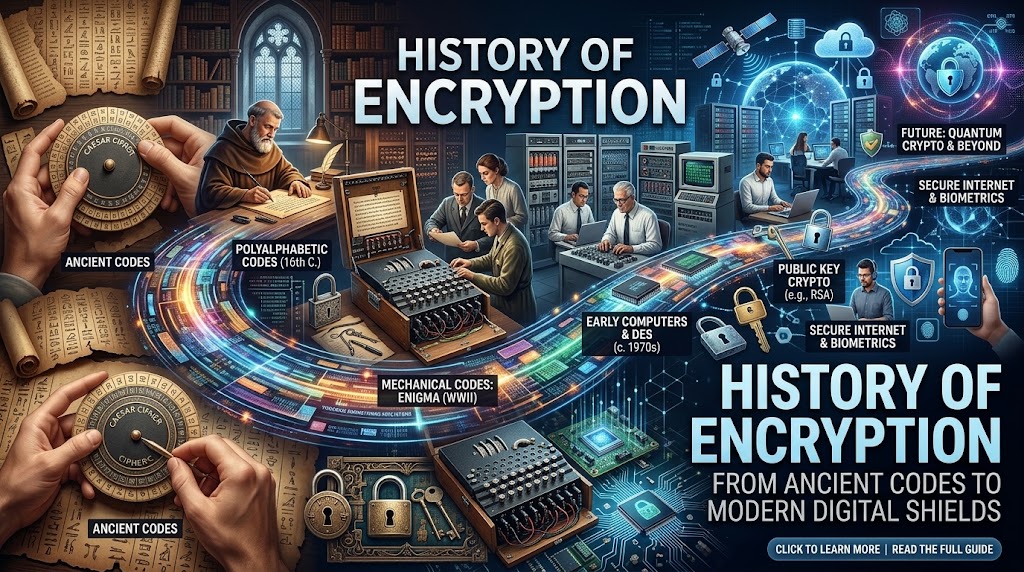
1. Introduction: The History of Encryption Started With One Man and One Secret
The history of encryption starts with a guy in ancient Egypt who did not want his coworkers reading his notes.
Think about it. 4000 years ago. No computers. No phones. Just stone and a chisel. Around 2000 BC, a scribe was carving a recipe for ointment onto the wall of a tomb. But instead of using normal Egyptian writing, he used weird symbols that only he and maybe one other priest understood.
Why? Because it was his recipe. And he did not want to share it.
That is it. That is where this whole thing started.
From that one guy to the billions of messages we send every day in 2026, the story is the same. Humans have secrets. And we will always find new ways to keep them.
This article is not going to be boring. I will tell you about Roman generals, Nazi code machines, nerds in the 1970s, and the quantum computers that might break the internet tomorrow.
History of Encryption.Let us start from the beginning.
Why Should You Care About This
Because right now, as you read this, your phone is scrambling your data. Your bank is scrambling your money. The government is. And all of it comes from ideas that are thousands of years old.
2. Ancient Times: When Hiding a Message Meant Carving It Differently
Before we had math, we had tricks.
In Egypt, priests would use different hieroglyphs in tombs. Not to confuse tourists 4000 years later. To confuse other priests.
In Mesopotamia, merchants did something clever. They would write a contract on a clay tablet. Then they would put that tablet inside another clay envelope and seal it. If you wanted to read it, you had to break the envelope. The person receiving it would know if someone had opened it.
In ancient China, military generals had codebooks. Instead of writing “attack the city at dawn”, they would write “the red flowers will bloom”. Only their generals had the book to translate it.
In India, there are texts from 500 BC that talk about changing letters around to hide religious knowledge.
Was any of this secure? Not really. But it worked because most people could not read in the first place.
The point is, the desire was already there. Keep this away from that person.
Humans Have Always Wanted Privacy
This is not a new internet problem. It is a human problem.
3. 100 BC: Julius Caesar and The History of Encryption in Rome
Julius Caesar was busy conquering Gaul. He had to send messages back to Rome. And messengers get captured.
So he came up with a system. Take the alphabet. A B C D E F. Now shift everything 3 places. So A becomes D, B becomes E, C becomes F.
His generals knew the rule. So when they got a message that said “DWK”, they knew it meant “ATK”. Attack.
The Romans called it the Caesar cipher.
Look, by today’s standards it is terrible. I could break it in 5 minutes. But 2000 years ago, it was enough. Most people could not read. And the few who could, did not expect letters to be shifted.
This is the first cipher that every computer science student learns. Not because it is good. Because it is simple.
And it shows something important. Even back then, war was the reason we invented new ways to hide information.
War Makes People Smart
When your life is on the line, you get creative.
4. 800 AD: The Smart Guys in Baghdad Who Invented Codebreaking History of Encryption
Fast forward 900 years. We are now in Baghdad. It is the year 800. This city is the center of the world for science and math.
In a library called the House of Wisdom, scholars were translating books from Greek and India. One of them was a guy named Al-Kindi.
Al-Kindi was curious. He started looking at secret messages. And he noticed a pattern.
In Arabic, the letter Alif appears a lot. In English, E appears a lot.
So he thought, what if I count the letters in a secret message? If one symbol shows up the most, it probably means the most common letter.
This was huge. This is called frequency analysis. And it broke almost every simple code at the time.
For the first time, hiding a message was not just about being clever. It was about math.
Al-Kindi even wrote a book about it. The first book ever written on how to make codes and break them.
This Changed Everything
After Al-Kindi, code makers had to get way smarter.
5. Renaissance to 1800s: Kings, Queens and The Cryptography Timeline History of Encryption
The 1500s to 1800s were messy. Kings were fighting. Countries were spying. Everyone was writing secret letters.
In 1586, a French diplomat named Blaise de Vigenere came up with a better idea. Instead of shifting every letter by 3, use a keyword.
So if your keyword is CAT, you shift the first letter by C, the second by A, the third by T, then start over.
This made frequency analysis much harder. For 300 years, people thought this was unbreakable. They called it “le chiffre indéchiffrable”. The unbreakable cipher.
Leonardo da Vinci wrote his notes backwards. Thomas Jefferson, yes the US president, invented a wooden wheel with 26 disks to scramble messages.
Every major country had a room. A “black chamber”. Where people opened other countries’ mail and tried to read it.
This was the era of quills, wax seals, and spies.
Diplomacy Was Just Spying With Better Clothes
If you did not have good codes, you lost wars.
6. 1918: Enigma and The History of Encryption in World War 2
World War 1 taught everyone that radio was a problem. The enemy could listen to everything.
So in the 1920s, German engineers built a machine. It looked like a typewriter. It was called Enigma.
Inside were rotors. Every time you pressed a key, the rotors moved. So if you typed A twice, you got two different letters.
The Germans thought it was impossible to break.
In Britain, there was a man named Alan Turing. He was a mathematician and he was weird and brilliant. He and his team at Bletchley Park built machines to try millions of settings.
By 1941, they were reading German messages. They knew where U-boats were. They knew attack plans.
Historians say this shortened the war by 2 to 4 years.
This was the moment the story of hiding information moved from paper to electricity.
This Is Where Computers Came From
Turing’s machines were the grandfathers of your laptop.
7. 1970s: IBM, DES and When Computers Took Over
The 1970s. Banks are using computers. They need to move money. They need to keep it safe.
IBM built something called DES. Data Encryption Standard.
In 1977, the US government said “this is the official standard”.
For the first time, scrambling was done by a chip, not a person. It was fast. It could do thousands of transactions.
But there was a catch. The key was only 56 bits. By 1998, a machine costing 250,000 dollars could try every possible key in 3 days.
Still, DES was important. It proved that computers were the future of keeping things secret.
Speed Was The Game Changer
What took a human a week, a computer did in a second.
8. 1976: The Year That Changed The History of Encryption Forever
This is the big one.
1976. Two guys at Stanford, Whitfield Diffie and Martin Hellman, published a paper.
They asked a question no one had answered well. How can two strangers talk securely without meeting first.
Their answer was Public Key Cryptography.
Here is the idea in plain English. You have two keys. One is public. You post it on your door. One is private. You keep it in your pocket.
If I want to send you a secret, I lock it with your public key. Only your private key can open it.
One year later, three MIT students, Ron Rivest, Adi Shamir, and Leonard Adleman, made this real. They called it RSA.
Without this idea, there is no Amazon. No online banking. No secure email.
This one paper from 1976 is why the internet works.
The Internet Would Not Exist Without This
Seriously. Go thank Diffie and Hellman.
9. 1990s: The Web, The Padlock and Modern Cryptography History of Encryption
1994. Netscape releases a browser. And they add something new. SSL.
You know the little padlock in your browser? That was it.
It meant your data was scrambled between you and the website.
In 1997, the US government said DES is too weak. They held a public contest. Anyone could submit a new algorithm.
In 2001, they picked one called Rijndael. We now call it AES.
AES-256 is still what the government and banks use today.
The 1990s made this normal. Your mom started using it to buy books online and had no idea.
Trust Is What Made E-commerce Work
No padlock, no credit cards online.
10. 2001 to 2013: Government, Privacy and The Big Fight
After 9-11, governments got scared. They said “terrorists use secret messages. We need access.”
Tech companies said “if we build a backdoor for you, hackers will find it.”
This fight is called the Crypto Wars.
Then 2013 happened. Edward Snowden leaked NSA documents. He showed the government was collecting phone records and forcing companies to help.
After that, everything changed. WhatsApp turned on protection for everyone. Apple started encrypting iPhones. Signal became popular.
People Woke Up History of Encryption
Privacy stopped being a tech thing. It became a people thing.
11. 2014 to 2020: When Protection Became Automatic History of Encryption
2014. WhatsApp turns on end to end protection for 2 billion people.
2016. Signal gets popular.
2018. Europe passes GDPR. Companies have to protect data or pay massive fines.
During these years, something important happened. Scrambling stopped being something you do. It just happened.
You open an app. It is on. You visit a website. It is on.
This is how it should be. Good security is invisible.
The Best Tools Are The Ones You Do Not Notice
If you have to remember to turn it on, you will forget.
12. 2021 to 2026: Quantum Computers and The Next Chapter
Now we have a new problem.
Quantum computers.
Normal computers try one key at a time. Quantum computers can try many at once using physics.
If someone builds a big enough one, it could break RSA. That would break a lot of the internet.
So starting in 2016, NIST ran a contest. Find new math that quantum computers cannot break.
In 2024, they announced winners. Algorithms called Kyber and Dilithium.
Companies are already starting to use them.
We are racing against physics now.
The Next 20 Years Will Be Wild
We are building for a future that does not exist yet.
13. The Algorithms That Shaped The Cryptography Timeline
Let us do a quick recap of the stars of the show.
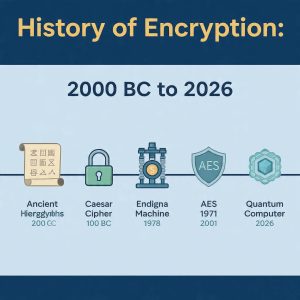
Caesar Cipher from 100 BC. Simple.
Vigenere from 1586. Much better.
Enigma from 1918. Mechanical beast.
DES from 1977. First computer standard.
RSA from 1977. The internet’s foundation.
AES from 2001. What we use today.
Cha20 from 2008. Fast for your phone.
Kyber from 2024. For the quantum future.
Each one was the best we had at the time.
Technology Always Evolves
When one breaks, we build the next.
14. Where You See This Every Single Day
This is not just for spies and governments.
Your bank uses it to move money.
Your hospital uses it for your records.
Your phone uses it to back up photos.
Bitcoin uses it to prove you own coins.
The military uses it for drones.
If we turned it all off tomorrow, the world would stop.
It Is Invisible But Critical
You do not see it, but everything depends on it.
15. The Hard Questions We Still Have Not Answered
There is a dark side.
Ransomware gangs lock hospital computers and demand money. They use the same math that protects you.
Police say “give us a way to read criminal messages”. Tech companies say “any backdoor will be abused”.
This fight started in the 90s and is still going in 2026.
There is no perfect answer.
Security Versus Safety
We are still trying to figure out the balance.
16. Conclusion: The Future of The History of Encryption
It started with an Egyptian scribe who did not want people reading his recipe.
Today it protects your credit card and your private photos.
The story of cryptography is the story of trust. Who do we trust, and how do we keep things private.
The tools will keep changing. From Caesar to AES to quantum. But the reason never changes. Humans have secrets.
The next 20 years will be about quantum safe math and computing on data without unlocking it.
Frequently Asked Questions History of Encryption
1. When did History of Encryption start
Around 2000 BC in ancient Egypt.
2. What was the Caesar Cipher
A simple shift where each letter moves 3 places. Used by Julius Caesar.
3. Who invented public key cryptography
Whitfield Diffie and Martin Hellman in 1976.
4. What do we use today
AES-256 is the main standard in 2026.
5. Can quantum computers break everything
A big enough quantum computer could break RSA. That is why we have new algorithms now.
6. Why does this matter to me
It protects your banking, messages, and photos every day.
7. Is encoding the same as History of Encryption
No. Encoding changes format. Encryption is for secrecy.
8. What is next
Quantum safe algorithms and computing on encrypted data.