
History of Hacker Culture: From MIT Train Models to AI Hackers 2026
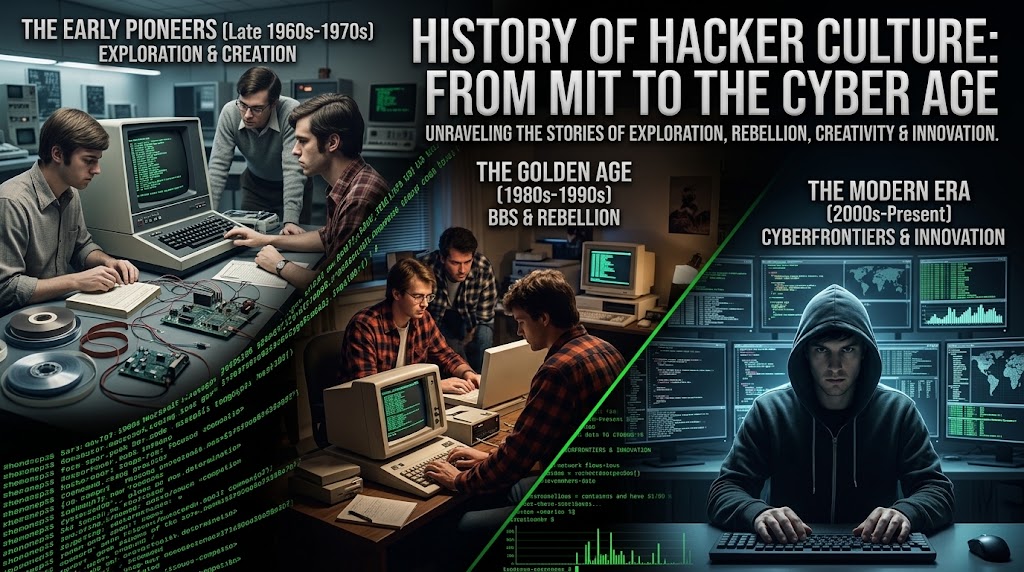
1. Introduction: The History of Hacker Culture Is Not About Crime
The history of hacker culture does not start with someone stealing credit cards.
It starts in 1961 at MIT. With a group of kids who stayed up all night trying to make a train set run faster.
That’s it. That’s how the Evolution of hacker culture began.
For 60 years, the word “hacker” meant curiosity. It meant building things. It meant “how does this work and how can I make it better”.
Then in the 1980s the media stole the word. And now everyone thinks hacker means criminal.
But the real Evolution of hacker culture is about passion, ethics, and changing the world with code.
From phone phreaks to cypherpunks to AI hackers in 2026.
This is the story they never told you.
Why The History of Hacker Culture Matters
Because every app you use, every website you visit, was built by hackers. And to understand the internet, you need to understand the Evolution of hacker culture.
2. 1960s: MIT and The Birth of The History of Hacker Culture
1961. MIT. Room 26-507. The Tech Model Railroad Club.
The kids there had a problem. The train set was slow. So they took it apart. They rewired it. They made it run at 2am when nobody was watching.
They called themselves “hackers”. Not because they broke laws. Because they “hacked” solutions.
One of them, Peter Samson, wrote the first music program. Another, Stewart Nelson, built the first spam filter.
The Evolution of hacker culture was born from play. From “what if we try this”.
The Hacker Ethic Was Born
Share. Be curious. Computers can change the world. That was the Origin of hacker culture in the 60s.
3. 1970s: Phone Phreaks – The History of Hacker Culture Goes Analog
The 70s. No computers in homes yet. But there were phones.
And some kids figured out that if you whistle at 2600 Hz, you could make free phone calls.
They were called “phone phreaks”. Phone + freak.
John Draper. “Captain Crunch”. He found a whistle in a cereal box that did the trick.
Steve Wozniak and Steve Jobs sold “blue boxes” to make free calls. That’s how they got money to start Apple.
The Origin of hacker culture in the 70s was about exploring systems. Phones were the first network.
Phreaking Was The First Hack
The Origin of hacker culture shows that hackers follow the network. In the 70s, the network was phones.
4. 1980s: Home Computers and The History of Hacker Culture Goes Mainstream
1981. IBM PC.
1984. Apple Macintosh.
Suddenly everyone had a computer.
And the history of hacker culture split in two.
Group 1: The builders. They wrote games, they modded hardware, they joined BBSes.
Group 2: The breakers. They cracked software to remove copy protection.
1983. Movie “WarGames”. A kid hacks the government. Everyone thought hackers were dangerous.
1986. “The Hacker Manifesto” by The Mentor. “We are hackers. We don’t cause harm”.
The Origin of hacker culture in the 80s was about identity. Who are we?
Two Types of Hackers
The Origin of hacker culture shows this split still exists today. White hats and black hats.
5. 1990s: The Internet and The History of Hacker Culture Explodes
1991. Linux. Linus Torvalds posted “I’m doing a free operating system”.
1993. Mosaic browser. The web was born.
1995. eBay, Amazon.
The Origin of hacker culture in the 90s was about building the internet.
Hackers wrote Apache. Hackers wrote Perl. Hackers wrote the first websites.
But also… 1990. Kevin Mitnick arrested. The FBI’s most wanted hacker.
1995. The Hacker Crackdown by Bruce Sterling. The government was scared.
The Origin of hacker culture became public. And misunderstood.
The Cypherpunks
The Origin of hacker culture in the 90s also gave us cypherpunks. “Privacy is necessary for an open society”. They invented Bitcoin. They invented PGP.
6. 2000s: The History of Hacker Culture Becomes Open Source
2000. Dot com bubble.
2001. Wikipedia. Anyone can edit.
2005. YouTube. Anyone can upload.
2007. iPhone. Anyone can build an app.
The History of hacking subculture in the 2000s was about openness.
Google hired hackers. Facebook was built by a hacker in a dorm.
The word “hacker” started meaning “founder”. “Growth hacker”. “Life hacker”.
The History of hacking subculture went from basements to boardrooms.
Hackers Won
The History of hacking subculture shows that by 2010, hackers were running the world.
7. 2010s: The History of Hacker Culture and Activism
2010. WikiLeaks. Chelsea Manning.
2011. Anonymous. “We are Anonymous. We do not forgive”.
2013. Edward Snowden.
The History of hacking subculture in the 2010s was about politics.
Hackers were fighting for free speech, against surveillance, for transparency.
Some called it cyberterrorism. Hackers called it activism.
The History of hacking subculture became about power.
Hacktivism
The History of hacking subculture shows that code became a form of protest.
8. 2016-2020: The History of Hacker Culture and Bug Bounties
Something changed in the 2010s.
Companies started paying hackers.
Google paid 6.7 million in bug bounties in 2019.
Facebook paid 7.5 million.

The History of hacking subculture became professional.
If you found a bug, you didn’t go to jail. You got paid.
This was huge. The History of hacking subculture went from underground to legitimate.
White Hats Became a Career
The History of hacking subculture in the 2020s is about jobs, not jail.
9. 2021-2023: The History of Hacker Culture and AI
2022. ChatGPT launched.
And hackers did what hackers do. They tried to break it.
“Prompt injection”. “Jailbreaks”. “DAN mode”.
The History of hacking subculture in 2023 was about hacking AI.
Hackers were finding ways to make AI say bad things. To steal data from AI. To make AI write malware.
The History of hacking subculture entered the AI era.
AI Is The New System
The Development of hacker culture shows hackers always hack the newest system.
10. 2024-2026: The Current History of Hacker Culture
Right now in 2026, the Development of hacker culture has 4 groups.
1. Security researchers. They find bugs and get paid.
2. Criminal hackers. Ransomware, fraud.
3. State hackers. North Korea, Russia, China.
4. AI hackers. People who hack and build AI.
The Development of hacker culture is bigger than ever.
There are 3 million cybersecurity jobs open. Most of them are hackers.
Hacker Is Now a Job Title
The Development of hacker culture came full circle. From hobby to career.
11. The 7 Principles of The History of Hacker Culture
Steven Levy wrote these in 1984. They’re still true.
1. All information should be free.
2. Mistrust authority. Promote decentralization.
3. Hackers should be judged by their hacking, not credentials.
4. You can create art and beauty on a computer.
5. Computers can change your life for the better.
6. Don’t litter other people’s data.
7. Public data is good, private data is bad.
The Development of hacker culture is built on these.
The Ethic Still Matters
The Development of hacker culture shows that ethics matter more than code.
12. Biggest Names in The Development of hacker culture
Richard Stallman. Free software.
Linus Torvalds. Linux.
Kevin Mitnick. The most famous hacker.
Adrian Lamo. Found Bradley Manning.
Snowden. Whistleblower.
George Hotz. iPhone jailbreak, Tesla self-driving.
The Historical background of hacker culture is their story.
They Were All Curious
The Historical background of hacker culture proves that curiosity changes the world.
13. How The Historical background of hacker culture Changed Technology
Without hackers: No Linux. No Internet. No Wikipedia. No Bitcoin.
The history of hacker culture is the history of the internet.
Every big tech company was started by hackers.
Apple. Microsoft. Google. Facebook.
The Historical background of hacker culture is why you have a smartphone.
We Live in a Hacker World
The history of hacker culture is your life.
14. The Dark Side: When The History of Hacker Culture Goes Wrong
Not all hackers are good.
Ransomware gangs.
Data brokers.
Election interference.
The Historical background of hacker culture has a dark side.
And that’s why we need ethics.
The original hackers said “do no harm”. We need to remember that.
Balance
The Evolution of hacker culture is about both creation and destruction.
15. The Future: Where The History of Hacker Culture Is Going
What’s next?
AI hackers. Hackers who use AI to find bugs.
Bio hackers. Hacking DNA.
Quantum hackers. Breaking encryption.
Space hackers. Hacking satellites.
The Evolution of hacker culture in 2030 will be about hacking reality itself.
The Spirit Won’t Die
The Evolution of hacker culture shows that as long as there are systems, there will be people who want to understand them.
16. Final Thoughts: The History of Hacker Culture Is About Curiosity
The History of hacking subculture started with a train set.
It gave us the internet, Linux, and the iPhone.
Yes, some hackers are criminals. But most are builders.
The History of hacking subculture is the history of people who ask “why” and “what if”.
And we need more of that.
Because the world has a lot of systems that need hacking. For good.
Frequently Asked Questions
1. What is the history of hacker culture in short
The history of hacker culture started in 1960s at MIT with students who loved to tinker. It grew through phone phreaks, open source, the internet, and now AI. The history of hacker culture is about curiosity and building.
2. When did hacker culture start
The history of hacker culture starts around 1961 at MIT with the Tech Model Railroad Club. So it’s over 60 years old.
3. What is the hacker ethic
The history of hacker culture is built on 7 principles. Share information, mistrust authority, judge by skill not credentials. The hacker ethic is from 1984.
4. Who are famous hackers in history
The history of hacker culture includes Richard Stallman, Linus Torvalds, Kevin Mitnick, Snowden, and Steve Wozniak. Builders and researchers.
5. Is hacker culture legal
The history of hacker culture shows most of it is legal. Bug bounty hunters, open source developers, security researchers. Only some is illegal.
6. How did hacker culture change the internet
The history of hacker culture IS the internet. Hackers built the web, Linux, Wikipedia, and most software you use.
7. What is the difference between hacker and cracker
In the history of hacker culture, “hacker” means builder. “Cracker” means criminal. Media mixed them up in the 80s.
8. What is the future of hacker culture
The history of hacker culture points to AI, quantum, and bio hacking. The spirit of curiosity will never die.


