World’s First Computer Chip: The Real Story of How Jack Kilby Changed the World in 1958
1. Introduction: World’s first computer chip Started Because One Engineer Had Nothing To Do During Summer
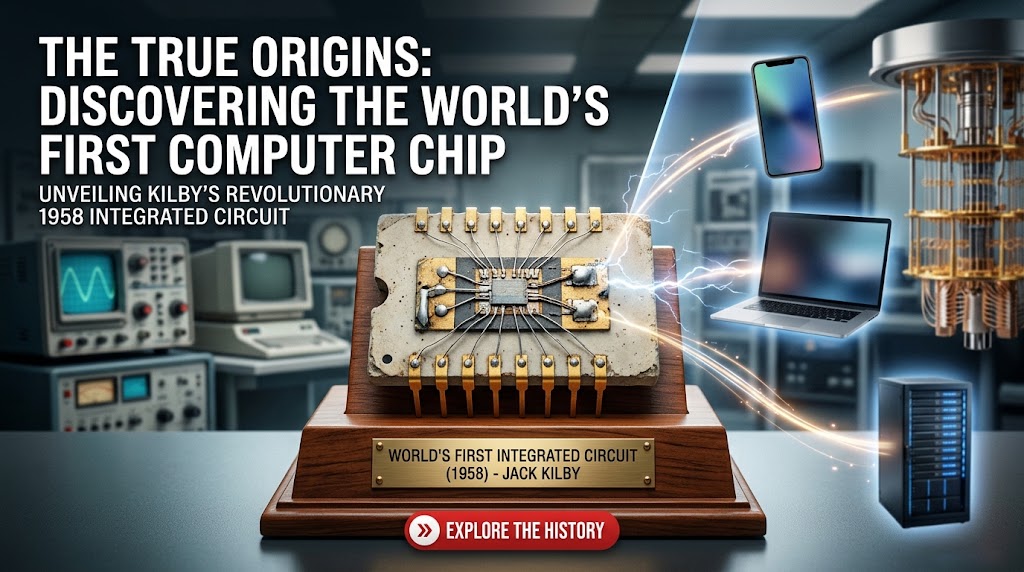
World’s first computer chip Picture this. It is September 1958 in Dallas, Texas. The Texas Instruments building is almost empty because everyone has gone on vacation. The hallways are quiet. The coffee machine is off. And sitting alone in the lab is a 35 year old engineer named Jack Kilby. He had just joined the company a few months ago and missed the vacation, so now he has two weeks with nothing to do and no one to talk to. Most people would have just taken the time off. But Kilby did something different. He started thinking about a problem that had been bothering everyone in the electronics world. Computers were getting smarter, but they were also getting impossible to build. Every new feature meant adding more transistors, more resistors, more capacitors. And every single one of those parts had to be soldered by hand. One bad connection and the whole machine would die. Kilby sat there and asked himself, what if we did not have to connect all these parts? What if we could build them all on one piece of material? He spent the next 12 days working on that idea. On September 12, he walked into his boss’s office with a small piece of germanium in his hand. It had some wires on it. He plugged it in and a wave showed up on the screen. That was it. That was the moment the First integrated circuit in history was born. It was tiny. It was ugly. It only made a beep. But it proved that an entire electronic circuit could live on one piece of material. And that proof is the reason you have a smartphone in your pocket right now.
Why This Matters To You Right Now
Because the phone you are reading this on, the laptop you work on, the TV in your living room, all of it exists because of that one afternoon in 1958.
2. Before 1958: Building a Computer Was Like Building a House With Tweezers
If you want to understand why the World’s original microchip was such a big deal, you have to go back to what computers looked like before it. In the 1940s we had ENIAC. It was huge. It filled a room. It used 17,000 vacuum tubes. And those tubes would burn out every few hours. So you needed people whose full-time job was just to replace tubes. Then in 1947 someone invented the transistor, and that was a huge step forward. Transistors were smaller and they did not burn out. But they created a new nightmare. Now instead of 17,000 tubes, you had 50,000 transistors. And every single transistor had to be made separately and then soldered to the board by hand. A computer in 1958 might have 5,000 parts.That is 5,000 chances for something to go wrong. Engineers had name for this. They called it “the tyranny of numbers.” The more you wanted a computer to do, the more parts you needed, and the more likely it was to break. Companies were spending millions just to wire these things together. Everyone knew this could not go on. Someone had to find a way to put all those parts onto one piece. That someone turned out to be Jack Kilby, and what he made became the Inaugural computer chip.
3. September 12, 1958: The Quiet Day When World’s first computer chip Was Invented in an Empty Lab
The TI lab was dead silent that summer. No meetings. No emails. No boss walking around. Just Jack Kilby and his bench. He had time to think, and he used it. His idea was so simple that it almost sounds stupid now. Instead of making transistors and resistors and capacitors as separate parts, why not make them all out of the same piece of semiconductor? He grabbed a strip of germanium. Germanium was what people used before silicon took over. He carefully added one transistor to it.
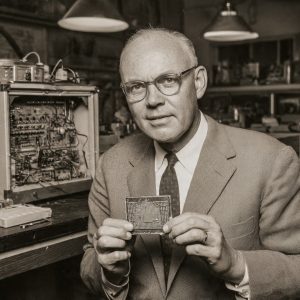
Then he added three resistors. Then a capacitor. He connected everything with thin gold wires that he attached by hand. When he finished, the whole thing was about the size of a paperclip. He wired it to a battery and an oscilloscope. He flipped the switch. And there it was. A perfect sine wave on the screen. He could not believe it. He grabbed his notebook and wrote two words. “It worked.” That wasFirst semiconductor chip. It was not fast. It was not powerful. But it proved that integration was possible. And that proof would change everything.
4. What The World’s first computer chip Looked Like and Why It Was Revolutionary Even Though It Was So Basic
If you saw the world’s first computer chip today, you would probably think it was junk. It was a small piece of germanium, maybe 7/16 of an inch long. On it was one transistor, three resistors, and one capacitor. The connections were made with gold wires that Kilby had to attach by hand under a microscope. It could only do one thing. It could generate a simple tone. But that was not the point. The point was the idea. For the first time in history, someone had put multiple electronic components onto a single piece of material. Before Kilby, every part had to be made separately and then connected. After Kilby, you could build everything at once. That idea is what we call an integrated circuit. And that idea is in every electronic device you own. The world’s first computer chip looked like nothing. But it was the start of everything.
5. 1959: The Other Guy – Robert Noyce and The Silicon Chip That Made It All Possible
Here is the part of the story most people do not know. While Kilby was working in Texas, another engineer was working on the same problem in California. His name was Robert Noyce. He was at Fairchild Semiconductor. Noyce did not know about Kilby. He just looked at the same problem and came to the same conclusion. But Noyce made two changes that made the chip actually usable. First, he used silicon instead of germanium. Silicon was tougher and could handle more heat. Second, he invented the “planar process.” This meant you could print all the connections on top of the chip instead of wiring them by hand. That meant you could make thousands of chips in a factory. So Kilby invented the world’s first computer chip. Noyce invented the chip that we mass produce. Both of them deserve credit. In 2000, Jack Kilby won the Nobel Prize in Physics for the world’s first computer chip.
6. 1960s: World’s first computer chip Went To Space and Helped Land Men on The Moon
The first people who really got how important the world’s first computer chip was were not computer companies. It was NASA and the military. In the 1960s the Cold War was on. America and Russia were racing to the moon. And NASA had a problem. They needed a computer for the Apollo spacecraft, but it had to be small and light and it could not break. The only way to do that was with integrated circuits. So they used chips in the Apollo Guidance Computer. In 1969, when Neil Armstrong landed on the moon, he was using a computer that only existed because of the world’s first computer chip. At the same time, the military was putting chips into missiles and radar. The world’s first computer chip went from a lab experiment to a national security technology in less than 10 years.
7. 1970s: World’s first computer chip Came Into Your House Through Calculators and The First PCs
By the early 1970s, chips were finally cheap enough for regular people. The first thing was calculators. Texas Instruments made pocket calculators that used chips. Suddenly you could do math anywhere for 100 dollars. Then in 1971, Intel did something crazy. They put a whole computer CPU onto one chip. They called it the 4004. It had 2,300 transistors. That was only possible because of the world’s first computer chip. Soon companies started building personal computers around these chips. The world’s first computer chip had left the government labs and moved into people’s homes.
8. 1980s: World’s first computer chip Created The PC Revolution
The 1980s belonged to the PC. In 1981 IBM released the IBM PC. It used an Intel 8088 chip with 29,000 transistors. Businesses bought them for spreadsheets. Then Microsoft released Windows. Suddenly you did not need to know how to code. By 1990, millions of PCs were in offices and schools. Every single one of them was running on chips that came from the idea of the world’s first computer chip. Video games also blew up. Nintendo. Sega. All of it needed fast chips. The world’s first computer chip had created a trillion dollar industry.
9. 1990s: World’s first computer chip Got Faster and Created The Internet
In 1965, Gordon Moore from Intel said that the number of transistors on a chip would double every 18 months. Everyone thought he was crazy. But he was right. For 30 years it held true. And it was only possible because of the foundation from the world’s first computer chip. In the 1990s we got Pentium chips with 3 million transistors. That was enough to run Windows 95 and Netscape. Suddenly everyone was online. Email. Websites. The world’s first computer chip made the internet possible.
10. 2000s: World’s first computer chip Shrunk and Went Into Your Pocket
The 2000s were about making things small. Nokia put email on phones. Then 2007 happened. Apple released the iPhone. The chip inside it was more powerful than NASA’s computers in 1969. And it fit in your hand. That was only possible because engineers spent 50 years taking the idea from the world’s first computer chip and shrinking it. By 2010, everyone had a smartphone. The world’s first computer chip had gone from a lab bench to your pocket.
11. 2010s: World’s first computer chip Got Big Again and Started Running The Cloud
While phones got smaller, data centers got huge. Google. Facebook. Amazon. They built buildings full of servers. Every server was packed with chips. Every search, every video, every photo went through chips. The world’s first computer chip had scaled up to run the entire internet. At the same time, chips went into cars and fridges and light bulbs. Everything got smart because chips got cheap.
12. 2020 to 2026: World’s first computer chip Is Now Running AI
This is where we are now. When you ask ChatGPT something, thousands of chips answer you. Nvidia makes GPUs for AI. Apple makes M1 and M2 chips. All of it goes back to 1958. The same idea. Put everything on one piece. The world’s first computer chip did not just make computers. It made AI possible.
13. How a Chip Actually Works Explained Like I Am Talking To My Younger Brother
Forget the technical stuff. A chip is just a lot of tiny switches. On or off. 1 or 0. Flip them fast enough and you can do anything. Math. Video. AI. The world’s first computer chip had one switch. Your phone has 134 billion. That is it. That is the whole trick.
14. Who Makes Chips Today and Why It Matters
Intel makes PC chips. TSMC in Taiwan makes chips for Apple. Samsung makes memory. Nvidia makes AI chips. All of them use Kilby’s idea. The problem is, making chips is so hard and expensive that only a few companies can do it. That is why the world freaked out during the chip shortage. That is why the US and Europe are spending billions to build new factories.
15. What Happens Next
We are at 3nm now. Soon 2nm. People are stacking chips on top of each other. And there is quantum computing. Maybe that will be the next “world’s first computer chip” moment. But for now, everything still runs on the integrated circuit.
16. Final Words: World’s first computer chip and One Question
Jack Kilby was not a genius trying to change the world. He was just bored and curious. He asked, “what if we put everything on one piece?” That question gave us the world’s first computer chip. From 1 transistor to 134 billion. From Dallas to your pocket. From 1958 to now. The world’s first computer chip is why we live the way we do.
Frequently Asked Questions
What is the world’s first computer chip</h3></h3>
<h3>The</h3>
world’
s f
irst computer chip was invented by Jack Kilby on September 12, 1958. It was the first integrated circuit.</h3>
&lt;h3>Who invented the world’s first computer chip
Jack Kilby
<p>invented the world’s first computer chip. Robert Noyce made the silicon version.</p></p><h3>W</h3>
<p>hat was the world’s first computer chip made of
Germ</p>
a
nium.</p>
<p><h3&
gt;Why is the world’s first computer chip important
Because it made computers small and cheap. Without it, no phones, no internet, no AI.