
History of Apple Silicon: How Apple Ditched Intel and Built The Fastest Chips on Earth
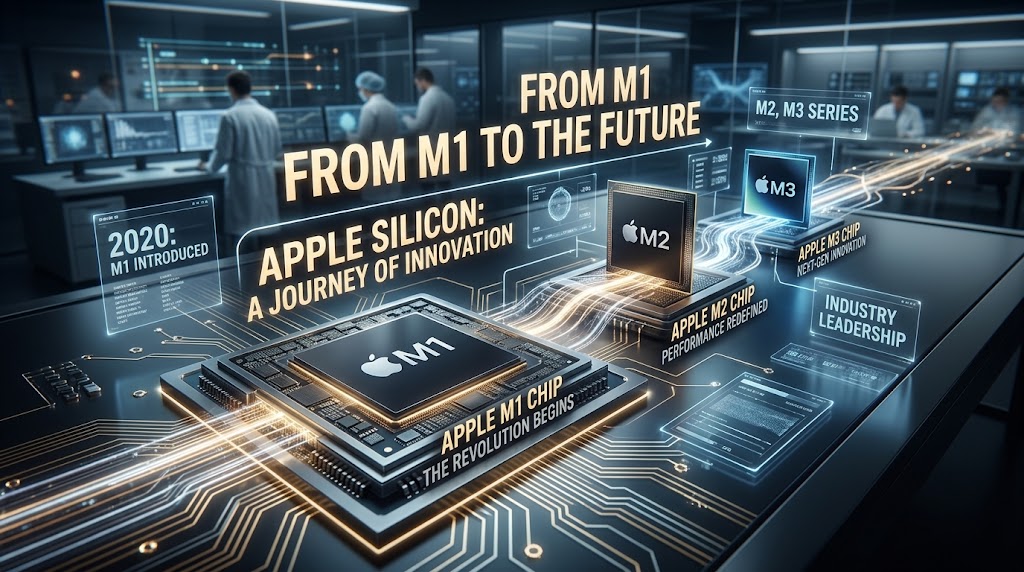
1. Introduction: Apple Silicon and The Day Apple Got Tired of Waiting
Apple Silicon didn’t start with a fancy keynote or a Steve Jobs “one more thing”. It started in a boring meeting room in 2019 when an Apple engineer slammed an Intel roadmap on the table and said, “Guys, we’ve been shipping the same 14nm chip for 5 years. Our iPhone chip is faster than this.”
That sentence changed the entire computer industry.
Today Apple ARM-based processors is in your pocket, on your desk, and in Apple’s most expensive machines. It’s faster than Intel, cooler than AMD, and gives battery life that sounds like a lie. This is the full history of Apple ARM-based processors. From a tiny iPhone chip in 2010 to the M4 Max in 2024 that beats $10,000 workstations.
Why You Should Care
Because this isn’t just about chips. It’s about how Apple stopped asking for permission and built its own future.
2. Before Apple’s in-house chips: 30 Years of Begging Other Companies
To understand why Apple’s in-house chips matters, you need to feel how much Apple hated relying on other people.
1984 to 1994: The Motorola Mess
The first Macs used Motorola 68000 chips. They were okay. Then Motorola got lazy. Apple was stuck. No upgrades. No speed.
1994 to 2005: PowerPC and The Oven
Apple teamed up with IBM and Motorola for PowerPC. The G5 was fast, but it was a furnace. Apple literally could not make a PowerBook G5 because it would melt. Steve Jobs was furious.
2005 to 2020: Intel Saves Apple, Then Slows Down
Switching to Intel was the best decision Apple ever made. For 15 years. But by 2019 Intel was stuck. 14nm for 5 years. Hot. Loud. Slow.
Meanwhile Apple’s iPhone chips were getting 40% faster every year. The engineers looked at each other and said “Why are we waiting?” That’s how Apple’s in-house chips was born.
3. 2010: A4 – The First Apple ARM-based processors Chip Nobody Cares About
The history of Apple ARM-based processors doesn’t start with M1. It starts with a chip most people have forgotten: A4.
The Story Behind A4
In 2008 Apple bought a small company called PA Semi. They hired chip designers from Intel and IBM and told them “build us a chip”.
One year later, A4 shipped in iPhone 4 and iPad 1. It wasn’t fast. But it proved Apple’s in-house chips.
Without A4, there is no Apple ARM-based processors. This was the first step.
4. 2011 to 2016: How iPhone Chips Trained Apple for Apple ARM-based processors
While Intel was busy releasing 5% faster chips, Apple was releasing a new A-Series chip every single year.
A5 to A10: The Secret Bootcamp
A7 in 2013 was the first 64-bit phone chip. Android companies laughed, then copied it. A10 in 2016 was already as fast as some Intel laptops.
Apple wasn’t just making phone chips. They were learning. How to build big CPU cores. How to build GPUs. How to build a Neural Engine.
All of this was practice for Apple ARM-based processors. Intel had no idea what was coming.
5. 2017 to 2019: Project Kalamata – The Secret Apple Silicon Mac
Inside Apple, this had a codename: Kalamata. The mission: take iPhone chip tech and scale it up 20x to power a Mac.
The Hardest Problem
An iPhone chip uses 5 watts. A MacBook Pro uses 100 watts. How do you scale that without melting?
Apple’s engineers spent 2 years figuring it out. By late 2019 they had prototype Macs running Apple ARM-based processors in the lab. They were already faster than Intel Macs and the battery lasted 2 days.
But Apple stayed quiet. The surprise was coming.
6. 2018: The First Apple Silicon Mac That Nobody Noticed
Two years before M1, Apple actually shipped the first Apple Silicon Mac.
The Developer Transition Kit
At WWDC 2018 Apple gave developers a Mac mini. Inside was an A12Z chip from iPad Pro.
Apple called it a “transition kit”. The real goal: let developers recompile apps for Apple ARM-based processors before real Macs shipped.
It was slow. But it worked. macOS ran fine on ARM. This was the proof that Apple ARM-based processors was real.
7. June 2020: Apple Silicon is Announced and Intel Gets Scared
WWDC 2020. COVID. Empty auditorium. Tim Cook on stage.
The Announcement
“We are transitioning all Macs to Apple Silicon in 2 years.”
He promised 2x performance. 4x battery. One chip for iPhone, iPad, and Mac.
Intel’s stock dropped 4% that day. The 2-year clock started. Apple Silicon was official.
8. November 2020: M1 Arrives and Apple Silicon Breaks The Internet
November 10th, 2020. Apple dropped 3 Macs with Apple Silicon: MacBook Air, MacBook Pro 13, Mac mini. All with M1.
What Made M1 Crazy
8 CPU cores. 8 GPU cores. 16-core Neural Engine. 5nm. Unified Memory.
The fanless MacBook Air with Apple’s custom chips beat the $3000 Intel MacBook Pro. Battery: 18 hours.
Tech YouTubers didn’t believe it. Then they ran the tests. Apple’s custom chips wasn’t hype. It was real. And it was 2 years ahead.
9. 2021: M1 Pro and M1 Max – Apple Silicon Goes After The Pros
Apple wasn’t done with Apple Silicon. One year later they aimed at professionals.
M1 Pro and M1 Max in New MacBook Pro
M1 Pro: 10 CPU cores, 16 GPU cores.
M1 Max: 10 CPU cores, 32 GPU cores, 400GB/s memory.
Video editors could edit 8K on a laptop. 3D artists sold their desktops.
The phrase “Macs aren’t for pros” died that day because of Apple Silicon.
10. 2022: M2 – Apple Silicon Gets Into a Rhythm
After the M1 explosion, M2 was calm. But important.
Why M2 Mattered for Apple Silicon
It showed Apple could ship Apple custom silicon every year like iPhone. M2 was 18% faster CPU, 35% faster GPU. New ProRes engine.
Apple Silicon was no longer a one-time event. It was a platform.
11. 2023: M2 Pro, M2 Max, M2 Ultra – Apple Silicon Finishes The Job
January: M2 Pro and Max. June: M2 Ultra.
The Last Intel Mac Dies
M2 Ultra was two M2 Max chips glued together. 24 CPU cores. 76 GPU cores. It went in the new Mac Pro.
With that, every Mac used Apple custom silicon. 18 years of Intel was over. Apple did it in 3 years.
12. 2023: M3 – Apple custom silicon Goes 3nm and Discovers Games
October 2023. “Scary Fast” event at 8pm.
M3, M3 Pro, M3 Max
First 3nm PC chips.
Hardware ray tracing. Mesh shading. Dynamic Caching.
For the first time, people said “maybe Macs can game” because of Apple custom silicon. M3 Max could have 128GB of memory. AI researchers loved it.
13. 2024: M4 – Apple Silicon Starts With iPad
May 2024. Apple surprised everyone. M4 came to iPad Pro first.
Why iPad Got Apple Silicon First
The new iPad Pro was thinner than an iPod. It needed the most efficient Apple Silicon ever.
M4 had a new display engine. And a Neural Engine 60x faster than M1. Apple was telling us: Apple’s in-house chips is now about AI.
14. 2024: M4 Pro and M4 Max – Apple Silicon at Its Peak
October 2024. The final M4 chips arrived.
M4 Pro and M14 mx Specs
M4 Pro: 14 CPU cores.
M4 Max: 16 CPU cores, 40 GPU cores, 500GB/s bandwidth.
The base M4 Mac mini beat the 2019 Intel Mac Pro.
Apple’s in-house chips had lapped Intel twice. The gap was embarrassing.
15. Why Apple Silicon Is So Fast: The 4 Things Apple Did Right
It’s not magic. It’s 4 decisions.
1. Unified Memory
CPU, GPU, Neural Engine share one RAM. No copying. Huge speed boost.
2. ARM Architecture
RISC. More work per watt than Intel’s x86.
3. Custom Cores
Apple designs its own “P-cores” and “E-cores”. They’re massive and fast.
4. TSMC and Process Lead
Apple was first to 5nm. First to 3nm. Intel was 2 years behind.
Apple’s in-house chips wins because Apple owns everything.
16. Final Thoughts: History of Apple Silicon Is The History of Apple Freedom
So what’s the history of Apple ARM-based processors?
15 years.
It started with a $500M company called PA Semi.
It practiced for a decade on iPhones.
It exploded in 2020 and changed computers forever.
What Apple M-series chips Really Did
It didn’t just make Macs fast. It made Apple free. No Intel. No delays. No excuses.
M5 is coming on 2nm. Then M6. The train won’t stop.
Apple ARM-based processors is why Apple is worth $3 Trillion today. And it started because one engineer got tired of waiting.
Frequently Asked Questions
What is Apple Silicon?
Apple’s custom chips designed in-house for iPhone, iPad, and Mac.
When did Apple ARM-based processors start?
2010 with A4. For Mac it started 2020 with M1.
Why did Apple leave Intel?
Intel was slow, hot, and late. Apple Silicon is faster and more efficient.
Is Apple Silicon better than Intel?
Yes. In speed and battery, Apple Silicon wins by a lot.
What is the newest Apple Silicon?
M4 Max as of late 2024.
Can Apple custom silicon run Windows?
Yes with Parallels. No Boot Camp.
Who makes Apple’s custom chips?
Apple designs it. TSMC builds it.


