
History Of The CPU: From Room-Sized Machines To The Chip In Your Pocket
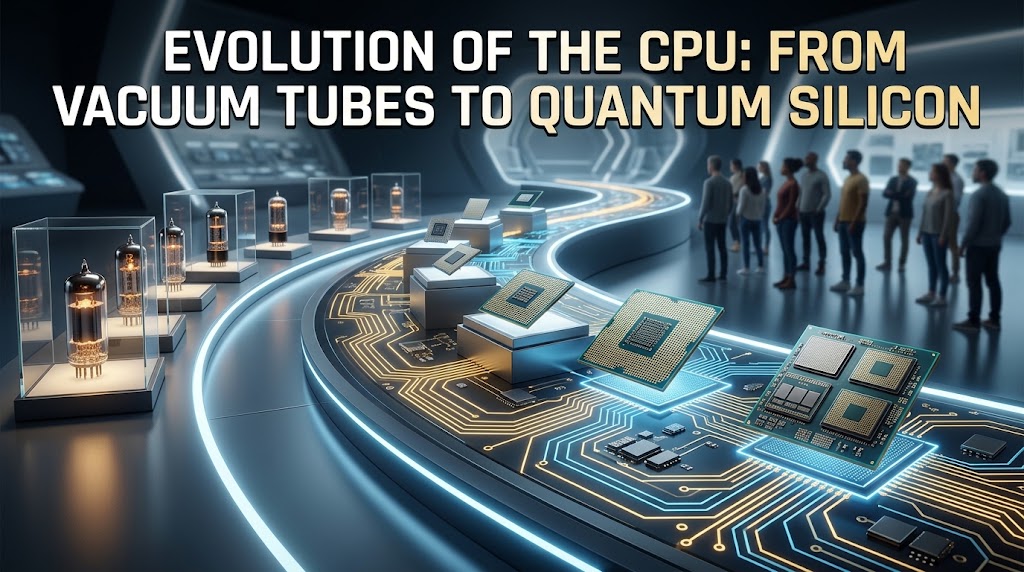
History Of The CPU: From Room-Sized Machines To The Chip In Your Pocket
History of the CPU.
It is the brain of everything.
Your phone. Your laptop. Your fridge. Even your car.
But 80 years ago, a CPU was bigger than a house.
Today it is smaller than your fingernail and 1 million times faster.
This is the story of how we got here.
The History of the CPU is the story of human ambition. Of making computers smaller, faster, and smarter.
Let’s go back to the beginning.
Chapter 1: Before CPUs – 1940s Mechanical Brains
When Computers Were People
Before there was a CPU, there were no computers.
“Computer” was a job title.
Mostly women who did math by hand for the army and NASA.
Then World War 2 started.
We needed to calculate artillery tables. Code breaking.
We needed machines.
1943: The Colossus. Built by British to break German codes.
It used vacuum tubes. It was not programmable.
1945: ENIAC. Built in the US.
ENIAC was 30 tons. 1800 square feet.
It could do 5000 additions per second.
But here is the key: ENIAC did not have a CPU.
It had to be rewired by hand for every new problem.
The “processor” was spread across the entire machine.
This was the pre-CPU era.
Chapter 2: 1948 – The Stored Program Idea History Of The CPU
Von Neumann Changes Everything
Mathematician John von Neumann had an idea.
“What if the program and data were stored in the same memory.”
Before this, you had to physically rewire the machine.
After this, you could just load new code.
This is called the Von Neumann Architecture.
And every CPU today still uses it.
CPU = Central Processing Unit.
The part that fetches instructions, decodes them, and executes them.
1949: EDSAC. First computer to use stored program.
Still no single “CPU chip”. The CPU was still 1000 vacuum tubes.
But the idea was born.
Computer History Museum CPU Exhibit
Chapter 3: 1950s – Transistors Replace Tubes
The History Of The CPU Gets Smaller
Vacuum tubes were huge and hot. They burned out.
1947: Bell Labs invented the transistor.
By 1954, computers started using transistors instead.
IBM 7090 in 1959.
The CPU was now the size of a large fridge instead of a room.
Speed went from thousands to millions of operations per second.
But still, a CPU was not one chip.
It was 1000s of transistors on circuit boards.
History of the CPU was about making it smaller piece by piece.
Chapter 4: 1960s – Integrated Circuits and The Birth of The Chip
The Most Important Invention
1958: Jack Kilby at Texas Instruments invented the Integrated Circuit.
Put multiple transistors on one piece of silicon.
1961: First IC computer.
Suddenly, the CPU could fit on a few chips instead of 10 boards.
1964: IBM System 360.
This was the first “family” of computers that used the same CPU architecture.
Businesses could upgrade without rewriting software.
This is when the word “CPU” started being used.
The CPU was now a set of chips. Not one chip yet.
Chapter 5: 1971 – The Microprocessor Is Born
Intel 4004 – The First Real History Of The CPU
This is where History of the CPU really starts.
1971. Intel. A small company in California.
A Japanese calculator company asked Intel to make chips for them.
Intel engineer Ted Hoff said “Instead of 12 chips, let’s put it all on one.”
On November 15 1971, Intel released the 4004.
4-bit CPU. 740 kHz. 2300 transistors.
It was the first CPU on a single chip. A microprocessor.
It was made for a calculator. But it could do anything.
This was the big bang.
For the first time, the entire CPU fit on something you could hold.
Price: $200.
Chapter 6: 1970s – 8 Bit CPUs and The Home Computer
Intel 8080 and MOS 6502
After 4004 came 8008. Then 8080 in 1974.
8-bit. 2 MHz.
This chip powered the Altair 8800. The first personal computer.
1975: MOS 6502 came out.
Cheaper. Faster. 1 MHz but did more per clock.
This CPU powered:
Apple II
Commodore 64
Nintendo NES
Atari
The History of the CPU is also the history of gaming.
For the first time, regular people had a CPU in their home.
2 to 8 MHz. 8000 transistors.
Chapter 7: 1980s – 16 Bit and 32 Bit – The PC Wars
Intel vs Motorola
1981: IBM PC. Used Intel 8088. 16-bit. 4.77 MHz.
This started the PC standard.
1982: Intel 80286. 16-bit. 12 MHz. Used in IBM PC AT.
1985: Intel 80386. First 32-bit x86 CPU. 33 MHz. 275,000 transistors.
This was huge. Now PCs could run real operating systems.
Windows. Linux. Unix.
Meanwhile Motorola had the 68000.
Used in:
Apple Macintosh
Commodore Amiga
Sega Genesis
The History of the CPU in the 80s was Intel vs Motorola.
Intel won the PC. Motorola won consoles and Macs.
Chapter 8: 1990s – The Gigahertz Race Begins
Pentium and The Rise of AMD
1993: Intel Pentium. 60 MHz. 3.1 million transistors.
No more numbers. Now brand names.
1995: Windows 95. Needed more CPU power.
1999: Intel Pentium 3. 1 GHz.
First CPU to break 1 GHz.
AMD was fighting back.
1999: AMD Athlon. Also 1 GHz. Sometimes faster.
This started the CPU wars.
For gamers and enthusiasts, CPU meant Intel or AMD.
Other CPUs:
IBM PowerPC in Macs
MIPS in PlayStation
ARM in phones starting to appear
By 2000, CPUs had 20+ million transistors.
Chapter 9: 2000s – Multi-Core and The End of GHz
Why Your History Of The CPU Has 8 Cores
2001: Intel Pentium 4. Pushed GHz to 3.8 GHz.
But it got too hot.
Engineers realized: We cannot make 1 core go faster forever.
Solution: Put 2 cores on one chip.
2005: Intel Core Duo. First dual-core for PCs.
2006: Intel Core 2 Duo. Much better.
2008: First quad-core CPUs.
The History of the CPU shifted.
From “faster” to “more cores”.
This is why your PC today has 6, 8, 16 cores.
Transistor count: 500 million to 1 billion.
Chapter 10: 2010s – Mobile CPUs and ARM Take Over
The History Of The CPU In Your Pocket
While Intel and AMD fought on PC, something else happened.
ARM.
ARM CPUs use less power. Perfect for phones.
2007: iPhone. Used ARM CPU.
2010: iPad.
2011: First quad-core phone CPUs.
By 2015, your phone CPU was faster than a 2005 PC.
Apple A9. Snapdragon 820.
Meanwhile on PC:
2011: Intel Sandy Bridge
2017: AMD Ryzen. AMD came back and beat Intel.
CPU cores went from 4 to 8 to 16 for normal people.
Transistors: 2 billion to 10 billion.
Chapter 11: 2020s – 3nm, AI, and The Future
Where The History of the CPU Is Going
2020: Apple M1. First ARM CPU for laptops. Beat Intel.
2022: 5nm CPUs from Intel, AMD, Apple.
2024: 3nm CPUs. 100+ billion transistors.
Now the focus is not just speed.
It is AI.
Every new CPU has an “NPU” for AI tasks.
Intel Meteor Lake. AMD Ryzen AI. Apple M3.
The History of the CPU is now about AI acceleration.
And we are hitting physics limits.
We cannot make transistors smaller forever.
So companies are stacking chips vertically. “3D CPUs”.
Chapter 12: Timeline Table – History of the CPU
| Year | CPU | Transistors | Clock Speed | Notes |
| — | — | — | — | — |
| 1945 | ENIAC | 17,000 Tubes | N/A | No CPU chip |
| 1971 | Intel 4004 | 2,300 | 740 kHz | First microprocessor |
| 1979 | Intel 8088 | 29,000 | 4.77 MHz | IBM PC |
| 1985 | Intel 80386 | 275,000 | 33 MHz | First 32-bit |
| 1993 | Intel Pentium | 3.1 Million | 60 MHz | Brand name starts |
| 2000 | Intel Pentium 4 | 42 Million | 1.5 GHz | GHz race |
| 2005 | Intel Core Duo | 151 Million | 2.16 GHz | First dual-core |
| 2017 | AMD Ryzen 7 1800X | 4.8 Billion | 4.0 GHz | AMD comeback |
| 2020 | Apple M1 | 16 Billion | 3.2 GHz | ARM on desktop |
| 2024 | AMD Ryzen 9 9950X | 19.2 Billion | 5.7 GHz | 16 cores |
Chapter 13: How CPU Architecture Changed
From CISC to RISC to Hybrid
Early CPUs: CISC. Complex instructions. Intel x86.
Mobile CPUs: RISC. Simple instructions. ARM.
RISC uses less power. CISC is more powerful.
Today Apple and Qualcomm use ARM for laptops.
Intel and AMD added RISC-like ideas to x86.
History of the CPU is also the history of instruction sets.
Chapter 14: The Companies That Shaped History Of The CPU
1. Intel – Dominated PC for 40 years
2. AMD – The underdog that keeps coming back
3. ARM – Powers 95 percent of phones
4. Apple – Designed their own CPUs with M1, M2, M3
5. IBM – Made PowerPC and mainframe CPUs
6. NVIDIA – Now making CPUs for AI with Grace
Chapter 15: 10 Facts About CPU History You Did Not Know
1. The first CPU cost $200 in 1971. That is $1500 today.
2. Intel 4004 was made for a calculator company.
3. The 6502 CPU was designed in 6 months by 3 people.
4. Pentium got its name because you cannot copyright numbers.
5. AMD once made Intel chips under license.
6. The first 1 GHz CPU was actually made by AMD, not Intel.
7. Your phone today has more power than NASA in 1969.
8. CPU clock speed stopped going up around 2005.
9. The word “core” did not exist before 2005.
10. A modern CPU has more transistors than people on Earth.
Chapter 16: What Is Next For CPU
The Next 20 Years
Problem: We cannot make transistors smaller forever.
Solutions companies are working on:
1. 3D Stacking – Put chips on top of each other
2. New Materials – Replace silicon with graphene
3. Optical CPUs – Use light instead of electricity
4. Quantum CPUs – For specific problems
5. AI Chips – CPUs with built-in neural networks
The History of the CPU will keep going.
But it will look different.
Chapter 17: Final Thoughts History Of The CPU
From Room to Pocket
80 years.
From ENIAC, 30 tons, to Apple M3, smaller than a coin.
The History of the CPU is the fastest technology jump in human history.
We went from 5000 calculations per second to 100 trillion.
And we put it in your pocket.
The CPU made the modern world.
And it is still getting better.
Frequently Asked Questions History Of The CPU
1. What does CPU stand for
Central Processing Unit. The brain of the computer.
2. Who invented the first CPU
Intel with the 4004 in 1971. But the idea started in 1940s.
3. What was the first CPU speed
Intel 4004 ran at 740 kHz.
4. Why did clock speed stop increasing
Because CPUs got too hot above 4 GHz.
5. What is the fastest CPU in 2024
Depends on task. For gaming: Intel Core i9-14900K. For multi-core: AMD Ryzen 9 7950X3D.
6. How many transistors in a modern CPU
Up to 100+ billion in 2024.
7. What is the difference between CPU and GPU
CPU does general tasks. GPU does graphics and parallel math.


