
The Rise Of AMD: How The Underdog Became Intel’s Biggest Threat And Changed The Computer Industry Forever
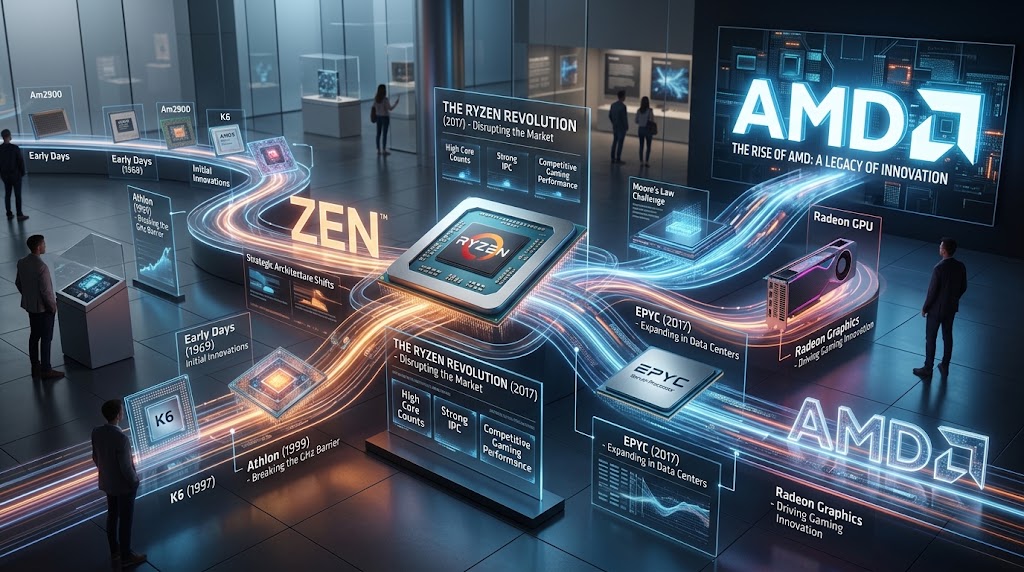
The Rise Of AMD: How The Underdog Became Intel’s Biggest Threat And Changed The Computer Industry Forever
The Rise of AMD.
May 1 1969. Sunnyvale California.
Eight engineers walked out of Fairchild Semiconductor and into a small rented office with almost no furniture and 100000 dollars in the bank.
Their leader was Jerry Sanders, a loud salesman who had no engineering degree but had the biggest ambition in Silicon Valley.
He told his team “We are going to make memory chips and we are going to sell them cheaper and faster than anyone else.”
Nobody believed them. Fairchild was huge. Intel was just starting. Texas Instruments owned the market.
55 years later that same small company is worth more than 200 billion dollars.
Today AMD makes the fastest gaming CPUs on Earth. They power the biggest supercomputers. They are in PlayStation and Xbox. They took 30 percent of the server market from Intel.
This is not just a business story. This is the Rise of AMD. The story of how the biggest underdog in tech refused to die.
Chapter 1: 1969 To 1981 – The Early Years And Learning To Copy
How The Rise of AMD Started With Logic Chips And Second Source Deals
In the beginning AMD did not invent anything. That was not the plan.
The plan was simple. Watch what the big companies make, then make it cheaper and sell it to more people.
Their first products were logic chips and SRAM memory in the early 1970s. They were not exciting but they paid the bills.
By 1975 AMD had 200 employees and real factories. By 1980 they were doing 100 million dollars in revenue.
But the real turning point came in 1982 when IBM decided to use Intel chips in the new IBM PC.
IBM had a rule that every critical part must have two suppliers. Intel could not supply the whole world alone.
So Intel signed a deal with AMD. The deal said AMD could legally copy and manufacture Intel’s 8086 and 8088 processors.
For the next 10 years AMD was basically “Intel with a different logo.” Engineers called it being a second source.
It was not glamorous but it was critical. Because of that deal AMD engineers learned how to design x86 CPUs from the inside.
They learned Intel’s secrets. They learned the manufacturing process.
Without that 1982 deal the Rise of AMD would have never happened because they would have never understood how to build a real processor.
Chapter 2: 1991 To 1998 – The Lawsuit That Made AMD Independent
Am386 Am48 And The Court Case That Changed Everything
By 1985 Intel released the 386 processor. It was 32 bit and very powerful.
AMD wanted to make it too. But Intel said no. The 1982 agreement did not cover the 386.
So AMD did something crazy. They sued Intel in 1987.
The lawsuit lasted 4 years. It was ugly. Both companies spent millions on lawyers.
Finally in 1991 AMD won. The court ruled that AMD had the right to make 386 compatible chips.
Months later AMD released the Am386. It was cheaper than Intel’s version and in some cases faster.
PC makers like Compaq and Gateway bought millions of them.
For the first time AMD was not just a clone. They were a real competitor.
Then came the Am486 in 1993 and the K5 in 1996. They were not great but they kept AMD alive.
The most important lesson from this period of the Rise of AMD is that AMD learned they could survive without Intel’s permission. That confidence would matter later.
Chapter 3: 1999 To 2003 – Athlon And The First Time AMD Was King
How Athlon 64 Beat Intel And Made Gamers Love AMD
The year 1999 changed everything for AMD.
Intel was selling the Pentium 3. It was good but expensive.
AMD released the Athlon. It was the first CPU to reach 1 GHz. Intel had not done it yet.
Gamers and tech reviewers went crazy. Benchmarks showed Athlon beating Pentium 3 in games and in work.
For the next 3 years AMD was the performance leader.
Then in 2003 AMD did something even bigger. They released Athlon 64.
It was the first 64 bit processor for regular people. Intel did not have 64 bit for desktops for another year.
Windows XP 64 bit ran better on AMD. Games ran better.
During this time AMD market share hit 25 percent. Dell even started selling AMD computers.EEE Computer History
This was the golden age and the highest point of the early Rise of AMD.
For a short time AMD was not the underdog. AMD was the king.
Chapter 4: 2006 To 2016 – The Dark Decade
Bulldozer ATI And Almost Bankruptcy
Success did not last. In 2006 AMD made two huge decisions.
First they bought ATI, a graphics card company, for 5.4 billion dollars.
The idea was smart. Combine CPU and GPU. But it drained all of AMD’s cash.
Second they bet on a new CPU architecture called Bulldozer.
Bulldozer launched in 2011. It was a disaster. It ran hot, it was slow, and it used too much power.
At the same time Intel released Core 2 Duo and then Core i7. They were twice as fast.
From 2007 to 2016 AMD lost money almost every year. They had to sell their factories to stay alive.
Tech websites wrote articles with titles like “Is AMD Dying.”
Stock price fell to 1.50 dollars in 2015.
If you were an AMD fan during this time it was painful.
But the company did not die. And that is why the Rise of AMD is such an incredible story. Because most companies would have given up.
Chapter 5: 2014 – Lisa Su And The Woman Who Saved AMD
How One CEO Changed The Culture And The Strategy
In October 2014 AMD hired a new CEO. Her name was Dr Lisa Su.
She had a PhD from MIT. She had worked at IBM and Texas Instruments.
She looked at AMD and made three brutal decisions.
First, cut costs. She laid off 30 percent of staff.
Second, sell the factories. AMD would no longer make its own chips. They would use TSMC instead.
Third, focus on one thing. Make one great CPU architecture and make it perfect.
That architecture was called Zen.
Engineers in Austin Texas had been working on it in secret for 3 years.
Lisa Su told them “You have one shot. If Zen fails, AMD fails.”
Everyone in the industry thought it was too late. Intel was 10 years ahead.
But Lisa Su believed. And that belief started the second Rise of AMD.
Chapter 6: 2017 – Ryzen Launches And The World Changes
8 Cores For 499 Dollars And Intel Panics
March 2 2017. AMD held a launch event in San Francisco.
On stage Lisa Su held up a chip. It was called Ryzen 7 1800X.
It had 8 cores and 16 threads. It cost 499 dollars.
Intel’s 8 core chip at the time cost 1000 dollars.
Reviewers tested it. In multi-core work Ryzen was equal to Intel. In gaming it was 5 percent behind but for half the price.
YouTube exploded. Reddit exploded. Everyone was talking about AMD again.
Six months later came Ryzen 5 with 6 cores for 229 dollars.
Then in 2018 came Ryzen 2000. Then in 2019 came Ryzen 3000 with 12 cores for 499 dollars.
Intel had no answer. They were stuck on 14nm and 4 cores.
For the first time in 12 years AMD was competitive again.
This moment is the heart of the modern Rise of AMD.
Chapter 7: 2020 To 2024 -Rise of AMD Beats Intel In Gaming And Servers
EPYC Ryzen 5000 and Ryzen 7000 Take The Lead
After Ryzen 3000, AMD did not stop.
2020: Ryzen 5000. It finally beat Intel in gaming too. The Ryzen 7 5800X3D became the best gaming CPU in the world.
2021: Ryzen 6000 for laptops. Battery life was better than Intel.
2022: Ryzen 7000. First desktop CPU on 5nm. 16 cores at 5.7 GHz.
But the biggest win was in servers.
In 2017 AMD launched EPYC. It was a server CPU with up to 64 cores.
Data centers loved it because it was cheaper and used less power than Intel Xeon.
By 2023 AMD had 25 percent of the server market. Companies like Google Amazon and Microsoft all used EPYC.
AMD stock went from 2 dollars in 2015 to over 200 dollars in 2023.
Lisa Su became one of the most respected CEOs in the world.
The Rise of AMD was complete. The underdog was now the leader.
Chapter 8: Why The Rise of AMD Matters To You
How Competition Made PCs Faster And Cheaper
You might not care about AMD as a company. But you care about your PC.
Before Ryzen in 2016, Intel sold you a 4 core CPU for 300 dollars.
After Ryzen in 2017, you could get 8 cores for 200 dollars.
Because AMD came back, Intel was forced to give us 10 cores 12 cores and 16 cores.
Because AMD came back, laptop prices dropped and battery life got better.
Because AMD came back, Sony and Microsoft could make powerful consoles for 500 dollars.
The Rise of AMD made technology better for 8 billion people.
That is why this story matters.
Chapter 9: AMD vs Intel vs Nvidia in 2024
The Three Way War For The Future
Today there are three giants.
Intel still has the most money and the biggest factories. They are trying to come back with Core Ultra.
Nvidia owns AI. Their chips power ChatGPT and every data center.
AMD is in the middle. They make great CPUs and good GPUs.
They are the only company that can fight both Intel and Nvidia at the same time.
In 2023 AMD launched the MI300. It is an AI chip designed to compete with Nvidia.
The next 5 years will decide if the Rise of AMD continues or if they fall back again.
Chapter 10: 10 Products That Defined The Rise of AMD
1. Am386 1991 The first time AMD won in court and in market
2. Athlon 1999 The first 1 GHz CPU that beat Intel
3. Athlon 64 2003 The first 64 bit CPU that forced Intel to copy
4. Radeon HD 2006 After buying ATI and entering graphics
5. Ryzen 7 1800X 2017 The comeback that shocked the world
6. Ryzen 9 3900X 2019 12 cores for 499 dollars
7. EPYC 7002 2019 64 cores that won data centers
8. RDNA 2 2020 GPU that went into PlayStation 5 and Xbox
9. Ryzen 7 5800X3D 2022 The best gaming CPU
10. MI300X 2023 AI chip to fight Nvidia
Chapter 11: The Business Strategy Behind Rise of AMD
Go Fabless Focus and Partner With TSMC
One reason AMD survived is that they changed how they make chips.
In 2009 they sold their factories and became “fabless.”
That means AMD designs the chips but TSMC in Taiwan manufactures them.
This was risky but smart. TSMC is 2 years ahead of Intel in manufacturing.
So while Intel struggled with 10nm, AMD was already on 7nm and then 5nm.
Lisa Su also focused the company. No more trying to do 20 things.
Just do CPUs and GPUs better than anyone else.
That focus is why the Rise of AMD worked when other comebacks failed.
Chapter 12: Problems Rise of AMD Still Has To Solve
AI Nvidia and Manufacturing Risk
AMD is not perfect.
Problem one: Nvidia owns 80 percent of AI. AMD’s MI300 is good but late.
Problem two: Intel is spending 100 billion dollars on new factories in the USA.
Problem three: AMD depends on TSMC. If there is a problem in Taiwan, AMD has no chips.
But compared to 2015, these are good problems to have.
Chapter 13: The Future of Rise of AMD 2025 To 2030
Zen 5 Zen 6 and The AI Battle
AMD’s roadmap is public.
2024: Ryzen 9000 on Zen 5.
2025: Ryzen 10000 on Zen 6.
2026: 2nm chips.
In servers AMD wants 50 percent market share.
In AI they want to be number 2 behind Nvidia.
In gaming they want to keep the crown.
If they do all that, the Rise of AMD will be remembered as the greatest comeback in tech history.
Chapter 14: Final Thoughts Rise of AMD
What The Rise of AMD Teaches Us
1969: 8 people in a room.
2024: 26,000 employees and 200 billion dollars.
AMD was left for dead in 2015. Analysts said they had 6 months left.
Then they built Zen. Then they beat Intel.
The Rise of AMD teaches us that in technology no lead is permanent.
It teaches us that focus beats size.
And it teaches us that one great product can change everything.
Frequently Asked Questions Rise of AMD
1. When was Rise of AMD founded
May 1 1969 by Jerry Sanders and seven other engineers.
2. Who is the CEO of AMD
Dr Lisa Su has been CEO since October 2014.
3. What does AMD stand for
Advanced Micro Devices.
4. Is AMD better than Intel in 2024
In gaming and multi-core work yes. In some business software Intel is still ahead.
5. What is AMD famous for
Ryzen CPUs for PCs and EPYC CPUs for servers.
6. Where are AMD chips made
AMD designs chips in the USA but TSMC manufactures them in Taiwan.
7. Did AMD really almost go bankrupt
Yes in 2015 the company was very close to running out of money.


