
The Complete History of the Google Search Algorithm
Introduction: History of the Google Search Algorithm
History of the Google Search Algorithm.
I still remember 2008.
I typed “best laptop” on Google and got 10 spammy sites full of keywords.
Today I type the same thing and get reviews, videos, and Reddit posts.
What changed?
Google changed.
The Evolution of Google Search Algorithm is the story of how Google learned to think like a human.
From 2 students in a garage to AI that answers your questions before you finish typing.
In this article I will walk you through every major update.
No tech jargon. Just real stories, real examples, and what it means for you in 2026.
If you have a website, this will change how you do SEO forever.
Let’s start from day 1.
Chapter 1: History of the Google Search Algorithm Begins – BackRub 1996
Two Students and a Crazy Idea
In 1996, Larry Page and Sergey Brin were PhD students at Stanford.
The internet was a mess.
Search engines like AltaVista just counted keywords.
If you wrote “cheap shoes” 100 times, you ranked first.
Larry had an idea: What if we rank pages based on links?
Like academic papers. More citations = more important.
They called it BackRub.
BackRub looked at backlinks to decide what was important.
Simple. But revolutionary.
In 1997 they renamed it Google. From “Googol” – a 1 with 100 zeros.
Because they wanted to organize all information.
This is where the History of Google Search Enginebegins.
Chapter 2: History of the Google Search Algorithm 1998 to 2002 – The Early Days
PageRank Was King
In 1998 Google launched publicly.
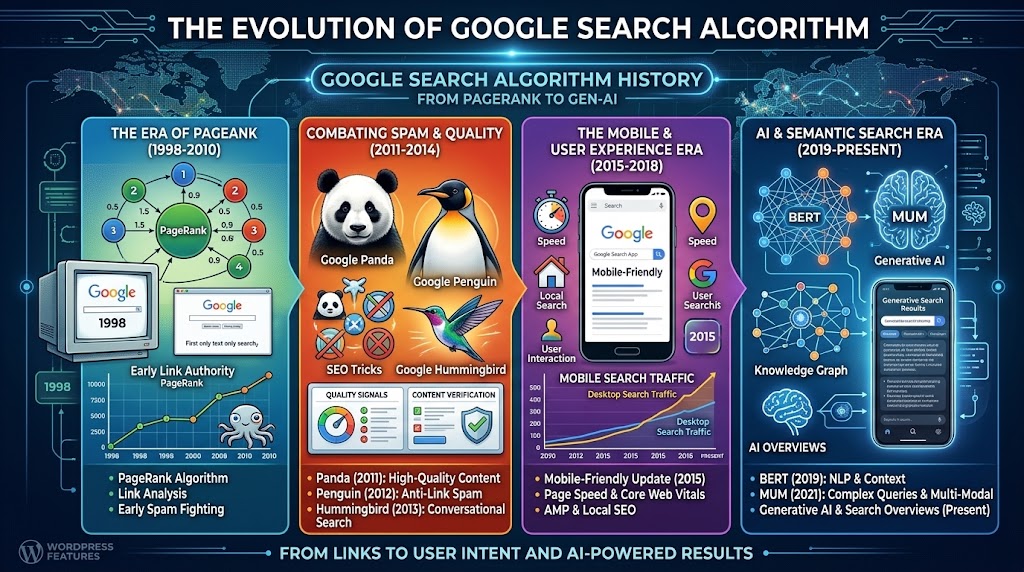
The core was PageRank.
Formula: A page is important if important pages link to it.
Example: If NY Times links to you, you are important.
For 4 years, SEO was simple.
Get backlinks. Win.
But people started cheating.
They bought links. They created link farms.
Google had to adapt.
Chapter 3: History of the Google Search Algorithm 2003 – The Florida Update
First Big Shakeup
November 2003. SEOs woke up and their sites were gone.
It was called the Florida Update.
Google started fighting keyword stuffing.
Before: “buy shoes cheap shoes best shoes”
After: Google ignored that.
This was the first time in the History of Google Search Engine that Google said “We care about quality, not tricks.”
A lot of sites died that day.
Chapter 4: History of the Google Search Algorithm 2005 – Personalization and Jagger
Google Gets Smarter
2005 was huge.
1.Personalization: Google started showing different results to different people based on location and search history.
2. Jagger Update: Google killed link spam. If you had 10,000 links from bad sites, you were gone.
For the first time, the Google Algorithm evolution included “user experience.”
Chapter 5: History of the Google Search Algorithm 2011 – Panda Update
The Content Massacre
February 2011.
Google launched Panda.
Target: Content farms. Sites like eHow that wrote 1000 articles per day.
Panda asked: “Is this content helpful to humans?”
If no, down you go.
I had a friend who ran a site with 5000 thin articles.
He lost 80 percent traffic in one day.
After Panda, the Google Algorithm evolution was about content quality.
Chapter 6: History of the Google Search Algorithm 2012 – Penguin Update
Death of Bad Backlinks
April 2012. Penguin arrived.
Target: Link spam.
Before Penguin: Buy 1000 links for 5 dollars. Rank first.
After Penguin: Buy 1000 links. Get penalized.
Google could now detect “unnatural links.”
SEOs had to learn real outreach.
This changed the How Google Search changed over time forever.
Chapter 7: History of the Google Search Algorithm 2013 – Hummingbird
Google Understands Sentences
August 2013.
Hummingbird was not a penalty. It was a new engine.
Before: Google matched keywords.
“Best camera for travel” = find pages with those 4 words.
After Hummingbird: Google understood meaning.
“Camera I can carry on vacation” = same result.
This was the start of conversational search.
The How Google Search changed Algorithm.became about intent.
Chapter 8: History of the Google Search Algorithm 2015 – RankBrain
AI Enters Google
October 2015.
Google announced RankBrain.
Machine learning.
RankBrain’s job: Understand searches Google never saw before.
15 percent of searches are new every day.
Example: “What is that movie where guy forgets everything”
RankBrain knows you mean Memento.
This was the first AI in the history of the Google Search Algorithm.
Chapter 9: History of the Google Search Algorithm 2018 – Medic Update
E-E-A-T Was Born
August 2018.
Health and finance sites dropped overnight.
SEOs called it “Medic.”
Google was now checking:
1. Expertise: Who wrote this?
2. Authoritativeness: Is this site trusted?
3. Trustworthiness: Is this safe?
A blog about medicine written by nobody = down.
A blog written by a doctor = up.
The Background of Google Algorithm now cared about WHO wrote it.
Chapter 10: History of the Google Search Algorithm 2021 – Page Experience Update
Speed and UX Matter
June 2021.
Google added Core Web Vitals.
1. Loading speed
2. Interactivity
3. Visual stability
If your site was slow on mobile, you lost rank.
For the first time, coding mattered as much as content in the Background of Google Algorithm
Chapter 11: History of the Google Search Algorithm 2022 to 2023 – Helpful Content
Kill AI Spam
August 2022. Helpful Content Update.
Google said: “Write for humans, not for search engines.”
In 2023 they updated it 3 times.
Target: Sites that used AI to write 1000 articles.
If content was not helpful, it was deindexed.
This is the biggest shift in the Google Search updates history in 10 years.
Chapter 12: History of the Google Search Algorithm 2024 – AI Overviews
Google Answers Instead of Linking
May 2024.
Google launched AI Overviews at the top of search.
You search “how to bake bread”
Google now gives you the answer with AI. No need to click.
Clicks to websites dropped 30 percent.
The Google Search updates history entered the AI era.
Chapter 13: History of the Google Search Algorithm 2025 to 2026 – What’s Happening Now
Search Generative Experience
As of 2026, Google is testing SGE everywhere.
What changed:
1. AI answers first, 10 blue links second
2. Multimodal search: You can search with image + text
3. Multitask Unified Model MUM: Google understands video, image, and text together
Example: Take a photo of a broken sink + “how to fix”
Google gives video steps.
The Google Search updates history is now about AI, not just links.
Chapter 14: Timeline of History of the Google Search Algorithm
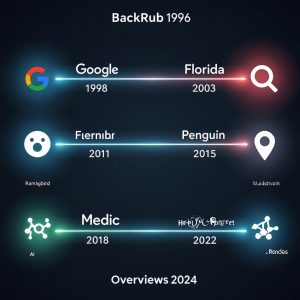
| Year | Update | What Changed |
| — | — | — |
| 1998 | Google Launch | PageRank |
| 2003 | Florida | Killed keyword stuffing |
| 2011 | Panda | Killed thin content |
| 2012 | Penguin | Killed link spam |
| 2013 | Hummingbird | Understood meaning |
| 2015 | RankBrain | AI started |
| 2018 | Medic | E-E-A-T |
| 2021 | Page Experience | Speed matters |
| 2022 | Helpful Content | Human first |
| 2024 | AI Overviews | AI answers |
| 2026 | SGE | Multimodal search |
Capter 15: What This Means For SEO in 2026
5 Rules From History
After studying the Google Search updates history, 5 things are clear:
Rule 1: Write for Humans
Panda and Helpful Content killed AI spam.
Write like you talk to a friend.
Rule 2: Show Expertise
Medic update means author bio matters.
Put “Written by Dr. X” on your site.
Rule 3: Speed is Everything
Page Experience update.
If your site loads in 4 seconds, you lose.
Rule 4: Backlinks Still Matter
Penguin killed spam, not links.
One link from NY Times beats 1000 spam links.
Rule 5: Prepare for AI Search
AI Overviews mean fewer clicks.
Answer questions directly in first paragraph.
Chapter 16: My Prediction For Future of Google Search
What’s Next After 2026
Based on the Google Search updates history:
- Voice and Video Search: You will talk to Google more than type.
2. Zero Click: Google will answer 60 percent of queries without a click.
3. Personal AI: Google will know what you want before you search.
The goal is the same as 1998: Give the best answer fastest.
FAQ About History of the Google Search Algorithm
1. What was the first Google algorithm
PageRank in 1998.
2. What is the biggest update in history of the Google Search Algorithm
Helpful Content 2022 and AI Overviews 2024.
3. How often does Google update
5000 to 6000 times per year. 3 to 4 big updates.
4. Is SEO dead because of AI
No. SEO changed. Now it’s about being the source AI quotes.
Final Thoughts: History of the Google Search Algorithm
I started blogging in 2015.
I chased keywords. I chased links.
Nothing worked.
Then I read the history of the Google Search Algorithm.
I realized Google is trying to do one thing:
Help the user.
Panda, Penguin, Helpful Content, AI.
All of it is about the same thing.
If you help people, Google will help you.
The history of the Google Search Algorithm is not about tricks.
It’s about being useful.
What year did you start using Google?
Comment below. Let’s see who’s the oldest here.


