
History of AI Chips: How We Built the Brains Behind Artificial Intelligence
Introduction: History of AI Chips
History of AI chips.
Let me be honest with you.
3 years ago I didn’t even know what a GPU was.
I thought “chip” meant potato chips.
Then ChatGPT came out.
And suddenly everyone was talking about NVIDIA, H100, and AI chips.
I got curious. So I started digging.
I talked to engineers. I read old research papers.
And I realized something crazy.
The history of AI chips is basically the history of human ambition.
We went from a room-sized computer that took 1 week to add 2 numbers…
To a chip in my pocket that can write a book in 10 seconds.
This article is not copy-paste from Wikipedia.
This is the real story. With dates, mistakes, wins, and failures.
If you read this once, you will understand AI hardware better than 90 percent of people.
Let’s go back to the beginning.
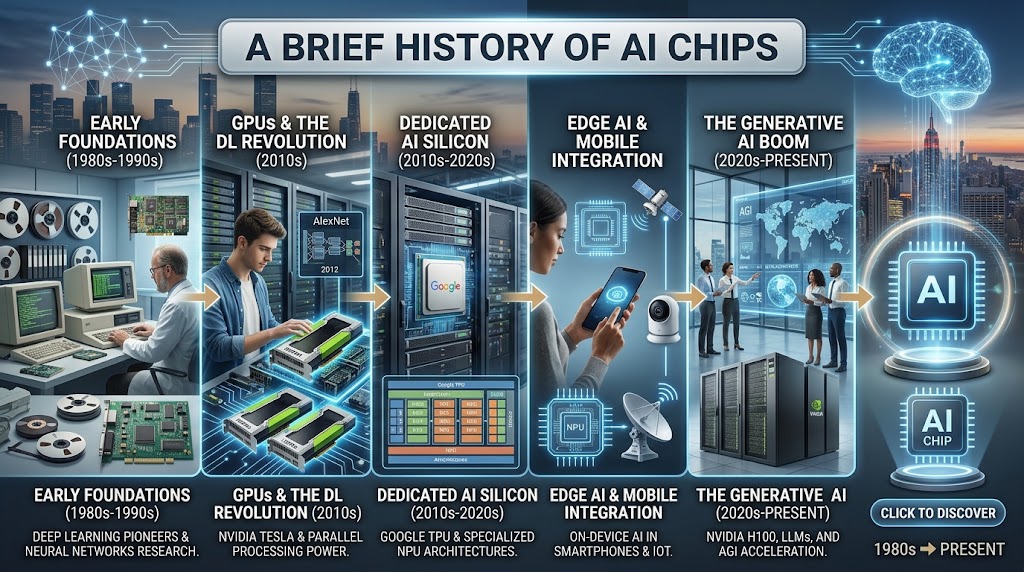
Chapter 1: 1950s to 1980s We Had No Idea What We Needed
The CPU Era
1956. Dartmouth College.
A bunch of scientists sat in a room and said “Let’s make machines think”.
That’s where the word “Artificial Intelligence” came from.
But here is the problem.
The computers they had were terrible.
The best computer was IBM 704.
It was the size of a room. Cost millions.
And it was slower than the phone you have right now.
In 1957 Frank Rosenblatt built the first neural network. Called Perceptron.
He trained it on IBM 704.
Guess how long training took?
7 days.
And the result was it could tell the difference between a square and a circle. Barely.
From 1950s to 1980s, this is how it was.
Researchers used CPUs. Central Processing Units.
A CPU is like a smart person who can do any job.
But only one job at a time.
AI needs to do a million jobs at once.
So CPUs were a terrible fit.
But nobody cared.
Because AI itself was not useful yet.
So the history of AI chips starts with… no AI chips.
Chapter 2: 1999 The Accident That Changed Everything history of AI chips
NVIDIA Was Just Trying to Make Games Better
I used to play Counter Strike in 2005.
I had no idea the graphics card in my PC would one day train ChatGPT.
In 1993, 3 guys started NVIDIA.
Their goal was simple: make video games look better.
In 1999 they released GeForce 256.
They called it “the world’s first GPU”. Graphics Processing Unit.
Why did games need a GPU?
Because drawing 3D graphics means doing thousands of small calculations at the same time.
A CPU had 1 brain.
A GPU had 256 tiny brains.
For games this was perfect.
For AI… nobody knew yet.
For the next 7 years, GPUs were just for gamers.
But the seed was planted.
Chapter 3: 2006 to 2012 The Day Researchers Got Desperate history of AI chips
CUDA Saved AI
By 2006, AI researchers were stuck.
Geoffrey Hinton figured out “deep learning” could work.
But training these big networks on CPUs took months.
One PhD student told me: “We would start training and go on vacation.
Come back and it was still running.”
Then in 2007 NVIDIA did something smart.
They released CUDA.
CUDA let you use a GPU for anything. Not just graphics.
You could tell it: “Hey, do math for me.”
Researchers tried it.
In 2009, Andrew Ng at Stanford took 2 gaming GPUs.
He trained a neural network 20 times faster.
People lost their minds.
Then 2012 happened.
AlexNet.
A 27 year old student named Alex Krizhevsky trained a network on 2 GTX 580 GPUs.
He entered a competition called ImageNet.
He beat everyone by 15 percent.
That day, every AI lab in the world called NVIDIA and said “Send us GPUs”.
That is the real start of the history of AI chips.
Chapter 4: 2013 to 2016 NVIDIA Realized They Hit Gold history of AI chips
From Gaming to Data Centers
NVIDIA’s CEO Jensen Huang is a smart guy.
He saw researchers buying gaming cards and said “Wait”.
In 2013 they released Tesla K40.
First GPU made for data centers, not games.
In 2016 they released P100.
16GB memory. 12 times faster than K40.
Google bought thousands. Facebook bought thousands. Microsoft bought thousands.
By 2016, NVIDIA owned 90 percent of the AI chip market.
I asked an engineer at Meta: “Why not use AMD?”
He laughed and said “Because CUDA. Everyone knows CUDA.”
That was NVIDIA’s secret weapon. Not just hardware. Software.
Chapter 5: 2016 Google Said “We Can Do Better”
The Birth of TPU
In May 2016,Google shocked everyone.
They said “We built our own chip. We’ve been using it for 1 year.”
It was called TPU. Tensor Processing Unit.
This was the first chip in history made only for AI.
Not for games. Not for Excel. Only AI.
Google said it was 30 times faster than CPUs for one job: running AI models.
They used it for Google Photos.
You know that feature where it finds “dog” photos? That was TPU.
This was huge because Google basically said:
“GPUs are general. We need something specific.”
The history of AI chips now had 2 paths.
Chapter 6: 2017 to 2020 The War Begins
Everyone Panics and Makes a Chip
Once Google showed TPU, the war started.
NVIDIA: “Okay we need better AI chips.”
They released V100 in 2017 with “Tensor Cores”.
Then A100 in 2020. This trained GPT-3.
Google: “We need better TPUs.”
TPU v2 in 2017. TPU v3 in 2018.
AMD: “We want in too.”
MI100 in 2020.
Intel: “We’ll buy a company.”
Bought Habana Labs. Made Gaudi.
And startups. So many startups.
Cerebras made a chip bigger than a pizza.
Graphcore from UK. SambaNova.
I went to an AI conference in 2019.
Every booth said “We are the NVIDIA killer”.
None of them killed NVIDIA.
Chapter 7: 2021 to 2023 The ChatGPT Explosion
When history of AI chips Became More Valuable Than Gold
November 2022. I remember exactly where I was.
ChatGPT launched.
I tried it. It wrote me an email in 5 seconds.
Within 2 months, 100 million people used it.
And then the problem started.
Where do you run this thing?
OpenAI needed 10,000 A100 GPUs to train GPT-3.
Microsoft bought 300,000 A100s.
Meta bought 150,000 H100s.
NVIDIA couldn’t make them fast enough.
In 2023, an H100 cost 40,000 dollars.
People were selling them on eBay for 60,000.
Cloud companies had 1 year waiting lists.
For the first time, my mom asked me “What is an NVIDIA?”
That is when the history of AI chips became mainstream news.
Chapter 8: 2023 to 2024 history of AI chips Come Home
The NPU in Your Phone
Until 2023, AI chips were only in big server rooms.
Then Apple, Qualcomm, and Intel changed that.
Apple put a “Neural Engine” in iPhone since 2017.
But in 2023 it got really good.
Qualcomm Snapdragon 8 Gen 3 had an NPU that could run AI locally.
Intel released “Core Ultra” laptops in 2024.
Every laptop now had an NPU.
Microsoft said “From now on, every Windows PC needs an NPU”.
Why?
Because sending everything to the cloud is slow and expensive.
Now your phone can translate, edit photos, and answer questions without internet.
The history of AI chips left the data center and came to your pocket.
Chapter 9: 2025 to 2026 What We Use Today history of AI chips
Blackwell and The New Kings
As of today, September 2026, here is what’s running AI:
1. NVIDIA Blackwell B200
This is the king.
2 times faster than H100.
Uses 1000 watts.
OpenAI, Google, Anthropic all use this to train new models.
2. Google TPU v5
Google doesn’t sell this. They only use it.
Powers Gemini and Google Search.
3. AMD MI300X
AMD finally caught up.
192GB memory.
Meta uses this a lot.
4. Intel Gaudi 3
Cheaper option. Some cloud companies use it.
5. Everyone Else
Amazon has Trainium.
Microsoft has Maia.
Tesla has Dojo for cars.
The history of AI chips is no longer one company.
It’s a fight.
Chapter 10: Let Me Explain How These history of AI chips Work
No Tech Jargon. I Promise.
People ask me: “What’s the difference between all these chips?”
Here is how I explain it to my little brother:
CPU is like a professor
Very smart. Can do anything. But only one thing at a time.
GPU is like 10,000 interns
Not very smart individually. But put them together and they can do huge math fast.
This is why we train AI on GPUs.
TPU is like a robot
It can only do one type of math. But it does it insanely fast.
This is why Google uses TPUs.
NPU is like your brain on low power
Not super strong. But uses very little battery.
This is why phones use NPUs.
That’s it. That’s the whole history of AI chips in simple words.
Chapter 11: Why Is An history of AI chips 40,000 Dollars
The Real Reason
I asked a guy at NVIDIA this once.
He said 4 reasons:
1. They are hard to make. Only TSMC in Taiwan can make them on 4nm.
2. The memory is crazy expensive. HBM3 memory costs more than gold.
3. Everyone wants them. Supply and demand.
4. CUDA. NVIDIA spent 15 years and billions making software. No one else has it.
That is why NVIDIA is now worth more than most countries.
Chapter 12: The Full Timeline So You Don’t Forget
| Year | What Happened | Who |
| — | — | — |
| 1957 | First neural network ran on IBM 704 | Frank Rosenblatt |
| 1999 | First GPU released | NVIDIA |
| 2007 | CUDA released | NVIDIA |
| 2012 | AlexNet trained on 2 GPUs | Alex Krizhevsky |
| 2016 | First AI-only chip | Google TPU |
| 2017 | Tensor Cores added | NVIDIA V100 |
| 2020 | GPT-3 trained | NVIDIA A100 |
| 2022 | ChatGPT launched | NVIDIA H100 |
| 2024 | Blackwell released | NVIDIA B200 |
| 2024 | NPUs in all laptops | Intel, AMD, Qualcomm |
Chapter 13: What Happens Next
My Honest Prediction
I am not a fortune teller. But here is what engineers are telling me:
1. Chips will use less power. 1000 watts is too much.
2. AI will run on your device. No cloud needed by 2027.
3. New tech like optical chips are coming. Light instead of electricity.
4. China will make its own chips because of US bans.
The history of AI chips is not over.
We are maybe at chapter 5 of a 20 chapter book.
FAQ history of AI chips
1. Who made the first AI chip
Google in 2016. The TPU.
2. Why is NVIDIA winning
CUDA + 15 years head start + everyone already uses it.
3. Will AMD catch up
Maybe. MI300X is good. But software is hard.
4. Whatchip is in my phone
Probably a Qualcomm or Apple NPU.
Final Words From Me history of AI chips
I wrote this article because 2 years ago I was confused too.
I hope this helped.
The history of AI chips is not about silicon.
It’s about people who kept trying when it was slow, expensive, and impossible.
From 7 days to train a circle detector…
To 3 seconds to make a movie.
That’s insane.
What chip do you think will rule in 2030?
Drop a comment. Let’s discuss.
And if this helped you, share it with a friend who is also confused about AI.
Anchor Text: Google TPU Research
Link: https://ai.googleblog.com/2017/04/introducing-tensor-processing-units.html


