
History of Microsoft AI: How Microsoft Won The AI Race
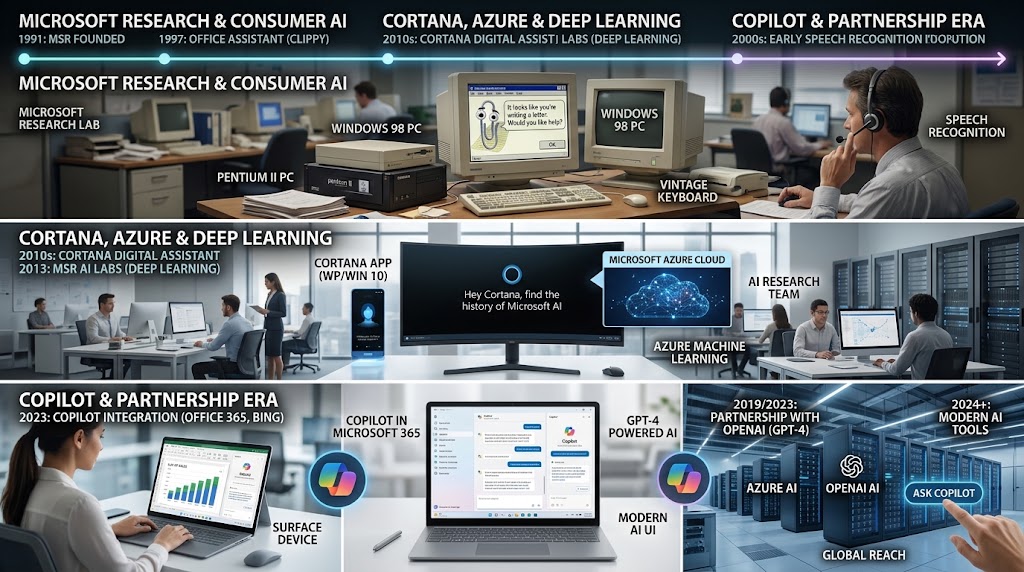
Introduction: history of Microsoft AI Started With Clippy
history of Microsoft AI did not start with ChatGPT. It started in 1997 with a paperclip named Clippy.
I remember Clippy popping up in Word. “It looks like you are writing a letter”. Everyone hated it. But that was Microsoft’s first try at AI.
Today in 2026 Microsoft is everywhere in AI. Copilot in Windows. Copilot in Office. ChatGPT running on Azure.
To get here Microsoft spent, 30 years, invested 13 billion in OpenAI, and beat Google at their own game.
This is the full story. The failures, the comeback, and how Microsoft became the biggest AI company.
Chapter 1: The history of Microsoft AI Begins 1991 to 2005
1991: Microsoft Research Is Born
Bill Gates created Microsoft Research. The goal was simple. Hire the smartest people and let them do crazy research.
For 10 years they published papers. Speech recognition. Computer vision. No one outside Microsoft cared.
1997: Clip pyand The First AI Assistant
Microsoft Office 97 launched with Clippy. An animated paperclip.
It used basic rules to help you. It was not smart. People turned it off.
But Clippy taught Microsoft one lesson. People want AI help, but it has to be useful.
2003 to 2005: AI in Xbox and Search
Microsoft put AI in Xbox for Halo bots.
They launched MSN Search. It had ranking AI.
All of this was small. Google was winning search. Microsoft was losing.
Chapter 2: history of Microsoft AI With Deep Learning 2006 to 2014
2006: Speech Recognition Breakthrough
Microsoft Research team did something big. They used deep learning for speech.
In 2009 they demoed real time translation. English to Chinese on stage. It was not perfect but it was the future.
2011: Siri vs Cortana
Apple launched Siri. Microsoft answered with Cortana in 2014.
Cortana was named after Halo. She was in Windows Phone and Windows 10.
She was better than Siri at some things. But Windows Phone died. So Cortana lost.
2014: Satya Nadella Becomes CEO
This changed everything.
Satya said “We are a cloud first, AI first company”.
He shut down failed products. He put all money into Azure and AI.
Chapter 3: history of Microsoft AI With Azure and OpenAI Bet 2015 to 2018
2015: Azure Machine Learning Launches
Microsoft launched Azure ML. The idea: Let companies build AI without buying servers.
AWS was winning cloud. Microsoft needed something different. AI was it.
2016: Tay Chatbot Disaster
Microsoft released Tay on Twitter. An AI chatbot.
Within 24 hours trolls taught it to say racist things. Microsoft shut it down.
Big embarrassment. But Microsoft learned. Safety matters in AI.
2017: AI on Every Developer Laptop
Microsoft added AI to Visual Studio. Added AI to Excel. Added AI to PowerPoint.
They also started working with OpenAI. A small startup in San Francisco.
Chapter 4: history of Microsoft AI With OpenAI Partnership 2019 to 2022
2019: The 1 Billion Dollar Bet
Satya Nadella wrote a check. 1 billion dollars to OpenAI.
Everyone said “why invest in a non-profit”.
Microsoft got 2 things. Exclusive cloud rights to run OpenAI models. And first access to new models.
This was the smartest move in the history of Microsoft AI.
2020: GPT-3 on Azure
OpenAI released GPT-3. Microsoft put it on Azure.
Now any company could use GPT-3 through Azure API. No one else had this.
2021 to 2022: GitHub Copilot
Microsoft owns GitHub. They launched Copilot.
It writes code for you. Trained on GitHub code.
Developers loved it. 1 million users in 1 year. This was the first real AI product from Microsoft.
Chapter 5: ChatGPT and history of Microsoft AI 2023
January 2023: 10 Billion More
Microsoft invested another 10 billion in OpenAI.
Deal: Microsoft gets 49 percent of profits. OpenAI runs only on Azure.
February 2023: Bing Chat Launches
Microsoft added ChatGPT to Bing. Called it “New Bing”.
They demoed it with a chatbot on the side of search.
It beat Google for 2 weeks. Then people found it could be rude. Microsoft added limits.
But the message was clear. Microsoft is back in search.
March to December 2023: Copilot Everywhere
Microsoft Copilot launched.
Copilot in Windows. Press Win + C and ask anything.
Copilot in Word. Write the document for you.
Copilot in Excel. Make formulas.
Copilot in Teams. Summarize meetings.
For 20 dollars per month. This was Microsoft’s AI strategy. Put AI in tools people already use.
Chapter 6: history of Microsoft AI With Copilot 2024 to 2026
2024: Copilot Plus PCs
Microsoft launched new Windows laptops. “Copilot Plus PC”.
They have a special AI chip inside. AI runs on your device, not cloud.

Features: Recall, Live Captions, AI in Paint.
2024: Phi-3 Small Models
Microsoft built its own AI models. Name: Phi-3.
They are small but smart. Can run on a phone.
Microsoft didn’t want to depend only on OpenAI.
2025: Copilot Agent
Copilot 2.0 could do tasks. Book meetings, send emails, analyze data.
It worked across all Microsoft 365 apps.
2026: Current State
As of 2026, here is where the history of Microsoft AI stands:
1. Copilot: 400 million monthly users across Windows and Office
2. Azure AI: The biggest cloud for AI. Runs ChatGPT, Meta Llama, and Microsoft models
3. OpenAI Partnership: Still exclusive. GPT-5 runs on Azure first
4. Surface AI: Every new Surface has Copilot button
5. GitHub Copilot: 20 million developers use it
Satya Nadella now says “We put AI in front of every user”.
Chapter 7: Mistakes in history of Microsoft AI
Mistake 1: Clippy and Cortana
Clippy was annoying. Cortana had no phone. Microsoft was early but failed.
Mistake 2: Tay Chatbot
They launched too fast without safety. Hurt Microsoft’s brand.
Mistake 3: Late to Search AI
Google had AI in search in 2018 with BERT. Microsoft waited till 2023.
Chapter 8: How Microsoft AI Is Different From Google
1. Microsoft Has Enterprise
Every company uses Office and Windows. Microsoft puts Copilot there. 1.2 billion people.
2. Microsoft Owns The Cloud For AI
Azure is where OpenAI, Anthropic, and Meta run models. Google Cloud is number 3.
3. Microsoft Partners Instead of Building All
Google builds everything in house. Microsoft partners with OpenAI and uses others models too.
Chapter 9: Real Examples of Microsoft AI in 2026
Example 1: Office Worker
Sarah uses Copilot in Outlook. “Summarize my emails”. Done in 10 seconds.
Example 2: Developer
Rahim uses GitHub Copilot. It writes 40 percent of his code.
Example 3: Company
A bank uses Azure AI to detect fraud. Trained on Microsoft’s cloud.
Example 4: Student
A student uses Copilot in Word to write essays and Copilot in PowerPoint to make slides.
Chapter 10: The Future of history of Microsoft AI
2027 to 2030: What Comes Next
Microsoft is betting on 3 things.
- AI Agents: Copilot that works for you all day. Books, calls, emails.
2. Small AI: Phi models running on your phone. No internet needed.
3. AI in Hardware: Every keyboard now has a Copilot key.
Satya’s goal: “AI for every person and every organization”.
Chapter 11: FAQ About history of Microsoft AI
1. When did history of Microsoft AI start
1991 with Microsoft Research. First product Clippy in 1997.
2. Who is the head of Microsoft AI
Mustafa Suleyman. He was co-founder of DeepMind. Now CEO of Microsoft AI.
3. Is Copilot better than ChatGPT
Copilot uses GPT-5 from OpenAI. But it is built into Office. ChatGPT is a separate app.
4. Does Microsoft own OpenAI
No. Microsoft invested 13 billion for 49 percent. OpenAI is still independent.
5. Is Microsoft AI free
Copilot in Windows is free. Copilot Pro in Office is 20 dollars per month.
Final Thoughts
The history of Microsoft AI is a comeback story.
They were early with Clippy. Then they were late. Then they got lucky with OpenAI.
Now in 2026 Microsoft is not a Windows company. It is an AI company.
The reason they won: Distribution. They put AI where 2 billion people already work.
Google invented the tech. Microsoft put it in your email.
What do you think Microsoft should build next. Comment below.
If this guide helped you, share it with someone who still thinks Microsoft is just Windows.


