
history of meta: How a Harvard Kid Built Facebook and Changed the Internet Forever
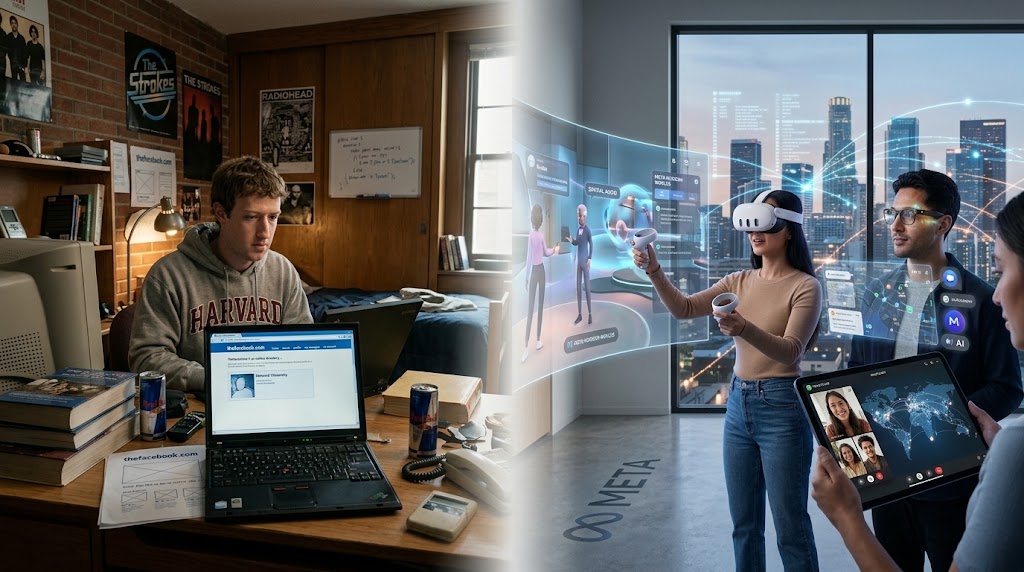
history of meta: It Started With a Drunk Kid and a Bad Idea
history of meta.
Let me be honest with you. When I first heard about Facebook in 2004, I thought it was stupid.
Another “college website”. There were hundreds of them back then. MySpace was king. Friendster was cool. Why would anyone care about “TheFacebook“?
22 years later I was wrong. Dead wrong.
That dumb college website is now Meta. 1.2 Trillion dollars. 3.2 Billion people use it every day. That’s more people than live in China and India combined.
I’ve spent weeks digging into the history of meta because I run a blog and I needed to understand how one company got so big. What I found was wild.
Dorm rooms. Billion dollar deals made on napkins. Congress hearings. Getting cancelled. Coming back. And now betting 100 Billion dollars on something called the “metaverse” that most people still don’t understand.
This isn’t a Wikipedia copy-paste. This is the real history of meta, told like a story. Because that’s what it is. A crazy story.
history of meta 2003-2004: Facemash Was Trash. And It Worked.
The Night Mark Got in Trouble
October 2003. Harvard University.
Mark Zuckerberg was 19. He was supposed to be studying. Instead he was in his dorm, drunk, and angry at a girl.
So he did what any 19 year old coder would do. He hacked Harvard’s website.
He pulled every student photo he could find. Then he built a site called Facemash. The whole point was: show 2 photos. Pick who’s hotter.
It was mean. It was dumb. Harvard shut it down in 4 days and almost kicked him out.
But here’s the thing. In those 4 days, 450 people used it. 22,000 photos were clicked.
Mark sat there and thought: “Wait. People really want to look at other people.”
That was it. That was the whole idea behind the history of meta.
February 4, 2004: TheFacebook Goes Live
A few months later, Mark cooled off and started coding again.
This time it wasn’t about rating. It was about connecting.
February 4, 2004. TheFacebook.com went live. You needed a harvard.edu email to join.
Within a week, half of Harvard was on it. Within a month, other Ivy League schools were begging to join.
Mark and his friends Dustin, Eduardo, and Chris moved to California. They dropped out. Everyone told them they were crazy.
But they kept going. Because they saw something no one else did. People wanted to be connected.
history of meta 2004-2006: The Smartest Growth Trick Ever
Why Facebook Beat MySpace
You remember MySpace right? Top 8 friends. Glitter backgrounds. Terrible music that played automatically.
Facebook won because Mark did something smart. He didn’t open it to everyone at once.
First Harvard. Then Yale. Then Stanford. Then all colleges. Then high schools. Then everyone.
Why? Because when you joined, all your real friends were already there.
That’s called a network effect. And it’s the reason Facebook killed MySpace.
By 2006, Yahoo offered 1 Billion dollars to buy Facebook.
Mark said no.
His own investors were mad. But Mark said “This will be worth 100 Billion one day.”
Everyone laughed. Today Facebook is worth 1.2 Trillion. Who’s laughing now?
The News Feed People Hated
In 2006 Facebook launched News Feed.
Instead of visiting profiles, you just scrolled and saw everything your friends did.
People lost their minds. They made groups like “We Hate News Feed”. They said Facebook was spying.
2 weeks later, everyone was addicted.
That News Feed is still what we scroll today. It’s the entire history of meta in one feature.
history of meta 2007-2009: How Do You Make Money From This?
history of meta the App Store Inside Facebook
In 2007 Facebook did something clever. They let other people build apps inside Facebook.
Suddenly your mom was playing FarmVille. Your cousin was playing Mafia Wars.
It brought in millions of users who just wanted to play games.
Sheryl Sandberg Shows Up
In 2008, Mark hired Sheryl Sandberg from Google.
Her job was simple: Make money.
She built the ad system. And it was scary good. You could tell Facebook “Show my ad to 20 year old guys in Dhaka who like sneakers.”
By 2009 Facebook had 300 Million users and was finally profitable.
But there was a huge problem coming. And it almost killed them.
history of meta 2010-2012: The Movie and The Near Death
The Social Network Made Them Famous
2010. The movie comes out. Suddenly everyone knows who Mark is.
Some people loved it. Some people hated it. But everyone knew Facebook now.
The 1 Billion Dollar Instagram Gamble
April 2012.Facebook buys Instagram for 1 Billion dollars.
Instagram had 13 employees. No revenue. Just photos.
Tech blogs roasted them. “Worst deal ever.”
Today Instagram is worth 500 Billion dollars. It’s where Gen Z lives.
Best deal in the history of meta. Maybe the best deal in tech history.
The IPO Disaster
May 2012. Facebook goes public. 104 Billion valuation. Huge party.
3 months later the stock crashes 50%.
Why? Phones.
Half of Facebook users were on mobile. But Facebook made zero money from mobile ads.
Investors thought Facebook was done. Inside the company people were panicking.
Mark gathered everyone and said “We are screwed unless we fix mobile.”
The Year They Fixed Everything history of meta
So they did. For 12 months straight, the whole company worked on mobile.
New app. New ads. New everything.
By 2013, 70% of their money came from phones.
That one year saved the history of meta. If they didn’t fix mobile, we wouldn’t be talking about them today.
history of meta 2014: The Two Craziest Purchases
WhatsApp for 19 Billion Dollars history of meta
February 2014. Facebook buys WhatsApp for 19 Billion dollars.
19 Billion. For an app that charged 1 dollar per year.
The internet exploded. “Mark lost his mind.”
But Mark saw it. Messaging was the future. Everyone texts. Everyone.
Today WhatsApp has 2 Billion users. It’s how half the world talks to family.
Oculus for 2 Billion Dollars
One month later. Facebook buys Oculus. VR goggles.
In 2014 VR was a joke. But Mark said “After phones, this is next.”
He was early. Maybe too early. But he was thinking 10 years ahead.
These two buys show you everything about the history of meta. Buy what’s big now. Buy what will be big later.
history of meta 2016-2018: The Years Everyone Hated Facebook
2016 Election
I’m not getting political here. But in 2016, Facebook got blamed for everything.
Fake news. Russian ads. Misinformation.
Congress was angry. Users were angry.
Cambridge Analytica
Then March 2018 happened.
87 Million people’s data was taken and used for political ads.
Mark had to sit in Congress for 10 hours while old people asked him “How does Facebook make money?”
The stock dropped 20% in one day. 120 Billion dollars gone.
I remember thinking “Is this it? Is Facebook done?”
How They Survived
They hired 30,000 people to delete bad stuff.
They built AI to catch it.
They changed privacy settings.
And ads kept coming in. Because where else were companies going to advertise?
The history of meta shows that if your product is useful enough, people will forgive you.
history of meta 2019-2021: TikTok and The Name Change
TikTok Shows Up
By 2019, teens stopped using Facebook. They were on TikTok.
Dancing. Memes. 15 second videos.
Facebook panicked and copied it. They launched Reels in 2020.
Apple Ruins Ads
2021. Apple updates iPhones. Now you can block apps from tracking you.
Facebook said “This will cost us 10 Billion dollars.”
October 28, 2021: Facebook Dies. Meta is Born.
This was the biggest day in the history of meta.
Mark gets on stage for 90 minutes. He talks about the metaverse. Virtual worlds. Avatars. Working in VR.
Then he says: “We are changing our name to Meta.”
Everyone was confused. “Why?”
Because Facebook is just one app. Meta is the company building the future.
That’s when I knew. This wasn’t a social media company anymore.
history of meta 2022-2023: Firing People and Betting on AI
2022 Was a Disaster
Stock went from 380 to 90 dollars.
The metaverse division was losing 15 Billion a year.
November 2022. Mark fires 11,000 people.
He calls it the “Year of Efficiency.” Sounds better than “we messed up.”
2023: AI Saves Them
But then AI happened.
July 2023. Meta releases Llama. A free AI that anyone can use. Developers loved it.
Same month. They launch Threads to kill Twitter. 100 Million people join in 5 days.
By end of 2023, the stock is back to 300 dollars.
The history of meta in these 2 years is simple. Cut the fat. Double down on AI.
history of meta 2024-2026: Where Are We Now?
The Numbers in 2026
Let me hit you with the numbers because they’re insane.
3.2 Billion people use Meta every day.
165 Billion dollars in revenue per year.
60 Billion dollars in profit.
1.2 Trillion dollar company.
AI is Everywhere
Open WhatsApp. There’s Meta AI.
Open Instagram. AI edits your videos.
See an ad. AI probably made it.
What About the Metaverse?
Still losing 15 Billion a year.
But Quest 3 is selling. Ray-Ban smart glasses are actually cool.
Mark still says “Give it 10 years.”
Maybe he’s right. Maybe he’s wrong. But he’s not stopping.
How Does Meta Actually Make Money?
Short answer: Ads.
98% of their 135 Billion dollar revenue comes from ads.
Think about it. Facebook is free. Instagram is free. WhatsApp is free.
So how do they pay for all those servers?
You.
Advertisers pay to show you stuff. And because Meta knows everything about you, those ads work really well.
A shop in Dhaka can pay 5 dollars and reach 1000 people who like shoes.
Now with AI, you don’t even make the ad. You just say “I sell shoes” and AI does the rest.
That’s the business. Simple and massive.
The 20 Moments That Defined history of meta
1. 2004: TheFacebook launches
2. 2006: Opens to everyone
3. 2007: News Feed
4. 2012: Buys Instagram
5. 2012: IPO
6. 2013: Fixes mobile
7. 2014: Buys WhatsApp
8. 2014: Buys Oculus
9. 2016: Election problems
10. 2018: Cambridge Analytica
11. 2020: Reels launches
12. 2021: Name change to Meta
13. 2022: 11,000 layoffs
14. 2023: Llama AI
15. 2023: Threads launch
16. 2024: AI in every app
17. 2025: Quest 3 sells well
18. 2026: 3.2 Billion users
The 3 Buys That Made Meta
1 Billion in 2012. Worth 500 Billion now.
Gave them young people.
19 Billion in 2014. Worth 200 Billion now.
Gave them the whole world.
Oculus
2 Billion in 2014.
Gave them a shot at the future.
Without these 3, the history of meta looks very different.
Who Is Beating Meta in 2026?
TikTok
1.5 Billion users. They own short video.
YouTube Shorts
2 Billion users. Google has infinite money.
Apple
Keeps changing iPhone rules to hurt Meta’s ads.
OpenAI
Ahead in AI right now.
But Meta has 3.2 Billion people. Every. Single. Day.
That’s hard to beat.
The 100 Billion Dollar Question: Was Metaverse Worth It?
From 2021 to 2026, Meta spent 100 Billion on the metaverse. Lost 60 Billion.
Horizon Worlds is basically empty.
So was it dumb?
Mark doesn’t think so. He thinks in 2030 we’ll all work in VR.
I don’t know if he’s right. But I know this. The history of meta is full of bets that looked dumb at first.
Mobile ads looked dumb in 2012. Instagram looked dumb in 2012.
Maybe metaverse will too.
10 Things I Learned From the history of meta
1. Get all your friends in one place. Then you win.
2. Mobile or die. No exceptions.
3. If someone copies you, copy them back faster.
4. Buy competitors before they get big.
5. Ads pay for everything.
6. When you screw up, spend money and fix it.
7. Change your name when you change your business.
8. Fire people when you have to. It sucks but it works.
9. Invest in AI before everyone else.
10. Think 10 years ahead, not 10 months.
FAQ: history of meta
When did Meta start?
February 4, 2004 as TheFacebook.
Why did they change the name?
To focus on metaverse and AR/VR, not just Facebook.
How many people use Meta?
3.2 Billion every day in 2026.
Is Meta profitable?
Yes. 60 Billion profit in 2023.
Last Word on the history of meta
Look. The history of meta is really our history.
It’s how we found college friends.
It’s how we talk to family on WhatsApp.
It’s how we see memes on Instagram.
It’s how businesses sell stuff.
It started with one kid in a dorm.
Now half the planet uses it.
There were scandals. There were mistakes. There were times I thought they were done.
But they kept building.
From Facebook to Meta.
From posts to AI.
From 2D to maybe one day VR.
The story isn’t over.
And if you’re reading this on your phone, you’re part of the history of meta too.


