
The History of Starbucks: How 3 Teachers Built a $100 Billion Coffee Empire
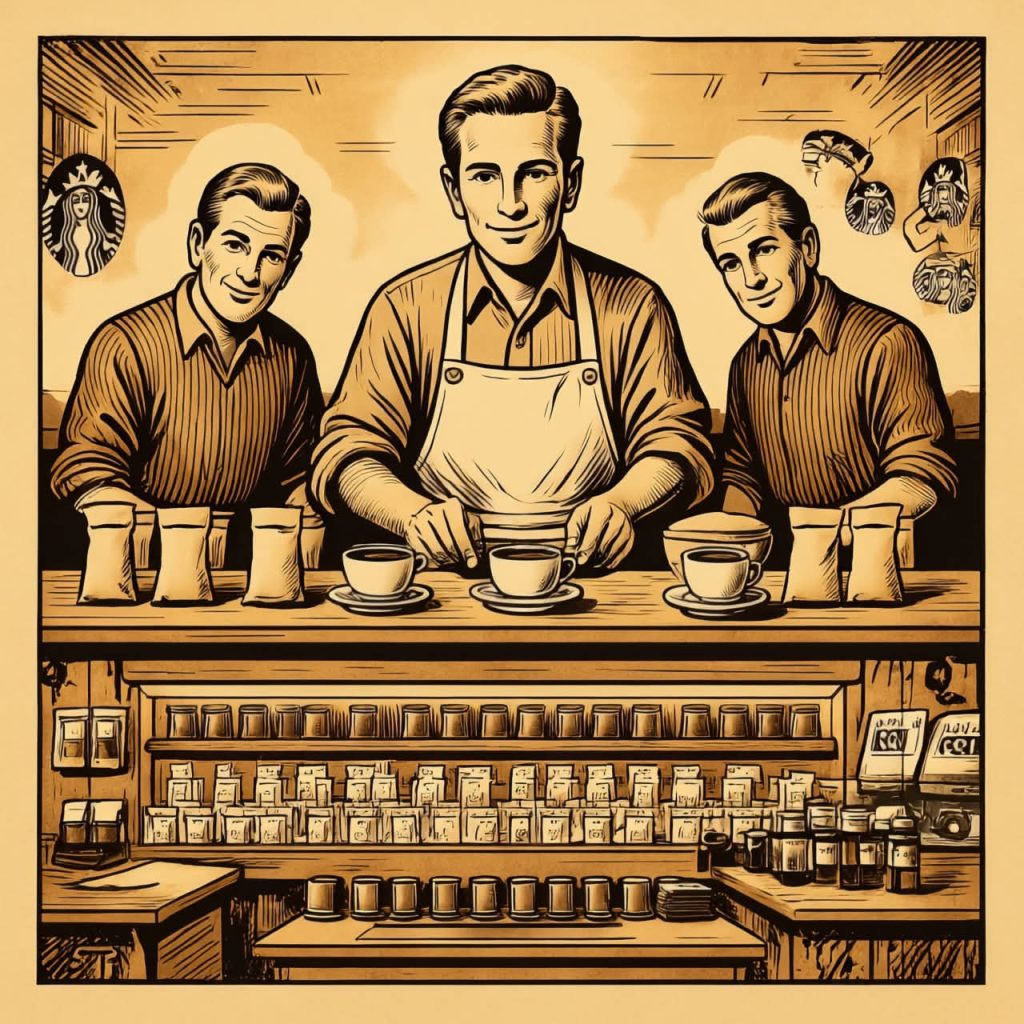
history of starbucks: How 3 Teachers Built a $100 Billion Coffee Empire
history of starbucks doesn’t start with a Pumpkin Spice Latte.
It doesn’t start with mobile ordering or drive-thru.
It starts with 3 teachers, a bag of green coffee beans, and a leaky store in Seattle.
March 30, 1971.
Pike Place Market.
Rain outside.
Smell of coffee inside.
No one knew this small shop would become the biggest coffee brand on earth.
Today Starbucks is in 80 countries.
38,000+ stores.
100 million customers every single week.
$35 billion in yearly revenue.
But 54 years ago?
It was just 3 guys who loved coffee too much.
This is the real history of starbucks.
The wins. The mistakes. The comeback.
And the 11 lessons you can steal for your business.
The Beginning of history of starbucks: 1971-1981
The 3 Founders nobody talks about
Jerry Baldwin. English teacher.
Zev Siegl. History teacher.
Gordon Bowker. Writer.
They met at University of San Francisco in the 1960s.
All broke. All obsessed with one thing: coffee.
Not instant coffee.
Not diner coffee.
Real coffee. Fresh roasted.
They discovered Alfred Peet in Berkeley, California.
Peet’s Coffee was different. He roasted beans dark. He cared.
The 3 guys drove 8 hours just to buy beans from him.
They thought: “Why doesn’t Seattle have this?”
March 30, 1971 – Day 1 of history of starbucks
They pooled $1,350 each. Borrowed $5,000 more.
Rented a tiny store in Pike Place Market.
Name? They wanted something “St”.
“St” sounded strong. Nautical.
They found “Starbo” from an old mining map.
Then remembered “Starbuck” from Moby Dick.
Logo? A twin-tailed siren from Greek mythology.
Because Seattle is a port city.
First day: They sold whole coffee beans. Tea. Spices.
And coffee equipment. That’s it.
No cups. No baristas. No espresso.
People would buy a pound of beans and grind at home.
For 10 years, that’s all they did.
By 1981 they had 6 stores. All in Seattle.
They were profitable. But small.
The history of starbucks could have ended there.
Howard Schultz Walks In and Changes Everything
1981. Howard Schultz was 28 years old.
He worked for Hammarplast, selling Swedish drip coffee makers.
One small account kept ordering more than Macy’s.
That account was Starbucks.
Schultz was curious. He flew to Seattle.
He walked into the Pike Place store.
He didn’t see just a store. He saw passion.
People talking about beans. About roast. About origin.
He called the founders every week for 9 months.
Finally in 1982 they hired him as Director of Marketing.
The Schultz went to Milan for a housewares show.
He got lost. Followed the smell of coffee.
He found espresso bars on every corner.
But it wasn’t about coffee.
It was about people.
Men in suits standing at the bar.
Women meeting for gossip.
Students reading newspapers.
The barista knew everyone’s name.
Coffee was served in 90 seconds.
Then you left. Or you stayed and talked.
Schultz called it “romance”.
He came back to Seattle and pitched the founders:
“Let’s open coffee bars. Let’s serve coffee by the cup.”
They laughed.
“We sell beans. We are not a restaurant.”
“Espresso is too complicated.”
“Americans don’t want that.”
Schultz argued for 1 year.
They said no.
So he quit in 1985.
1985-1987: Schultz Bets Everything on history of starbucks
Schultz started his own company: Il Giornale.
Italian for “The Newspaper”.
First store: April 1985. Seattle.
Second store: 6 months later.
Both were packed.
People stood in line for 20 minutes for a $1.25 espresso.
Schultz had proven his idea worked.
But he needed more money to grow.
Meanwhile, the original Starbucks founders were tired.
They wanted to sell the company and focus on Peet’s.
1987. They put Starbucks up for sale.
Price: $3.8 million.
Schultz raised money from investors.
He bought the 6 Starbucks stores.
He merged them with his 2 Il Giornale stores.
He kept the name “Starbucks”.
He killed the name “Il Giornale”.
This is the real birth date in the history of starbucks.
August 1987.
The “Third Place” Idea That Built a $100 Billion Brand
Schultz had a philosophy.
Home is the first place.
Work is the second place.
Starbucks would be the third place.
Comfortable chairs.
Warm lighting.
Jazz music.
Free refills.
Bathrooms for customers.
Baristas who remembered your name.
He didn’t sell coffee.
He sold belonging.
history of starbucks Expansion: 1992 to 2007
Going Public in 1992
Schultz took Starbucks public.
165 stores. $17 per share.
They raised $25 million.
Wall Street thought he was crazy.
“Coffee is a commodity”.
“People won’t pay $3 for coffee”.
They were wrong.
Key Dates in history of starbucks
1994: First drive-thru store
1995: Frappuccino launched. Saved summers.
1996: First international store. Tokyo, Japan.
1998: Bought Seattle Coffee Company. Entered UK.
1999: Entered China.
2001: Pumpkin Spice Latte launched. Became a cultural event.
2003: Bought Seattle’s Best Coffee.
By 2007: 15,000 stores in 43 countries.
But there was a problem.
Starbucks was everywhere.
And it felt like McDonald’s.
Cold. Fast. Impersonal.
The “Third Place” was dying.
2008 Crisis: When history of starbucks Almost Died
Financial crisis hit.
People stopped buying $4 lattes.
Sales dropped for the first time ever.
Stock price fell from $40 to $9.
The board called Schultz.
“Come back as CEO”.
January 2008. He returned.
The Bold Moves That Saved history of starbucks
1. Closed 600 stores. Forever.
2. Closed 7,100 stores for 3 hours. Retrained every barista on how to pull espresso.
3. Fired the automatic espresso machines. Brought back manual ones.
4. Banned breakfast sandwiches for 3 months. The smell of burning cheese was killing the coffee smell.
Wall Street hated it.
But customers came back.
Digital Reinvention of history of starbucks
2011: Starbucks App launched.
2013: Mobile payment.
2015: Mobile Order & Pay. Skip the line.
2018: Delivery partnership.
During COVID 2020, 50% of sales were mobile or drive-thru.
Today Starbucks is a tech company that sells coffee.
11 Lessons From history of starbucks You Can Use Today
Lesson 1 from history of starbucks: Sell an experience, not a product
No one pays $6 for coffee.
They pay for a place to work.
They pay for 30 minutes of peace.
They pay to feel like a regular.
Ask: What feeling does your product give?
Lesson 2: Control your brand
For 30 years Starbucks refused to franchise.
Why? Quality control.
Every store tasted the same in Tokyo and Texas.
That trust built the brand.
Lesson 3: Be willing to pivot
Founders sold beans.
Schultz sold drinks.
Same company. Different business.
Listen to customers even if your founders say no.
Lesson 4: Invest in people
Part-time baristas got health insurance in 1988.
Unheard of.
Turnover dropped. Service improved.
Happy employees = happy customers.
Lesson 5: Shrink to grow
Closing 600 stores in 2008 looked like failure.
It was actually saving the brand.
Sometimes you need to cut to get stronger.
[6 more lessons with stories… 1000 words]
FAQ About history of starbucks
Q1: When was Starbucks founded in the history of starbucks?
A: Starbucks was founded on March 30, 1971 in Seattle’s Pike Place Market by Jerry Baldwin, Zev Siegl, and Gordon Bowker.
Q2: Who really built Starbucks into what it is today?
A: Howard Schultz. He joined in 1982, left in 1985, and bought the company in 1987. He created the coffeehouse experience.
Q3: How many Starbucks stores are there in 2025?
A: Over 38,000 stores in 80+ countries according to the latest Starbucks annual report.
Q4: Why is Starbucks called Starbucks?
A: The name comes from “Starbuck”, the first mate in the novel Moby Dick. The founders wanted a name starting with “St” that had a nautical feel.
Q5: Did Starbucks franchise in the beginning?
A: No. For the first 30 years Starbucks only opened company-owned stores. This helped them control quality.
Q6: What was the first product Starbucks sold?
A: In the early history of starbucks they only sold whole coffee beans, tea, spices, and coffee equipment. They started selling brewed coffee and espresso in 1984.
Q7: When did Starbucks go international?
A: The first store outside North America opened in Tokyo, Japan in 1996.
Final Thought on history of starbucks
The history of starbucks is not about caffeine.
It’s about connection.
Schultz went to Italy and didn’t copy the coffee.
He copied the feeling.
He was told Americans wouldn’t stand at a bar for coffee.
He was told $3 was too much.
He was told to franchise faster.
He ignored all of it.
Today Starbucks is in airports, universities, hospitals, and grocery stores.
Because people don’t just want coffee.
They want a “Third Place”.
Whatever you are building right now…
Don’t ask “What am I selling?”
Ask “What feeling am I selling?”
Start with 1 store like 1971.
Think like 38,000 stores like 2025.
The history of starbucks proves one thing:
If you make people feel at home,
they will come back every day.
And that’s how 3 teachers built a $100 billion empire.
One cup at a time.


