The Wooden Horse of Troy: History or Merely a Fabricated Fable?
The Wooden Horse of Troy: History or Merely a Fabricated Fable?
wooden horse of troy.
It is the most famous trick in history.
A giant wooden horse. Left at the gates of a city.
Soldiers hiding inside.
At night the gates open. The city burns.
Everyone knows the story.
But did it really happen.
For 3000 years people have asked the same question.
Was the wooden horse of troy real. Or was it just a story made up by poets.
Today we have archaeology. We have ancient texts. We have science.
Let’s dig into the truth.
This is the story of the wooden horse of troy. History or fable.
Chapter 1:Wooden Horse of Troy We All Know
Homer and Virgil Tell The Tale
The story starts with the Trojan War.
Around 1200 BC, according to legend.
King Menelaus of Sparta’s wife Helen ran away with Prince Paris of Troy.
Menelaus was angry.
He gathered all of Greece and sailed to Troy to get her back.
The war lasted 10 years.
For 9 years nothing happened. The Greeks could not get past Troy’s walls.
Then in year 10, Odysseus had an idea.
“Let’s build a giant wooden horse,” he said.
“We will leave it as a gift to the gods. Then we will sail away.”
The Greeks built the horse. It was huge.
Inside, 30 of the best Greek warriors hid.
The rest of the Greek army burned their camp and sailed away.
The Trojans came out. They saw the horse.
Some said “Burn it.”
Others said “Bring it inside as an offering to Athena.”
Priest Laocoon warned them. “Beware Greeks bearing gifts.”
But the Trojans did not listen.
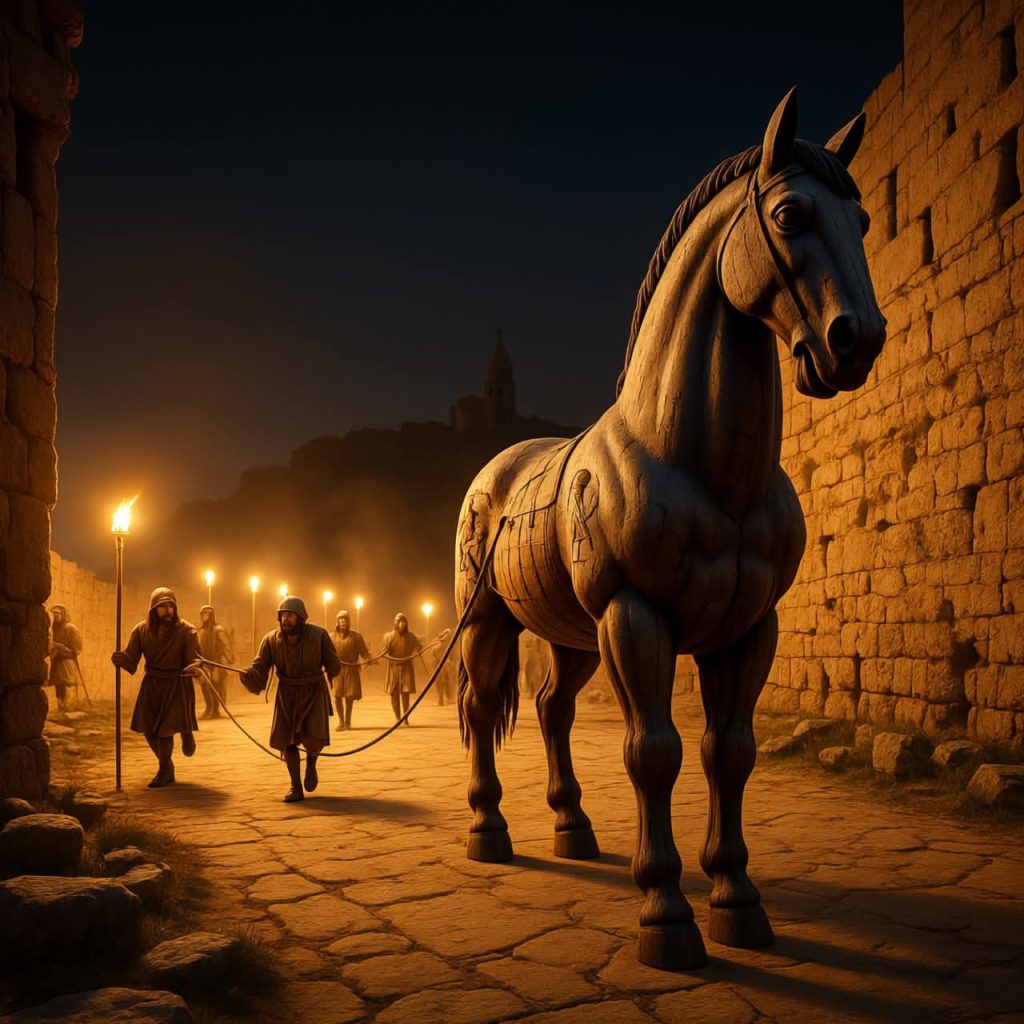
They dragged the wooden horse of troy inside the city walls.
That night, the Greeks climbed out.
They opened the gates.
The rest of the army came back and burned Troy to the ground.
End of story.
But is it true.
British Museum Troy Exhibition
Chapter 2: Where Does The Story Come From
Homer The Iliad and The Odyssey
The problem is that Homer never mentions the horse in The Iliad.
The Iliad covers only 51 days of the 10 year war.
And it ends before Troy falls.
The wooden horse of troy is mentioned in The Odyssey.
But only in 2 lines.
The real detailed story comes 700 years later from a Roman poet named Virgil.
In his book The Aeneid, written around 20 BC, Virgil tells the full story.
Laocoon. The priest. The arguments. The horse.
All of it.
So we have a 3000 year old war.
And the most detailed account was written 1200 years after it happened.
That is like us writing a detailed account of a war from the year 800.
Makes you wonder.
Chapter 3:Wooden Horse of Troy Did Troy Even Exist
Heinrich Schliemann and The Discovery
For 2000 years people thought Troy was a myth.
Just a story.
Then in 1870 a German businessman named Heinrich Schliemann said “No. Troy was real.”
He went to a hill in modern Turkey called Hisarlik.
He started digging.
And he found it.
City after city. Built on top of each other.
9 layers of Troy.
Troy 1 to Troy 9.
Troy 6 and Troy 7a match the time of the Trojan War. Around 1300 to 1200 BC.
They had walls. They had evidence of fire. They had arrows.
So Troy was real.
But did the wooden horse of troy happen there.
That is a different question.
Archaeological Site of Troy UNESCO
Chapter 4: Argument 1 – It Was Real
The Case For A Real Wooden Horse
Some historians believe the wooden horse of troy was real.
Here is why.
Reason 1: Ancient warfare used tricks
The Greeks were famous for tricks. Ambushes. Deception.
Building a wooden structure to hide soldiers is not impossible.
Reason 2: The horse was a religious symbol
Horses were sacred to Poseidon. The god of the sea.
Leaving a horse as an offering makes sense.
Reason 3: Oral history remembers it
For 400 years before Homer, Greeks told stories of the war.
The horse was part of that memory.
Reason 4: Archaeology shows Troy was destroyed
Troy 7a was burned around 1190 BC.
Maybe by Greeks. Maybe using a trick.
If the wooden horse of troy was real, it would have been made of wood.
Wood rots. We would never find it.
So absence of evidence is not evidence of absence.
Chapter 5: Argument 2 – It Was A Metaphor
The Case That The Horse Was Not A Horse
Other historians say no. The wooden horse of troy was a metaphor.
Here is their case.
Theory 1: The Earthquake Machine
The Greek word for horse is “hippos”.
The word for an earthquake machine used in sieges was similar.
Maybe “horse” meant a siege tower on wheels.
Theory 2: The Ship Theory
Some ancient texts say “horse” was slang for a Greek ship.
Maybe the Greeks came back on ships at night.
Theory 3: The Poseidon Theory
Poseidon was the god of horses and earthquakes.
“Wooden horse” meant “earthquake sent by Poseidon.”
Troy’s walls fell in an earthquake.
Theory 4: It Was Made Up
Virgil wrote The Aeneid to make Rome look good.
Romans claimed they were descended from Trojan survivors.
A dramatic story of a trick made the Trojans look foolish, not weak.
If the wooden horse of troy was a metaphor, it makes more sense.
Chapter 6: What Ancient Writers Actually Said
Going Back To The Sources
Let’s look at what people actually wrote.
Homer, 750 BC: Mentions the horse twice. Very briefly. No details.
Greek lyric poets, 600 BC: Mention it more.
Virgil, 20 BC: Gives the full story with Laocoon and the priest.
Diodorus Siculus, 50 BC: Says the horse was a siege engine.
Pausanias, 150 AD: Says he saw a painting of the horse in Greece.
Notice something.
The story gets bigger over time.
First 2 lines. Then a paragraph. Then a whole book.
That is how myths grow.
The wooden horse of troy might have started as a small detail and became the main event.
Chapter 7: Could You Actually Build It
The Engineering Problem
Let’s be practical.
Could you build a wooden horse big enough to hide 30 men.
Yes.
Ancient Greeks were great carpenters.
A horse 3 meters tall. Hollow inside. On wheels.
30 men could fit if they were cramped.
Could you drag it to the city gates.
Yes. With ropes and logs.
Could the Trojans be dumb enough to bring it inside.
That is the real question.
Troy had been at war for 10 years.
Would they really fall for such a trick.
That is why many historians doubt it.
Chapter 8: 10 Clues From Archaeology
What Troy 7a Tells Us
Archaeologists found:
1. Walls destroyed by fire
2. Arrowheads in the streets
3. Bodies left unburied
4. Evidence of a short siege
5. No evidence of a giant horse
6. Trojan storage jars full of food
7. Signs the city was surprised
8. No Greek pottery from that layer
9. Evidence of earthquake damage
10. The city was smaller than Homer described
So Troy was attacked and burned.
But there is zero evidence of the wooden horse of troy.
Chapter 9:Wooden Horse of Troy Why The Story Survived
The Power of A Good Story
Even if the wooden horse of troy was not real, the story survived for a reason.
It teaches a lesson.
“Do not trust your enemy.”
“Pride comes before a fall.”
“Beware Greeks bearing gifts.”
It is also a great story.
Heroes. Gods. Trickery. Fire.
Stories like that last 3000 years.
The wooden horse of troy is memorable because it is simple.
Chapter 10: Modern Theories
What Historians Think Today
Most historians today agree on this:
1. Troy was real
2. There was a war around 1200 BC
3. The wooden horse of troy probably did not happen exactly like Virgil said
The most popular theory:
The “horse” was a naval attack.
Or an earthquake.
Or a siege tower.
Over 3000 years the story changed into a giant wooden horse.
Chapter 11: The Wooden Horse of Troy Horse In Art And Culture
From Ancient Pots to Hollywood
The wooden horse of troy appears everywhere.
Ancient Greek pots from 700 BC show it.
Roman mosaics show it.
Renaissance paintings show it.
Movies like Troy 2004 show it.
The image is burned into our brains.
Even if it never happened, it feels real.
Chapter 12:Wooden Horse of Troy What If It Was Real
How It Would Have Worked
Let’s imagine it was real for a second.
The Greeks build it in 3 days.
They hide inside. No food. No water. For 24 hours.
At night they climb out quietly.
They kill the guards.
They open the gates.
The rest of the army runs in.
Troy burns.
It is possible.
But very risky.
One cough and the whole plan fails.
Chapter 13: The Laocoon Problem
The Priest Who Warned Everyone
In Virgil’s story, priest Laocoon says “Do not bring in the horse.”
Two sea serpents come and eat him and his sons.
That scene is famous. There is a statue of it in the Vatican.
But Laocoon only appears in Virgil. Not in Homer.
So did he exist.
Probably not.
He was added to make the story more dramatic.
Chapter 14: Other Ancient “Trojan Horses”
This Trick Happened Before
The idea of hiding soldiers is not unique.
In 425 BC, Greeks hid in a cave to attack Spartans.
In medieval times, armies used fake gifts.
The wooden horse of troy was just the most famous version.
Chapter 15: Final Verdict
History or Fable
So what is the answer.
Was the wooden horse of troy real.
Most likely: No. Not exactly.
Troy was real. The war was real. The destruction was real.
But the giant wooden horse was probably a story.
A story that grew over 1000 years.
It started as a trick. Became a horse. Became a legend.
Chapter 16: Why It Still Matters
The Lesson of The Wooden Horse
Even if it is a fable, the wooden horse of troy teaches us something.
Do not be blinded by gifts.
Do not ignore warnings.
Sometimes the biggest danger looks like a present.
That is why we still tell the story.
Frequently Asked Questions Wooden Horse of Troy
1. Was the wooden horse of troy real
Probably not. Troy was real but the horse was likely a myth.
2. Who built he wooden horse
According to myth, Odysseus and the Greek army.
3. How many soldiers were inside
Legends say 30 to 40 of the best Greek warriors.
4. Did Homer describe the horse
Only briefly. Virgil gave the full story 700 years later.
5. Has the horse ever been found
No. It was made of wood and would have rotted away.
6. Where was Troy located
In modern day Hisarlik, Turkey.
7. What “beware Greeks bearing gifts” mean
Do not trust an enemy even if they offer you something nice.