
5 Terrifying Medical Practices From The Middle Ages That Drove Patients To Certain Death
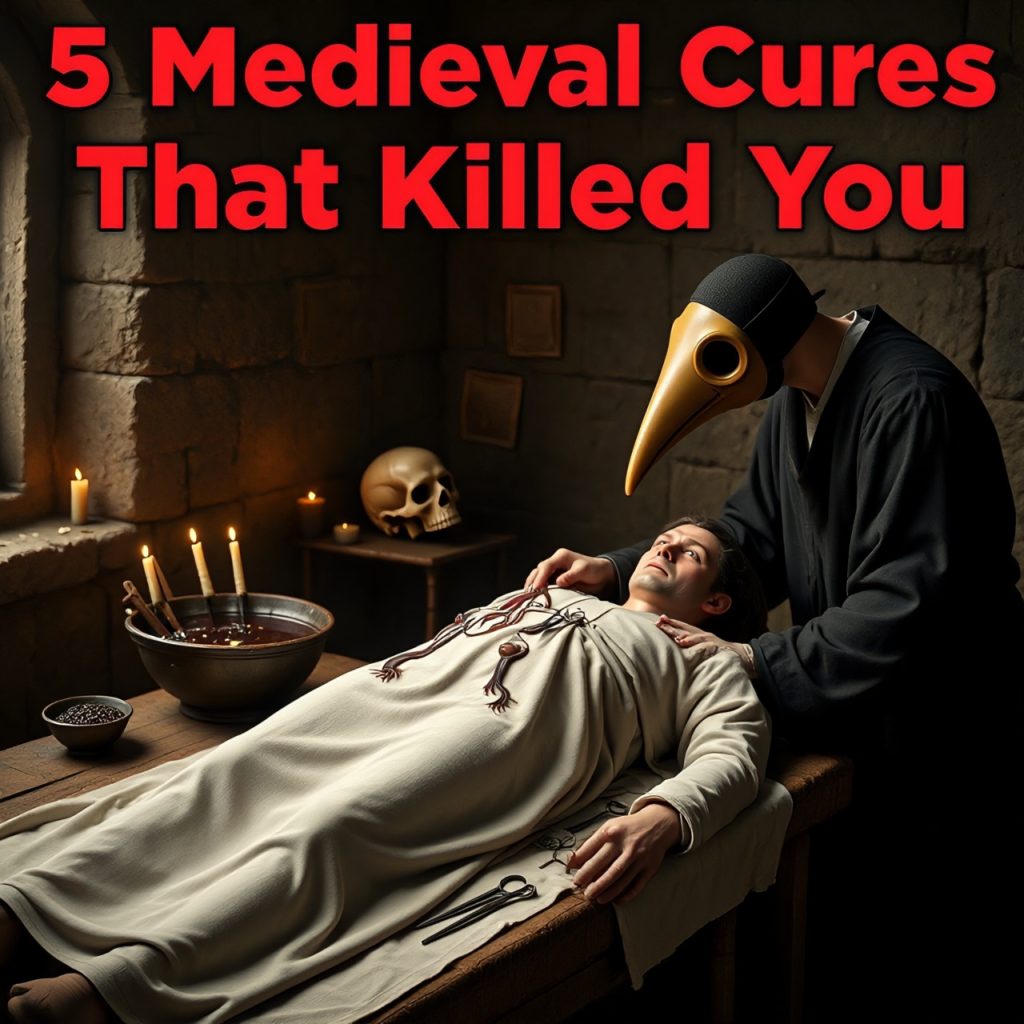
5 Terrifying Medical Practices From The Middle Ages That Instead Of Curing Drove Patients To Certain Death
medieval medical practices.
The Middle Ages lasted from 500 AD to 1500 AD.
1000 years of castles, knights, and plagues.
It was also 1000 years of the worst medicine in human history.
If you got sick in the Middle Ages, you had two choices. Pray, or go to a doctor who might kill you faster than the disease.
Today we have antibiotics and surgery. Back then they had leeches and superstition.
These are 5 terrifying medieval medical practices that were supposed to heal people.
Instead they drove patients straight to their grave.
Chapter 1: Bloodletting – Draining Life To Save Life
The Most Popular medieval medical practices For 1000 Years
Imagine you have a fever.
You go to the town barber. He was also the doctor.
He ties a cloth around your arm. He takes out a sharp blade.
And he cuts you open.
Then he puts leeches on your skin to suck more blood.
This was called bloodletting. And it was the number one treatment for almost everything in the Middle Ages.
Doctors believed the human body had 4 “humors”. Blood, phlegm, black bile, and yellow bile.
If you were sick, it meant your humors were unbalanced.
The solution was simple. Drain the extra blood.
Rich people were bled with fancy silver bowls. Poor people used leeches.
A typical treatment could remove 1 to 2 liters of blood. That is almost half of your blood.
People were bled for headaches. For fever. For pregnancy. For mental illness. Even healthy people were bled every spring “to stay healthy.”
The problem was obvious. Most people in the Middle Ages were already malnourished and weak.
Then you take away half their blood.
What happened next. They got dizzy. They fainted. They got infections from dirty blades. And many just died.
George Washington died in 1799 because doctors bled him 4 times in 24 hours for a throat infection.
Bloodletting was one of the most dangerous medieval medical practices because everyone believed it worked. Even when the patient was turning pale and dying.
The irony is that sometimes it did help a little. If someone had high blood pressure it would drop. But 99 percent of the time it just made sick people weaker.
This practice lasted until the 1800s. 1300 years of draining people to death.Wellcome Collection Medieval Medicine
Chapter 2: Trepanning – Drilling Holes In Your Skull
When Headache Meant A Drill
You have a bad headache in 900 AD.
The healer says “Evil spirits are trapped in your head.”
His solution. Take a sharp stone or metal tool.
And drill a hole directly into your skull.
This was called trepanning. And it is one of the oldest medieval medical practices we have proof of.
Archaeologists have found skulls from the Middle Ages with perfect round holes in them.
Some people had 7 or 8 holes in one skull. Meaning they survived multiple drillings.
Why did they do it.
They believed headaches, seizures, and mental illness were caused by demons.
The only way to let the demon out was to make a hole.
The tools were terrible. No anesthesia. No antiseptic. Just a hand drill and screaming.
The patient was held down by 4 people.
The healer would slowly scrape and drill until he reached the membrane under the skull.
If he went too deep, the patient died instantly.
If he stopped in time, the patient might survive with a hole in their head and a massive risk of infection.
The crazy part is that some people did survive.
We know because the bone around the hole shows signs of healing.
That means they lived weeks or months after.
But most did not. Infection killed them in days.
Trepanning was terrifying because it was done with full confidence. The healer thought he was saving you.
Today we do brain surgery in sterile rooms. In the Middle Ages they did it in a barn with a dirty drill.
This is why medieval medical practices were so scary. Good intentions, terrible results.British Library Medicine History
Chapter 3: Purging And Vomiting – Poison As Medicine
Drink Mercury To Cure Syphilis
In the Middle Ages, if you were constipated, the doctor gave you poison.
If you had syphilis, the doctor gave you more poison.
If you had a fever, the doctor made you vomit until you collapsed.
This was called purging. And it was based on the same humor theory as bloodletting.
Doctors believed sickness was “bad stuff” inside you.
So they had to get it out. Either from the top or the bottom.
For the top, they used emetics. Herbs that made you vomit for hours.
For the bottom, they used laxatives so strong they caused bloody diarrhea.
The most famous purge was mercury.
In the 1400s and 1500s, syphilis spread across Europe.
Doctors had no cure. So they gave patients mercury pills and mercury vapor baths.
The idea was that mercury would “burn out” the disease.
What it actually did was burn out the patient’s teeth, gums, kidneys, and brain.
Symptoms of mercury poisoning: shaking, hair loss, madness, death.
Patients would literally rot while alive.
And doctors called it treatment.
Another popular purge was antimony. A metal that causes violent vomiting.
People were given antimony cups to drink water from. The water became toxic.
They thought the vomiting meant the medicine was working.
In reality, the medieval medical practices of purging killed thousands through dehydration and organ failure.
A person with a simple stomach bug would be given poison, then bleed, then die.
The worst part was that doctors wrote books about it. They taught it in universities.
For 500 years, medical schools taught that poison was medicine.
Chapter 4: Barber Surgeons – The Butchers With Razors
Amputation Without Painkillers
In the Middle Ages there were no real surgeons.
There were barbers.
Barbers cut hair. And they also cut people.
Because they had sharp razors, people assumed they could do surgery too.
These men were called barber surgeons.
And they performed the most terrifying medieval medical practices of all.
Need a tooth pulled. Go to the barber.
Need an arm amputated. Go to the barber.
Need a tumor cut out. Go to the barber.
There was no anesthesia. The only pain relief was alcohol or a piece of wood to bite.
The procedure went like this.
4 strong men would hold the patient down on a table.
The barber surgeon would take his saw.
And he would cut through flesh and bone while the patient screamed.
A leg amputation took 3 minutes if the surgeon was fast.
If he was slow, the patient bled to death on the table.
After the cut, they poured boiling oil or tar on the wound “to stop bleeding.”
That caused even more pain and infection.
Infection was the real killer.
There was no concept of germs. Surgeons wiped their bloody tools on their apron and used them on the next patient.
Gangrene set in within days.
9 out of 10 patients died after surgery.
And yet people went to them because there was no other option.
Battlefield medicine was even worse. After a war, hundreds of men would be lined up for amputation.
The barber surgeons worked like factory workers. Saw, cut, next.
This is why people feared doctors more than disease.
Because medieval medical practices meant guaranteed pain and likely death.
The barber pole with red and white stripes comes from this time. Red for blood, white for bandages.
Chapter 5: Plague Doctors And Cures That Spread Disease
The Beak Mask That Did Nothing
1347. The Black Death arrives in Europe.
It kills 1 in 3 people. 50 million dead.
People were desperate. So doctors tried anything.
This created the worst medieval medical practices of the entire era.
First, the plague doctor costume.
Long black robe. Gloves. Hat. And the famous beak mask.
The beak was stuffed with herbs and flowers.
Doctors thought the plague spread through “bad air.”
The herbs would filter the air.
Did it work. No.
The plague was spread by fleas on rats. The mask did nothing.
But the costume did spread fear. People saw a plague doctor and knew someone in the house was dying.
Second, the cures.
Doctors told people to bathe in vinegar.
They told people to hold flowers to their nose.
They told people to sit in rooms full of smoke.
They told people to bleed themselves.
They told people to take mercury and arsenic pills.
All of it useless. All of it harmful.
The most insane cure was “theriac.”
It was a paste made from 60 ingredients including snake meat, opium, and honey.
People paid fortunes for it. It did nothing.
Some doctors even recommended sexual activity “to balance the humors.”
During a plague.
Other medieval medical practices during the Black Death included flagellants.
People who whipped themselves in the streets to beg God for forgiveness.
And Jews were blamed and massacred because people thought they poisoned the wells.
Medicine had completely collapsed.
The plague doctors were paid by cities to treat the poor.
But most refused to touch patients. They just stood in the doorway and gave advice.
If you were rich, you fled to the countryside.
If you were poor, you died with a plague doctor watching.
It would take 300 more years before we understood bacteria and germs.
Until then, these medieval medical practices were all people had.
Chapter 6: Why Were medieval medical practices So Deadly
4 Reasons From History
Reason 1: No Science
They did not know about bacteria. They did not know about anatomy. They guessed.
Reason 2: The Church Controlled Medicine
For 1000 years the Church said illness was God’s punishment. So prayer was more important than treatment.
Reason 3: Books Were Copied Not Tested
Doctors read Greek texts from 1000 years earlier and never questioned them.
Reason 4: No Regulation
Anyone could call themselves a doctor. Barbers, monks, old women. All gave medical advice.
The result was 1000 years where getting sick was often a death sentence.
Chapter 7: 10 More Horrifying medieval medical practices
1. Leech Therapy Used up to 50 leeches on one person
2. Cauterization Burning wounds with hot iron
3. Urine Therapy Drinking urine to cure disease
4. Mummy Powder Grinding mummies to make medicine
5. Astrology Doctors would not treat you unless stars were right
6. Animal Dung Used as medicine for wounds
7. Tooth Extraction With pliers and no pain relief
8. Cupping Sucking skin with fire to draw out blood
9. Herbal Overdoses Poisonous plants used as cure
10. Exorcism For mental illness instead of care
Chapter 8: Did Anyone Survive These Treatments
The Lucky Few
Yes. Some people survived bloodletting. Some survived trepanning.
But not because of the treatment.
They survived in spite of it.
Young healthy people could lose blood and recover.
People with strong immune systems fought off infection from dirty tools.
And sometimes the disease just ran its course and the person got better on their own.
Doctors took credit.
“The leeches cured him” they said, when the patient was already getting better.
This is why these medieval medical practices lasted so long. Because sometimes people lived.
Chapter 9: The End Of medieval medical practices Medicine
How We Finally Got Real Doctors
The Renaissance in 1400s started to change things.
Doctors began dissecting bodies. They learned real anatomy.
In 1543 Andreas Vesalius published a real anatomy book.
In 1847 Ignaz Semmelweis said doctors should wash their hands.
In 1865 Joseph Lister used antiseptic.
Slowly, the horror ended.
By 1900, bloodletting was gone. Barber surgeons were gone.
Modern medicine was born.
But it took 1000 years.
Chapter 10: Final Thoughts medieval medical practices
The Darkest Chapter In Medicine
The 5 terrifying medieval medical practices we covered killed millions.
Bloodletting weakened the sick.
Trepanning drilled into brains.
Purging poisoned the body.
Barber surgeons butchered patients.
Plague doctors spread fear not cures.
These medieval medical practices were done with confidence.
Doctors truly believed they were helping.
That is the scariest part.
Today we look back and are horrified.
In 500 years people might look at some of our treatments the same way.
The Middle Ages remind us that medicine is always improving.
And that the line between cure and killing can be very thin.
Frequently Asked Questions medieval medical practices
1. What were medieval medical practices
Medical treatments used from 500 to 1500 AD including bloodletting and trepanning.
2. Did bloodletting really work
No. It usually made patients weaker and killed them faster.
3. Why did theill holes in skulls
To let evil spirits out and cure headaches and mental illness.
4. Who performed surgery in the Middle Ages
Barbers. They were called barber surgeons.
5. Did any medieval treatments actually help
A few herbs helped with pain. But most treatments did more harm.
6. When did medieval medicine end
Around 1800s when science and germ theory started.
7. What is the scariest medieval medical practice
Trepanning. Because it involved drilling into a conscious person’s skull.


