
Here Are The Three Oldest Universities In The World That Laid The Foundation For Modern Education
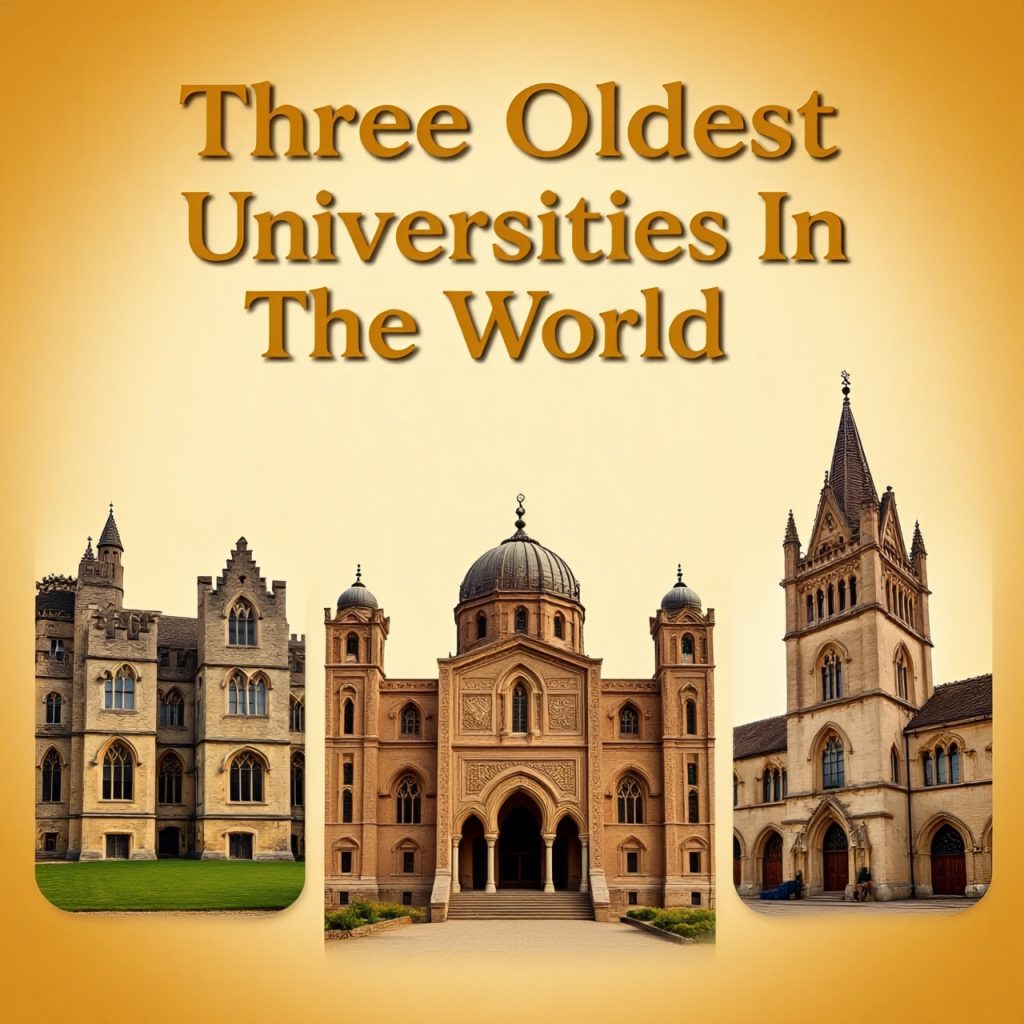
Intaroduction:The 3 Oldest Universities in The World That Built Modern Education
I was sitting in my three oldest universities in the world library last month, stressed about finals.
And I looked around and thought: “People have been doing this for 1000 years?”
Yeah. They have.
While we’re stressing about GPA and student loans, there are 3 schools on this planet that have been teaching students since before the Crusades. Before Columbus. Before the printing press.
These 3 places didn’t just teach people. They invented how we teach people today.
If you’ve ever sat in a lecture hall, taken a final exam, or got a degree… you can thank these 3 universities.
Let’s go back in time.
1. University of al-Qarawiyyin – Morocco, 859 AD
The Oldest Three Oldest Universities In The World Still Running
Fes, Morocco. 859 AD.
A woman named Fatima al-Fihri had a problem. She was rich, religious, and wanted to build something that would last.
So she used her inheritance to build a mosque. But not just a mosque. She built a school next to it.
That school is now called the University of al-Qarawiyyin.
And it’s still open. Today. Right now.
That’s 1165 years.
What Made It Revolutionary
In 859, “university” wasn’t even a word yet.
But al-Qarawiyyin had everything we associate with a modern university:
1. Degrees – They gave students an “ijazah”. A certificate saying you’re qualified to teach.
2. Subjects – Theology, law, grammar, medicine, astronomy, math. Not just religion.
3. Library – The Qarawiyyin Library has books from the 9th century. It was restored in 2016 and it’s stunning.
4. Students from everywhere – People came from Spain, Egypt, Iraq to study here.
This is where the idea of a “degree” started.
Famous People Who Studied Here
– Ibn Khaldun – The father of sociology and history. He studied here in the 1300s.
– Maimonides – Jewish philosopher who changed medicine and philosophy.
– Pope Sylvester II – The Pope who introduced Arabic numbers to Europe. He studied in Fes.
Think about that. A Pope studied in a Muslim university in 900s.
Why It Matters To Modern Education
Every time you get a diploma, you’re using a system invented here.
The idea that you study for years, pass tests, and get a paper that says “you’re qualified” – that started in Fes.
UNESCO and Guinness both recognize al-Qarawiyyin as the oldest continuously operating university.
It’s still teaching 8000 students today. Same campus. Same mission.
2. Al-Azhar University – Egypt, 970 AD
The Heart of Islamic Learning
Cairo, Egypt. 970 AD.
The Fatimid Caliphate decided they needed a center for learning. So they built Al-Azhar Mosque and attached a university to it.
“Al-Azhar” means “the radiant one”.
For 1054 years it has never closed.
How It Changed Three Oldest Universities In The World
Al-Azhar did 3 things that changed education forever:
1. It Made Education Free
From day 1, students didn’t pay tuition. They got free housing and food too.
Students from poor families in Africa and Asia could come study.
Sound familiar? Scholarships started here.
2. It Standardized Curriculum
Al-Azhar created the first real “course catalog”.
You had to study grammar, then logic, then theology, then law. In order.
That’s the foundation of majors and prerequisites today.
3. It Became The Authority
If you had a question about law, science, or religion in the Muslim world, you asked Al-Azhar.
They issued “fatwas” and rulings that were respected from Indonesia to Morocco.
The Library That Saved Knowledge
During the Crusades and Mongol invasions, libraries in Baghdad were burned.
But scholars ran to Cairo with their books. Al-Azhar saved them.
Today it has over 500,000 manuscripts. Some are 1000 years old.
Al-Azhar and Modern Universities
When European universities started in 1000s and 1100s, they copied Al-Azhar.
The structure: Rector, deans, professors, students.
The system: Lectures, debates, exams.
The idea: A place where all subjects are taught together.
Oxford and Paris sent people to study how Al-Azhar worked.
So when you sit in a lecture hall, that room layout was perfected in Cairo 1000 years ago.
Al-Azhar still has 500,000 students today. It’s the largest Islamic university in the world.
3. Three Oldest Universities In The World of Bologna – Italy, 1088 AD
The First European University
Bologna, Italy. 1088 AD.
This is the one Europeans call “the oldest”.
Why? Because it’s the oldest university in the Western world that uses the European model.
It started by accident.
Students came to Bologna to study law. Roman law.
The teachers were so good that more students came. Then the students got together and said “We should run this school.”
And they did.
The Student-Run Revolution
This is wild. In 1088, the STUDENTS hired the professors.
If a professor was late, the students fined him.
If a professor didn’t teach well, the students fired him.
Students set the tuition.
It was the first time students had power in a university.
That idea of “student rights” started in Bologna.
What Bologna Invented
Bologna gave us almost everything in modern college:
1. Faculties – Law, Medicine, Arts. Separate departments.
2. Exams – Oral exams in front of a panel. Sound familiar?
3. Academic Degrees – Bachelor, Master, Doctor. Those titles started here.
4. Student Associations – “Nations” of students from the same country. Like international student clubs.
Famous Alumni
– Copernicus – He studied law here and discovered the Earth goes around the Sun.
– Dante – The poet who wrote The Divine Comedy.
– Thomas Aquinas – One of the most important Christian philosophers.
The Bologna Process 1999
Even today Bologna is shaping education.
In 1999, 29 European countries signed the “Bologna Process” in this city.
It standardized degrees across Europe. Bachelor = 3 years. Master = 2 years.
So when you hear “Bologna Degree”, it’s named after this 900 year old school.
Bologna still has 90,000 students. It’s huge.
How These 3 Schools Created Modern Education
The Things We Still Use Today
Let’s connect the dots.
| What We Do Today | Who Invented It | When |
| — | — | — |
| Get a Degree | al-Qarawiyyin | 859 |
| Free Tuition/Scholarships | Al-Azhar | 970 |
| Student-Run Unions | Bologna | 1088 |
| Faculties and Departments | All Three | 900-1100 |
| Libraries | All Three | 900-1100 |
| Final Exams | Al-Azhar + Bologna | 1000s |
None of these existed before these 3 schools.
Before 859, education was monks teaching in monasteries. One on one.
These universities said: “Let’s get 1000 people in one place. Teach them together. Test them. Give them a paper.”
That’s literally how every college works now.
The Similarities Between Them
1000 Years Apart But The Same Ideas
What’s crazy is these 3 schools never talked to each other.
Fes. Cairo. Bologna.
Different religions. Different languages. Different continents.
But they all came up with the same system:
1. A permanent campus – Not traveling teachers
2. Multiple subjects – Not just religion
3. Qualified teachers – You needed a degree to teach
4. A way to test students – Exams
5. A certificate at the end – Proof you learned
It’s like they all discovered the same formula for human learning.
What Student Life Was Like 1000 Years Ago
It’s Not That Different
Let me paint you a picture.
In Fes, 900 AD:
You wake up at dawn. Pray. Go to the mosque-university.
Sit on the floor in a circle. A sheikh lectures.
You take notes on paper. At night you study in the library by oil lamp.
You’re homesick. You miss your family in Spain.
In Bologna, 1100 AD:
You wake up. Rent is expensive.
Go to a lecture on Roman law. 200 students in a room.
After class you go to the student tavern and argue about law.
You’re stressed about your oral exam next week.
Sound familiar?
The only difference is WiFi.
Why Three 3 Survived When Others Didn’t
The Secret To Lasting 1000 Years
Thousands of schools started and closed. Why did these 3 survive?
1. They adapted – Al-Qarawiyyin started with religion, now teaches science.
2. They had funding – Rich donors, governments, and endowments.
3. They were needed – Cities, governments, and religions needed educated people.
4. They were in important cities – Fes, Cairo, Bologna were all trade centers.
Most other medieval schools closed during wars, plagues, or because they ran out of money.
These 3 didn’t.
The Dark Side: What They Got Wrong
Let’s Be Honest
These universities were amazing. But they weren’t perfect.
1. Women – For 800 years, almost no women. Fatima founded al-Qarawiyyin but women couldn’t study there for centuries.
2. Slavery – Some early funding came from bad places.
3. Religious control – For a long time you couldn’t study science without religion.
Modern universities fixed these problems. But we should remember the flaws too.
Visiting Them Today
You Can Still Walk These Halls
Good news: You can visit all 3.
al-Qarawiyyin, Fes – The library is open to tourists. It’s beautiful. Blue tiles, old books.
Al-Azhar, Cairo – The mosque is open. The university has a museum.
Bologna, Italy – You can tour the Archiginnasio. The old anatomy theater is insane.
If you ever get the chance, go.
Stand in a classroom that’s been used for 1000 years. It’s humbling.
What These Three Oldest Universities In The World Teach Us Today
3 Lessons For Modern Education
1. Education Should Be Free or Affordable
Al-Azhar was free in 970. We’re still fighting about student loans in 2024.
2. Students Should Have a Voice
Bologna let students run the school. Modern schools are finally doing student feedback.
3. Knowledge Should Be Shared
All 3 had massive libraries and welcomed foreign students.
The internet is just a faster version of that.
Myths About Old Universities
Let’s Clear Some Things Up
Myth 1: “They only taught religion”
No. They taught math, medicine, astronomy, law, language.
Myth 2: “Degrees are new”
No. The ijazah from al-Qarawiyyin in 900s is the same as your diploma.
Myth 3: “European universities came first”
No. Al-Qarawiyyin and Al-Azhar were 100-200 years before Bologna.
Final Thoughts: We Stand On Their Shoulders Three Oldest Universities In The World
1000 Years of Students
Think about this.
When a student in 859 in Fes graduated, he had no idea that in 2024 a student in New York would be doing the same thing.
When a professor in 970 in Cairo gave a lecture, he was using the same format a professor in London uses today.
When students in 1088 in Bologna complained about exams, they were complaining about the same thing you complained about last semester.
We are part of a 1000 year chain.
These 3 oldest universities in the world didn’t just teach people.
They figured out how humans learn best. And we’ve been using their system ever since.
So next time you’re stressed about finals, remember:
Someone in Morocco was stressed about the same thing in 900 AD.
You’re not alone. You’re part of history.
Frequently Asked Questions Three Oldest Universities In The World
1. What are the 3 oldest universities in the world
University of al-Qarawiyyin in Morocco 859, Al-Azhar University in Egypt 970, and University of Bologna in Italy 1088.
2. Which university is the oldest
University of al-Qarawiyyin in Fes, Morocco is recognized by UNESCO as the oldest.
3. Are these universities still open
Yes. All 3 are still operating and teaching students today.
4. Did women study at these universities
Not for the first 800 years. Today all 3 have female students and professors.
5. What did they teach
Law, theology, medicine, astronomy, math, grammar, and philosophy.
6. How did they influence modern universities
They invented degrees, faculties, exams, libraries, and student organizations.
7. Can I visit them
Yes. All 3 are open to visitors and have museums and libraries.


