The Tunguska Explosion: What Blew Up Siberia in 1908?
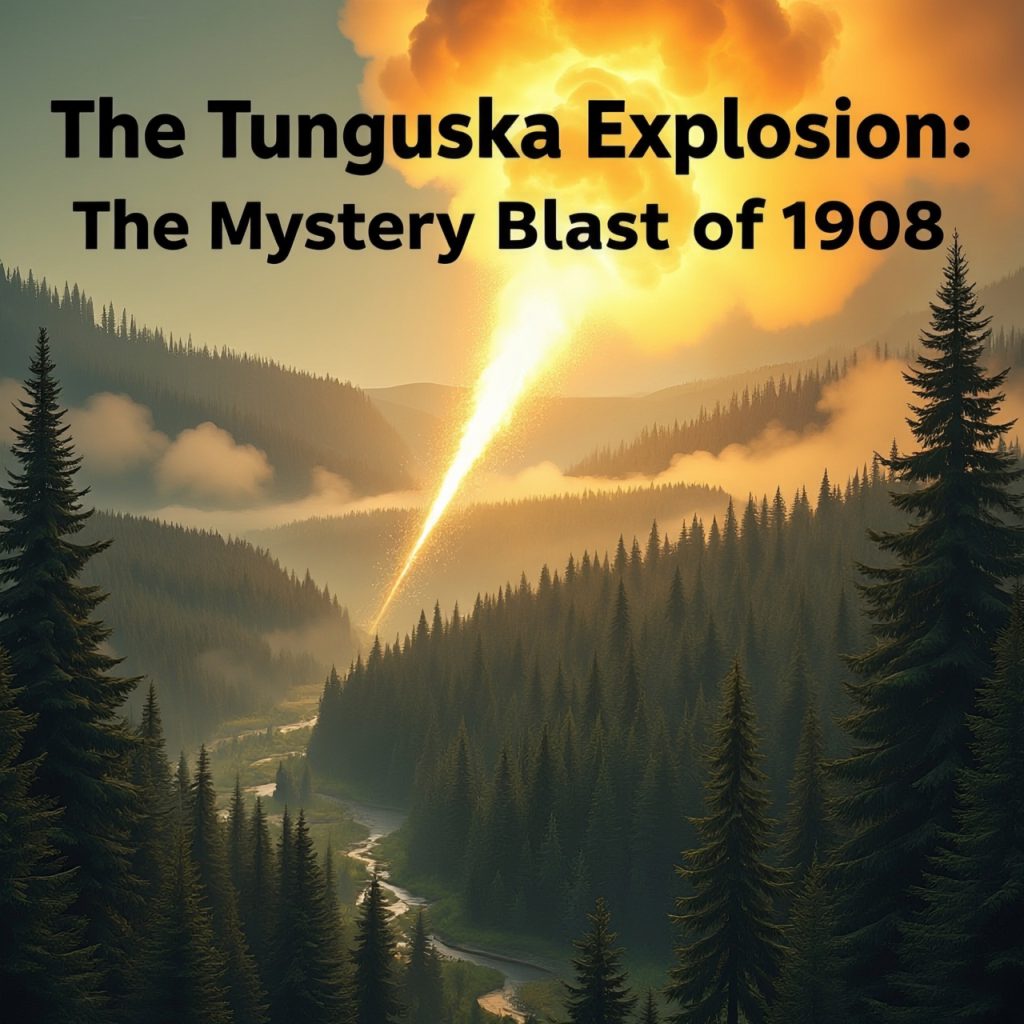
Introduction: The Tunguska Explosion That Shook the World
The Tunguska Explosion started with light.
June 30, 1908. Early morning. Siberia.
A place so remote that maps barely had it.
Reindeer herders were making tea.
Then the sky got bright. Brighter than noon.
A ball of fire screamed across the sky.
People were thrown off their feet 40 miles away.
Then came the boom. And another boom. And another.
Windows shattered 400 miles away.
The Tunguska Explosion was the largest and most mysterious aerial explosion in history, occurring in the forests of Siberia.
80 million trees. Gone.
And we still don’t know exactly what it was.
Why This Keeps Me Up at Night
Because it could happen again. Tomorrow. Over your city.
1. The Tunguska Explosion: A Normal Morning Gone Wrong
1908 was a different time.
Siberia in 1908
Cold. Empty. The Evenki people lived there with reindeer.
No phones. No radios. No one was watching the sky.
7:14 AM
That’s the exact time. We know because seismographs in England felt it.
Something came in from the east. Fast.
2. What People Saw During The Tunguska Explosion
Eyewitnesses are the only proof we have.
“A Second Sun”
That’s what one man said.
“It was so hot I thought my shirt would catch fire.”
The Sound
First silence. Then 3 huge booms.
Like artillery. Like the earth cracking.
The Shockwave
People 200 miles away felt it.
In London, the sky glowed at night for days.
Scientists think dust from the explosion circled the globe.
3. The Tunguska Explosion Flattened a Forest
This is the scary part.
800 Square Miles
That’s the size of Rhode Island.
All trees knocked down.
All pointing away from the center.
The Butterfly Pattern
Scientists call it that.
Trees fell in a circle, with a weird “butterfly” shape in the middle.
That tells us it exploded in the air, not on the ground.
4. No Crater. No Rock. Just Questions
For 19 years, no one went to look.
Too Far. Too Remote.
Siberia in 1908? No roads. No trains.
Then World War 1. Then revolution.
Finally: 1927
A scientist named Leonid Kulik led an expedition.
He thought he’d find a giant crater.
He Found Nothing
No crater. No big meteorite.
Just dead trees. And tiny glass beads in the dirt.
Kulik died confused.
5. What Was The Tunguska Explosion? The 3 Best Guesses
We’ve been arguing for 115 years.
Guess 1: A Meteor
A rock, about 160 feet wide.
It came in at 33,000 mph.
5 miles above the ground, it exploded.
The heat and force knocked everything down.
The rock itself turned to dust.
This is what most scientists believe now.
Guess 2: A Comet
Ice and dust.
A comet would also explode in the air and leave nothing behind.
Comets are dirty snowballs.
Guess 3: The Crazy Ones
UFO. Black hole. Alien ship. Tesla’s death ray.
Fun to think about. Zero proof.
6. The People Who Lived Through The Tunguska Explosion
The Evenki.
Their Stories
They called it “the fire that fell from the sky.”
Some thought it was the god Ogdy coming to punish them.
The Cost
Reindeer died. Forests burned.
Their lives changed overnight.
7. Why The Tunguska Explosion Matters Today
Because it was a warning shot.
A City Killer
If Tunguska hit today over New York, Tokyo, or London…
Millions would die. No warning.
That’s Why We Track Asteroids Now
NASA and other agencies watch the sky because of Tunguska.
We don’t want to be surprised.
8. Science Finally Caught Up
Computers helped.
We Simulated It
In the 2000s, scientists ran models.
A 100-200 foot rock. Exploding 6 miles up.
Perfect match to the tree fall pattern.
The Dust
Those tiny beads Kulik found?
They have nickel and iridium.
That’s what space rocks are made of.
9. The Forest That Healed
Nature doesn’t stay dead.
Go There Today
You’ll see trees.
It looks normal from a plane.
But on the ground, the trees grow twisted.
It took 100 years.
10. The Tunguska Explosion and Other Airbursts
It wasn’t the only one.
Chelyabinsk 2013
A much smaller rock. 60 feet.
Exploded over Russia.
1,500 people injured. Windows broke.
That was Tunguska’s little brother.
11. Could We Stop The Tunguska Explosion Today?
Maybe.
We See 90% of Big Asteroids
NASA tracks anything bigger than 450 feet.
But Tunguska Size?
We might only see it a few days before.
Not enough time to do much.
12. The Expeditions That Found Nothing
Scientists keep going.
Every 10 Years
Russians go and dig. Take soil samples.
Looking for that one piece of rock.
Nothing Yet
Just more dust. More questions.
13. The Tunguska Explosion in Movies and Books
We love mysteries.
Why We’re Obsessed
Because it’s unsolved.
Because it’s real.
Because it reminds us we’re small.
14. 5 Things About The Tunguska Explosion That Are Just Weird
1. It happened in summer. Easiest time to travel. Still took 19 years.
2. No one died. Just pure luck.
3. The sky glowed. For nights after, people in Europe could read outside at midnight.
4. Animals knew first. Reindeer ran before the boom.
5. We still don’t have the rock.
15. If The Tunguska Explosion Happened Today
Let’s be honest.
Over a City
3 million dead. Instantly.
Another 10 million from fires and fallout.
The Good News
We’re watching.
We have plans. Nukes. Gravity tractors.
But we’d need warning.
16. Final Thoughts: Living With The Tunguska Explosion
The Tunguska Explosion is not just history.
It’s a Reminder
The universe doesn’t care about us.
Rocks fall. All the time.
It’s Also Hope
No one died in 1908.
The forest grew back.
We learned.
The Tunguska Explosion was the largest and most mysterious aerial explosion in history, occurring in the forests of Siberia.
No crater. No answers. Just a circle of dead trees and a story we tell to remember to look up.
115 years later, we’re still asking: What was it?
Frequently Asked Questions About The Tunguska Explosion
1. What was The Tunguska Explosion?
The Tunguska Explosion was a massive explosion on June 30, 1908, in Siberia that flattened 800 square miles of forest.
2. What caused it?
Most likely a meteor or comet that exploded in the air about 5-6 miles above the ground.
3. How powerful was it?
About 10-15 megatons. 1,000 times stronger than the Hiroshima atomic bomb.
4. Why was there no crater?
Because it exploded in the air. The object vaporized before hitting the ground.
5. Did anyone die?
No confirmed deaths. A few people were injured by the shockwave.
6. Where exactly did it happen?
Near the Podkamennaya Tunguska River in remote central Siberia, Russia.
7. Has anything like it happened since?
The 2013 Chelyabinsk meteor was similar but much smaller.
8. Can it happen again?
Yes. That’s why scientists track asteroids.
9. What did people see?
A bright fireball, followed by loud explosions and a massive shockwave.
10. Why is The Tunguska Explosion still a mystery?
Because we never found the actual rock. Only the damage it left behind.
Anchor Text: History.com Tunguska Mystery
Link: https://www.history.com/news/tunguska-explosion-1908