Hindenburg Airship Disaster: How History’s Largest Aircraft Turned To Ash In An Instant
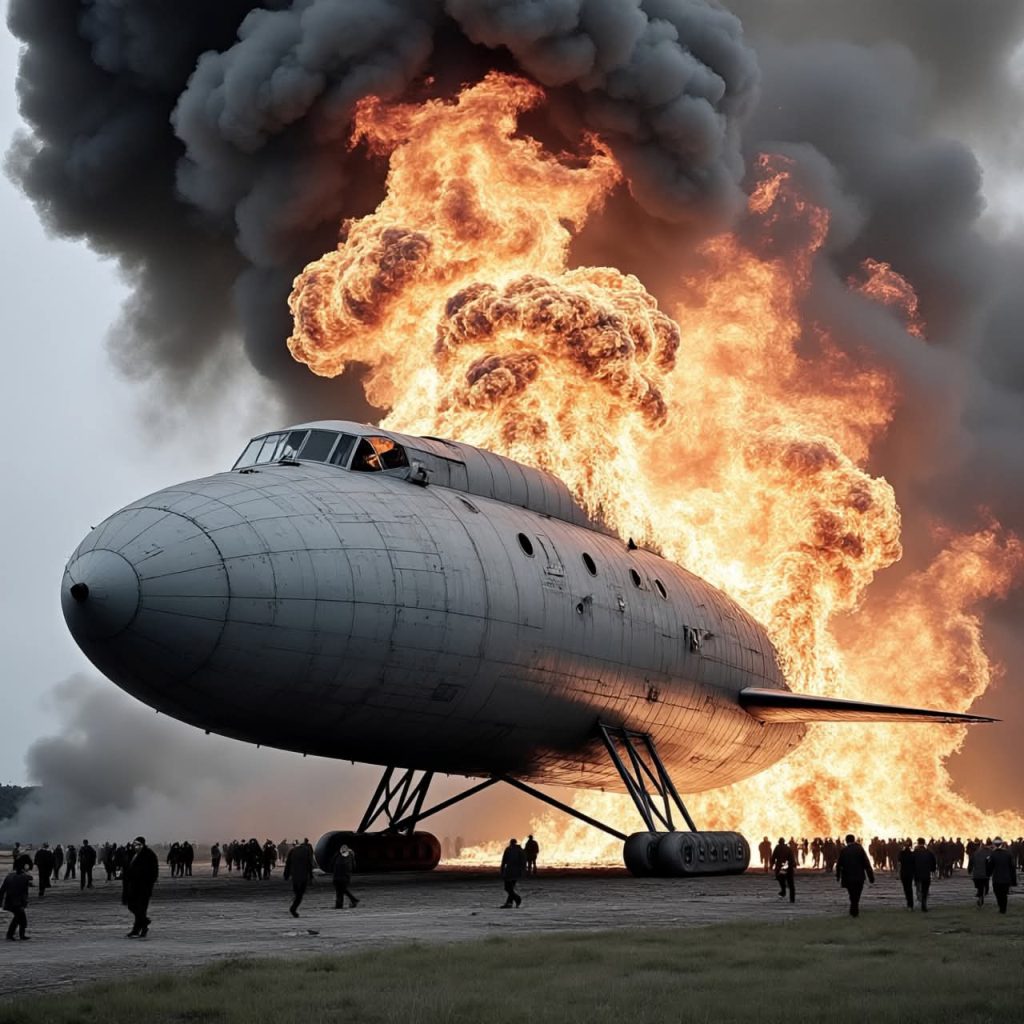
1. Introduction: Hindenburg Airship Disaster and The Night The Sky Caught Fire
Hindenburg Airship Disaster.It was supposed to be a beautiful ending to a long trip.
May 6, 1937. 7:25 PM. Lakehurst, New Jersey.
After 3 days crossing the Atlantic Ocean from Frankfurt, Germany, the LZ 129 Hindenburg was finally coming home. It was the largest aircraft ever built by human hands. 804 feet long. Bigger than 3 football fields. Inside were 97 people. Businessmen in suits. Families with kids. A crew of 61.
On the ground, hundreds of people waited with cameras. The rain had just stopped. The clouds were breaking. A radio announcer named Herbert Morrison was speaking live to millions of Americans. “It’s practically standing still,” he said.
Then someone on the ground pointed up and yelled.
A small flame. Near the tail.
And that was the start of the Hindenburg Airship Disaster.
37 seconds later, the biggest aircraft in the world was a burning wreck on the ground. 36 people were dead. And the dream of luxury airship travel was over forever.
This is the full story of the Hindenburg Airship Disaster. Not just the facts, but the people, the fear, and the 37 seconds that changed history.
Why We Still Watch It Today
Because we have the video. Because we can hear a man cry on the radio. And because it reminds us how fast everything can go wrong.
2. Before The Hindenburg Airship Disaster: The Hindenburg Was The Future
In 1937, the Hindenburg was not just an airship. It was a symbol.
A Flying Palace
Imagine a hotel, but it floats.
That was the Hindenburg.
It was 804 feet long and 135 feet wide. The Titanic was 882 feet. This thing was almost as big.
Inside there were 25 passenger cabins, each with 2 beds. A dining room with white tablecloths. A lounge where a piano player played music. There was even a smoking room, but you had to go through two doors to get in so no spark could escape.
It could carry 50 passengers and 61 crew. It crossed the Atlantic in 2.5 days. A ship took 5 days. An airplane in 1937 took 20 hours but was loud and bumpy.
A ticket cost $400. That is $9,000 today. Only rich people flew. Movie stars like Marlene Dietrich. Politicians. Businessmen.
Germany built the Hindenburg to show the world their technology. It flew with giant swastikas on the tail.
To everyone in 1937, the Hindenburg meant the future. Ships were too slow. Airplanes were too small. Airships were the answer.
No one thought that future would burn.
3. May 6, 1937: Hour By Hour Timeline of The Hindenburg Airship Disaster
Lakehurst Naval Air Station. New Jersey, USA.
Morning – The Flight is Late
The Hindenburg left Frankfurt on May 3. It should have landed in Lakehurst on the morning of May 6. But there were thunderstorms over the Atlantic. So Captain Max Pruss circled for hours waiting for the weather to clear.
6:00 PM – They Arrive
Finally they reach New Jersey. But it is too late to land. It is getting dark and the wind is bad.
7:19 PM – The Approach
Captain Pruss decides to land anyway. He starts dropping ropes to the ground crew. 200 men are waiting to grab them.
7:21 PM – Herbert Morrison is Live
“The Hindenburg is now turning… it’s practically standing still… I watch the people down below…”
Millions are listening on the radio.
7:25 PM – The Hindenburg Airship Disaster Begins
A ground crew member sees a flicker. “Look at that!”
At the tail, a small flame appears.
7:25:10 – The Fire Spreads
In 10 seconds the entire tail is on fire. The hydrogen inside is burning.
7:25:30 – The Ship Falls
The frame collapses. The nose points up. People are screaming inside.
7:25:37 – Impact
The Hindenburg hits the ground. The explosion can be heard for miles.
37 seconds. That is all it took for the Hindenburg Airship Disaster.
4. What Caused The Hindenburg Airship Disaster – 3 Theories That Still Fight Today
Even now in 2026, we argue about this. Here are the 3 main ideas.
Theory 1: Hydrogen
The Hindenburg was filled with 7 million cubic feet of hydrogen. Hydrogen burns. It burns fast. Germany wanted helium because it does not burn, but the US had all the helium and refused to sell it to Germany in 1937 because of politics. So they used hydrogen. One spark and it was a bomb.
Theory 2: Static Electricity
There was a thunderstorm 10 miles away. As the Hindenburg came down in the wet air, static built up on the fabric skin. When the landing ropes touched the wet ground, a spark jumped from the ship to the ground. That spark lit the leaking hydrogen.
This is what most experts believe today.
Theory 3: Sabotage
The Hindenburg had swastikas. Some people hated Nazis. The FBI thought maybe someone planted a bomb. They investigated for months. They found nothing.
The truth is, we will probably never know 100%. And that mystery is part of why the Hindenburg Airship Disaster is still talked about.
5. 37 Seconds of Terror: What It Was Like Inside During The Hindenburg Airship Disaster
We have survivor stories. This is what they said it was like.
The First 5 Seconds
Werner Franz was 14. He was a cabin boy. He said he heard a “whoosh” and saw fire on the ceiling. He thought it was a movie.
10 Seconds In
The lights went out. The ship tilted up. People were thrown from their seats. The floor got hot.
20 Seconds In
The windows blew out from the heat. People started jumping. The ship was falling.
37 Seconds
Impact. Metal twisted. Fire everywhere.
Werner said he was blown out a window and landed in a puddle. He got up and ran.
Captain Max Pruss was knocked unconscious. He woke up on fire and rolled on the ground to put it out.
Ground crew ran into the flames to pull people out. One of them, Allen Hagaman, died saving others.
62 people lived. 36 did not.
The Hindenburg Airship Disaster was fast, but for the people inside it felt like forever.
6. The Victims and Heroes of The Hindenburg Airship Disaster
Who Died
13 passengers. 22 crew. 1 ground crew.
Many died from the fire. Some died from jumping.
Who Lived and Why
Werner Franz, the 14 year old boy. He lived to be 90 and told his story.
Margaret Mather, a passenger. She opened her cabin window and jumped. Broke her leg but lived.
Joseph Spah, a crew member. He carried 3 people out of the fire.
The ground crew. Without them, more would have died. They ran into a burning airship with no fear.
The Crash of the Hindenburg was not just numbers. It was people.
7. After The Flames: How The Hindenburg Airship Disaster Killed an Entire Industry
Before May 6, 1937, companies were planning airship routes to South America, to Asia.
After May 6, no one bought a ticket.
Why
1. People saw the video. They were scared.
2. Airplanes were getting better. The DC-3 was safe and fast.
3. Insurance companies refused to cover airships.
Within 6 months, Germany grounded all passenger airships. The Graf Zeppelin II, the Hindenburg’s sister, never carried one passenger.
The Crash of the Hindenburg did not just end one ship. It ended the entire idea of passenger airships.
8. Conspiracies and New Evidence About The Hindenburg Airship Disaster
Because we have film, everyone becomes an expert.
The Paint Theory 1997
A scientist named Addison Bain said the skin of the Hindenburg was painted with iron oxide and aluminum powder. That is basically rocket fuel. He said the whole ship was flammable. This is popular now.
The Lightning Theory
The storm was close. Maybe lightning hit the tail.
The Nazi Sabotage Theory
A 1975 movie said anti-Nazi people bombed it. No proof.
The FBI said in 1937: “Cause unknown.”
In 2026 we still say: “Cause unknown.”
That is the Hindenburg Airship Disaster.
9. Why The Hindenburg Airship Disaster Has So Much Footage
This is the real reason you know about it.
In 1937, newsreel cameras were at every big event.
For the Hindenburg Airship Disaster we have:
1. 3 different film crews
2. Dozens of photos taken every second
3. The full 10 minute radio broadcast
No other disaster from the 1930s has this. The Titanic sank at night. The Hindenburg burned at dusk, on camera.
That is why the Hindenburg Airship Disaster feels so real 89 years later.
10. 20 Facts About The Hindenburg You Didn’t Learn In School
1. It Had Running Water
And flush toilets.
2. The Piano Was Aluminum
To save weight.
3. It Flew Over The 1936 Berlin Olympics
Dropping Nazi flyers.
4. It Made 10 Safe Trips
Before the Hindenburg Airship Disaster.
5. The Swastikas Were Painted Over
For US flights because Americans complained.
6. It Was Named After President Hindenburg
Who died in 1934.
11. The Radio Broadcast: “Oh, The Humanity”
Herbert Morrison was not supposed to be famous. He was just doing his job.
When the fire started, his voice cracked.
“Ladies and gentlemen, this is the worst thing I’ve ever witnessed…”
Then the famous line: “Oh, the humanity!”
That 30 second clip is played in every documentary about the Hindenburg Airship Disaster.
It made the disaster real to people listening in their kitchens.
12. How The Hindenburg Airship Disaster Changed Aviation
After 1937, the world picked airplanes.
The DC-3
Carried 21 people. Could fly in bad weather.
The Boeing 307
First plane with air conditioning.
By 1940, Pan Am was flying across the ocean in planes.
No one mentioned airships anymore.
The Hindenburg Airship Disaster chose the future for us.
13. Visiting Lakehurst Today: The Site of The Hindenburg Airship Disaster
You can go there now.
Hangar One
It is still standing. It is massive. 1,000 feet long.
The Marker
A small concrete pad where the tail hit. It says “Site of the Hindenburg Disaster May 6 1937.”
Every year on May 6, people leave flowers.
The Hindenburg Airship Disaster is still remembered.
14. Movies and Books About The Hindenburg Airship Disaster
The Hindenburg 1975
With George C Scott. Says it was a bomb.
HBO Documentary
Made in 2007. Uses new science.
Books
Over 50 books. “Titanic of the Air” is the most famous.
The Hindenburg Airship Disaster will never leave pop culture because we can see it.
15. Final Thoughts: Hindenburg Airship Disaster and The 37 Seconds
37 seconds.
From the future to ash.
The Hindenburg Airship Disaster was not just about fire. It was about hope. The hope that we could travel in luxury through the sky.
36 people died. But their story saved thousands later because it taught us about safety, about hydrogen, about risk.
The Hindenburg Airship Disaster ended one era and started another.
From 804 feet of hope to a twisted metal frame.
And it all happened faster than you can make a cup of tea.
Frequently Asked Questions
What caused the Hindenburg Airship Disaster
Most experts say static electricity ignited leaking hydrogen. But paint and sabotage are also theories.
How many people died in the Hindenburg Airship Disaster
36 people died. 62 survived.
Where did the Hindenburg Airship Disaster happen
Lakehurst Naval Air Station, New Jersey, United States.
Why did the Hindenburg disaster
ted States refused to sell helium to Germany in 1937.