
History of Wi-Fi: From Secret Military Tech in 1942 to Wi-Fi 7 in 2026
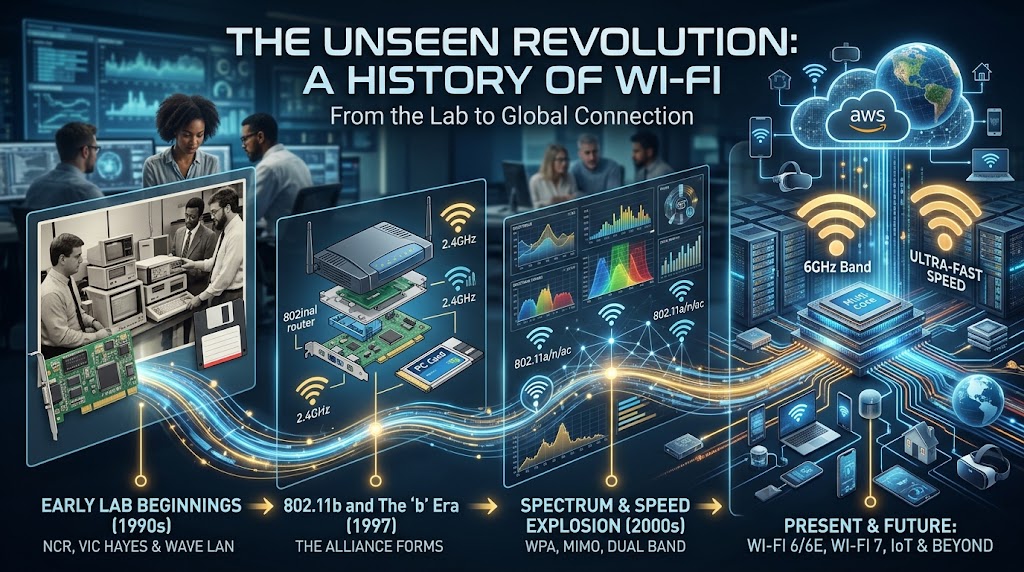
1. Introduction: The History of Wi-Fi Hit Me When My Internet Cable Died
The history of Wi-Fi is something I never cared about until the day my internet cable got cut by a rat and I had 2 hours to submit my college project, and I was panicking until I remembered my neighbor’s Wi-Fi password, and that one “free wifi” connection saved my degree. That night I went down a rabbit hole and found out that the Evolution of Wi-Fi doesn’t start with routers. It starts in 1942 with a Hollywood actress and a piano. Yeah, you read that right. Today I’m going to tell you the full history of Wi-Fi like a story, because wireless internet didn’t just appear. It took 80 years, 3 wars, and a bunch of nerds fighting over radio waves to give us the Wi-Fi we use 200 times a day in 2026.
2. 1942: The Evolution of Wi-Fi Started With a Movie Star and a Torpedo
Picture this. It’s World War 2. 1942.
There’s this actress named Hedy Lamarr. She was super famous. But she was also a genius.
And her problem was this: German submarines were using radio to control torpedoes. But if the Allies jammed the radio signal, the torpedo would miss.
So Hedy had an idea. What if the radio signal could jump between 88 different frequencies? Like a piano player jumping keys. The enemy couldn’t jam all 88 at once.
2.1 This Was The First Wi-Fi
She called it “frequency hopping”. The US Navy said “no thanks” at first. But that idea is the great-grandfather of the history of Wi-Fi. Without Hedy, there is no Wi-Fi. Period.
3. 1970s-1980s: The Origin of Wi-Fi technology Was Stuck In University Labs
Fast forward 30 years. 1971. University of Hawaii.
A guy named Norman Abramson built something called ALOHAnet. It connected computers on different islands using radio waves. No cables.
This was the first wireless computer network. It was slow. It was buggy. But it proved one thing: computers can talk without wires.
3.1 Why This Matters
The Origin of Wi-Fi technology owes everything to ALOHAnet. Because 20 years later, the same ideas were used in your home router.
4. 1991: The Day The Origin of Wi-Fi technology Became Real
1991. Netherlands.
Engineers at NCR and AT&T were trying to make cash registers talk to each other without cables in stores.
They created the first real wireless LAN. It was 1.6 Mbps. That’s slower than 1 YouTube video today.
But they named it “WaveLAN”. And this is the moment the Origin of Wi-Fi technology became a product you could buy.
5. 1997: IEEE Gave The history of Wi-Fi Its Name
By 1997, everyone was building wireless stuff. But nothing worked together.
So IEEE stepped in. They created a standard. They called it 802.11
802.11 meant “any device using this can talk to any other device”.
And at 2 Mbps, it was terrible. But it was official. This is when the History of wireless fidelity got its birth certificate.
6. 1999: The Development of Wi-Fi Got Its Name – Wi-Fi
Okay here’s the fun part. 1999.
A group of companies formed the “Wi-Fi Alliance”. They needed a name people could remember. “IEEE 802.11b” is not catchy.
So they hired a branding company. And the company came up with “Wi-Fi”.
It doesn’t stand for anything. It’s just like “Hi-Fi”.
6.1 Wi-Fi 1 Was Born
In 1999 they also launched 802.11b. 11 Mbps. Suddenly you could browse the web without cables. Starbucks started putting Wi-Fi in coffee shops. The Development of Wi-Fi went from labs to laptops.
7. 2003-2009: The history of Wi-Fi Got Fast – Wi-Fi 4 and Wi-Fi 5
2003: 802.11g came out. 54 Mbps. This was huge.
2009: 802.11n came out. We called it Wi-Fi 4. 600 Mbps. And it used 2 bands. 2.4GHz and 5GHz.
This is when the Development of Wi-Fi exploded. Netflix started streaming. YouTube went HD. Because Wi-Fi was finally fast enough.
7.1 2013: Wi-Fi 5 Changed Everything
802.11ac. Wi-Fi 5. 3.5 Gbps. Beamforming. This is the Wi-Fi most of us had until 2020. It made 4K streaming and online gaming possible.
8. 2014-2020: The history of Wi-Fi Went Everywhere
From 2014 to 2020, Wi-Fi stopped being a “computer thing”.
It went into your fridge. Your TV. Your doorbell. Your light bulb.
8.1 The Internet of Things
The Development of Wi-Fi is now the history of smart homes. Because every device needed wireless.
And in 2018, the Wi-Fi Alliance got smart. They stopped calling it 802.11ax. They called it Wi-Fi 6. Much easier.
9. 2019-2021: Wi-Fi 6 and Wi-Fi 6E – The Development of Wi-Fi Gets Smart
Wi-Fi 6 was made for crowds. Stadiums. Airports. Apartments.
It uses something called OFDMA. Fancy word. Means “more devices at once without lag”.
Then 2021: Wi-Fi 6E. Same speed but it uses the new 6GHz band. Empty highway. No traffic.
This part of the Historical background of Wi-Fi is why Zoom calls don’t lag when your brother is watching Netflix.
10. 2024-2026: Wi-Fi 7 and The Future of The Historical background of Wi-Fi
We’re here now. 2026.
Wi-Fi 7. Official name: 802.11be.
10.1 What’s New in Wi-Fi 7
40 Gbps speed. That’s faster than most wired internet.
Less than 5ms lag. Good for VR and cloud gaming.
MLO – Multi-Link Operation. It uses 2.4GHz, 5GHz, and 6GHz all at once.
The Historical background of Wi-Fi is now about replacing cables completely.
11. 5 Things I Learned From Studying The Historical background of Wi-Fi
After researching this for weeks, here’s what blew my mind.
Lesson 1: A Hollywood actress invented the core idea. Not an engineer.
Lesson 2: Wi-Fi was almost called “WaveLAN”. Thank god they changed it.
Lesson 3: Every 4 years Wi-Fi gets 3x faster.
Lesson 4: The history of Wi-Fi is a fight over radio waves. Governments own them.
Lesson 5: We’re maybe 50% through the history of Wi-Fi. 6G and Li-Fi are coming.
12. Where Is The Wi-Fi history Going Next
Here’s what’s coming 2027-2030.
Wi-Fi 8: AI built into your router. It will predict lag and fix it.
Li-Fi: Internet through light bulbs. 100 Gbps.
Satellite Wi-Fi: Starlink + Wi-Fi 7. Internet anywhere.
The history of Wi-Fi is going from “wireless in home” to “wireless everywhere”.
13. Why The Evolution of Wi-Fi Matters To You
Because you’re using it right now.
Every scroll, every video, every game. All Wi-Fi.
If you’re a student, learn Wi-Fi. Network jobs pay $80k+.
If you have a business, upgrade to Wi-Fi 6E or 7. Your customers will feel it.
The history of Wi-Fi proves that the best tech becomes invisible.
14. Myths About The history of Wi-Fi
14.1 Myth: Wi-Fi Causes Cancer
No. Wi-Fi uses less radiation than your microwave. The history of Wi-Fi has 30 years of safety studies.
14.2 Myth: Wi-Fi and Bluetooth Are The Same
No. Bluetooth is for headphones. Wi-Fi is for internet. Different history.
14.3 Myth: More Bars = More Speed
No. 2 bars on Wi-Fi 7 is faster than 5 bars on Wi-Fi 4.
15. Complete Timeline of The history of Wi-Fi
1942: Hedy Lamarr invents frequency hopping
1971: ALOHAnet at University of Hawaii
1991: First WaveLAN 1.6 Mbps
1997: IEEE 802.11 standard 2 Mbps
1999: Wi-Fi name and 802.11b 11 Mbps
2003: 802.11g 54 Mbps
2009: Wi-Fi 4 802.11n 600 Mbps
2013: Wi-Fi 5 802.11ac 3.5 Gbps
2019: Wi-Fi 6 802.11ax
2021: Wi-Fi 6E 6GHz band
2024: Wi-Fi 7 802.11be 40 Gbps
16. Final Thoughts: The history of Wi-Fi Is The Story of Cutting Cables
The history of Wi-Fi is really the story of humans hating cables.
We cut the phone cable. We cut the TV cable. We cut the internet cable.
It started with a torpedo in 1942. And in 2026, it ends with your entire house running wireless at 40 Gbps.
Hedy Lamarr just wanted to help win a war. She didn’t know she was building the foundation for Netflix, Zoom, and TikTok.
The history of Wi-Fi proves that crazy ideas take time. 80 years from a piano idea to Wi-Fi 7.
And we’re still writing it.
Frequently Asked Questions
What is the history of Wi-Fi
The history of Wi-Fi starts in 1942 with Hedy Lamarr and goes to Wi-Fi 7 in 2026.
Who invented Wi-Fi
The history of Wi-Fi has many inventors but Hedy Lamarr invented frequency hopping and IEEE created the standard.
When was Wi-Fi invented
The history of Wi-Fi started in 1942 but the first Wi-Fi product came in 1999.
What is next for Wi-Fi
The next part of the history of Wi-Fi is Wi-Fi 8, Li-Fi and satellite Wi-Fi.
Why is the history of Wi-Fi important
Because the history of Wi-Fi explains how we went from cables to wireless everything.


