History of Server Technology: From Giant Mainframes to AI Cloud Servers
1. Introduction: I Didn’t Realize How Much server technology Runs My Life
server technology.Let me be honest with you.
Two years ago I had no idea what a server even was. I thought the internet just… existed. Like magic.
Then my website crashed at 2 AM and my hosting company told me “the server is down”. That’s when I started digging.
And what I found blew my mind.
Server systems is literally behind everything. Every email, every YouTube video, every time you order food online. There’s a server somewhere doing the work.
But here’s the crazy part. 60 years ago, a “server” was a machine the size of your living room that cost millions of dollars.
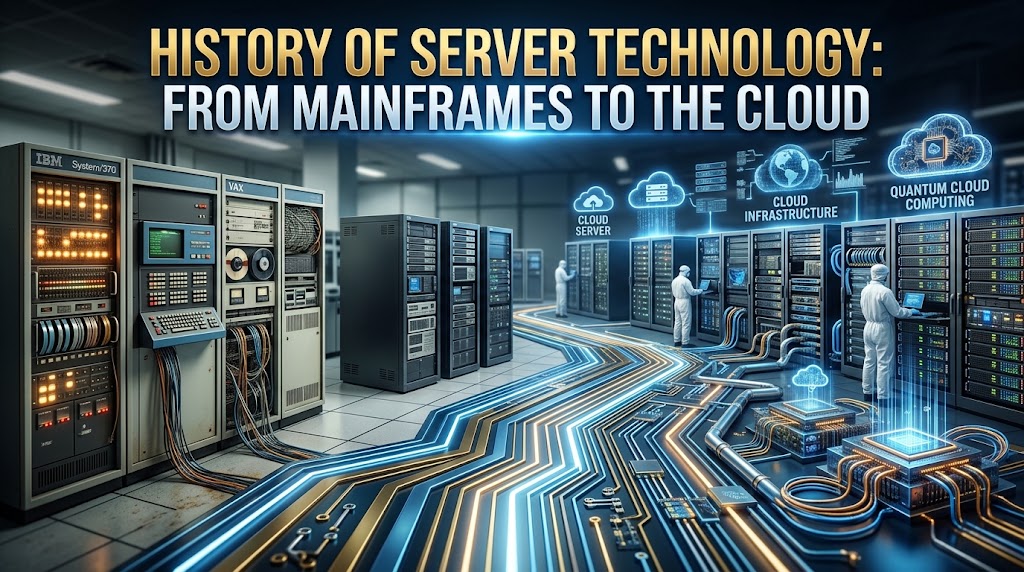
This is the story of how we got from that giant machine to the AI cloud servers running the world in 2026.
2. The 1960s: When Servertech Meant a Room Full of Noise
Picture this. It’s 1965. You walk into a computer room.
The noise is deafening. There are machines taller than you, with blinking lights and tape drives spinning. The room is freezing because of the air conditioning.
That was Server infrastructure in the 1960s.
IBM Built The First Real Servers
IBM was the king back then. They made something called a mainframe.
Only The Richest Could Afford It
We are talking millions of dollars. Only governments, big banks, and universities had them.
Everything ran on that one machine. If it crashed, payroll stopped. If it crashed, students couldn’t register for classes.
Server infrastructure at this time was fragile, expensive, and powerful all at the same time.
3. The 1970s: Computers Started Shrinking and server technology Got Personal
In the 70s, things got interesting.
Computers started to get smaller. Not “laptop small”, but “fits in a room instead of a building” small.
DEC Changed The Game
Digital Equipment Corporation made the PDP-11. It was still big, but compared to a mainframe it was tiny.
Departments Got Their Own server technology
Now the accounting department could have its own computer. The HR department could have its own too.
This was huge. For the first time, Server systems wasn’t “one machine for everyone”. It was “many machines for different teams”.
4. The 1980s: My Dad’s Office Got Its First File Server
My dad told me this story. In 1987 his office got their first “network”.

Before that, if you wanted to share a file, you had to walk to someone’s desk with a floppy disk.
LANs Changed Everything
Local Area Networks meant all the PCs in the office could talk to each other.
The Server Was Just a PC
They took one computer, put a big hard drive in it, and called it the “server”.
That was it. That was Server hardware and architecture in the 80s.
But it worked. And it was the beginning of what we have today.
5. The 1990s: The Internet Hit and server technology Exploded
The 90s. This is when everything went crazy.
I remember the sound of dial-up internet. And I remember the first time I saw a website.
The Web Needed Servers
When Tim Berners-Lee invented the World Wide Web, suddenly every company needed a website.
Apache Became King
Some guy wrote free software called Apache. And it ran most of the internet.
Microsoft tried with IIS. But Apache won.
Data Centers Started Popping Up
Companies couldn’t run websites from their basement anymore. So they rented space in “data centers”.
Server hardware and architecture moved out of offices and into massive buildings.Anchor Text: AWS Cloud Computing Guide
6. The 2000s: Virtualization Blew My Mind
The 2000s. This is when I learned something that made me go “wait, what?”
One Physical Server = 20 Virtual Servers
VMware came along and said “hey, you can run 20 computers inside one computer”.
It sounded like magic. But it was real.
Blade Servers Saved Space
Instead of big towers, companies started using thin blades. You could fit 100 servers in one rack.
Modern server solutions became efficient. You didn’t need a room full of machines anymore.
7. The 2010s: I Stopped Buying Servers and Started Renting Them
This is when my life changed.
AWS Launched and Killed The Old Way
In 2006 Amazon said “don’t buy a server. Rent one from us. Pay by the hour.”
I thought it was a joke.
server technology Became a Utility
Like electricity. You don’t buy a power plant. You just pay your bill.
By 2015, I hadn’t touched a physical server in years. Everything was in “the cloud”.
That’s what Modern server solutions became. Invisible.
8. Containers and Kubernetes: The New Way to Do server technology
Around 2014, developers got annoyed with virtual machines. They were slow.
Docker Made Apps Portable
Docker said “package your app and it will run anywhere”.
Kubernetes Managed Everything
Google built Kubernetes to manage thousands of containers.
Suddenly server technology wasn’t about servers anymore. It was about code.
9. The Buildings Behind server technology Are Insane
I visited a data center once.
It’s Bigger Than a Football Stadium
Rows and rows of racks. Blinking lights as far as you can see.
The Power Bill is Crazy
One data center uses as much power as a small town.
And cooling? They pump millions of gallons of water to keep server technology from overheating.
It’s not just software. It’s concrete, steel, and electricity.
10. 2020-2024: AI Changed server technology Again
Then ChatGPT happened.
CPUs Weren’t Enough
AI needs GPUs. Lots of them.
Training AI Costs Millions
OpenAI spent over $100 million just on server technology to train GPT-4.
In 2024, if you’re not talking about GPU servers, you’re not talking about Modern server solutions.
11. Edge Computing: Bringing server technology Closer to Me
I play online games. And lag sucks.
Edge Means Closer Servers
Instead of data traveling across the country, edge puts servers in your city.
Why It Matters
For gaming, for self-driving cars, for TikTok. Speed matters.
Modern server solutions is leaving the big data centers and moving to small boxes everywhere.
12. Security: The Dark Side of server technology
With great power comes great hackers.
DDoS Attacks Are Constant
Someone can take down a website just by sending too much traffic.
Zero Trust Is The New Rule
Don’t trust anyone. Verify everything.
Half of the money spent on Modern server solutions in 2026 goes to security.
13. Green server technology: We Have to Fix This
Data centers use 1% of the world’s electricity. That’s insane.
Liquid Cooling Is The Future
Water cools better than air. So they pump it through the servers.
100% Renewable
Google and Microsoft are running on solar and wind.
Servertechy has to be sustainable or it won’t survive.
14. What’s Next for server technology
I’m excited and scared.
Quantum Servers
Still early, but IBM is building them.
Serverless
I won’t even think about servers. I’ll just write code.
AI Managing AI
Servers that fix themselves.
server technology is disappearing. And that’s good.
15. How server technology Changed Everything
Think about it.
In 2000, starting a website cost $50,000.
In 2026, it costs $10.
Small Teams Can Do Big Things
Two people can serve 100 million users because server technology scales automatically.
That’s the real revolution.
16. Final Thoughts: server technology Is Invisible But Everything
From a noisy mainframe in 1960 to an AI server in the cloud in 2026.
Servertech has come a long way.
And you don’t see it. You don’t think about it.
But it’s there. Every time you click, swipe, or tap.
And it will keep evolving.
Frequently Asked Questions
What is server technology
Servertech is the hardware and software that runs websites, apps, and cloud services.
How did server technology start
server technology started in the 1960s with mainframe computers used by big organizations.
What cloud server technology
Cloud server technology means renting servers online instead of buying physical hardware.
What is the future of server technology
The future of server technology is AI, serverless, and edge computing with automatic management.
Why does server technology matter
server technology powers everything online from social media to banking to artificial intelligence.