
History of Microprocessor: How a Tiny Chip From 1971 Runs Your Phone Today
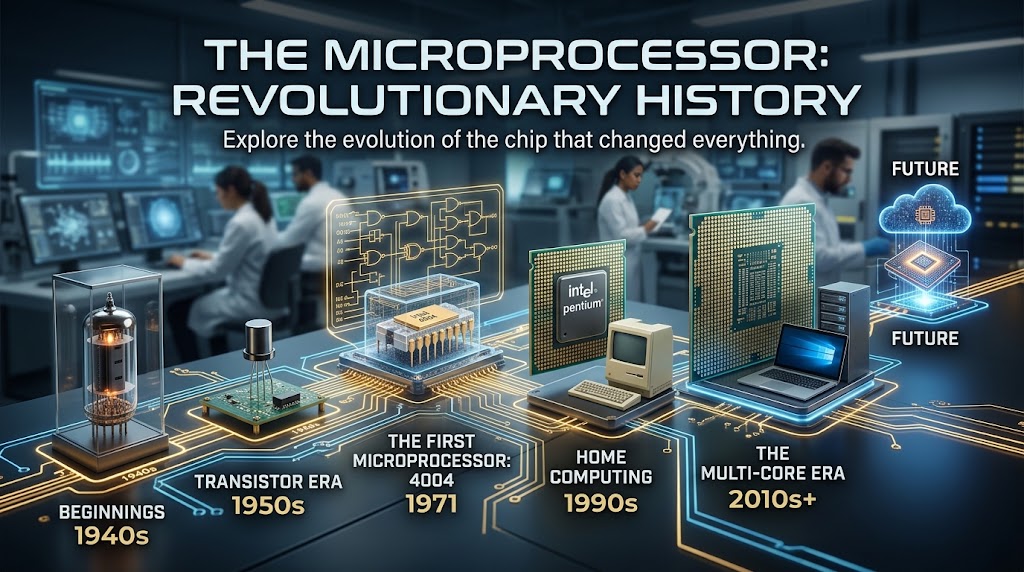
1. Introduction: history of microprocessor Starts With One Crazy Idea
history of microprocessor
In 1971, three engineers at a small company in California were tired. A Japanese company wanted them to build 12 different chips for a calculator.
One guy named Ted Hoff said, “This is stupid. Why don’t we just make one chip that can do everything?”
Everyone laughed.
4 months later, they made it. And that one chip changed the world forever.
That chip was called the 4004. And that day, the history of microprocessor began.
Today that same idea is in your phone, your car, your fridge, and even your toothbrush.
Let’s walk through the whole history of microprocessor together. No boring textbook stuff. Just the real story.
Why You Should Read This
Because you are using a microprocessor right now to read this. Knowing where it came from is pretty cool.
2. Before The microprocessor: Computers Were Dumb Giants
Imagine a computer so big it needed its own room. And so dumb it could only do one job.
That was 1960.
Room Sized Machines
ENIAC was the size of a basketball court. It used 17,000 tubes that burned out every week.
Then Came Transistors
Smaller. Faster. But still, every computer was custom made.
If you wanted to add a new feature, engineers had to solder new wires for weeks.
Computers were powerful but not smart.
The world needed a brain that could be taught new things. That is what started the history of microprocessor.
3. 1971: The Birth Intel 4004 and The Start of history of microprocessor
November 15, 1971.
Intel put a small ad in a magazine. Most people ignored it.
The ad said: “A microprogrammable computer on a chip.”
That was the Intel 4004.
The 3 Guys bhind It
Ted Hoff had the idea. Federico Faggin designed it. Stan Mazor wrote the instructions.
Busicom, a Japanese calculator company, paid for it. They had no idea what they were starting.
What Was So Special
The 4004 had 2300 transistors. That is less than what is in your microwave today.
It ran at 740 kHz. It could do 60,000 calculations per second.
But the big deal was this. You could program it. You could tell it to be a calculator today and a traffic light controller tomorrow.
That is why the history of microprocessor starts here.
4. 1972 to 1974: The history of microprocessor Gets Faster 8008 and 8080
Intel did not stop.
Intel 8008
This was the first 8-bit chip. It was used in early computer terminals.
It was slow. But it proved the idea worked.
Then Came The 8080
1974. This chip was different.
It was cheap. It was fast enough. And hobbyists loved it.
A kit computer called Altair 8800 used the 8080. Two college kids saw it and thought, “We can write software for this.”
Those kids were Bill Gates and Paul Allen. They started Microsoft.
Think about that. The entire history of microprocessor and Microsoft starts with the 8080.
5. 1975 to 1978: The Wild West Days of The history of microprocessor
Once Intel showed it was possible, everyone wanted to make chips.
Motorola 6800
Motorola’s chip was clean. Engineers liked it. It went into early arcade machines.
The 6502 Changes Everything
MOS Technology made the 6502. And it cost only 25 dollars.
That was crazy cheap back then.
Steve Wozniak used it to build the Apple II. Commodore used it for the C64. Nintendo used it for games.
The 6502 put the microprocessor in every kid’s bedroom.
Zilog Z80
Zilog made a better 8080. It ran CP/M which was the first real PC operating system.
The history of microprocessor in the 70s was like a street fight. And everyone was throwing punches.
6. 1978 to 1985: The IBM Deal That Made The history of microprocessor Big
This is the turning point.
Intel 8086 and 8088
Intel made 16-bit chips. The 8088 was the cheaper one.
IBM Comes Calling
1980. IBM was building a personal computer. They needed a brain.
They chose the Intel 8088.
That decision made Intel. Because every company that copied the IBM PC also had to buy Intel chips.
The 286 and 386
1982: Intel 286. Could run multiple programs.
1985: Intel 386. True 32-bit power.
Windows started running on the 386.
For the first time, the history of microprocessor entered normal homes and offices.
7. 1990 to 1999: The history of microprocessor Gets Famous Pentium and The Chip Wars
The 90s were loud.
Pentium
Intel dropped numbers. Called it Pentium.
TV ads. “Intel Inside” stickers. 3.1 million transistors.
This microprocessor could play games and run Windows 95.
AMD Fights Back
AMD said, “We can make the same chip cheaper.” And they did.
Cyrix tried too. Prices dropped. Everyone could afford a PC.
RISC vs CISC
Apple used PowerPC. Sun used SPARC. They were RISC chips. Simpler, used less power.
Intel used CISC. More complex, but faster for PCs.
The history of microprocessor in the 90s was all about who was faster.
8. 2000 to 2009: The history of microprocessor Hits a Wall Then Finds a New Way
Around 2004, something weird happened. Chips stopped getting faster.
The Heat Problem
If you made a chip run at 5 GHz, it would melt.
So engineers did something smart. Instead of one fast core, they put 2 cores. Then 4 cores.
Intel Core 2 Duo. AMD Athlon X2.
Now your computer could do many things at once.
Meanwhile, In Your Pocket
While PCs got more cores, phones got smart.
ARM made tiny microprocessor chips that used almost no battery.
Nokia used them. Then Apple used them for the iPhone.
The history of microprocessor split. Big chips for PCs. Tiny chips for phones.
9. 2010 to 2019: The history of microprocessor Powers The Cloud and Your Phone
This decade, everything went online.
On Your Desk
Intel Core i7. 4 cores. Then 6 cores. Then 8 cores.
AMD disappeared for a while, then came back with Ryzen in 2017. And it was good.
In Your Hand
Apple A9. Snapdragon 845.
Your phone in 2019 was faster than a gaming PC from 2010.
In The Cloud
Google, Amazon, Facebook bought millions of Xeon and EPYC chips.
The history of microprocessor was no longer about your PC. It was about the internet itself.
10. 2020 to 2026: The history of microprocessor Enters AI
This is the part we are living in right now.
Apple Kills Intel
Apple said “We’re done with Intel.” They made their own M1 chip.
It was based on ARM. It was fast. It used no battery.
The AI Boom
ChatGPT came out. And it needed huge amounts of computing.
Nvidia GPUs were used as microprocessor for AI. Thousands of them in one room.
The history of microprocessor is now about AI chips, not just PC chips.
11. How Does a microprocessor Actually Work Let Me Explain Simply
I promise, no boring engineering.
A microprocessor is just a super fast light switch.
The 4 Steps It Repeats Billions of Times
1. Get the job: “Add 5 and 5”
2. Understand it: “Okay, addition”
3. Do it: 5 + 5 = 10
4. Save it: Put 10 in memory
That’s it.
The magic is there are 134 billion tiny switches inside. Turning on and off.
The Intel 4004 had 2300 switches. Your phone has 100 billion.
That is the entire history of microprocessor in one sentence. More switches.
12. Who Makes microprocessor Today The Big 4
Intel
Still the biggest. Makes chips for PCs and servers.
AMD
The comeback kid. Ryzen chips are really good now.
ARM
They don’t make chips. They sell the recipe. Apple, Samsung, Qualcomm all use it.
Nvidia
They make GPUs. But now those GPUs are used as microprocessor for AI.
13. What’s Next in The history of microprocessor
The story isn’t over.
More Cores
Your next laptop will have 20 cores. Your next server will have 200.
Special Chips
One chip just for AI. One just for graphics. One just for your camera.
3D Chips
Instead of making chips flat, we stack them. Like Lego.
Quantum
Still 10 years away. But maybe the next big step in the history of microprocessor.
14. 5 Ways The history of microprocessor Changed Your Life
Let’s be real.
1. You Got a PC
Because of the microprocessor, computers left the lab.
2. You Got The Internet
Every website runs on servers with microprocessor.
3. You Got a Smartphone
Your phone is a microprocessor with a screen and camera.
4. Your Car Got Smart
Modern cars have 100 microprocessor chips.
5. You Got AI
ChatGPT, Midjourney. All run on specialized microprocessor chips.
15. Quick Questions About The history of microprocessor
Who invented the microprocessor
Ted Hoff, Federico Faggin, and Stan Mazor at Intel in 1971.
What was the first one
Intel 4004.
Why did chips stop getting faster
They got too hot. So we added more cores.
Is ARM better than Intel
Depends. ARM uses less battery. Intel is faster for big tasks.
16. Final Words: history of microprocessor and You
50 years ago, the microprocessor was a calculator chip.
Today it is in everything you touch.
The history of microprocessor is really the story of us. How we made computers smaller, cheaper, and for everyone.
From 2300 transistors to 134 billion.
From a room-sized machine to a chip in your pocket.
And the craziest part? We are just getting started.
The next 50 years of the history of microprocessor will be AI, robots, and things we can’t even imagine yet.
It all started with 3 tired engineers and one crazy idea in 1971.
Frequently Asked Questions history of microprocessor
What is the history of microprocessor
The history of microprocessor starts in 1971 with Intel 4004 and goes to today’s AI chips.
Who invented the microprocessor
Intel engineers invented the first microprocessor in 1971.
How fast were early microprocessor
The Intel 4004 did 60,000 calculations per second. Your phone does trillions.
What is the future of microprocessor
More cores, AI chips, and 3D stacked designs.


