
History of the ARM Processor: How A Tiny British Chip Conquered The World
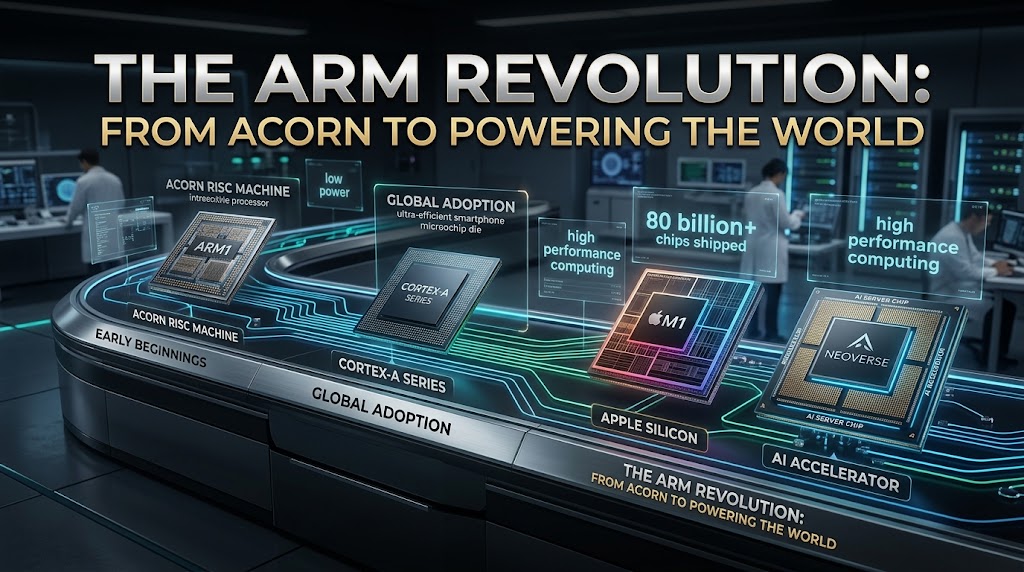
1. Introduction: History of the ARM Processor Starts in a Tiny Office
The History of the ARM Processor doesn’t feel like a normal tech story.
There’s no billion dollar launch. No Steve Jobs keynote. No giant factory.
It starts in 1983. In Cambridge, England. In a small office with bad heating and two engineers drinking tea.
Sophie Wilson and Steve Furber just wanted to make a faster computer for British schools. That’s it.
40 years later, that chip is in your iPhone. Your Android. Your MacBook. Your car. Your smart fridge.
Over 280 billion ARM chips have been made. More than any other processor ever.
Intel built the PC world. But ARM quietly built everything else.
So how did this happen? How did a chip nobody heard of take over the world?
Let’s start from the beginning, and I’ll tell you the whole story like we’re sitting in a coffee shop.
Why you should care
Because if you use any tech made after 2007, you’re using ARM right now.
2. 1983: Acorn Computers and The Problem Nobody Saw
To understand the History of the ARM Processor, you need to meet Acorn Computers.
Who was Acorn
A small British company. About 20 people. They made the BBC Micro, a computer for UK schools.
It was 1983. Computers were huge, slow, and expensive.
The problem
The BBC Micro used a 6502 processor. It was fine for 1981. But by 1983 it felt ancient.
Acorn wanted to build the next computer. Something 10x faster.
They looked at Intel. Too expensive.
They looked at Motorola. Too much power.
One of the founders, Hermann Hauser, said in a meeting: “What if we just build our own CPU?”
Everyone laughed. Then they realized he was serious.
That’s how the History of the ARM Processor really started. Not with a plan, but with “we have no other choice.”
3. 1985: Two People, One Whiteboard, and ARM1
Now meet the two people who changed everything.
Sophie Wilson
She was 28. She had already written the BBC BASIC language. She was quiet, but scary smart.
Steve Furber
Hardware genius. He could look at a circuit and tell you what was wrong.
In 1984, they got a budget of basically nothing. And a goal: make a RISC processor.
What is RISC
RISC means “Reduced Instruction Set Computer”.
Think of it like this:
Intel CISC = “Go to store, buy milk, bread, eggs, come back” – one big complicated command.
ARM RISC = “Go to store. Buy milk. Buy bread. Buy eggs. Come back.” – small simple commands.
Simple commands = less power = less heat = faster.
In 1985, after 6 months, they had ARM1.
25,000 transistors. Ran at 6MHz.
For context, your Apple Watch has 5 billion transistors.
Sophie wrote the whole instruction set on paper in one afternoon. Steve soldered the first prototype by hand.
The History of the ARM Processor started with two people and a lot of tea.
4. 1987: ARM2 and The Computer That Shocked Everyone
ARM1 was just proof it worked. ARM2 was the real chip.
What was better
32-bit. Built-in 4KB cache. 8MHz.
And in 1987, Acorn put it inside a new computer called the Acorn Archimedes.
The reaction
Tech magazines lost their minds. The Archimedes was 10x faster than an IBM PC. And it cost less.
For the first time, the History of the ARM Processor had a real product that regular people could buy.
But here’s the problem: Acorn was still tiny. They couldn’t afford to make chips at scale.
They needed a partner. A big one.
5. History of the ARM Processor: 1990 and The Day ARM Became a Company
1990. This is the most important year nobody talks about.
Acorn was running out of money. So they did something smart.
They spun off the chip team into its own company: ARM Holdings.
The three parents
1. Acorn – gave the technology
2. Apple – gave $3 million. They were building something called “Newton”
3. VLSI Technology – gave manufacturing
The crazy decision
ARM decided: “We will never make chips. We will only design them and license the design to others.”
Think about that. In 1990, every chip company made their own chips. ARM said “no, we’ll be the architects.”
That one decision is why the History of the ARM Processor is so different from Intel.
6. 1993: The Apple Newton and The First Time ARM Was in Your Pocket
1993. Apple announces the Newton MessagePad.
It was a tablet. 10 years before the iPad.
Inside was the ARM610.
Did Newton succeed
God no. It was a flop. People made fun of it.
Did ARM succeed
Yes.
Because the Newton proved one thing: ARM could run for a week on 2 AA batteries.
An Intel laptop at the time died in 2 hours.
Engineers at Nokia, Ericsson, and Motorola saw that and thought: “This is what we need for phones.”
So the History of the ARM Processor quietly moved from computers to your pocket.
7. 1995-2005: The Lost Decade Where ARM Won Everything
This is the boring part. And the most important part.
From 1995 to 2005, ARM was everywhere and nowhere.
Nokia
Every Nokia phone used ARM7.
Ericsson, Motorola, Siemens
All ARM.
Symbian OS
Ran on ARM. 80% of smartphones before iPhone.
Did you hear about ARM during this time? No.
Because ARM’s name wasn’t on the phone. Samsung’s was. Nokia’s was.
ARM was like the person who writes the song but the singer gets famous.
By 2005, 1 billion ARM chips shipped per year.
The History of the ARM Processor was now the history of mobile phones. And nobody knew it.
8. 2007: iPhone and The Moment ARM Went Mainstream
January 9, 2007. Moscone Center.
Steve Jobs: “Today Apple reinvents the phone.”
The iPhone.
Inside was a Samsung S5L8900 chip. And inside that was an ARM11 core.
Why this broke everything
Before iPhone, phones did calls and texts. After iPhone, phones did everything.
And they all needed ARM to do it.
After 2007, Qualcomm made Snapdragon. Samsung made Exynos. Huawei made Kirin.
All ARM.
The History of the ARM Processor went from “that British thing” to “the future of computing” in one keynote.
9. 2010-2015: Android, Tablets, and 10 Billion Chips a Year
After iPhone, Android exploded.
The chip makers
Qualcomm, Samsung, MediaTek, Huawei.
All of them licensed ARM cores.
Cortex-A8, A9, A15
These were the names you’d see in Galaxy S phones.
By 2015, ARM was shipping 10 billion chips per year.
The History of the ARM Processor was now bigger than Intel and AMD combined.
But ARM still had one problem: they were only in phones and tablets. Not real computers.
That was about to change.
10. History of the ARM Processor: 2016 When SoftBank Paid $32 Billion
2016. Random Tuesday.
SoftBank, a Japanese company, announces: “We’re buying ARM for $32 billion.”
Everyone was like “what?”
Why pay so much
SoftBank CEO Masayoshi Son saw the future: IoT, self-driving cars, AI, 5G.
Everything would need a chip. And everything would need low power.
He bet that ARM would be in 100 billion devices.
That purchase made the History of the ARM Processor go from tech news to business news.
11. 2020: The Day History of the ARM Processor Scared Intel – Apple Silicon M1
October 2020. Apple Event.
“Today we’re leaving Intel. All Macs will use Apple Silicon.”
And they showed the M1.
What happened
The M1 was an ARM chip designed by Apple.
And it was faster than a $2000 Intel i7. While using 75% less power.
Tech YouTubers cried. Intel engineers got quiet.
For the first time in the History of the ARM Processor, ARM was in laptops and desktops, beating x86 at its own game.
That was the moment. The war started.
12. 2021-2024: ARM Invades Servers, Cars, and Windows History of the ARM Processor
After Apple, the floodgates opened.
Amazon
Launched “Graviton” servers. ARM-based. 40% cheaper to run.
Microsoft
“Windows 11 runs great on ARM” with Snapdragon laptops.
Cars
Tesla FSD, BMW iDrive, Ford. All ARM.
AI
NVIDIA’s new AI chips have ARM cores.
By 2024, 90% of all chips shipped were ARM.
The History of the ARM Processor had left phones and was now in data centers.
13. How ARM Actually Works: RISC Explained Like You’re 5
I know this is boring but stick with me. This is why ARM won.
Intel x86 = CISC
It’s like a Swiss Army knife. 200 tools. Heavy. But can do anything.
ARM = RISC
It’s like 30 simple tools. Light. Fast. Uses less battery.
Your phone can’t carry a Swiss Army knife all day. It needs the light tools.
That’s the entire History of the ARM Processor in one paragraph.
Less power. Less heat. Smaller size.
14. ARM vs x86: The Fight That Will Decide The Next 10 Years
This is the current war.
Team x86
Intel and AMD. They own PCs and servers. They’re good at raw power.
Team ARM
Apple, Qualcomm, Amazon, Google. They own mobile and are moving to PCs and servers. They’re good at efficiency.
For 30 years they didn’t fight.
Now they are.
Who wins?
My bet: both. But ARM is growing 10x faster.
The History of the ARM Processor is now being written in real time.
15. History of the ARM Processor: What Happens Next 2025-2030
I can’t see the future. But here’s what everyone in tech is betting on.
1. AI atthe edge
Every AI device needs to run on battery. That’s ARM.
2. Windows ARM laptops
Snapdragon X Elite is already beating Intel in battery life.
3. Data centers
Amazon, Google, Microsoft will be 50% ARM by 2030.
4. RISC-V
The only real threat. It’s open source. But ARM has a 40 year head start.
Experts say 1 trillion ARM chips will ship by 2030.
16. Final Thoughts: What The History of the ARM Processor Teaches Us
Let me leave you with 3 lessons from 40 years of ARM.
Lesson 1: Efficiency beats power
ARM didn’t win by being the fastest. It won by being the smartest with battery.
Lesson 2: Licensing beats manufacturing
ARM never built a factory. It sold ideas. And made $3 billion a year.
Lesson 3: Two people can change the world
Sophie Wilson and Steve Furber. 1985. A whiteboard.
That’s it.
So next time you scroll TikTok on your phone, or edit a video on your MacBook M3, remember:
Inside is a tiny piece of Cambridge, England. Designed by two people who just wanted to make a school computer faster.
That’s the History of the ARM Processor. And it’s still being written.
Frequently Asked Questions History of the ARM Processor
1. What does ARM stand for?
Originally “Acorn RISC Machine”. Now it just means ARM.
2. Who invented ARM?
Sophie Wilson and Steve Furber at Acorn Computers in 1983-1985.
3. Why does my phone use ARM?
Because it uses 10x less battery than Intel.
4. Is Apple M1 M2 M3 ARM?
Yes. All Apple Silicon is custom ARM chips.
5. Who owns ARM now?
SoftBank Group, based in Japan.
6. How many ARM chips have been shipped?
Over 280 billion as of 2024.
QuestionsM replace Intel?
In laptops and servers, it already is.


