
History of LinkedIn: How Reid Hoffman Built The 1.2 Billion User Career Network
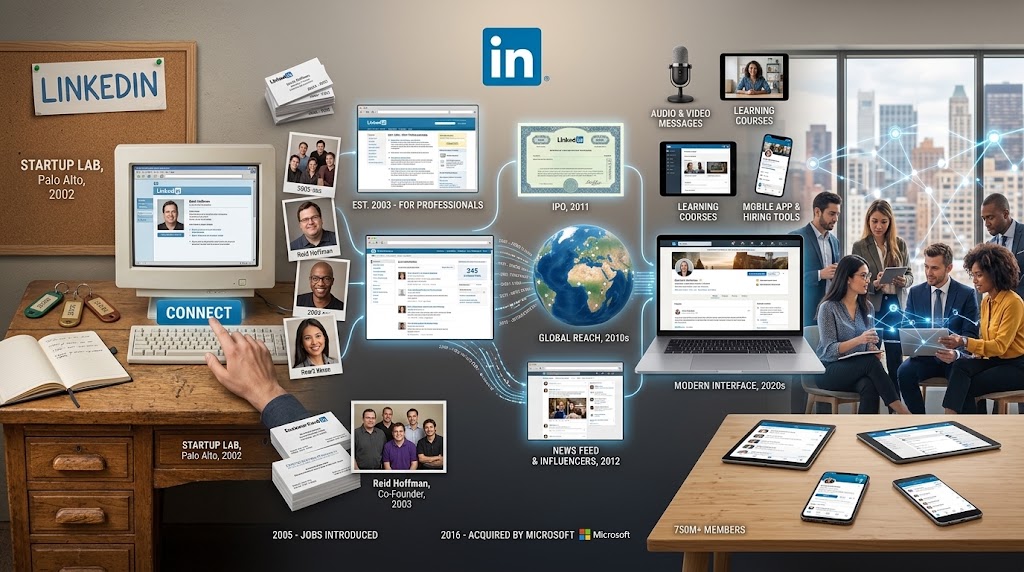
history of LinkedIn: It Started As a Digital Resume Book
history of LinkedIn.
May 5, 2003. A Monday morning.
A guy named Reid Hoffman sent an email to 350 of his friends. “Hey, I built a website for professionals. You should join.”
That website was LinkedIn.
No one thought it would work. Facebook was for college kids. MySpace was for music. Who needed a website just for jobs?
22 years later, LinkedIn has 1.2 Billion users. It’s owned by Microsoft for 26.2 Billion dollars. And if you’re looking for a job in 2026, you have to be on it.
So what is the history of LinkedIn? It’s not a story of viral dances or photo filters.
It’s the story of a boring idea that became essential. Of resumes moving online. Of recruiters paying 10,000 dollars a month. Of one guy who believed “your network is your net worth.”
This is the full history of LinkedIn. From PayPal to Microsoft. From 0 to 1.2 Billion.
history of LinkedIn 1967-2002: Reid Hoffman Before LinkedIn
Reid Hoffman: The PayPal Guy
Reid Hoffman was born in 1967 in Stanford, California. His dad was a lawyer. His mom was an environmental lawyer.
He went to Stanford. Then Oxford. He studied philosophy and symbolic systems.
In 1997, he joined a company called SocialNet. It was a dating site. It failed.
But Reid learned something: “People connect online for a reason. Not just to date.”
In 1998, he joined PayPal as COO. Employee number 4.
PayPal exploded. eBay bought it for 1.5 Billion dollars in 2002.
Reid made millions. But he was bored. He wanted to build something bigger.
The “Professional Network” Idea
In late 2002, Reid was at dinner with friends. Someone said “I need to hire an engineer.”
Another person said “I know 3 people.”
Reid thought: “What if there was a website where everyone’s work experience was listed? And you could see who knows who?”
He called it LinkedIn. Linked In to your professional network.
In December 2002, he incorporated LinkedIn Corp.
He raised 2.5 Million dollars from Sequoia Capital.
But he had no product. No users. Just an idea.
history of LinkedIn 2003-2004: Launch and First 10,000 Users
May 5, 2003: LinkedIn Goes Live
The site launched with 4,500 users. Mostly Reid’s friends from PayPal, Google, and Stanford.
It was ugly. White background. Text only. No photos.
What could you do? Add your job history. Add people you knew. That’s it.
No news feed. No messaging. No posts.
The Slow Growth Problem
For 6 months, nothing happened.
People signed up because Reid asked them to. Then they left.
Reid said later “We almost died 3 times in the first year.”
The problem: Why would anyone come back?
Facebook had friends. LinkedIn had… coworkers?
The Breakthrough: Import Your Email
In 2004, LinkedIn added one feature. “Import your email contacts and invite them.”
Suddenly growth exploded.
If you invited 100 people, and 20 joined, they invited 20 more.
By end of 2004: 1 Million users.
This is the first lesson in the history of LinkedIn: Growth comes from other people’s networks.
history of LinkedIn 2005-2008: Making Money From Recruiters
“How Do We Make Money?”
In 2005, LinkedIn had 4 Million users and no revenue.
Investors were asking “Is this a real business?”
Reid and CEO Dan Nye figured it out.
Who has money and needs LinkedIn? Recruiters.
LinkedIn Recruiter: 10,000 Dollar Product
In 2005, they launched LinkedIn Recruiter.
For 10,000 dollars per year, recruiters could search all profiles, message anyone, and see who knew who.
Companies paid it. Gladly.
Because hiring one engineer through a recruiter cost 30,000 dollars. LinkedIn was cheaper.
By 2006: 8 Million users. 10 Million revenue.
Premim Accounts for Job Seekers
2005: They also launched Premium for 19.95 per month.
“You can see who viewed your profile. You can message anyone.”
Did people buy it? Yes. Because jobs.
By 2008: 30 Million users. Profitable.
The history of LinkedIn from 2005-2008 is simple: Find who has money and sell to them.
history of LinkedIn 2009-2011: IPO and 100 Million Users
Jeff Weiner Becomes CEO
In 2008, Reid stepped down as CEO. He brought in Jeff Weiner from Yahoo.
Jeff’s job: Make LinkedIn bigger and ready for IPO.
100 Million Users
2011. LinkedIn hit 100 Million users.
May 19, 2011: LinkedIn went public.
IPO price: 45 dollars.
First day close: 94 dollars.
Valuation: 8.9 Billion dollars.
A professional networking site was worth 9 Billion.
Wall Street was shocked.
Why The IPO Worked
Because LinkedIn had revenue. Real revenue.
2010 revenue: 243 Million dollars. 94% from recruiters and ads.
Facebook had no revenue in 2004. LinkedIn had revenue on day 1.
This is why the history of LinkedIn is different. It was a business from the start.
history of LinkedIn 2012-2015: Content, Acquisitions, and 400 Million Users
“We Are Not Just Resumes”
Jeff Weiner said “LinkedIn should be where professionals learn.”
2013: They launched LinkedIn Influencers. Bill Gates. Richard Branson. They posted articles.
2014: They bought Lynda.com for 1.5 Billion dollars. Online courses.
2015: They launched LinkedIn Pulse. News for professionals.
The Mobile Problem
In 2013, 40% of users were on mobile. But the app sucked.
Jeff spent 1 year rebuilding it.
By 2015: 400 Million users. 3 Billion revenue.
LinkedIn was now a real media company.
history of LinkedIn 2016: The 26.2 Billion Dollar Microsoft Deal
The Phone Call
June 2016. Jeff Weiner got a call from Satya Nadella, CEO of Microsoft.
“Want to talk about LinkedIn?”
Microsoft had tried to build LinkedIn 3 times and failed.
They had Outlook. They had Office. But they had no social network for work.
26.2 Billion Dollars
13.7 Billion in cash. The rest in stock.
June 13, 2016, the deal was announced.
26.2 Billion dollars. The biggest deal in Microsoft history.
People said Microsoft overpaid. LinkedIn stock was at 130 dollars. Microsoft paid 196 dollars per share.
Why Microsoft Did It
Satya said “LinkedIn is the professional graph. Office is the productivity graph. Together they’re unstoppable.”
Imagine Word telling you “Your coworker John is an expert in this.”
Imagine Outlook suggesting “Email Sarah, you worked together at Google.”
That was the plan.
history of LinkedIn 2017-2020: Under Microsoft
Nothing Changed. And That Was Good.
Microsoft promised “We won’t mess with LinkedIn.”
And they didn’t.
Jeff Weiner stayed CEO until 2020.
LinkedIn kept its own brand. Its own office.
Growth Explodes
2017: 500 Million users.
2019: 675 Million users.
2020: 740 Million users.
Why? Because Microsoft integrated LinkedIn into everything.
In Outlook: “This person is on LinkedIn”
In Word: “Hire a writer from LinkedIn”
In Teams: “See their LinkedIn profile”
COVID Boost
2020. Everyone lost jobs. Everyone went to LinkedIn.
Job posts doubled.
LinkedIn became essential.
history of LinkedIn 2021-2026: AI and 1.2 Billion Users
Where history of LinkedIn Is in 2026
1.2 Billion members.
67 Million companies.
65 Billion quarterly revenue for Microsoft from LinkedIn.
AI Everywhere
2023: AI writes your “About” section.
2024: AI writes job descriptions for recruiters.
2025: AI messages candidates for you.
New Features
LinkedIn Live for video.
LinkedIn Newsletter for creators.
LinkedIn Learning with 20,000 courses.
The history of LinkedIn from 2021-2026 is about AI making networking automatic.
The 5 Reasons in the history of LinkedIn It Succeeded
1. It Solved One Boring Problem
Resumes. Jobs. Networking.
Not fun. But necessary.
People need jobs every 2-3 years.
2. It Made Money Day 1
No “we’ll figure out ads later”.
Recruiters paid from 2005.
3. Network Effects
The more people on LinkedIn, the more valuable it is.
If your boss is on it, you have to be on it.
4. Microsoft Didn’t Kill It
They bought it and eft it alone. Like Facebook did with Instagram.
5. It Became The Internet’s Resume
In 2026, if you’re not on LinkedIn, do you even have a job?
The Timeline: history of LinkedIn
1. December 2002: LinkedIn Inc founded by Reid Hoffman
2. May 5, 2003: LinkedIn launches
3. 2005: LinkedIn Recruiter launches
4. 2008: Jeff Weiner becomes CEO
5. 2011: IPO at 8.9 Billion
6. 2014: Buys Lynda.com for 1.5 Billion
7. June 13, 2016: Microsoft buys LinkedIn for 26.2 Billion
8. 2018: 500 Million users
9. 2020: Jeff Weiner steps down
10. 2023: AI features launch
11. 2026: 1.2 Billion users
history of LinkedIn vs Other Social Networks
LinkedIn vs Facebook
Facebook is for friends.
LinkedIn is for coworkers.
You post vacation photos on Facebook.
You post “I got promoted” on LinkedIn.
LinkedIn vs Indeed
Indeed is for job listings.
LinkedIn is for networking before the job.
LinkedIn vs Twitter
Twitter is for opinions.
LinkedIn is for “thought leadership” posts.
LinkedIn won because it stayed focused.
How LinkedIn Makes Money in 2026
1. Talent Solutions: 60% of Revenue
Recruiters pay 10,000 to 100,000 per year.
2. Marketing Solutions: 25%
Companies pay to run ads. “Hire developers in Dhaka”
3. Premium Subscriptions: 10%
19.99 to 99.99 per month for job seekers.
4. Learning: 5%
LinkedIn Learning subscriptions.
Total: 15 Billion dollars per year.
10 Lessons From the history of LinkedIn
1. Boring businesses make the most money.
2. Sell to the person with the budget. Recruiters.
3. Network effects take 5 years.
4. Don’t chase trends. Stay professional.
5. IPO when you have revenue.
6. Let the big company buy you and leave you alone.
7. Content keeps people coming back.
8. Mobile or die.
9. AI helps, but people still want human connections.
10. Your network really is your net worth.
FAQ: history of LinkedIn
What is the history of LinkedIn?
LinkedIn was founded in 2002 by Reid Hoffman and launched in 2003. Microsoft bought it in 2016 for 26.2 Billion.
Who founded LinkedIn?
Reid Hoffman, along with Allen Blue, Konstantin Guericke, Eric Ly, and Jean-Luc Vaillant.
Is LinkedIn still independent?
No. Microsoft owns LinkedIn since 2016.
How many users does LinkedIn have?
1.2 Billion members in 2026.
Final Word: The history of LinkedIn
The history of LinkedIn is not exciting.
No scandals. No viral dances. No teen drama.
It’s the story of a resume website that became the world’s professional network.
Reid Hoffman didn’t want to be cool. He wanted to be useful.
And that’s why Microsoft paid 26.2 Billion dollars.
From 350 emails in 2003 to 1.2 Billion people in 2026.
The history of LinkedIn proves one thing:
If you solve a real problem for real people with real money, you don’t need to be viral.
You just need to be essential.
That’s LinkedIn.


