How Was Money Created And Why We Stopped Using Barter
How Was Money Created And Why We Stopped Using Barter
How was money created?
10,000 years ago there was no money.
If you wanted bread, you gave a chicken.
If you wanted a house, you gave 10 cows.
That was it. That was the economy.
Then something changed.
Humans invented a new idea.
An idea so powerful it built empires, caused wars, and runs your phone today.
That idea is money.
But money didn’t appear in one day.
It took 5000 years of trial and error.
Shells, salt, gold, paper, and now code.
Let’s go back to the beginning.
Barter Was A Nightmare
Imagine this.
You’re a farmer in 8000 BC.
You grow wheat.
You need shoes.
So you find a shoemaker.
He says: “I don’t need wheat. I need meat.”
Now you have to find a hunter.
Trade wheat for meat.
Then take meat to shoemaker.
Get shoes.
This is called the “double coincidence of wants.”
Both people have to want what the other has.
It wasted days.
And what if you wanted a cow but only had 1 chicken?
You can’t cut a cow in half.
Barter worked for small villages.
But when cities got big, it broke.
In Mesopotamia markets got so big that people spent whole days just finding trades.
Priests started keeping records on clay tablets.
“I owe you 3 goats.”
That was the first IOU. The first debt.
Humans needed something better.
How Was Money Created: Secret 1 – Commodity Money
The First Money Was Stuff People Wanted
Around 5000 BC people got smart.
Instead of trading anything, they picked 1 thing everyone wanted.
Different places picked different things.
1. Salt in Africa
So valuable that Roman soldiers were paid in salt.
That’s where “salary” comes from. Sal = Salt.
In Ethiopia, blocks of salt were used as money until 1940.
2. Shells in Asia and Pacific
Cowrie shells. Small, hard to find, everyone liked them.
In China they were used for 3000 years.
The Chinese word for money still has the shell symbol.
3. Cattle in Europe
A cow was worth a lot. “Capital” comes from “caput” meaning head of cattle.
“Fee” comes from cattle too.
4. Grain in Egypt
You could eat it. So everyone accepted it.
Pharaohs paid workers in grain.
5. Tea Bricks in Mongolia
Compressed tea. You could drink it or trade it.
This was called Commodity Money.
Money that had value itself.
Problem?
Heavy. Rotten. Easy to steal.
Try carrying 100kg of salt to buy a house.
And what if there was a bad harvest? Salt got cheap.
So people looked for something better.
How Was Money Created: Secret 2 – Metal Coins
Gold Changed Everything
Around 700 BC in Turkey, a kingdom called Lydia did something new.
They took gold and silver.
Melted it.
Stamped a lion on it.
Boom. The first coin.
Why gold?
1. Rare
2. Doesn’t rot
3. Easy to carry
4. Everyone wants it
5. Hard to fake
Now you didn’t need 10 cows.
You needed 3 small gold coins.
Coins spread fast.
Greeks copied it and put gods on coins.
Romans copied it and put emperors on coins.
It was propaganda and money in one.
Roman Empire had one currency for 500 years.
From England to Iraq, everyone used the same coins.
That made trade explode.
But kings were greedy.
They started mixing copper with gold.
“Debasing” the coin.
That’s the first inflation.
By 300 AD a Roman soldier’s pay was worth 1/20th of what it was.
People lost trust.
Barter came back.
Still, for 2000 years, money = metal.
If you had gold, you were rich.
If you didn’t, you weren’t.
How Was Money Created: Secret 3 – Paper And Banks
The Receipt That Became Money
Fast forward to 1000 AD. China. Song Dynasty.
Merchants got tired of carrying 50kg of iron coins.
So they gave coins to a banker.
Banker gave them a paper receipt.
“Redeem this for 10 coins.”
People started trading the paper instead of coins.
Because it was easier.
That was the first paper money. Called “Jiaozi.”
Then in 1600s Europe, goldsmiths did the same.
People left gold with them for safety.
Got a paper note back.
Soon people realized:
The goldsmith had 100 gold bars.
But issued 200 paper notes.
Because not everyone would claim at once.
That’s called “fractional reserve banking.”
And that’s how banks were born.
Bank of England started in 1694.
They issued notes.
“Pay the bearer 5 pounds.”
Paper money took off because:
1. Light
2. Hard to fake
3. Government backs it
By 1900, most countries used paper.
But it was still tied to gold.
1 dollar = 1/35 ounce of gold.
You could walk into a bank and demand gold.
The Big Break: Fiat Money
Money Backed By Nothing
In 1971, US President Nixon did something crazy.
He went on TV and said: “Dollar is no longer tied to gold.”
Overnight, money became Fiat.
Fiat means “by government order.”
Now money has value for 2 reasons:
1. Government says it does
2. Everyone agrees to use it
That’s it.
The paper in your pocket is worth something because we all believe it is.
Sounds crazy.
But it works.
Why?
Because governments control supply.
And we pay taxes in that money.
So we need it.
This let governments print money for wars, schools, hospitals.
But also caused inflation.
Because printing too much = each dollar worth less.
Zimbabwe printed so much that 1 loaf of bread cost 100 billion dollars.
Venezuela did the same.
So trust is everything.
How Was Money Created Digital Money Money That Isn’t Real
From Cards To Code
1990s: Credit cards.
2000s: Online banking. PayPal.
2010: Bitcoin.
Today 90% of money doesn’t exist as paper.
It’s just numbers in a computer.
You swipe. Bank moves numbers.
No gold. No paper.
Just trust in the system.
Then came crypto.
Bitcoin in 2009. Created by Satoshi.
Money with no government.
No bank.
Just math and computers.
Is it real money?
El Salvador says yes.
Companies like Tesla accept it.
People use it. People accept it.
So yes.
Money is whatever we agree it is.
Now Central Banks are making CBDC.
Digital Dollar. Digital Taka.
Money that lives on your phone.
Cash is dying.
5 Things That Make Money Work
Through 5000 years, good money always had these:
1. Durable
Doesn’t rot. Gold, metal, paper. Not bread.
2. Portable
Easy to carry. You can’t use elephants as money.
3. Divisible
Can break into small parts. 1 dollar to 100 cents.
4. Uniform
Every 1 dollar is the same.
5. Accepted
Everyone agrees it has value.
Shells had it.
Gold had it.
Dollars have it.
Bitcoin is trying to have it.
The Weirdest Money In History
Humans got creative when desperate.
1. Rai Stones – Pacific Islands
Giant stone wheels. 4 meters wide. 4 tons.
You didn’t move them. You just said “this is mine now.”
Even if it fell in the ocean, it was still yours.
2. Teeth – Africa
Whale teeth were used as money in Fiji.
3. Cigarettes – WW2 Prison Camps
Cigarettes became currency. 1 cigarette = 1 candy.
4. Vodka – Russia 1990s
After the Soviet Union collapsed, people traded vodka for food.
5. Beads – Native Americans
Wampum beads. Used for 200 years.
Lesson: Money is trust. Nothing more.
What Happens Next
We’re in the middle of another change.
Cash is dying.
Cards, bKash, Nagad, Apple Pay are taking over.
Central banks are making “Digital Dollars” and “Digital Taka.”
Crypto is trying to replace banks.
In 50 years your grandkids might ask:
“What was a wallet?”
“What was cash?”
Money keeps changing form.
But the idea stays the same.
A way to trade without barter.
The next 500 years?
Maybe money will be reputation.
Or time.
Or data.
3 Big Ideas To Remember
1. Money was invented to solve barter problems
It’s a tool, not magic.
2. Every 500 years money changes form
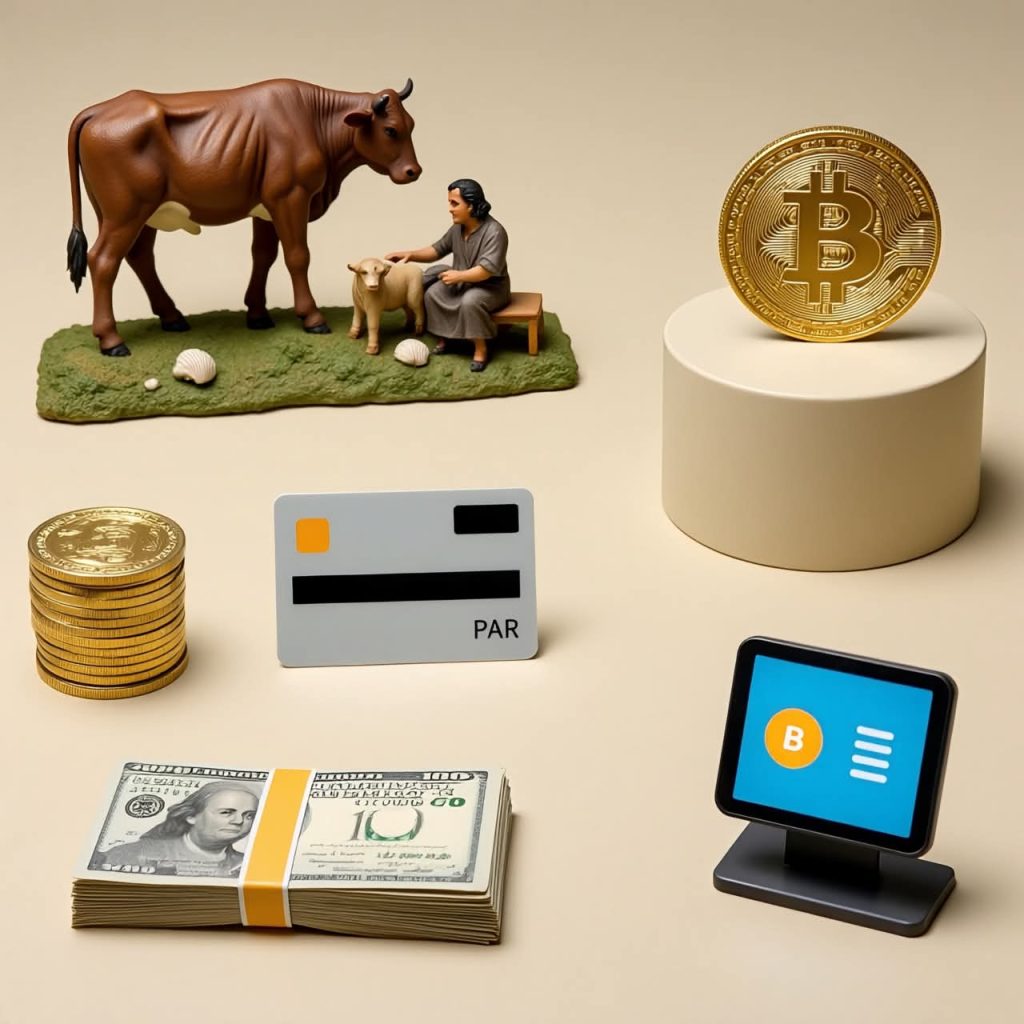
Barter → Commodity → Coins → Paper → Digital
3. Money only works because we believe it does
Gold, paper, code. All the same.
FAQ – How Was Money Created
1. How was money created?
Money was created to solve problems with barter. People first used commodities like salt and shells, then metal coins, then paper money, and now digital money.
2. What was the first form of money?
The first money was commodity money. Things like salt, shells, cattle and grain that everyone wanted and could trade.
3. When were coins invented?
The first coins were made around 700 BC in Lydia, modern Turkey. They were made of gold and silver.
4. Why did we stop using gold?
Gold was heavy and limited. In 1971 countries switched to fiat money, which is backed by government instead of gold.
5. Is digital money real money?
Yes. Most money today is digital. It’s just numbers in bank computers. As long as people accept it, it’s real money.
6. What will money look like in the future?
Most likely it will be fully digital. Central bank digital currencies and crypto will play a bigger role. Cash will disappear.
Read more:https://worldhistorytales.com/operation-mincemeat-dead-body/