
The Great Fire of London in 1666: The Event That Reduced The Entire City To Ashes In Just Four Days!
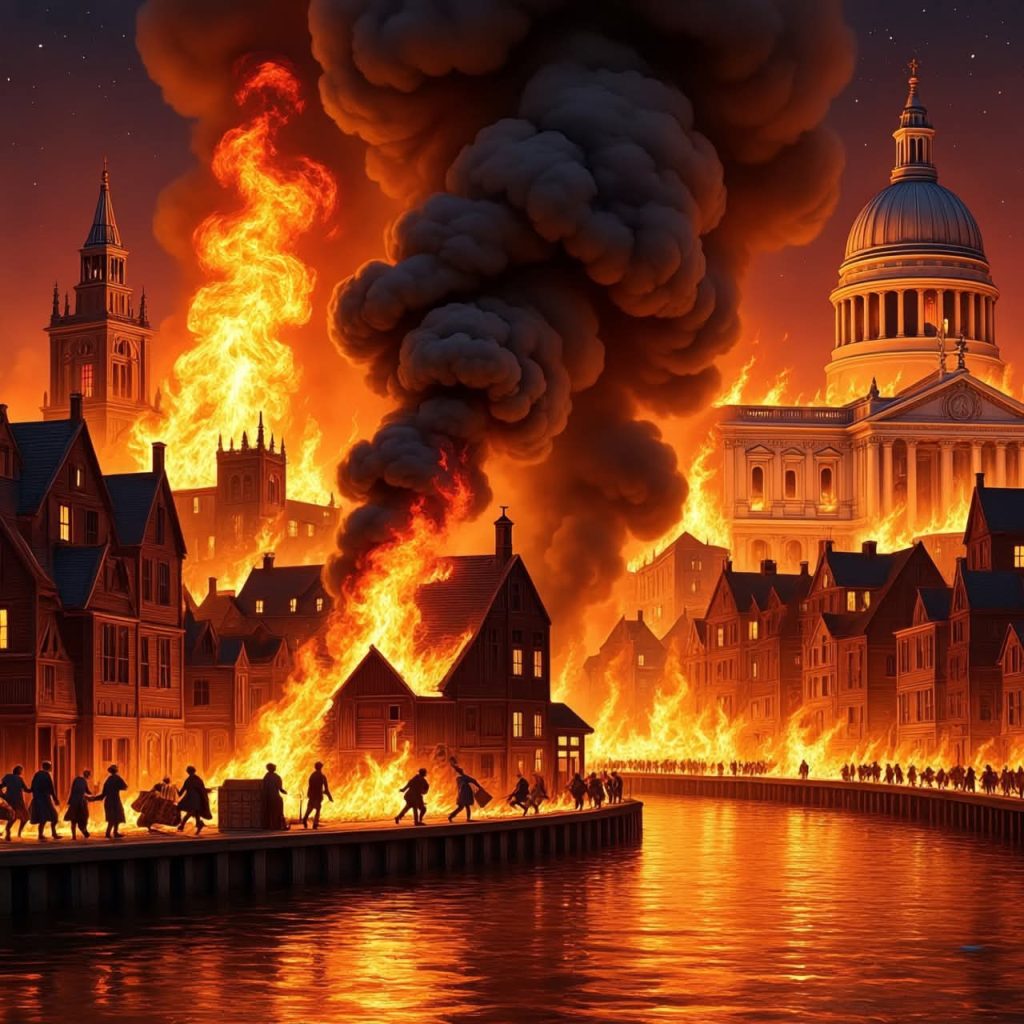
1. Introduction: The Night Great Fire of London 1666 Started to Burn
Great Fire of London 1666
Let me paint you a picture.
It’s 1 o’clock in the morning. Sunday, September 2, 1666.
London is quiet. Too quiet. People are sleeping in houses that are basically made of firewood stacked next to each other. The air is dry. The wind is blowing from the east.
And in a small bakery on Pudding Lane, an oven is still hot.
No one knows it yet, but by Wednesday night, The Great Fire of London 1666 will have eaten half the city.
13,200 houses. Gone.
87 churches. Ash.
436 acres. Black.
But only 6 people officially died.
How is that even possible? How did The Great Fire of London 1666 spread so fast? And how did a city this broken manage to come back stronger?
Bhai, this story is wild. It’s about panic, bad decisions, heroes, and rebirth.
So grab some tea. Let’s go back 358 years.
2. London in 1666: A City That Was Begging to Burn
Before we talk about the fire, you need to see London in 1666. And honestly? It was a mess.
Imagine living there
Half a million people crammed into a tiny space inside old Roman walls. The streets were so narrow that if two carts came face to face, one had to back up.
Everything was wood
Houses were made of timber, with thatched roofs. They leaned over the street so much that neighbors could shake hands from upper windows.
Basically, the whole city was a giant bonfire waiting for a match.
And it smelled bad
There was no proper sewage. Trash was dumped in the street. Rats everywhere.
Just one year before, in 1665, London got hit by the Great Plague. 100,000 people died.
So when The Great Fire of London 1666 started, London was already tired, dirty, and weak.
It was like the city was asking for trouble.
3. It Started With Bread: The Bakery on Pudding Lane
Sunday, September 2. Around 1 AM.
Thomas Farriner. He was a baker. Normal guy. Had a shop on Pudding Lane, right by London Bridge.
That night he went to bed but forgot to fully put out his oven.
A spark. That’s all it took.
At first, nobody panicked. Fires in bakeries? Happened all the time. But this time the wind was strong. And it hadn’t rained properly in months. Everything was dry as paper.
Within 30 minutes, Farriner’s house was on fire. He and his family climbed out a window to escape. His maid didn’t make it. She became the first person to die in The Great Fire of London 1666.
Farriner probably had no idea that his forgotten oven would go down in history.
4. Day 1: Sunday – “Don’t Worry, It’s Small”
The Lord Mayor of London was a guy named Thomas Bloodworth.
When people woke him up and told him about the fire, he came, looked at it, and said the most famous dumb line in history:
“Pish! A woman could piss it out.”
Yeah. That didn’t age well.
Why nobody cared at first
1. Fires happened all the time in London.
2. The fire brigade didn’t exist yet.
3. People thought the stone walls would stop it.
Big mistake.
The wind kept pushing the flames west. Wooden houses caught fire like matches. By Sunday evening, 300 houses were gone.
People started packing. But most still thought, “It’ll be fine by morning.”
Spoiler: It wasn’t.
5. Day 2: Monday – Chaos and Running
Monday morning. The Great Fire of London 1666 was serious now.
King Charles II came down to the city. He was actually walking around, telling people to pull down houses to make gaps. That’s called a “firebreak.”
But it was chaos.
What people did
Samuel Pepys, this guy who kept a diary, wrote that he buried his cheese and wine in the garden so the fire wouldn’t get it. I mean, priorities, right?
The Thames River was full of boats. People were throwing furniture, paintings, food onto anything that floated.
By Monday night, the fire reached St. Paul’s Cathedral. The roof was lead. It melted and started running down the street like silver water.
People watched their city burn and didn’t know what to do.
6. Day 3: Tuesday – The Day Hell Came to London
If Monday was bad, Tuesday was worse.
The wind was still going. The fire jumped over the River Fleet like it was nothing.
St. Paul’
The big dome collapsed. The sound was like 100 cannons. People miles away heard it.
Desperate moves
Soldiers started using gunpowder to blow up houses. It was dangerous but it worked. It made gaps the fire couldn’t cross.
King Charles II was out there himself, helping. He told people, “Don’t worry about your stuff. Save your lives.”
By Tuesday night, half of London was gone. The sky was orange. You couldn’t breathe without tasting smoke.
People thought it was the end of the world.
Great Fire of London Britannica
7. Day 4: Wednesday – The Wind Finally Stops
Wednesday morning.
And then… the wind stopped.
Just like that.
For the first time in 4 days, firefighters and regular people had a chance. With no wind and the firebreaks working, The Great Fire of London 1666 finally started to die down.
By Thursday morning, it was over.
4 days.
That’s all it took to erase most of medieval London.
8. After The Fire: Walking Through Ash
When the smoke cleared, London looked like the moon.
Black. Quiet. Nothing.
The numbers
– 13,200 houses gone
– 87 churches gone
– 436 acres burned
– About 100,000 people homeless
The weird part: deaths
Only 6 people officially died. Historians think it was more, but still. For a fire that big, that’s crazy low. Probably because the fire moved slow enough that people could run.
The money
About £10 million in damage. In 1666 money. That’s billions today.
London was gone. But what happened next is the important part.
9. Who Did It? Blame and Conspiracies
After a disaster, people need someone to blame.
Theory 1: The French
England was at war with France. So obviously, French spies did it.
Theory 2: The Catholics
Protestants blamed Catholics.
They even caught a guy. Robert Hubert. French. One arm. He confessed. They hanged him.
Problem? He was in prison in Oxford when the fire started. He was probably innocent. But people needed someone.
The truth
It was an accident. Bread. An oven. Bad luck. And a city built to burn.
10. Rebuilding: How London Rose From Ash
King Charles II and Parliament sat down and said, “We’re not making the same mistakes.”
New Rules
1. No wood: All new houses had to be brick or stone.
2. Wider streets: So fire couldn’t jump across.
3. No overhangs: Buildings had to be straight.
The hero: Christopher Wren
Sir Christopher Wren was an architect. The king gave him the job to rebuild London.
He designed the new St. Paul’s Cathedral with that huge dome we know today. He also designed 51 new churches.
It took 10 years. But the new London was safer, cleaner, and honestly, prettier.
The Great Fire of London 1666 destroyed the old city. But it gave us the modern one.
11. The Diaries: How We Know What Happened
We know so much about The Great Fire of London 1666 because two guys wrote everything down.
Samuel Pepys
He was a government worker. His diary is gold.
“Sept 2: I saw the houses at the end of the bridge all on fire… and an infinite great fire on this and the other side the bridge.”
He even wrote about burying his cheese. Real human stuff.
John Evelyn
Another diarist. He walked through the city after.
“London was, but is no more.”
Chills, right?
Without them, The Great Fire of London 1666 would just be numbers.
12. The Weird Good Things That Came From The Fire
I know it sounds wrong. But The Great Fire of London 1666 actually helped.
1. It killed the plague
Fire + heat killed the rats. Cleaned the streets. The Great Plague never came back.
2. It forced modernization
No more medieval wooden maze. London became a real modern city.
3. It created jobs
Rebuilding employed thousands for a decade.
Sometimes you have to burn something down to build something better.
13. 10 Things You Probably Didn’t Know
1. The Monument
They built a 202-foot tall column called The Monument. You can still climb it. 311 steps.
2. It started and ended at bakeries
First fire: Farriner’s bakery. Last house to burn: also a bakery.
3. The king helped
Charles II was out there for 4 days straight.
4. The Royal Mint survived
Because it was stone.
5. The bells of St. Paul’s melted
And you could hear it miles away.
6. Pets were saved
People put dogs and cats on boats.
7. The fire stopped at Temple Bar
Right on the city border.
8. No insurance
Everyone just lost everything.
9. It invented fire insurance
After 1666, the first fire insurance companies started.
10. You can still see marks
Some buildings in London still have burn marks from 1666.
14. What If It Happened Today?
Let’s be real. If The Great Fire of London 1666 happened today?
Fire trucks would be there in 10 minutes. Hydrants everywhere. Fireproof buildings.
It would be out in 2 hours.
But in 1666 they had buckets. And prayer.
Makes you grateful, doesn’t it?
15. You Can Still Visit Great Fire of London 1666
Today
London didn’t forget.
The Monument
Go climb it. Best view of the city. And a reminder.
St. Paul’s
The one standing now is Wren’s. Built after the fire.
Pudding Lane
There’s a plaque. “Here Thomas Farriner’s bakery stood.”
Walk those streets and you can feel it. The Great Fire of London 1666 is still there.
16. Final Thoughts:Great Fire of London 1666
The Great Fire of London 1666 lasted 4 days.
But it changed 400 years of history.
It taught us about city planning. About fire safety. About not building everything out of wood.
But more than that, it taught us about people.
People lost everything. Their homes. Their shops. Their lives.
But 10 years later, London was better than before.
That’s resilience.
When I walk through London now and see brick buildings and wide streets, I think: this is because of a fire in 1666.
The Great Fire of London 1666 wasn’t the end.
It was a reset button.
Frequently Asked Questions Great Fire of London 1666
1. What caused The Great Fire of London 1666?
A bakery oven left burning on Pudding Lane.
2. How long did The Great Fire of London 1666 last?
4 days. Sept 2 to Sept 5, 1666.
3. How many people died?
Officially 6. Probably more, but not many.
4. How much of London burned?
436 acres. 13,200 houses. 87 churches.
5. Who rebuilt London?
Sir Christopher Wren was the main architect.
6. Did the fire stop the plague?
Yes. It killed the rats and cleaned the city.
7. Can I visit places from The Great Fire of London 1666?
Yes. The Monument, St. Paul’s, and Pudding Lane.


