
Salahuddin Ayyubi: Why Did Even His Enemies Respect This Great Hero Who Conquered Jerusalem?
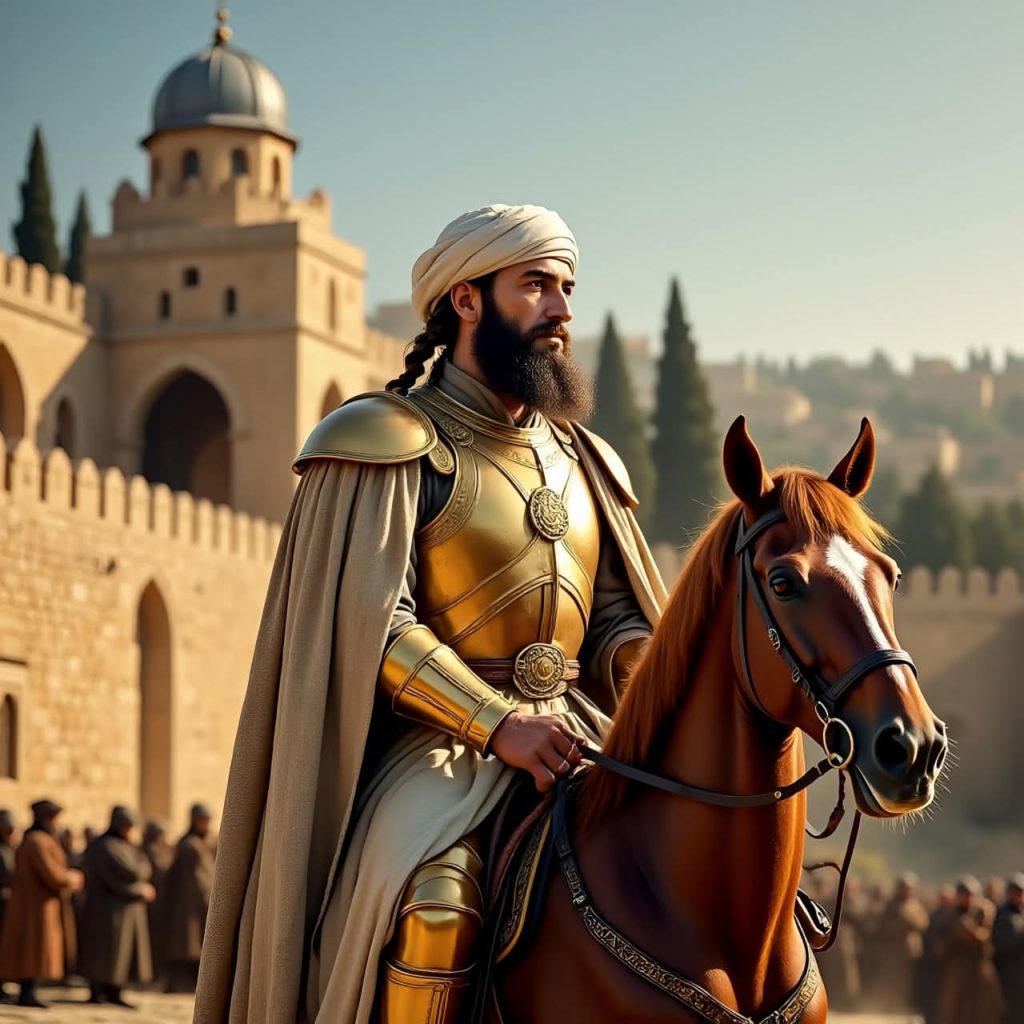
1. Introduction: Who Was Salahuddin Ayyubi?
Salahuddin Ayyubi.Let me ask you something .
Have you ever heard of a conqueror who cried when he won?
That’s Salahuddin Ayyubi for you.
It’s 1187. The world is on fire. For 90 years Jerusalem has been under Crusader rule. Muslims are heartbroken. Christians are celebrating. And in the middle of all this chaos, one man rises. Not with arrogance. Not with cruelty. But with justice.
His name was Salahuddin Ayyubi.
To Muslims, he was the hero who freed Al-Quds. To Christians, he was the enemy general. But here’s what’s wild: even the kings who fought him wrote letters praising him. Even the soldiers he defeated said, “This man is different.”
Why? Because when Salahuddin Ayyubi conquered Jerusalem, he didn’t do what everyone expected. He didn’t kill. He didn’t burn. He showed mercy.
In a time of blood, he chose justice.
Today in 2026, we’re drowning in hate, politics, and division. The story of Salahuddin Ayyubi hits different now. It reminds us what real leadership looks like.
So let’s go deep. Who was this man? Why did even his enemies respect him? And what can we learn from him?
2. Early Life: The Quiet Boy From Tikrit
Salahuddin Ayyubi was born in 1137 in Tikrit, Iraq. His full name was Salah ad-Din Yusuf ibn Ayyub. “Salah ad-Din” means “Righteousness of the Faith.”
He wasn’t born in a palace. His dad was a government official and soldier. The family was Kurdish. Normal people.
As a kid, Salahuddin wasn’t running around with a sword. He was the quiet kid in the corner with a book. He loved reading about religion, law, and poetry. Teachers said he was thoughtful. He prayed. He asked big questions.
But outside his house, the Muslim world was a mess.
The Crusaders had taken Jerusalem in 1099. It was brutal. And Muslim rulers? They were busy fighting each other instead of uniting.
That broke young Salahuddin’s heart. He made a promise to himself: “One day I will unite us. And I will take back Jerusalem.”
He was 12 years old when he made that promise.
Jerusalem – UNESCO World Heritage Site
3. Rise In Egypt: Cleaning A Broken System
In 1169, Salahuddin was sent to Egypt as a commander. He was 31.
Egypt was broken. Corruption everywhere. People were poor. Leaders were weak.
Most people would’ve just taken the power and enjoyed it. Not Salahuddin.
He started fixing things. He fired corrupt officials. He built schools and hospitals. He sat with poor people and listened to them.
Within a few years, he became the Sultan of Egypt.
But here’s the thing. Salahuddin knew Egypt alone couldn’t defeat the Crusaders. He needed the whole Muslim world united.
So for the next 15 years, he did what no one else could.
He traveled. He talked. He fought when he had to. He made peace when he could. Slowly, Syria, Iraq, Arabia, and Egypt came under one rule.
By 1186, Salahuddin Ayyubi was the undisputed leader of most of the Muslim world.
And he had only one target left: Jerusalem.
4. The lattle of Hattin: Strategy Over Strength
July 1187. The Crusaders made a dumb move.
They marched their whole army into the desert near a place called Hattin to fight Salahuddin.
Big mistake.
It was 110°F. No water. Soldiers were dropping from heat.
Salahuddin didn’t attack right away. He waited. He cut off their water supply. He let the sun do half the work.
Then he attacked.
The Crusader army was destroyed. Their king, King Guy, was captured.
After Hattin, everything changed. Cities started surrendering without a fight because word had spread: “Salahuddin doesn’t slaughter people.”
That reputation saved thousands of lives.
5. Conquering Jerusalem: The Day Mercy Won
October 1187. Salahuddin’s army stood outside Jerusalem.
Inside, people were terrified. They remembered 1099. When Crusaders took the city, they killed everyone in the streets. Even in churches.
So the leaders of Jerusalem sent messengers: “If you spare us, we surrender.”
Salahuddin said yes.
He asked for ransom, but if you were too poor, he let you go free. He told his soldiers: “Don’t touch the churches. Don’t touch civilians.”
When Salahuddin finally walked into Jerusalem, he didn’t raise his sword. He went straight to Al-Aqsa Mosque and prayed. People said he cried.
Compare that.
1099: Crusaders take Jerusalem → massacre.
1187: Salahuddin takes Jerusalem → mercy.
That’s why even today, Christian and Jewish historians write about Salahuddin with respect.
6. The Third Crusade: Respect Between Enemies
After Jerusalem, Europe lost its mind. They launched the Third Crusade.
The biggest name? Richard the Lionheart from England.
Richard and Salahuddin fought for 2 years. Battles, truces, negotiations.
But even while fighting, they respected each other.
There are 2 famous stories:
Story 1: When Richard was sick
Richard got a bad fever. Salahuddin heard about it. So he sent his own personal doctor with medicine and fresh fruit.
Story 2: The horse
Richard’s horse died in battle. A few days later, Salahuddin sent him a new horse as a gift.
They never met face to face. But they exchanged letters.
In 1192 they signed a peace treaty. Jerusalem stayed Muslim. But Christians could visit freely.
Richard later told his men: “We are fighting the most honorable man in the world.”
When was the last time you heard an enemy say that?
The Crusades – Britannica History
7. Why Did Even His Enemies Respect Salahuddin Ayyubi?
Let’s break this down. 4 reasons.
1. He kept his word
In the 1100s, kings lied constantly. Salahuddin didn’t. If he promised safe passage, he gave it. If he made a treaty, he honored it.
2. He showed mercy
After battles, Salahuddin would free prisoners. He’d send doctors to enemy wounded. He gave money to widows, even Christian widows.
3. He lived simply
While other kings lived in gold, Salahuddin lived in a tent. He wore simple clothes. When he died, he had almost no money.
4. He was fair
He didn’t attack on holy days. He protected all religions in Jerusalem.
A Christian writer at the time said: “Salahuddin is the most generous and noble prince in the world.”
That’s why his enemies respected him. Because respect isn’t given for winning. It’s earned by character.
8. How Salahuddin Ayyubi Ruled Jerusalem
After taking the city, Salahuddin made 3 big decisions.
For Muslims
He reopened Al-Aqsa Mosque. He cleaned it and made it a place of prayer again.
For Christians
He protected the Church of the Holy Sepulchre. Pilgrims were allowed to visit.
For Jews
He allowed Jews to return to Jerusalem after being banned for 90 years.
No forced conversions. No mass killings. No destroying holy sites.
Under Salahuddin, Jerusalem became a city of peace again.
That’s leadership.
9. The Personal Life of Salahuddin Ayyubi: A King With Nothing
In 1193, Salahuddin died in Damascus. He was 55.
When they checked his treasury, they found 1 gold coin and 47 silver coins. That was it.
Where did all the money go?
Schools. Hospitals. Feeding the poor. Helping orphans.
He owned no palace. No treasure. No luxury.
At his funeral, both Muslims and Christians came. Because everyone respected Salahuddin Ayyubi.
10. 10 Leadership Lessons From Salahuddin Ayyubi
We can learn a lot from him today.
1. Lead with character, not fear
People followed Salahuddin because they trusted him.
2. Be patient
It took him 15 years to unite Muslims. He didn’t rush.
3. Mercy is strength
Choosing mercy after winning is harder than revenge.
4. Keep your word
Your reputation is everything.
5. Live simply
Don’t get corrupted by power.
6. Respect other faiths
Salahuddin protected churches and synagogues.
7. Take care of your people
He built schools and hospitals.
8. Be strategic
Hattin wasn’t won by brute force. It was won by brains.
9. Stay humble
Even as Sultan, Salahuddin prayed and fasted.
10. Have a bigger purpose
His goal was justice, not just land.
11. How Muslims Remember Salahuddin Today
For Muslims, Salahuddin is more than history. He’s an example.
In schools, kids learn about Salahuddin.
In mosques, Imams talk about his justice.
Parents tell their kids: “Be like Salahuddin.”
Why? Because he showed you can be strong and kind. You can be religious and tolerant. You can win and still be humble.
12. How The West Remembers Salahuddin Ayyubi
Even in Europe and America, Salahuddin is studied. They call him “Saladin.”
Western historians call him “the ideal knight.” Not because he was Christian, but because he had chivalry.
There are movies, books, and games about Salahuddin. People are fascinated by a man who had power but didn’t abuse it.
In 2005, the movie “Kingdom of Heaven” showed Salahuddin as a wise and merciful leader. That’s the image that stuck.
13. Salahuddin vs Other Conquerors
Let’s be real. Most conquerors are remembered for blood.
Genghis Khan? Massacres.
Crusaders in 1099? Massacre.
Colonial rulers? Massacre.
Salahuddin? He’s remembered for mercy.
That’s why his name survived 800 years. Because people don’t remember how much land you took. They remember how you treated people.
14. The Legacy of Jerusalem Under Salahuddin
After Salahuddin, Jerusalem stayed Muslim for hundreds of years.
But more importantly, it stayed safe for all religions.
That model of coexistence is still studied today. Politicians and scholars look back at Salahuddin’s Jerusalem as an example of how to manage a holy city with multiple faiths.
15. 7 Myths About Salahuddin Ayyubi
Let’s clear some stuff up.
Myth 1: He was Arab
Nope. He was Kurdish.
Myth 2: He hated Christians
No. He protected them.
Myth : He was a brutal warrior
He fought when needed, but he preferred peace.
Myth 4: He was super rich
He died poor.
Myth 5: He destroyed Jerusalem
He rebuilt it.
Myth 6: He and Richard hated each other
They respected each other.
Myth 7: He was perfect
No. He was human. But he tried.
16. Final Words: Why Salahuddin Still Matters in 2026
800 years later, why are we still talking about Salahuddin Ayyubi?
Because the world needs him.
We live in a time of revenge, cancel culture, and hate. Salahuddin reminds us of something different.
You can be strong without being cruel.
You can win without destroying.
You can have faith without hating others.
When Salahuddin entered Jerusalem, he could’ve taken revenge for 1099. He didn’t.
When Salahuddin fought Richard, he could’ve been petty. He wasn’t.
That’s why even his enemies respected Salahuddin Ayyubi.
He didn’t just conquer Jerusalem.
He conquered hearts.
Frequently Asked Questions
1. Who was Salahuddin Ayyubi?
Salahuddin Ayyubi was a 12th century Muslim leader who united Muslims and liberated Jerusalem in 1187.
2. Why is Salahuddin Ayyubi famous?
For mercy, justice, and conquering Jerusalem without bloodshed.
3. Did Salahuddin Ayyubi kill civilians?
No. He let civilians leave safely and protected holy places.
4. Why did enemies respect Salahuddin Ayyubi?
Because he was honest, kept promises, and treated people with dignity.
5. What was his relationship with Richard the Lionheart?
They were enemies in war but respected each other and signed a peace treaty.
6. Was Salahuddin Ayyubi rich?
No. He died with almost no money because he gave it to charity.
7. What can we learn from Salahuddin Ayyubi today?
That true leadership is about justice, mercy, and humility.


