
The Black Death: How One Disease Brought Life Across Europe to a Standstill
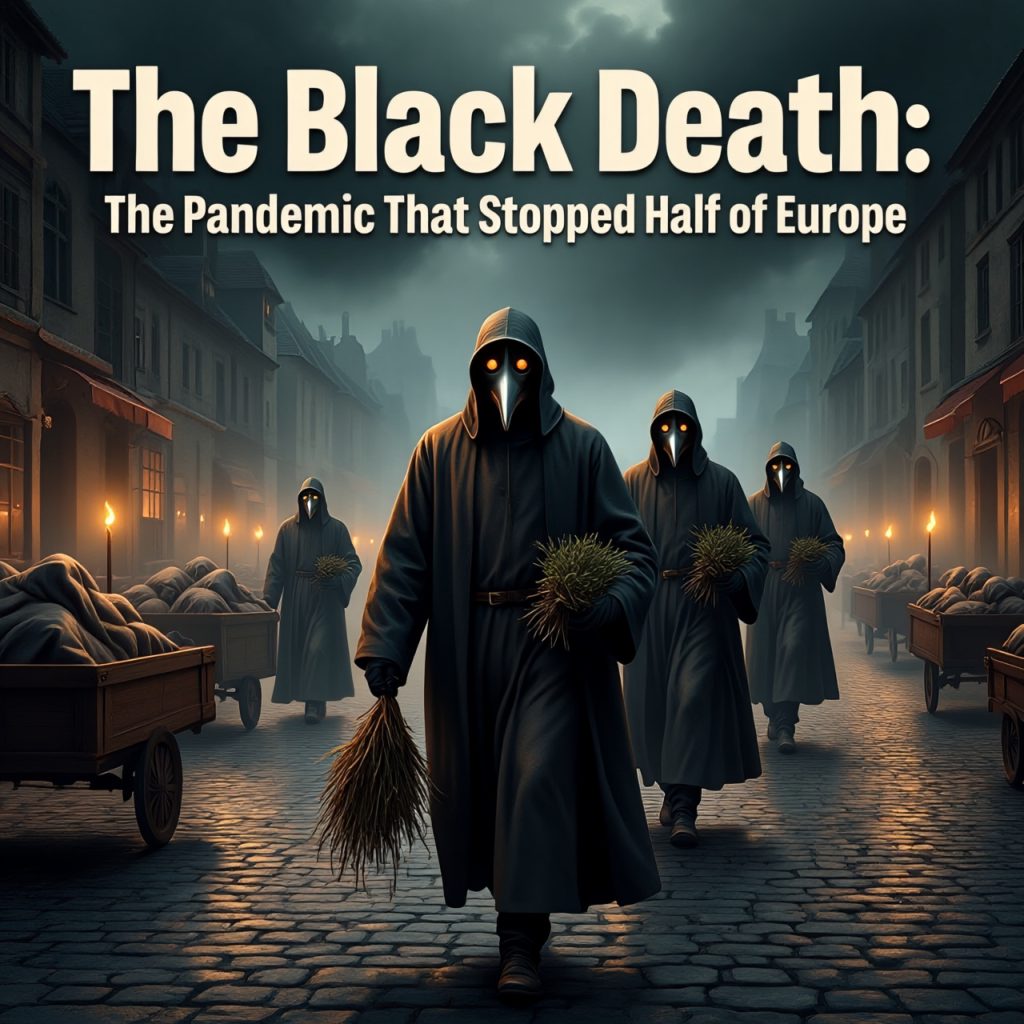
Introduction:The Black Death Day the World Went Quiet
The Black Death.It was the autumn of 1347 and the port of Messina smelled wrong.
Sailors were stumbling off 12 Genoese ships. Their faces were pale. Their clothes were soaked in blood. Some of them had these awful black lumps in their armpits, like rotten fruit. By the time the dockworkers realized what was happening, it was already too late.
Within a week, people in Messina started dying. Within a month, Sicily was burning bodies in the streets. Within a year, The Black Death had marched across an entire continent.
This wasn’t war. This wasn’t famine. This was something worse.
In just four years, The Black Death killed 25 million people. That’s one out of every two people in Europe.
Imagine your city today. Now erase half the people. The schools. The shops. The churches. Gone.
That’s what happened. The Black Death brought life across half of Europe to a standstill in an instant.
And the craziest part? Nobody knew why.
Why You Should Care About a 700-Year-Old Plague
Because we’ve lived through this. Fear. Lockdowns. Blame. Grief.
The Black Death is the first time the whole world felt what a pandemic really does to people. Not just to bodies, but to society.
1. How The Black Death Started Far Away From Europe
Nobody in Europe saw it coming because it didn’t start there.
It Began With Rats in Central Asia
Around 1346, in the grasslands of what’s now Kyrgyzstan and Mongolia, something shifted.
Rats carry a bacteria called *Yersinia pestis*. Usually it stays in rats. But that year, the fleas that lived on the rats got hungry. And they started biting people.
At first it was just villages. Then traders. Then armies.
The Siege of Caffa Changed Everything
Caffa was a busy trading port in Crimea. The Mongols were trying to take it.
There’s this old story that the Mongols got so desperate they started throwing dead bodies over the city walls with catapults. Maybe true, maybe not.
What IS true is that the traders inside Caffa got sick. And when they fled on ships, they took the sickness with them.
They thought they were escaping. They were actually delivering it.
2. The Great Mortality Lands in Europe
Ships were fast. And deadly.
Messina, October 1347
Picture it. 12 ships pull in. The harbormaster walks up and sees the crew. Some are dead on deck. The rest look like ghosts.
He tells them to leave. They refuse. They’re too sick to sail.
Three days later, the first person in Messina dies. Then ten. Then a hundred.
From Italy to Everywhere
From Sicily, it jumped to Genoa and Venice. Merchants carried it to France. Soldiers carried it to Spain.
By the summer of 1348, Paris was losing 800 people a day. They ran out of coffins.
By 1349, England was a graveyard. Villages were completely empty. You could walk for miles and not see a single person.
The plague moved about 3 miles a day on foot. By ship, it crossed Europe in weeks.
3. What The Black Death Actually Did to People
If you caught it, you knew. And you had maybe 3 days.
It Came in 3 Flavors, All Bad
1. Bubonic: This was the “classic” one. Painful black boils showed up in your armpits, neck, and groin. They called them buboes. They could be the size of an apple. Fever, vomiting, and then the boils would turn black.
2. Septicemic: This one skipped the boils. It went straight to your blood. Your skin would turn black and purple. Most people died in less than 24 hours.
3. Pneumonic: The worst. It got in your lungs. You’d cough blood. And because it was in the air, you could give it to anyone near you. 100% fatal.
Day by Day
Day 1: You feel like you have the flu.
Day 2: The fever hits. The pain starts.
Day 3: You’re delirious. The boils are black.
Day 4 or 5: You’re dead.
Doctors stood over patients and had no idea what to do. Because there was nothing to do.
4. Why the Bubonic Plague Tore Through Medieval Cities
Europe in 1347 was basically asking for a pandemic.
Reason 1: It Was Filthy
There were no sewers. People threw chamber pots out the window. “Gardyloo!” they’d shout.
Rats lived in every grain store and every house.
Reason 2: People Were Packed Together
A peasant family of 8 would sleep in one room. If one person got sick, everyone got sick.
Reason 3: Nobody Knew Anything
The best medical theory at the time was “miasma”. Bad air.
So doctors told people to burn herbs and carry flowers. It smelled nice. It did nothing.
Reason 4: Trade Never Stopped
Even as people were dying, ships kept moving. Because money was more important than fear. Until the fear got too big.
5. Life During The Black Death: When the World Just Stopped
This is the part people don’t talk about enough. It wasn’t just death. It was silence.
The Churches Went Empty
Priests were dying too. Who was left to give last rites?
In some towns, bodies sat in houses for a week because no one would come to collect them.
The Farms Died
Who’s going to plant wheat when half the village is dead?
Fields were abandoned. Food got scarce. But weirdly, with fewer people, there was enough for those who survived.
People Turned on Each Other
Neighbors stopped talking. Families locked their doors.
If you coughed, people would cross the street.
A writer in Florence said, “Brother abandoned brother, uncle abandoned nephew, sister abandoned brother.”
6. Flagellants and Fear: How People Tried to Make Sense of It
When science fails, people turn to God. And to blame.
The Whipping Men
Groups called Flagellants started walking from town to town. 200 men at a time.
They’d strip to the waist and whip themselves with leather straps that had metal tips. Until they bled.
They thought if they suffered enough, God would stop the plague.
The Blame Game
Someone had to be at fault, right?
Jews were accused of poisoning wells. In Strasbourg, 2,000 Jews were burned alive in one day.
Foreigners were attacked. Lepers were attacked.
Fear makes people cruel.
7. The Economic Impact of The Black Death: Death Made People Rich
This sounds awful, but it’s true.
Workers Suddenly Had Power
Before 1347, if you were a peasant, you were stuck. You worked the lord’s land and that was it.
After the plague, half the workers were dead.
So if you survived, you could say: “Pay me double, or I’m leaving.”
And lords had to pay. Because who else was going to harvest the crops?
The End of Feudalism
For 500 years, people were tied to the land. The Black Death broke that.
People could move. They could negotiate. A middle class started to form.
It took 50 years, but the entire economy of Europe was rebuilt on the backs of the survivors.
8. How The Black Death Broke the Catholic Church
The Church was supposed to have answers. It didn’t.
When Priests Died Too
People watched priests get sick and die just like everyone else.
Kids asked, “If God loves us, why is he letting this happen?”
And the Church had no good answer.
Faith Got Weird
Some people became super religious. Others walked away completely.
The Church lost a lot of power after 1350. It never really got it back.
9. Medicine in 1348: Masks, Leeches, and Desperation The Black Death
Doctors tried. God bless them, they tried.
The Plague Doctor The Black Death
You’ve seen the pictures. Long black robe. Wide-brimmed hat. And the beaked mask.
The beak was stuffed with lavender and rose petals.
They thought disease came from bad smells. So they wore perfume.
They also carried a stick to poke patients. So they wouldn’t have to touch them.
The “Cures”
Bloodletting. Leeches. Purging. Sitting in a bath of urine.
Banging drums to scare away the bad air.
One doctor suggested carrying a small animal and letting it bite you, so the poison would go into the animal instead.
Nothing worked.
10. The Social Breakdown: When Rules Don’t Matter Anymore
Society fell apart for about 4 years.
People Abandoned Family
There are records of parents leaving sick children on the roadside.
Of husbands running away and leaving wives to die.
Mass Graves
In London they dug huge pits. 30 feet across. They’d throw 200 bodies in, cover them with lime, and dig another one.
Crime Exploded
With no law, people looted. They robbed the dead.
One chronicler wrote that it felt like the world had ended.
11. The Black Death and the Peasants’ Revolt
Fast forward 30 years to 1381.
The survivors remembered. “We did all the work. And we got nothing.”
So 100,000 peasants marched to London. They burned the tax records. They demanded freedom.
The king put it down, but the message was clear.
The old world was dead. The Black Death had killed it.
12. Art and Culture After the Great Mortality
After so much death, art changed.
Death Was Everywhere in Art
Painters started doing “Danse Macabre”. The Dance of Death.
Skeletons dancing with kings and peasants. The point was: death doesn’t care who you are.
Books Got Real
Boccaccio wrote The Decameron. 10 people hide in a villa to escape the plague and tell stories.
Chaucer wrote Canterbury Tales in the same period.
Art stopped being just about God. It started being about people.
13. The One Good Thing: Science Was Born From This
Out of the horror came some smart ideas.
Quarantine
In 1377, the city of Venice said: “Any ship has to wait 40 days before docking.”
40 days in Italian is “quaranta giorni”. That’s where we get the word quarantine.
Public Health
Cities started cleaning streets. They banned pigs from running loose.
They created the first health boards.
It took centuries, but this was the beginning of modern medicine.
14. How Long Did The Black Death Actually Last
The big wave was 1347 to 1351. Four years of hell.
But it didn’t go away.
It came back. Again and again. Every 10 or 20 years for the next 300 years.
The Great Plague of London in 1665? That was the same disease.
The last big outbreak in Europe was in Marseille in 1720.
Europe didn’t really feel safe until the 1700s when cities got cleaner.
15. The Black Death vs COVID: What’s the Same
We’ve been here before.
The Same Fear
The same rumors. “It came from foreigners.” “It’s God’s punishment.” “The government is lying.”
The Same Lockdowns
Towns closed their gates. People stayed home. Trade stopped.
The Big Difference
We had science. They had prayers.
We had hospitals. They had mass graves.
But the human reaction? Fear, grief, anger. That hasn’t changed in 700 years.
16. Final Thoughts: What The Black Death Really Did
The Black Death didn’t just kill 25 million people.
It killed the Middle Ages.
What Died With It
The idea that kings and lords owned everyone.
The idea that the Church had all the answers.
The idea that the world would never change.
What Was Born
A world where workers had value.
A world where people started asking “why” instead of just praying.
A world that led, eventually, to the Renaissance.
Half of Europe stood still in 1348.
But in that silence, the modern world started to grow.
The Black Death is proof of something. Pandemics don’t just end lives.
They change the lives of everyone who’s left behind.
Frequently Asked Questions About The Black Death
1. What exactly was The Black Death?
The Black Death was a pandemic caused by the bacteria Yersinia pestis. It swept through Europe from 1347 to 1351 and killed an estimated 25 million people. That was about 50% of Europe’s population at the time.
2. Where did The Black Death come from?
It most likely started in Central Asia, in modern-day Kyrgyzstan or Mongolia. From there it traveled along the Silk Road to Crimea. Infected traders then brought it to Europe on ships that landed in Sicily in October 1347.
3. What were the symptoms?
There were three main types. Bubonic plague caused large, painful black boils. Septicemic plague poisoned the blood and killed in a day. Pneumonic plague infected the lungs and spread through the air. Most victims died within 3 to 5 days.
4. Why did it spread so quickly?
Medieval cities were dirty, crowded, and full of rats. There was no understanding of germs. Trade ships moved between countries constantly. And because people didn’t know how it spread, they couldn’t stop it.
5. How many people died in total?
In Europe: about 25 million. Worldwide: historians estimate 50 to 75 million. Some cities lost more than half their people. Entire villages disappeared.
6. Did The Black Death cause any positive changes?
Strangely, yes. Because so many workers died, the survivors could demand higher wages. This weakened feudalism and created a middle class. It also led to the invention of quarantine and the start of public health.
7. What did people think caused The Black Death?
Most people thought it was God’s punishment for sin. Others blamed “bad air”. Some blamed Jews, foreigners, or lepers. The real cause, bacteria, wouldn’t be discovered for another 500 years.
8. Is the plague still around?
Yes. Yersinia pestisstill exists. The WHO reports about 600 cases a year, mostly in Africa and Asia. Today we have antibiotics, so it’s treatable. In 1348, it wasn’t.
9. How did people treat The Black Death?
They didn’t have real treatments. They tried bloodletting, herbs, prayer, and wearing plague doctor masks with flowers. None of it worked. The only thing that helped was isolating the sick.
10. How is The Black Death remembered today?
It changed art, religion, and politics forever. It’s remembered as the deadliest pandemic in history. And it’s a warning. When the world stops, it doesn’t go back to the way it was before.


