
History of DNS: How The Internet Got Its Phonebook From 1983 to 2026
1. The History of DNS Starts Because Nobody Could Remember Numbers
The history of DNS starts with a simple problem. Humans are bad at remembering numbers.
In 1982 if you wanted to visit a computer on ARPANET, you had to type something like 128.9.0.32. That was the IP address. No names. Just numbers.
Imagine trying to remember the IP address of every website you visit today. Google is 142.250.185.78. Facebook is 157.240.11.35. You’d go crazy.
That’s why the history of DNS matters. It’s the story of how the internet got a phonebook.
DNS stands for Domain Name System. It turns human readable names like google.com into IP addresses that computers understand. Without it, the internet we know today wouldn’t exist.
Why This Story Matters
Because every time you type a website name, DNS is working behind the scenes. And the history of DNS is the story of how we went from a single text file to a system that handles 3 trillion queries per day.
2. 1969 to 1982: Before DNS – The HOSTS.TXT Days
Before the history of DNS began, the internet was tiny. ARPANET only had a few hundred computers.
So they used a file called HOSTS.TXT. It was a simple text file that listed every computer name and its IP address.
Every time a new computer joined the network, someone at SRI had to update the HOSTS.TXT file. Then everyone else had to download the new version.
It worked when there were 50 computers. But by 1983 there were thousands. The file was huge. Downloads were slow. And if two people tried to add a name at the same time, chaos.
Engineers knew this wouldn’t scale. The history of DNS needed to begin.
One File to Rule Them All
And it was breaking.
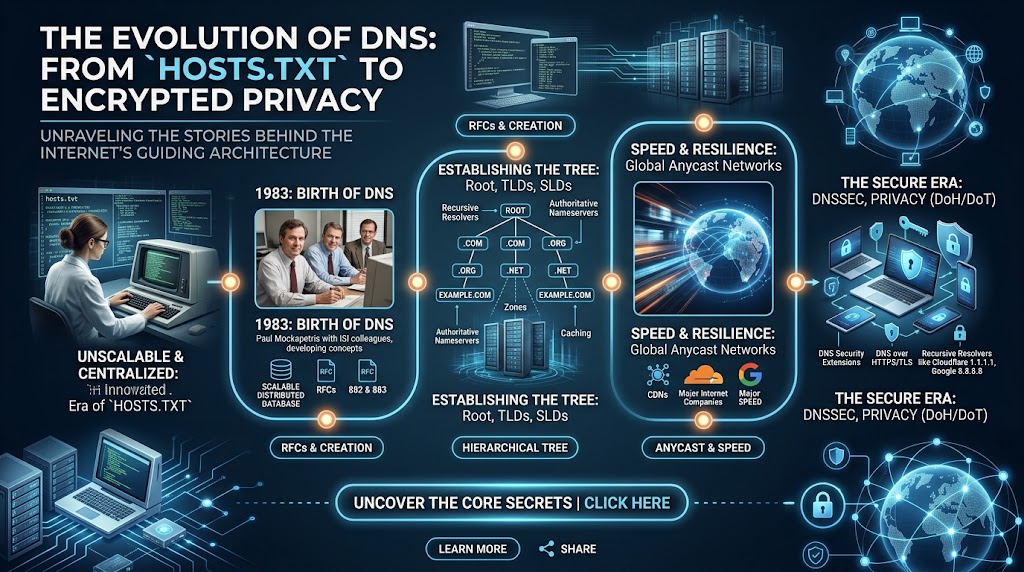
3. 1983: The History of DNS Officially Begins With Paul Mockapetris
In 1983, Paul Mockapetris wrote two RFCs that changed everything. RFC 882 and RFC 883.
He proposed a distributed database instead of one big file. Instead of one computer knowing everything, millions of servers would each know a small part.
He called it the Domain Name System. DNS.
The history of DNS officially starts here. November 1983.
The idea was simple. Break the internet into domains. com, edu, gov, org. Each domain would be managed by different servers. If you wanted to find google.com, you’d ask the .com servers.
This was genius because it could scale forever.
Paul Mockapetris: The Father of DNS
He solved a problem that was about to break the internet.
4. 1984 to 1987: BIND and The History of DNS Goes Live
Paul didn’t just write the idea. He helped build it.
In 1984 the first DNS server software was released. It was called BIND. Berkeley Internet Name Domain.
Universities and companies started installing BIND. Slowly the old HOSTS.TXT system was replaced.
By 1987, DNS was the standard. The history of DNS in these years is about replacing a manual system with an automatic one.
Suddenly you could type “mit.edu” instead of “18.72.0.3”.
The Internet Got Names
And it never looked back.
5. 1988 to 1995: DNS Grows With The Web
When the World Wide Web launched in 1991, DNS became even more important.
Suddenly millions of people needed to visit websites. And they couldn’t remember IP addresses.
Companies started buying domain names. The history of DNS during this time is about growth. More domains, more servers, more traffic.
In 1993 there were about 28,000 domains. By 1995 there were 100,000.
ICANN was formed in 1998 to manage domain names. But before that, the US government ran it.
DNS Became the Backbone of the Web
No DNS, no websites.
6. 1996 to.2003: Scaling Problems and DNS Attacks
As the internet grew, so did problems with DNS.
The history of DNS includes the first big DNS attacks. In 1997 someone tried to take down DNS servers with too much traffic. It was called a DDoS attack.
In 2002 the DNS root servers were attacked. 13 servers handle all DNS queries for the entire internet. For an hour, the internet was slow.
Engineers responded by adding more root servers and making DNS more distributed.
This period taught us that DNS is critical infrastructure.
DNS is a Single Point of Failure
So we had to make it stronger.
7. 2004 to 2010: Security and DNSSEC
In 2005, hackers figured out how to poison DNS caches. They could send you to fake bank websites.
The history of DNS needed security.
So engineers created DNSSEC. Domain Name System Security Extensions. It adds digital signatures to DNS data so you know it’s real.
Rollout was slow. By 2010, major domains like .gov and .org started using DNSSEC.
This was a huge step. The history of DNS was no longer just about speed. It was about trust.
Making DNS Trustworthy
So hackers couldn’t lie to you.
8. 2011 to 2016: New Domain Names and IPv6
In 2012 ICANN opened applications for new domain names. Not just .com. Now we have .app, .blog, .ai, .shop.
Over 1000 new domains were added.
The history of DNS also had to deal with IPv6. The internet was running out of IP addresses. So DNS had to support the new longer addresses.
By 2016, Google and Facebook were serving DNS to billions of people.
More Names, More Addresses
DNS had to grow with the internet.
9. The History of DNS: 2017 to 2020 Speed and Privacy
In 2018, Cloudflare and Google launched 1.1.1.1 and 8.8.8.8. Public DNS servers that were faster and more private.
Before this, your ISP handled DNS and they logged everything you did.
The history of DNS in this period is about privacy. DNS over HTTPS came out. Now your ISP can’t see what websites you visit.
DNS became faster too. Queries that took 100ms now take 10ms.
DNS Got Faster and More Private
Because users demanded it.
10. 2021 to 2026: The History of DNS Today With AI and Edge
Today in 2026, DNS handles 3 trillion queries per day.
The history of DNS now includes AI. DNS providers use AI to detect and block malicious domains in real time.
Edge computing means DNS servers are everywhere. When you type a website, you hit a DNS server that’s 10ms away.
New features like DNS over QUIC make DNS even faster.
And with the rise of Web3, we now have blockchain DNS like .eth domains.
3 Trillion Queries Every Day
DNS is the busiest system on the internet.
11. The People Behind The History of DNS
Paul Mockapetris wrote DNS in 1983.
Jon Postel managed the early domain names.
The BIND team at Berkeley made DNS software.
The ICANN team manages domains today.
And thousands of engineers keep DNS running.
A Team Effort
No one person runs DNS. It’s run by everyone.
12. How History of DNS.Actually Works Behind the Scenes
When you type google.com, here’s what happens.
1. Your computer asks a DNS resolver.
2. The resolver asks the root servers.
3. The root says “ask .com servers”.
4. The .com servers say “ask Google’s servers”.
5. Google’s servers give the IP address.
All of this happens in 20 milliseconds.
The history of DNS is the story of making this process faster and faster.
It Happens in the Blink of an Eye
But behind it are millions of servers.
13. DNS vs The Old HOSTS File
Before DNS, we had HOSTS.TXT.
The history of DNS shows why that failed. One file. One server. Manual updates.
DNS is distributed. Automatic. Scalable.
If we still used HOSTS.TXT today, the file would be 50GB and your computer would crash.
Distributed Wins
Centralized systems break at scale.
14. Problems in The History of DNS
DNS has problems.
It can be attacked with DDoS.
It can be censored by governments.
It can leak your browsing history.
Engineers are fixing this with DNSSEC, DoH, and DoT.
The history of DNS is also a story of constant improvement.
Nothing Is Perfect
But DNS keeps getting better.
15. The Future of The History of DNS
What’s next for DNS?
AI will predict what domains you need.
Blockchain DNS will give more control to users.
Quantum computing might break DNSSEC, so we need new encryption.
The history of DNS is still being written.
DNS in 2030
It will be faster, more private, and more secure.
16. Conclusion: The History of DNS Changed the Internet
The history of DNS started in 1983 because we couldn’t remember numbers.
Today DNS is the phonebook of the internet. It handles 3 trillion queries per day.
From HOSTS.TXT to AI-powered edge DNS, it has evolved nonstop.
And every time you type a website name, you’re using DNS.
Frequently Asked Questions History of DNS
1. When did History of DNS start
The history of DNS starts in 1983 with RFC 882 and RFC 883 by Paul Mockapetris.
2. Who invented DNS
Paul Mockapetris invented the Domain Name System.
3. What did we use before DNS
We used a HOSTS.TXT file that listed every computer.
4. How many History of DNS queries per day in 2026
Over 3 trillion queries per day.
5. What is DNSSEC
DNSSEC adds security so DNS data can’t be faked.
6. What is 8.8.8.8
Google’s public DNS server.
7. What is 1.1.1.1
Cloudflare’s fast and private DNS server.
8. What is next for DNS
AI, blockchain domains, and even faster privacy.