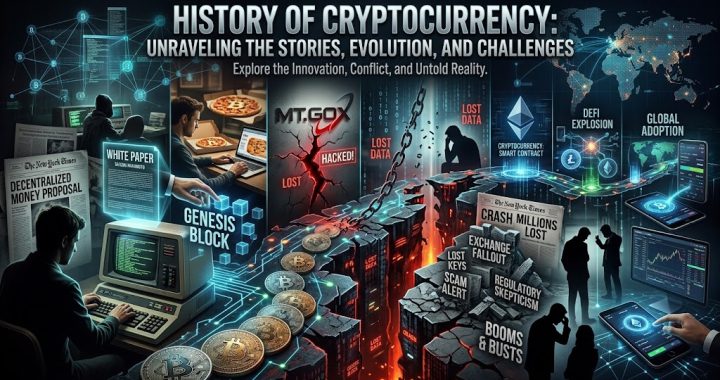
History of Blockchain: The Complete Human Story From 1991 to 2026
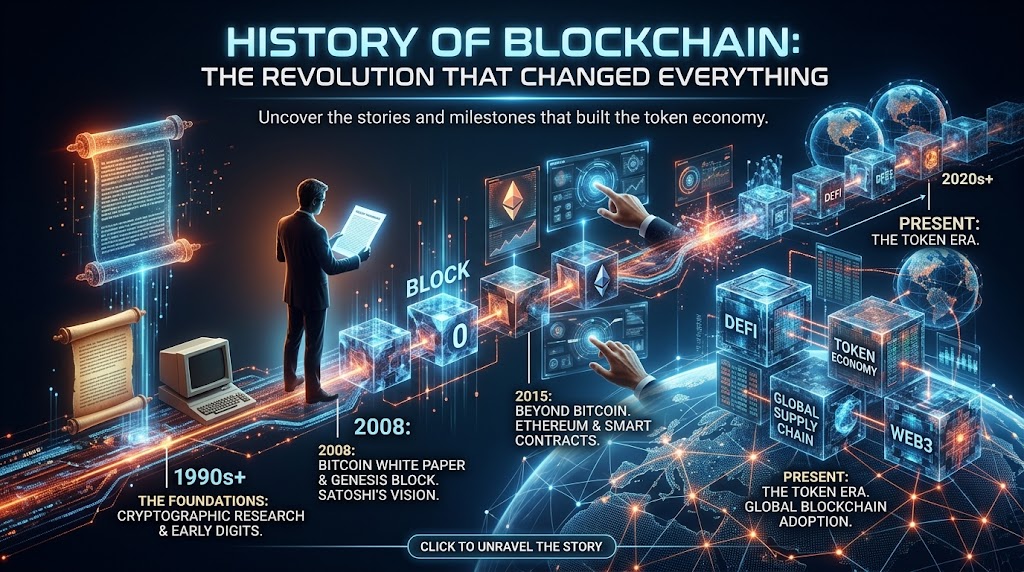
1. The History of Blockchain Starts in 1991 With Two Professors Who Just Wanted to Timestamp a File
The history of blockchain does not start with Bitcoin. It does not start with crypto bros or NFTs. It starts in 1991 with two professors who were worried about something very simple and very human. Lying.
Stuart Haber and W Scott Stornetta were looking at a problem that we all face today but nobody had a good answer for back then. In the digital world, how do you prove that a document was created on a specific day and that nobody changed it later. With paper you can use ink and a notary. With computers you can just edit the file and pretend it was always like that.
So they came up with an idea. What if we link documents together. What if each new document contains proof of the last one. And what if we use math to lock it all together so that if you try to change the past, everything breaks.
They wrote a paper in 1991. Then another one in 1992. And then for 18 years nothing happened. Nobody cared.
Fast forward to 2009 and an anonymous person named Satoshi Nakamoto read that paper and thought, what if we put money on this. And that is how Bitcoin was born.
Today in 2026 the history of blockchain includes over 1000 different networks. It includes 2 trillion dollars. It includes art, games, banks, and governments. But it all started because two guys wanted to prove when a file was made.
Why This Story Matters
Because blockchain is not about getting rich. It is about trust. And trust is the most human problem we have.
2. The 1990s: The Years When History of Blockchain Was Just an Idea Nobody Understood
If you told someone in 1995 about blockchain they would look at you like you were crazy. Because the word did not even exist yet.
In 1991 Haber and Stornetta published their first paper. In 1992 they made it better with Merkle trees. This let you check one piece of data without downloading everything. It was clever.
Then silence. For years.
In 1998 Nick Szabo wrote about bit gold. He described digital money with proof of work and a public ledger. He was basically describing Bitcoin. But he never built it. The internet was not ready.
The history of blockchain in the 90s is just papers sitting in libraries. No funding. No startups. No hype.
But those papers mattered. Because ideas do not die. They wait.
The Idea Was Sleeping
Until the world was ready for it.
3. 2008 to 2009: The Financial Crisis That Created Bitcoin
2008 was a terrible year. Banks collapsed. People lost their homes. Governments printed trillions to save the banks.
On October 31, 2008, in the middle of all that, an email was sent to a small cryptography mailing list.
The subject was Bitcoin: A Peer-to-Peer Electronic Cash System.
The sender was Satoshi Nakamoto.
The email had a link to a 9 page paper. It explained how to send money online without a bank. Without a middleman. Without asking permission.
Satoshi took the chain idea from 1991. Added proof of work. Added the internet. And made it real.
On January 3, 2009, the first block was mined. The Genesis Block. Inside it Satoshi put a headline from the newspaper about bank bailouts.
That was not an accident. That was the whole point.
The history of blockchain starts here. With code running on computers all over the world.
Block Zero
Was the beginning of everything.
4. 2010 to 2013: Pizza, Hacks and Learning the Hard Way
For the first few years blockchain and Bitcoin were the same thing. There was nothing else.
In 2010 a guy named Laszlo bought two pizzas for 10,000 Bitcoin. At the time it was 40 dollars. Today it is over a billion dollars. That is the first real purchase.
In 2011 Bitcoin hit 1 dollar. People started noticing.
In 2013 it hit 1000 dollars. Then it crashed.
Mt Gox became the biggest exchange. 70 percent of all Bitcoin went through it. Then it got hacked and everyone lost their money.
The history of blockchain in these years is messy. It is people making mistakes. It is people learning. It is people asking, is this thing even real.
And it was real. Even if it was ugly.
The Proof Was in the Pizza
That this could actually work.
5. 2013 to 2015: The Year a 19 Year Old Changed Everything
In 2013 a kid named Vitalik Buterin wrote a paper. He was 19 years old and he was asking a different question.
What if blockchain could do more than money. What if it could run programs.
That paper became Ethereum.
In July 2015 Ethereum launched. For the first time developers could write smart contracts. Code that lives on the blockchain and runs by itself.
This changed everything. Because now blockchain was not just about payments. It was about apps.

In 2016 a project called The DAO raised 150 million dollars. Then it got hacked. Ethereum split into two.
The history of blockchain now had two stories. Bitcoin for money. Ethereum for everything else.
Programmable History of Blockchain
Opened the door to the future.
6. 2017: The Year Everyone Went Crazy
2017 was wild.
Companies started selling tokens. They called it ICOs. You did not need a bank. You did not need permission. You just needed a website.
5 billion dollars was raised in one year.
CryptoKitties launched. People spent 100,000 dollars on digital cats. The network got so clogged that you could not send a transaction.
Bitcoin went from 1000 dollars to 19,000 dollars.
Your grandma was asking you about Bitcoin.
The history of blockchain in 2017 is hype and greed and scams and real innovation all at the same time.
The Bubble Burst
But the technology did not.
7. 2018 to 2020: The Quiet Years That Mattered Most
2018 was painful. Bitcoin crashed to 3000 dollars. 80 percent gone.
But this is when the real work happened.
IBM built Hyperledger for businesses.
Walmart started tracking food with blockchain.
China announced it would build a national blockchain.
And on Ethereum, DeFi was born. People lending and borrowing without banks.
The history of blockchain in these years is not about price. It is about building.
Builders Build in the Bear
And that is why the next bull came.
8. 2021: The Year History of Blockchain Became Fun
2021 was different.
NFTs exploded. A digital picture sold for 69 million dollars.
Games like Axie Infinity let people in the Philippines earn a living.
Nike and Adidas launched NFTs.
Facebook changed its name to Meta.
Ethereum was too expensive. So Solana and Polygon grew fast.
The history of blockchain in 2021 is about culture. It was no longer just for programmers.
Everyone Was Invited
Artists, gamers, creators, everyone.
9. 2022 to 2023: The Crash That Made It Stronger
2022 was rough.
Luna collapsed. 60 billion gone.
FTX collapsed. Billions stolen.
Bitcoin fell to 15,000 dollars.
But the technology kept getting better.
Ethereum switched to proof of stake. Energy use dropped 99 percent.
Governments started making clear rules.
Layer 2s made transactions cheap.
The history of blockchain here is about growing up.
Pain Made It Better
And that is how industries mature.
10. 2024 to 2026: The Years History of Blockchain Became Normal
2024. The US approved Bitcoin ETFs. Wall Street was in.
2025. Real World Assets. People put houses and bonds on blockchain.
2026. AI agents started paying each other with crypto. No human involved.
Today we have Bitcoin for saving. Ethereum for apps. Solana for speed.
The history of blockchain in 2026 is about blockchain becoming invisible. Like wifi. You do not think about it. It just works.
It Is Just Infrastructure Now
Part of the internet.
11. The Humans Behind the History of Blockchain
This is not a story about technology. It is a story about people.
Haber and Stornetta who started it in 1991.
Satoshi who built it in 2009 and then disappeared.
Nick Szabo who described it before it existed.
Hal Finney who believed in it first.
Vitalik who made it programmable.
And thousands of developers who wrote code for free because they believed in it.
No CEO
No company. Just people.
12. How History of Blockchain Works in Plain English
Forget the technical words.
Think of a public notebook.
Anyone can read it.
Anyone can add a page.
No one can erase a page.
Everyone has a copy.
That is blockchain.
The history of blockchain is the story of making that notebook secure.
No Middleman
That is the whole point.
13. The Different Types of History of Blockchain
Public blockchains. Anyone can join. Bitcoin, Ethereum.
Private blockchains. One company runs it. Like Walmart.
Consortium blockchains. A group runs it. Like banks.
The history of blockchain includes all of them.
Different Tools
For different jobs.
14. The Problems We Are Still Solving
It is slow.
It is expensive sometimes.
It is hard to use.
It used to waste too much energy.
The history of blockchain is also the history of fixing these problems.
We Are Still Early
And that is okay.
15. What Comes Next
By 2030 your house deed will be on blockchain.
Your vote will be on blockchain.
AI will pay with crypto.
The history of blockchain is moving from finance to everything.
This is called Web3. An internet owned by users.
The Next 10 Years
Will be bigger than the last 15.
16. Final Thought: The History of Blockchain Is About Us
The history of blockchain started with a problem about trust in 1991.
It became money in 2009.
It became apps in 2015.
In 2026 it is becoming the foundation of the internet.
The idea never changed. Use code instead of trusting a middleman.
The history of blockchain proves that works.
Frequently Asked Questions History of Blockchain
1. When did the history of blockchain start
1991 with Haber and Stornetta.
2. Who invented blockchain
Haber and Stornetta invented it. Satoshi built the first one.
3. What was the first History of Blockchain
Bitcoin in January 2009.
4. What is the difference between blockchain and Bitcoin
Bitcoin uses blockchain. Blockchain can do more than money.
5. How many blockchains exist now
Over 1000 in 2026.
6. What is a smart contract
Code that runs on a blockchain.
7. Is blockchain only for crypto
No. It is used in many industries.
8. What is next for blockchain
Tokenization, AI, and government adoption.