History of Bitcoin: From 2008 Whitepaper to $100K Digital Gold in 2026

1. The History of Bitcoin Started in a Financial Meltdown
history of Bitcoin.October 2008. The world was scared.
Lehman Brothers collapsed. Banks were begging for bailouts. People were losing houses and jobs.
In the middle of all that chaos, a post appeared on a cryptography mailing list.
The subject line was simple. Bitcoin: A Peer-to-Peer Electronic Cash System.
The name at the bottom was Satoshi Nakamoto.
Nobody knew who Satoshi was. And nobody thought this 9 page PDF would change money forever.
The history of Bitcoin starts right there. Not in a boardroom. Not in a bank. But in anger at a broken financial system.
Satoshi’s first line in the whitepaper was clear. What is needed is an electronic payment system based on cryptographic proof instead of trust.
That one sentence started a revolution.
Today in 2026 Bitcoin is worth over $100,000. Over 400 million people own it. Countries hold it on their balance sheets.
But back in 2008 it was just an idea sent to 30 people.
Why We Still Talk About This
Because the history of Bitcoin is proof that one person with code can challenge the entire banking system.
2. 2008 to 2009:History of Bitcoin The Whitepaper and Genesis Block
November 1, 2008. The whitepaper went live.
It explained how digital money could work without a middleman. No PayPal. No Visa. No bank.
Instead of trusting a company, you trust math. And a network of computers.
Satoshi worked alone for months. Writing code. Fixing bugs.
Then on January 3, 2009 at 18:15 UTC, block number 0 was mined. This is called the Genesis Block.
Inside that first block Satoshi left a message. It was a headline from The Times newspaper. Chancellor on brink of second bailout for banks.
That was not random. That was the whole point of Bitcoin.
The history of Bitcoin officially begins with that block. Satoshi mined the first 50 Bitcoin. They were worth zero.
For the next year only a handful of people even knew Bitcoin existed.
50 Coins and a Message
That was all it took to start.
3. 2009 to 2010: Pizza Day and The First Real Purchase
For most of 2009 Bitcoin was mined by hobbyists on regular laptops.
There was no price. No exchange. You just mined it and gave it away.
In 2010 the first exchange opened. People started trading Bitcoin for dollars. The price was less than one cent.
Then came May 22, 2010. A programmer named Laszlo Hanyecz posted on a forum. He offered 10,000 Bitcoin for two pizzas.
Someone took the deal. Two Papa John’s pizzas delivered to his house.
At the time 10,000 Bitcoin was worth about 40 dollars.
In 2026 those same 10,000 Bitcoin are worth over 1 billion dollars.
We now call May 22 Pizza Day. Bitcoiners celebrate it every year.
The history of Bitcoin in this period is about proving it could actually buy something real.
From Zero to Pizza
That was the first step.
4. 2011 to 2013: Mt Gox Silk Road and First Bull Run
2011 was the year Bitcoin hit 1 dollar for the first time.
A website called Mt Gox became the main place to buy and sell Bitcoin. At one point 70 percent of all Bitcoin trades happened there.
But Bitcoin also got bad press.
Silk Road was an online market that only took Bitcoin. In 2013 the FBI shut it down and seized 144,000 Bitcoin.
Headlines said Bitcoin is for criminals.
Despite that, more people kept joining. By late 2013 the price hit 1000 dollars for the first time.
Then it crashed back to 200 dollars in 2014.
The history of Bitcoin in these years is about volatility. Huge gains. Huge crashes. And a lot of confusion.
The World Was Watching
Even if they didn’t understand it yet.
5. 2014 to 2016: Mt Gox Hack and Surviving Crypto Winter
February 2014. Disaster.
Mt Gox announced it had been hacked. 850,000 Bitcoin were gone. That was worth 450 million dollars at the time.
The price crashed to 200 dollars. News sites declared Bitcoin dead.
But Bitcoin didn’t die. The network kept running. Blocks kept being added every 10 minutes.
Developers kept working. New wallets came out. New exchanges opened that were more secure.
In July 2016 the first halving happened. This is a key part of the history of Bitcoin. Every 4 years the amount of new Bitcoin created is cut in half. This makes Bitcoin more scarce over time.
After the halving the price slowly started climbing again.
What Doesn’t Kill It
Makes it stronger. That became the Bitcoin motto.
6. 2017: The Year Everyone Heard About Bitcoin
If you weren’t in crypto in 2017 you missed something wild.
Bitcoin started the year at 1000 dollars. By December it was 19,000 dollars.
Coinbase added 100,000 new users in a single day.
Your uncle was asking you about Bitcoin at Thanksgiving dinner.
TV news talked about it every night.
But it wasn’t just hype. Big things happened. The first Bitcoin futures launched on the Chicago Mercantile Exchange. Wall Street was officially involved.
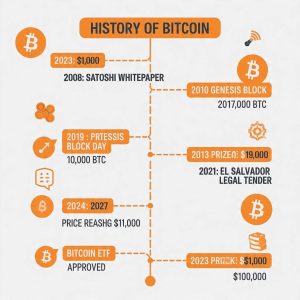
Then in December the bubble popped. By February 2018 Bitcoin was back down to 3,000 dollars.
The history of Bitcoin in 2017 is about mainstream attention. For the first time regular people knew what Bitcoin was.
FOMO Was Real
And so was the crash after.
7. 2018 to 2020: Building During the Bear Market
2018 and 2019 were quiet. Prices were low. Media didn’t care.
But this is when the most important work happened.
The Lightning Network launched. It let people send Bitcoin instantly for almost no fee.
Better hardware wallets came out. Safer exchanges.
Big companies started buying. MicroStrategy put Bitcoin on its balance sheet. Then Tesla bought 1.5 billion dollars worth.
March 2020. COVID hit. Everything crashed. Bitcoin fell to 3,800 dollars.
But it recovered faster than stocks. By December 2020 Bitcoin was at 29,000 dollars.
The history of Bitcoin in this period is about institutions. It stopped being just for tech people.
Smart Money Arrived
And they weren’t selling.
8. 2021: 69,000 Dollars and a Country Adopts History of Bitcoin
2021 was insane.
Bitcoin hit a new all time high of 69,000 dollars in November.
NFTs were everywhere. DeFi was growing. Every company wanted to do something with crypto.
But the biggest news came in September.
El Salvador became the first country in the world to make Bitcoin legal tender. President Nayib Bukele said citizens could now pay taxes and buy coffee with Bitcoin.
Other countries started talking about it too.
The history of Bitcoin in 2021 is about legitimacy. It was no longer a fringe experiment.
From Internet Money to National Money
That was a huge shift.
9. 2022 to 2023: FTX Collapse and Trust in Code
2022 was the worst year since 2014.
First Terra Luna collapsed. Then hedge fund 3AC went bankrupt.
Then FTX.
FTX was the second biggest crypto exchange. Its CEO was on magazine covers. Then it turned out he had stolen billions of dollars of customer money.
Bitcoin crashed to 15,000 dollars. People lost trust in crypto companies.
But here is the important part. Bitcoin itself never stopped working. Not one block was missed. Not one transaction failed.
The history of Bitcoin here teaches a lesson. Don’t trust companies. Trust the code.
In 2023 things started recovering. BlackRock the biggest asset manager in the world applied for a Bitcoin ETF.
Code Over CEOs
That’s why Bitcoin survived.
10. The History of Bitcoin 2024 to 2026 ETF and 100K
January 2024 changed everything.
The US government approved spot Bitcoin ETFs. Now anyone could buy Bitcoin through their normal stock broker. BlackRock, Fidelity, all the big names launched one.
Trillions of dollars now had an easy way to buy Bitcoin.
April 2024. The fourth halving. Mining rewards dropped again.
2025. Bitcoin broke 80,000 dollars.
2026. Bitcoin crossed 100,000 dollars and kept going.
Countries started adding Bitcoin to reserves. Banks started offering Bitcoin services.
The history of Bitcoin today is about Wall Street adoption and global recognition.
People now call it digital gold.
16 Years From Zero to 100K
Nobody saw that coming in 2008.
11. The People Who Shaped The History of Bitcoin
Satoshi Nakamoto wrote the code and then disappeared in 2011. He never spent his Bitcoin. To this day nobody knows who he is.
Hal Finney was the first person to receive Bitcoin from Satoshi. He was a cryptographer who believed in the project from day one.
The Bitcoin Core developers. A group of volunteers who maintain the code. They argue a lot but they keep the network safe.
The miners. Companies and individuals who run computers to secure the network.
No CEO
No marketing team. Just people who believe in the idea.
12. How History of Bitcoin Actually Works Without Jargon
Let’s keep this simple.
Bitcoin is a public notebook. Everyone can see it.
When you send Bitcoin, that transaction gets written in the notebook.
Miners are people with computers who compete to add new pages to the notebook. The winner gets new Bitcoin as a reward.
There will only ever be 21 million Bitcoin. The code says so and no one can change it.
That’s it. That’s why people trust it.
The history of Bitcoin is the story of that notebook running nonstop for 16 years.
Math Instead of Banks
And it works.
13.History of Bitcoin Compared to Gold Banks and Other Crypto
People always ask how Bitcoin is different.
Compared to gold. Gold is heavy and hard to move. Bitcoin moves in 10 minutes anywhere in the world.
Compared to banks. Banks charge fees and take days. Bitcoin is open 24 hours and costs a few cents.
Compared to other cryptocurrencies. Most have a company behind them. Bitcoin has no company. No one can shut it down or change the rules.
The history of Bitcoin shows why being first matters. It has the most trust and the most security.
Digital Gold
That’s the nickname that stuck.
14. The Problems in The History of Bitcoin
It’s not perfect.
Energy use. Bitcoin mining uses a lot of electricity. Miners are now moving to renewable energy to fix this.
Speed. The main Bitcoin network can only do 7 transactions per second. That’s why Lightning Network was built for fast payments.
Price swings. Bitcoin can drop 20 percent in a day. That scares new people.
Lost coins. About 4 million Bitcoin are probably lost forever because people lost passwords.
The history of Bitcoin includes all these problems. And engineers are working on solutions every day.
Still Early
We are only 16 years in.
15. What Comes Next in The History of Bitcoin
Nobody knows the future. But here is what people expect.
More countries will adopt Bitcoin as legal tender.
More companies will add it to their balance sheets.
Lightning payments will become normal for small purchases.
More countries will approve Bitcoin ETFs.
Some analysts predict 1 million dollars per Bitcoin by 2030.
The history of Bitcoin is still being written. Every day new blocks are added.
21 Million Forever
That part will never change.
16. Final Thought: The History of Bitcoin Changed How We Think About Money
The history of Bitcoin started with a PDF during a financial crisis.
A person or group nobody knows wrote code that created money without a government.
16 years later that code is worth trillions of dollars.
Bitcoin survived hacks, crashes, bans, and bad press.
Why? Because it solved a real problem. People want money they control. Money that works anywhere. Money that no one can print more of.
The history of Bitcoin proves that technology can give power back to people.
Whether you own Bitcoin or not, its impact is real. Banks are changing. Governments are changing. The way we think about money is changing.
And it all started with 9 pages and a message in the Genesis Block.
Frequently Asked Questions History of Bitcoin
1. When was History of Bitcoin created
The history of Bitcoin begins on January 3 2009 with the mining of the Genesis Block.
2. Who created Bitcoin
Satoshi Nakamoto. The real identity is still unknown in 2026.
3. How much is one Bitcoin worth today
In 2026 Bitcoin trades above 100,000 dollars.
4. How many Bitcoins will ever exist
Only 21 million. About 19.8 million have been mined already.
5. What is Bitcoin mining
It is the process where computers secure the network and earn new Bitcoin as a reward.
6. Is Bitcoin legal around the world
Yes in most countries. It is legal tender in El Salvador and the Central African Republic.
7. What is a Bitcoin halving
Every four years the reward for mining new Bitcoin is cut in half. This makes new supply more scarce.
8. What is the future of Bitcoin
Experts expect more adoption by countries, more ETF products, and faster payments through the Lightning Network.